
Knowledge Base
Articles In This Section
How Workato Actually Works: A Simple BreakdownWorkato Workflow Apps: A Complete OverviewHow to Build Your First Recipe in Workato Getting Started with Data Orchestration in WorkatoUnderstanding Webhooks in WorkatoWorkato FAQs: The Ultimate List of Common Workato FAQsHow to Sync your SurveyMonkey Data within Quickbase using WorkatoWhat is WorkatoUnderstanding Workato Custom Connectors How to use Workato's Logging SystemHow to use GitHub Secret Scanning for your Workato Developer API10 Key Benefits of WorkatoHow to Use Workato to Send an Email through Outlook What is Workato ONEHow to Connect Workato to RingCentralHow to Set Up HTTP Requests in Workato: Built-in and Custom How to Build a Workato Center of ExcellenceHow to use Data Tables in Workato: Step-by-Step GuideHow to Use Conditional Actions in Your Workato Recipe How to Set Up a Call Ended Trigger in Workato for RingCentralHow to Create a New App Connection in WorkatoGetting Started with Data Orchestration in WorkatoWhat is Workato ONEHow to Set Up HTTP Requests in Workato (Built-in and Custom)How to Manage API Clients and Client Roles in WorkatoHow to Process File Attachments in WorkatoSections
What is an MCP Server and Why It Matters for your AI Foundation
Modern enterprises face an increasingly complex AI landscape. Deploying and integrating AI solutions across multiple departments, applications, and environments requires a standardized, scalable, and secure infrastructure.
This is where MCP servers (Modular Computing Platform servers) become critical—they provide a consistent foundation for AI workloads while enabling rapid adoption, integration, and operational efficiency.
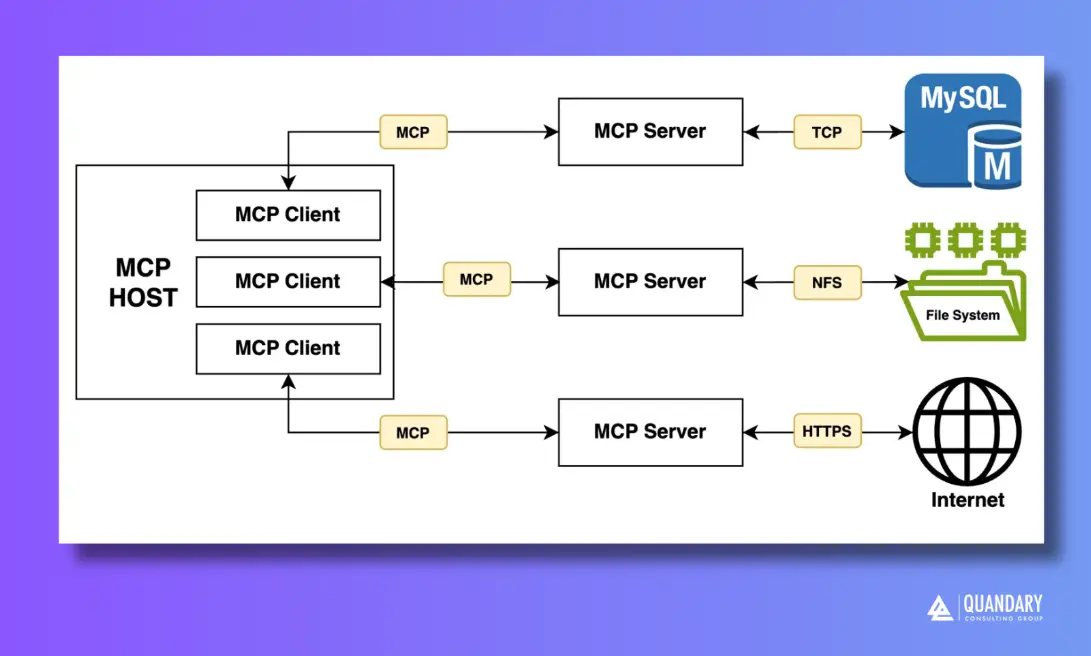
What is an MCP Server and Why It Matters for your AI Foundation
- Standardized Architecture: MCP servers offer a uniform hardware and software stack that simplifies the deployment of AI models across on-premises and cloud environments. This reduces inconsistencies, minimizes compatibility issues, and accelerates AI adoption.
- Scalability & Performance: Designed to handle diverse AI workloads, including large language models (LLMs), vision models, and multi-modal applications, MCP servers deliver the computational power and memory bandwidth necessary for real-time AI processing.
- Simplified Integration: By offering pre-configured frameworks, APIs, and orchestration tools, MCP servers make it easier to integrate AI into legacy systems and enterprise workflows, aligning with automation and GenAI strategies.
- Operational Efficiency: Standardization reduces the overhead of managing heterogeneous infrastructure. IT teams can focus on AI innovation rather than troubleshooting inconsistent hardware or software environments.
- Security & Compliance: MCP servers often come with enterprise-grade security features, ensuring AI data and models meet regulatory requirements while supporting secure multi-tenant environments.
Three Use Cases for MCP Servers in AI
- Enterprise Automation: Deploying AI-driven RPA (Robotic Process Automation) solutions on standardized servers ensures predictable performance across departments.
- Data Analytics & Insights: Running large-scale predictive models or real-time analytics on MCP servers allows for faster, more accurate business insights.
- Multi-Modal AI Integration: Supporting LLMs, vision AI, and speech models on a single standardized infrastructure simplifies complex workflows for product recommendation, fraud detection, or customer service.
In Conclusion
MCP servers are more than just hardware—they are the backbone of standardized, enterprise-ready AI integration. For organizations looking to accelerate their automation, GenAI, and integration strategies, leveraging MCP servers ensures consistent performance, reduced complexity, and secure deployment at scale.
Quandary Consulting Group helps enterprises implement MCP server strategies, enabling seamless AI integration and measurable business outcomes.
By: Kevin Shuler
Email: kevin@quandarycg.com
Date: 02/01/2026



© 2026 Quandary Consulting Group. All Rights Reserved.
Privacy Policy