Quickbase
How to Choose the Right Quickbase Partner in 2026


TL;DR
- The right Quickbase Partner should provide more than application development. Look for a partner that understands business process optimization, workflow automation, system integration, data architecture, governance, AI, user adoption, and long-term platform strategy.
- Quickbase certifications and partner status matter, but proven business outcomes matter just as much. Evaluate potential partners based on industry experience, technical expertise, integration capabilities, client reviews, case studies, measurable results, discovery methodology, responsiveness, and ongoing support.
- An experienced Quickbase Partner can accelerate time-to-value while reducing implementation risk and technical debt. Proven development methodologies and scalable architecture help organizations build applications that can evolve as processes, users, data, integrations, and business requirements change.
- Quickbase becomes significantly more powerful when it is connected to the broader enterprise technology ecosystem. The right partner can integrate Quickbase with ERP, CRM, accounting, HR, project management, AI, and other business systems while automating data movement and cross-functional workflows.
- Quandary Consulting Group is a Quickbase Elite Partner that combines business process expertise with Quickbase development, integration, automation, data, and AI capabilities. This business-first approach helps organizations modernize operations, improve visibility, increase adoption, and generate greater long-term value from their Quickbase investment.
The business landscape is more dynamic and competitive than ever. Organizations are under constant pressure to improve efficiency, streamline operations, and deliver exceptional customer experiences while maintaining agility. To stay ahead, businesses need technology solutions that can evolve alongside their needs.
Quickbase helps organizations do exactly that. As a leading low-code platform, Quickbase enables businesses to build custom applications, automate workflows, and connect critical processes without the time and expense of traditional software development. However, maximizing the value of Quickbase often requires specialized expertise. That's where a Quickbase Partner comes in.
This guide explores what a Quickbase Partner is, the benefits of working with one, how to choose the right partner, and why partnering with an Elite Quickbase Partner can help accelerate your organization's success.
First, What Is Quickbase?
Quickbase is a low-code application development platform that allows organizations to rapidly build custom business applications, automate workflows, and connect data across departments and systems.
As businesses grow, they often accumulate disconnected software systems, spreadsheets, manual processes, and data silos that create inefficiencies and limit visibility. Quickbase addresses these challenges by providing a centralized platform where teams can build tailored solutions that support their unique business processes.
Unlike traditional custom software development, which can take months or years to complete, Quickbase enables organizations to deploy applications quickly while maintaining enterprise-grade security, scalability, and governance. Organizations use Quickbase to support a wide range of initiatives, including:
- Project and portfolio management
- Construction project tracking
- Compliance and audit management
- Manufacturing operations
- Field service management
- Resource allocation and workforce planning
- Customer relationship management
- Inventory and supply chain management
By empowering teams to build solutions faster, Quickbase helps organizations become more agile, responsive, and efficient.
Quandary Case Study: Gateway Terminals Consolidated 18 Legacy Systems into a Single Custom Terminal Operations ERP using Quickbase
Why Are Low-Code Platforms Like Quickbase Still Growing in Popularity?
Low-code platforms like Quickbase continue to grow in popularity because organizations need faster ways to modernize business processes, automate workflows, connect data, and build custom applications without relying exclusively on traditional software development.
As businesses adopt more cloud applications, automation, AI, and AI agents, their technology environments are becoming more capable, but they are also becoming more complex. Critical processes frequently span multiple systems, departments, data sources, and approval layers. Traditional enterprise applications may manage individual functions well, but they do not always support the cross-functional workflows that connect those functions.
Low-code development helps close these operational gaps.
Instead of waiting months for a traditional software development project, organizations can use low-code platforms to create and continuously improve applications around specific business requirements. This allows IT and business teams to respond more quickly as processes, regulations, customer expectations, and operating models change.
Why Companies Use Quickbase for Low-Code Development
Quickbase provides organizations with a flexible platform for building and managing operational applications while maintaining the governance, security, and control required in enterprise environments.
Organizations can use Quickbase for:
- Rapid application development: Build custom business applications around specific operational requirements without developing every component from scratch.
- Workflow automation: Automate approvals, assignments, notifications, escalations, data updates, and other repetitive steps that slow down business processes.
- Connected data and processes: Bring information from multiple teams and systems into a more unified operational environment.
- Real-time dashboards and reporting: Give employees and leadership greater visibility into projects, resources, workflows, risks, and performance.
- Enterprise integrations: Connect Quickbase with ERP, CRM, HR, financial, project management, and other business systems through APIs and integration platforms such as Workato.
- Governance and security: Establish permissions, business rules, standardized workflows, and controls while still giving teams flexibility to improve how work gets done.
- Scalable process management: Replace spreadsheet-dependent and manually coordinated processes with structured applications that can evolve as the organization grows.
Low-Code Is Becoming More Important as Organizations Adopt AI
The growth of enterprise AI makes low-code development even more relevant.
AI assistants and AI agents need reliable access to business data, clearly defined processes, appropriate permissions, and systems where actions can be executed safely. When operational information remains fragmented across spreadsheets, inboxes, disconnected applications, and undocumented workflows, implementing AI becomes significantly more difficult.
Low-code platforms such as Quickbase can help organizations create the structured operational layer that connects people, processes, data, automation, and AI.
For example, an organization might use Quickbase to manage the underlying workflow and business rules, Workato to orchestrate data and actions across enterprise systems, and AI to classify information, summarize documents, identify risks, recommend actions, or support more complex decisions.
This combination allows organizations to move beyond isolated automation and toward more intelligent, connected operations.
Why Quickbase Makes Sense for Enterprise Modernization
Organizations do not always need another large-scale system replacement to modernize operations. In many cases, the greater opportunity is improving how existing systems, data, and teams work together.
Quickbase gives organizations a way to modernize high-friction processes without rebuilding their entire technology environment. Companies can begin with a specific operational problem, build a solution around measurable business requirements, connect it with existing systems, and expand the application as their needs evolve.
That combination of speed, flexibility, integration, governance, workflow automation, and AI readiness is why low-code platforms like Quickbase continue to play an important role in digital transformation and enterprise modernization.
Quandary Case Study: Google Transforms Project Intake Across 2,500+ Projects and 19 Partner Teams with Custom Quickbase Application
Would Quickbase Work for My Company?
Quickbase is a strong fit for organizations that have outgrown spreadsheets, disconnected applications, and manual processes but do not necessarily need—or want—to replace their existing enterprise systems.
As companies grow, the processes that once worked well can become increasingly difficult to manage. Data spreads across applications, teams create their own spreadsheets and workarounds, approvals require more manual coordination, and leadership has a harder time getting a clear view of what is happening across the business.
Common signs that your organization may benefit from Quickbase include:
- Teams rely heavily on spreadsheets, email, or shared documents to manage critical workflows.
- Employees enter or update the same information across multiple systems.
- Business data is fragmented across ERP, CRM, project management, financial, HR, and other applications.
- Leaders lack real-time visibility into projects, resources, costs, risks, or operational performance.
- Approvals and handoffs depend on emails, meetings, or manual follow-up.
- Reporting requires employees to manually collect, reconcile, and validate data from multiple sources.
- Departments struggle to share information or maintain consistent processes.
- Existing workflows become harder to manage as transaction volumes, teams, customers, or projects grow.
- Enterprise software does not fully support the specialized processes that make the business unique.
- The organization wants to introduce automation, AI, or AI agents but lacks the connected data and standardized workflows needed to support them effectively.
Quickbase helps address these challenges by providing a flexible operational platform for building applications, automating workflows, centralizing business data, and connecting processes across existing technology environments.
Rather than requiring organizations to replace every system they already use, Quickbase can help fill the operational gaps between those systems. Organizations can create tailored applications around the way their teams actually work while establishing clearer business rules, permissions, approvals, reporting, and governance.
When Quickbase is combined with integration and automation platforms such as Workato, organizations can also connect workflows across their broader technology stack, allowing information to move between systems with fewer manual handoffs.
The result is a more connected operational environment that gives employees the tools they need to work efficiently, gives leaders greater visibility into performance, and creates a stronger foundation for scalable automation and AI.
Qundary Case Study: Amneal Pharmaceuticals Modernizes Product Catalog Management With Quickbase and Workato
What Is a Quickbase Partner?
A Quickbase Partner is a consulting and technology organization with specialized expertise in designing, building, integrating, deploying, and optimizing solutions on the Quickbase platform. Quickbase Partners help organizations turn business requirements into scalable applications and connected workflows that improve how work gets done.
Quickbase makes it possible to build applications rapidly, but successful enterprise implementation requires more than configuring tables, forms, and dashboards. Organizations need to understand how processes should work, where data comes from, which systems need to communicate, how users interact with the application, and what governance and security controls need to be in place.
This is where an experienced Quickbase consulting partner adds value.
What Does a Quickbase Partner Do?
A Quickbase Partner can support the entire application and process modernization lifecycle, including:
- Discovery and requirements gathering: Identify business requirements, operational bottlenecks, user needs, dependencies, and measurable objectives before development begins.
- Process analysis and optimization: Evaluate existing workflows and eliminate unnecessary steps before automating them.
- Quickbase application development: Design custom applications around the organization's workflows, data models, business rules, roles, and reporting requirements.
- System integration: Connect Quickbase with ERP, CRM, HR, finance, project management, document management, and other enterprise platforms.
- Workflow automation: Automate approvals, notifications, assignments, escalations, data synchronization, document processing, and other repetitive activities.
- Data architecture and migration: Structure operational data appropriately and migrate information from spreadsheets, legacy applications, or disconnected databases.
- Testing and deployment: Validate applications, integrations, permissions, workflows, and business rules before releasing solutions to users.
- Governance and security: Establish appropriate access controls, development standards, application governance, and processes for managing changes as the Quickbase environment grows.
- User training and adoption: Help employees understand how applications support their work and give internal teams the knowledge they need to maintain and improve solutions.
- Ongoing Quickbase support and optimization: Continuously improve applications as processes, integrations, technologies, and business requirements evolve.
Why Work With a Quickbase Partner Instead of Building Everything Internally?
Organizations can build Quickbase applications internally, and that accessibility is one of the platform's strengths. However, enterprise applications often become significantly more complex as they expand across departments, systems, and use cases.
An experienced Quickbase Partner brings architecture, integration, automation, process improvement, and governance expertise to the implementation. This helps organizations avoid creating isolated applications that solve an immediate problem but become difficult to scale or maintain over time.
A partner can also help determine what should be built in Quickbase, what should remain in an existing system of record, and where integration or automation should connect the two.
This becomes increasingly important as organizations introduce AI and AI agents. AI initiatives depend on reliable data, clearly defined workflows, appropriate permissions, integration with enterprise systems, and governance over the actions AI can perform. A well-designed Quickbase environment can become part of that broader operational foundation.
What Should You Look for in a Quickbase Consulting Partner?
The right Quickbase Partner should understand more than the platform itself. Look for a consulting team that can connect Quickbase development to broader business outcomes and your existing technology environment.
That includes expertise in business process optimization, application architecture, enterprise integration, workflow automation, data management, governance, AI enablement, and change management.
At Quandary Consulting Group, we approach Quickbase as part of the larger operational ecosystem. Instead of beginning with the question, “What should we build in Quickbase?” we begin by understanding how the business operates, where friction exists, what systems and data are involved, and what measurable outcome the organization needs to achieve.
From there, Quickbase can become part of a connected solution that brings together people, processes, systems, data, automation, and AI. Our goal is not simply to build another application, it is to create a scalable operational solution that reduces manual work, improves visibility, connects critical systems, and continues delivering value as the organization evolves.
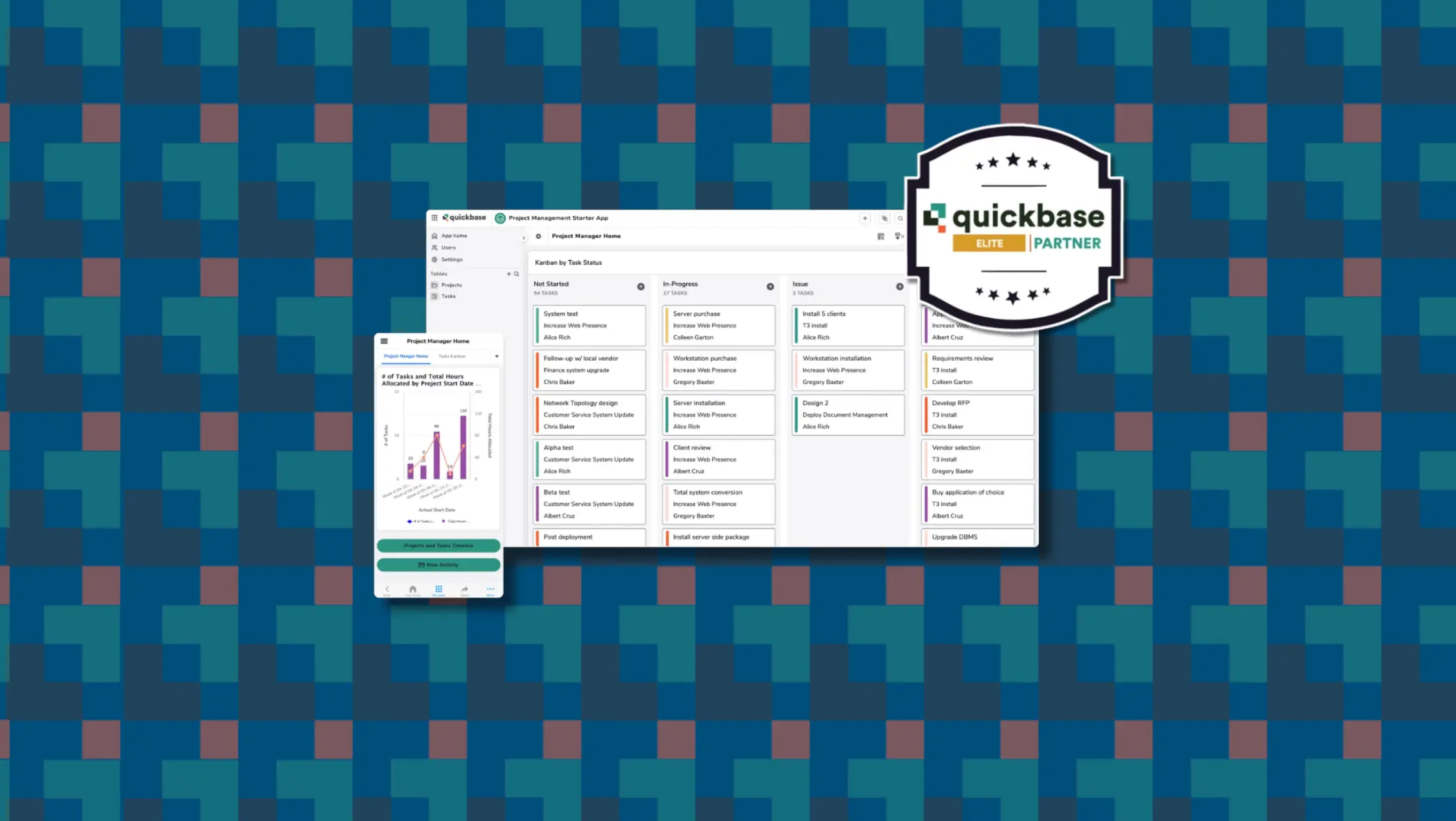
Quandary Case Study: Quickbase Sales Management System Helps AiN Group Drive $100K in Annual Efficiency Gains
Should You Build Quickbase Internally or Work With a Quickbase Partner?
Organizations can successfully build and manage Quickbase applications internally, work with a Quickbase Partner, or use a hybrid approach that combines external expertise with internal development capabilities. The right model depends on the complexity of the application, available internal resources, integration requirements, governance needs, timeline, and long-term goals.
For relatively straightforward departmental applications, an internal Quickbase team may be able to design and deploy a solution effectively. However, as Quickbase expands across business units, integrates with enterprise systems, supports mission-critical workflows, or becomes part of a broader automation and AI strategy, experienced architecture and implementation support becomes increasingly valuable.
Building Quickbase Internally
Building internally gives organizations direct ownership over development and allows employees who understand the business to create applications around their specific needs.
Benefits include:
- Greater day-to-day control over application development and changes.
- Lower initial consulting costs.
- Development of internal Quickbase expertise.
- Direct involvement from employees who understand existing workflows.
- Greater flexibility for smaller applications and incremental improvements.
Potential challenges include:
- A longer learning curve for more sophisticated applications.
- Limited exposure to Quickbase architecture and development best practices.
- Applications that solve immediate problems but become difficult to scale.
- Inconsistent data models, permissions, naming conventions, and development standards.
- Greater difficulty managing complex integrations and automation.
- Increased risk of application sprawl as more departments begin building independently.
- Limited internal capacity to maintain applications as the Quickbase environment grows.
Working With a Quickbase Partner
A Quickbase consulting partner brings specialized experience in application architecture, process optimization, integration, automation, data management, governance, and deployment.
Instead of learning through trial and error, organizations can apply patterns and methodologies developed across other complex Quickbase implementations.
Benefits include:
- Faster implementation and shorter time-to-value.
- Experienced Quickbase application architecture and development.
- Process optimization before automation begins.
- More sophisticated integrations with ERP, CRM, financial, HR, project management, and other enterprise systems.
- Stronger governance, permissions, security, and development standards.
- Reduced implementation and scalability risk.
- Access to integration, automation, data, and AI expertise beyond Quickbase itself.
- A more structured foundation for expanding Quickbase across additional workflows and departments.
Potential considerations include:
- An upfront consulting investment.
- Time from business and IT stakeholders during discovery, testing, and implementation.
- The need to select a partner that understands both Quickbase and the organization's broader business and technology environment.
What About a Hybrid Quickbase Development Model?
For many organizations, the most effective approach is a hybrid model.
A Quickbase Partner can establish the initial architecture, integrations, governance framework, development standards, and complex applications while internal teams build the skills to manage ongoing improvements and simpler use cases.
This approach combines external expertise with internal ownership.
It can also support a governed citizen development model, where employees closest to business processes participate in application development while IT maintains appropriate standards for security, data, integrations, permissions, and enterprise architecture.
When Should You Consider Hiring a Quickbase Partner?
Working with a Quickbase Partner becomes particularly valuable when an organization:
- Is implementing Quickbase for the first time.
- Needs to replace complex spreadsheets or legacy applications.
- Plans to use Quickbase across multiple departments or business units.
- Needs to integrate Quickbase with multiple enterprise systems.
- Has mission-critical workflows that require strong reliability and governance.
- Needs to migrate or restructure significant amounts of operational data.
- Wants to automate complex, cross-functional business processes.
- Has an existing Quickbase environment that has become difficult to maintain or scale.
- Wants to connect Quickbase with AI, AI agents, or broader enterprise automation initiatives.
The decision ultimately comes down to complexity, internal capability, risk, and speed. Simple Quickbase applications can often be built successfully in-house. More complex enterprise initiatives typically require deeper expertise in architecture, integration, process design, automation, and governance.
For organizations that want both speed and long-term internal ownership, a hybrid model can provide a practical path: use a Quickbase Partner to establish the right foundation, then empower internal teams to build and evolve from it.
Quandary Case Study: Eagle Telemedicine Deploys a Quickbase Medical Billing System With HyperCare Support
What Can a Quickbase Partner Offer Your Business?
A Quickbase Partner can help your organization get more value from Quickbase by combining platform expertise with business process optimization, application development, integration, automation, data strategy, and governance.
The best Quickbase Partners operate as an extension of your team rather than simply taking a list of requirements and building an application.
The process typically begins with discovery. A partner works with business and IT stakeholders to understand how work happens today, where bottlenecks exist, which systems and data are involved, what employees need from the solution, and which business outcomes matter most.
From there, the partner can determine how Quickbase fits into the broader technology environment and design a solution around the organization's actual operational requirements.
Key Benefits of Working With a Quickbase Partner
Faster Time-to-Value: An experienced Quickbase Partner can accelerate application design, development, integration, testing, and deployment by applying proven architecture patterns and development practices from the beginning.
Better Business Processes: A strong partner evaluates the underlying workflow before automating it. This helps eliminate unnecessary steps, clarify responsibilities, improve handoffs, and prevent inefficient processes from simply becoming faster inefficient processes.
Reduced Implementation Risk: Experienced Quickbase consultants can help organizations avoid common issues involving application architecture, data structure, permissions, integrations, governance, scalability, and user adoption that may otherwise create expensive rework or technical debt.
Greater ROI From Quickbase: A partner can help prioritize applications and automation opportunities based on measurable business value, including hours saved, processing time reduced, errors eliminated, revenue accelerated, operational costs lowered, or visibility improved.
Enterprise System Integration: Quickbase rarely operates in isolation. A partner can connect Quickbase with ERP, CRM, HR, financial, project management, document management, and other enterprise platforms so information can move between systems without unnecessary manual entry.
Workflow and Process Automation: Quickbase Partners can help automate approvals, assignments, notifications, escalations, document workflows, data synchronization, exception handling, and other repetitive activities across business processes.
Better Operational Visibility: Well-designed Quickbase applications can provide real-time dashboards and reporting that give employees and leadership clearer visibility into projects, resources, costs, workloads, bottlenecks, risks, and overall performance.
Stronger Governance and Scalability: As Quickbase adoption expands, governance becomes increasingly important. A partner can establish development standards, permissions, application ownership, data controls, integration patterns, and change-management practices that allow the environment to grow without becoming difficult to manage.
AI and Automation Readiness: As organizations introduce AI assistants and AI agents, they need structured processes, reliable data, clearly defined permissions, and governed access to enterprise systems. A Quickbase Partner with broader automation and AI expertise can help create the operational foundation these technologies require.
Ongoing Optimization: Business requirements rarely remain static. An experienced partner can continue improving applications, integrations, automation, reporting, and governance as the organization grows and new technologies become part of the operating environment.
A Quickbase Partner Should Deliver More Than an Application
The real value of a Quickbase Partner is not simply the ability to build faster. A successful Quickbase implementation should improve how information moves through the organization, how teams collaborate, how decisions are made, and how effectively existing technology supports the business.
That requires looking beyond Quickbase itself.
At Quandary Consulting Group, we evaluate the complete operational environment, including people, processes, systems, data, integrations, automation, governance, and AI. Quickbase may serve as the operational application layer, while platforms such as Workato connect data and actions across the broader enterprise technology stack.
This approach allows organizations to solve the immediate business problem while creating an architecture that can support additional workflows, automation, integrations, and AI initiatives over time.
Ultimately, a Quickbase Partner should help you answer a bigger question, “How can we design a better way for this work to get done?”
Quandary Case Study: BrandSafway Automates High-Volume Employee Onboarding With Quickbase and Workday Integration
Key Quickbase Use Cases: What Can You Build With Quickbase?
Quickbase is used to build custom business applications, automate workflows, connect operational data, and manage processes that do not fit neatly inside traditional enterprise software.
Because the platform is highly configurable, organizations can use Quickbase across departments and industries without forcing every team into the same standardized workflow. It is particularly valuable for processes that still depend heavily on spreadsheets, email, manual data entry, disconnected applications, or legacy systems.
Common Quickbase use cases include project management, construction operations, workforce management, procurement, asset tracking, field service management, compliance, credentialing, financial operations, inventory management, reporting, and workflow automation.
Quickbase for Construction and Engineering
Construction and engineering organizations can use Quickbase to connect project, field, workforce, financial, and operational information across complex project portfolios.
Common construction use cases include:
- Project and portfolio management
- Workforce and labor management
- Daily field reporting
- Subcontractor management
- RFIs and submittals
- Change order management
- Equipment and asset tracking
- Safety inspections and incident management
- Procurement and material tracking
- Budget and cost visibility
- Project billing workflows
- Production tracking
- Resource planning and scheduling
Quickbase can also connect with construction ERP, accounting, project management, telematics, and field applications, helping organizations create better visibility between field and back-office operations without replacing the specialized platforms they already use.
Quickbase for Manufacturing
Manufacturers can use Quickbase to improve visibility and coordination across production, inventory, quality, maintenance, procurement, and supply chain operations.
Common manufacturing use cases include:
- Production tracking
- Inventory and material management
- Quality assurance and quality control
- Equipment maintenance
- Asset management
- Supplier management
- Procurement workflows
- Safety and compliance tracking
- Work order management
- Production scheduling
- Operational reporting
By connecting information across departments and systems, Quickbase can help manufacturers identify bottlenecks earlier, reduce manual coordination, and make operational data more accessible to the people responsible for taking action.
Quickbase for Professional Services
Professional services organizations can use Quickbase to manage the operational workflows that connect clients, projects, employees, resources, budgets, and financial performance.
Common use cases include:
- Client and engagement management
- Project tracking
- Resource allocation
- Capacity planning
- Time and expense management
- Budget tracking
- Project profitability
- Contract and document management
- Approval workflows
- Performance reporting
Centralizing these processes can give leadership greater visibility into resource utilization, project status, delivery risks, and profitability across the organization.
Quickbase for Healthcare
Healthcare organizations can use Quickbase to modernize operational and administrative workflows while connecting information across teams and existing healthcare technology.
Common healthcare Quickbase use cases include:
- Provider onboarding
- Credentialing management
- Referral management
- Prior authorization workflows
- Compliance tracking
- Workforce management
- Patient access operations
- Document and approval workflows
- Operational reporting
- Audit and exception management
- Facility and asset management
Quickbase can also serve as an operational layer between existing systems, helping healthcare organizations coordinate workflows that span EHRs, credentialing platforms, contact centers, financial systems, Microsoft 365, and other applications.
Quickbase for Field Service Management
Organizations with distributed field teams can use Quickbase to coordinate technicians, work orders, equipment, schedules, customer information, and field activity within a connected operational environment.
Common field service use cases include:
- Work order management
- Technician scheduling and dispatch
- Asset and equipment tracking
- Inspection management
- Preventive maintenance
- Field data collection
- Inventory and parts management
- Customer communications
- Service history
- Billing and approval workflows
- Performance dashboards
Automating the flow of information between field and office teams can reduce administrative work while giving managers greater visibility into work status, technician capacity, assets, and service performance.
Quickbase for Procurement and Financial Operations
Quickbase can also support procurement, purchasing, accounts payable, and other financial workflows that require coordination across employees, vendors, approvers, and enterprise systems.
Common use cases include:
- Purchase requisitions
- Purchase order management
- Approval workflows
- Vendor onboarding and management
- Invoice processing
- Contract tracking
- Budget visibility
- Spend management
- Exception management
- Procurement reporting
When Quickbase is integrated with ERP, accounting, document management, and other financial systems, organizations can reduce repetitive data entry and create more consistent processes from request through approval, purchasing, invoicing, and payment.
Quickbase for Compliance and Governance
Organizations operating in highly regulated environments can use Quickbase to standardize processes, document activities, manage approvals, and create greater visibility into compliance requirements.
Common use cases include:
- Compliance tracking
- Certification management
- Credential management
- Policy and procedure workflows
- Audit management
- Risk tracking
- Corrective action management
- Document approvals
- Employee certifications
- Regulatory reporting
Structured workflows, permissions, reporting, and auditability can make it easier to manage processes that otherwise depend on spreadsheets, email, and manual follow-up.
Quickbase for AI-Enabled Operations
Quickbase can also become part of the operational foundation for AI and AI agents.
AI performs more reliably when it has access to structured data, clearly defined workflows, appropriate permissions, and systems where approved actions can occur. Quickbase can provide this operational context while integrations and orchestration platforms connect AI with additional enterprise systems.
Organizations can combine Quickbase, automation, integration, and AI to support use cases such as document classification, intelligent routing, data extraction, exception identification, workflow recommendations, automated research, and human-in-the-loop decision support.
What Business Processes Can Quickbase Replace or Improve?
Quickbase is particularly useful when a business-critical process has outgrown the tools currently supporting it.
If employees are managing an important workflow through spreadsheets, email chains, shared documents, disconnected databases, manual approvals, or repetitive data entry, Quickbase may provide a more structured and scalable alternative.
It can also fill workflow gaps between larger enterprise platforms. Instead of replacing an ERP, CRM, EHR, HRIS, or project management system, Quickbase can connect the processes that extend across those systems.
That flexibility means Quickbase use cases are not limited to a specific department or industry. Organizations can begin with one high-friction process and expand into additional applications, integrations, automation, and AI capabilities as business requirements evolve.
Quandary Case Study: Deviney Construction/Magnolia Utility Services Modernizes Field Operations With Quickbase, FastField, Samsara, and Vista
Quickbase Partner Services and Add-On Options
Quickbase Partners provide services and technology solutions that help organizations implement, integrate, customize, and continuously improve their Quickbase environments.
Depending on the organization's needs, a partner may support everything from a single application build to a broader enterprise modernization initiative involving multiple Quickbase applications, integrations, workflow automation, data migration, governance, and AI.
What Are Quickbase Partner Add-Ons and Extensions?
Quickbase can also be extended beyond standard application development. Depending on the partner and use case, organizations may incorporate additional capabilities that improve how Quickbase connects with users, data, systems, automation, and AI.
These extensions can include:
- Advanced reporting and analytics
- Automated email and notification workflows
- Document generation and document processing
- Electronic signature integrations
- Mobile and field data collection
- Custom user interfaces and portals
- API-based integrations
- Integration accelerators and reusable connectors
- Industry-specific applications and templates
- Advanced workflow orchestration
- AI-powered document processing and data extraction
- AI assistants and AI agents
- Custom approval and exception-management workflows
What Services Do Quickbase Partners Provide?
Common Quickbase Partner services include:
Quickbase Application Development: Design and build custom Quickbase applications around specific business processes, user requirements, data structures, and operational goals.
Quickbase Implementation: Plan, configure, test, deploy, and support new Quickbase environments and applications while establishing a scalable foundation for future development.
Workflow and Process Automation: Automate approvals, notifications, assignments, escalations, document workflows, data updates, exception handling, and other repetitive processes.
Quickbase Integrations: Connect Quickbase with ERP, CRM, HRIS, accounting, project management, document management, and other enterprise systems through APIs, native integrations, and integration platforms such as Workato.
Application Modernization: Replace or improve spreadsheet-based processes, legacy databases, disconnected applications, and outdated workflows with structured Quickbase solutions.
Data Migration and Architecture: Clean, structure, migrate, and organize data from spreadsheets, databases, legacy applications, and other business systems.
Dashboards and Reporting: Create role-specific dashboards, operational reports, KPI tracking, and real-time visibility into projects, workflows, resources, risks, costs, and performance.
Process Optimization: Evaluate how work currently moves through the organization and redesign inefficient processes before introducing automation.
Quickbase Governance: Establish application ownership, development standards, permissions, data controls, documentation, change-management practices, and governance frameworks that support responsible growth.
User Training and Adoption: Prepare employees, administrators, and internal developers to use, manage, and continuously improve Quickbase applications.
Ongoing Quickbase Support: Maintain, troubleshoot, enhance, and optimize applications and integrations as business requirements change.
Quickbase Can Be Part of a Larger Connected Technology Ecosystem
For enterprise organizations, the greatest value often comes from extending Quickbase beyond a standalone application.
For example, Quickbase can serve as an operational application and workflow layer while Workato orchestrates integrations and automation across ERP, CRM, HR, financial, document management, and other enterprise systems. AI can then support activities such as document classification, information extraction, summarization, risk identification, intelligent routing, and decision support.
This architecture allows organizations to use the right technology for each part of a business process rather than forcing every requirement into a single platform.
How Do You Determine Which Quickbase Services You Need?
Organizations should begin with the business problem rather than a specific feature or add-on.
A Quickbase Partner can evaluate the current process, systems, data, integrations, users, security requirements, and desired business outcomes before determining which combination of Quickbase development, integration, automation, reporting, governance, AI, and ongoing support makes sense.
At Quandary Consulting Group, this means looking beyond the immediate application requirement and considering how the solution fits into the organization's broader operational architecture.
The goal is to avoid adding technology simply because it is available. Each application, integration, automation, or AI capability should solve a defined business problem and contribute to measurable improvements in efficiency, visibility, scalability, risk reduction, employee productivity, or financial performance.
Quandary Case Study: AES Clean Technology Cuts Document Administration Management 50% With Quickbase Workflow Automation
How Do You Choose the Right Quickbase Partner?
Choosing the right Quickbase Partner requires looking beyond basic platform experience. The right partner should understand Quickbase development, but they should also understand your business processes, existing technology environment, integration requirements, data architecture, governance needs, and long-term goals.
Quickbase maintains a partner ecosystem that can help organizations identify providers with platform expertise. However, capabilities can vary considerably between consulting firms. Some partners specialize primarily in application development, while others provide broader expertise across process optimization, enterprise integration, automation, data, governance, AI, and digital transformation.
When comparing Quickbase consulting partners, consider the following factors:
1. Quickbase Experience and Platform Expertise
Evaluate how much experience the partner has designing and implementing Quickbase solutions and the complexity of the environments they support.
Ask whether the partner has experience with departmental applications, enterprise deployments, application modernization, complex data models, multi-system integrations, and mission-critical workflows.
Experience across multiple industries can also be valuable because it gives consultants exposure to different operational models and approaches to solving similar business problems.
2. Certifications, Partner Status, and Technical Expertise
Review the organization's Quickbase partnership status, certifications, technical capabilities, and relevant recognition.
However, certifications should be considered alongside practical implementation experience. A strong Quickbase consulting team should be able to explain how it approaches architecture, security, permissions, governance, integration, testing, deployment, and long-term application management.
3. Relevant Quickbase Case Studies
Ask potential partners to provide examples of Quickbase projects that resemble the complexity or business requirements of your initiative.
Strong case studies should go beyond describing what the partner builds. Look for measurable business outcomes such as:
- Reduced processing or cycle times
- Fewer hours spent on manual work
- Lower operational costs
- Faster billing or revenue recognition
- Improved data accuracy
- Greater project or operational visibility
- Reduced application or administrative overhead
- Increased capacity without proportional headcount growth
These outcomes provide a better indication of whether a partner focuses on business value rather than application delivery alone.
4. Process and Business Consulting Capabilities
A Quickbase Partner should understand the process before building the application.
During discovery, the consulting team should ask how work happens today, where delays occur, which employees and departments participate, what systems contain relevant data, where manual handoffs exist, and what outcome the organization wants to improve.
Be cautious when a partner begins prescribing a technical solution before understanding the underlying business problem.
5. Integration and Automation Expertise
Quickbase frequently needs to communicate with other enterprise applications. Evaluate whether the partner can integrate Quickbase with your existing technology stack, including ERP, CRM, HRIS, financial, project management, document management, Microsoft 365, and other business platforms.
This becomes particularly important when processes cross multiple systems.
A partner with broader integration and orchestration expertise can help determine what belongs in Quickbase, what should remain in an existing system of record, and how data and actions should move between those platforms.
6. Governance and Scalability
Ask how the partner approaches Quickbase governance as adoption grows.
This should include considerations such as application ownership, development standards, user permissions, data access, documentation, integration architecture, testing, change management, and application lifecycle management.
Good governance helps organizations maintain the flexibility of low-code development without allowing the environment to become fragmented, difficult to maintain, or dependent on undocumented institutional knowledge.
7. AI and Future Technology Readiness
In 2026, organizations should also consider whether a Quickbase Partner understands how low-code platforms fit into a broader automation and AI strategy.
AI assistants and AI agents depend on trusted data, defined workflows, appropriate permissions, integrations, monitoring, and clear rules governing the actions they can perform.
A partner does not need to introduce AI into every Quickbase application. However, it should understand how the architecture being created today can support automation, AI, and emerging technologies as business requirements evolve.
8. Client Reviews and References
Review testimonials, third-party reviews, customer references, and published case studies.
Pay attention to what customers say about communication, problem-solving, technical expertise, reliability, flexibility, and post-launch support. When possible, ask for references from organizations with similar project requirements or operating environments.
9. Discovery and Implementation Methodology
Ask prospective Quickbase Partners to explain what happens before development begins and how the project progresses from discovery through deployment.
A mature methodology should include requirements gathering, process analysis, solution architecture, iterative development, testing, stakeholder feedback, deployment, training, documentation, and post-launch optimization.
You should also understand how the partner defines success and which KPIs it recommends establishing before implementation begins.
10. Communication and Long-Term Support
Technical expertise matters, but so does the working relationship.
Evaluate how quickly the partner communicates, how clearly it explains technical decisions, how stakeholders participate in the project, and what happens after deployment.
The best Quickbase implementations continue evolving as the business changes. Your partner should be able to support ongoing optimization without creating unnecessary dependency.
Questions to Ask a Quickbase Partner Before Hiring Them
Before selecting a Quickbase consulting company, ask questions such as:
- How long have you worked with Quickbase?
- Can you show us projects similar to ours?
- What measurable results do your Quickbase projects achieve?
- How do you approach discovery and process optimization?
- How do you determine whether something should be built in Quickbase or handled by another system?
- What experience do you have with enterprise integrations and APIs?
- Which integration and automation platforms do you support?
- How do you approach Quickbase governance and security?
- How do you prevent applications from becoming difficult to maintain as they grow?
- How do you measure ROI after implementation?
- What training and documentation do you provide?
- What does ongoing support look like after launch?
- How do you approach AI and AI agents when they become relevant to a workflow?
Choosing a Quickbase Partner for Long-Term Value
Ultimately, the right Quickbase Partner should help your organization solve business problems, not simply build applications.
Look for a team that can connect Quickbase expertise with process improvement, enterprise architecture, integration, automation, governance, and measurable business outcomes.
At Quandary Consulting Group, we approach Quickbase within the context of the entire operational environment. That means understanding how people, processes, systems, data, automation, and AI need to work together before determining what technology should be built or integrated.
The result should be more than a functional Quickbase application. It should be a scalable operational solution that reduces friction, improves visibility, connects existing technology, and continues creating value as the business evolves.
Quandary Case Study: FLYTEgroup Modernizes Hotel Commission and Invoice Operations With Quickbase, Workato & Document Automation
Why Choose an Elite Quickbase Partner?
A Quickbase Elite Partner represents a high level of experience and commitment within the Quickbase partner ecosystem. For organizations evaluating Quickbase consulting companies, Elite Partner status can provide an additional indication that the consulting team has substantial experience designing, developing, integrating, and supporting solutions on the platform.
This becomes particularly important when Quickbase supports complex or business-critical operations. Enterprise implementations may involve multiple applications, large data sets, sophisticated permissions, integrations with core business systems, workflow automation, regulatory requirements, and processes that extend across multiple departments.
Working with an experienced Elite Quickbase Partner can help organizations approach these requirements with a more mature architecture and delivery strategy from the beginning.
Deep Quickbase Expertise and Experience
Elite Quickbase Partners bring extensive hands-on experience with the platform and understand how to translate complex business requirements into scalable applications.
That expertise extends beyond building tables, forms, and dashboards. Experienced consultants understand data architecture, application design, permissions, workflow automation, integrations, governance, performance, testing, deployment, and long-term application management.
This helps organizations build applications that solve today's problem without creating unnecessary limitations as requirements evolve.
Faster Time-to-Value
Organizations often work with an Elite Quickbase Partner because they want to move quickly without sacrificing architecture or scalability.
Experienced partners bring established discovery processes, development methodologies, reusable frameworks, and lessons learned from previous implementations. Rather than spending months learning through trial and error, organizations can apply proven approaches to application design and deployment.
The result can be a faster path from identifying an operational problem to putting a working solution in the hands of users.
Advanced Quickbase Development and Customization
Enterprise workflows rarely fit perfectly into an out-of-the-box application.
Elite Partners can design custom Quickbase applications around an organization's specific processes, users, business rules, approval structures, reporting requirements, and data models.
This flexibility is especially valuable when organizations need to modernize spreadsheet-driven processes, replace legacy applications, connect workflows across departments, or create operational applications that complement existing enterprise systems.
Enterprise Integration and Workflow Automation
Quickbase often delivers greater value when it connects with the rest of the organization's technology ecosystem.
An experienced Quickbase Partner can help integrate Quickbase with systems such as ERP, CRM, HRIS, financial, project management, document management, Microsoft 365, and other enterprise applications.
Partners with broader integration and orchestration expertise can also use platforms such as Workato to automate processes that span multiple applications.
Instead of treating Quickbase as an isolated platform, this approach allows it to become part of a connected operational architecture where information and actions can move across systems with fewer manual handoffs.
Security, Governance, and Compliance Considerations
Security and governance become increasingly important as Quickbase applications expand across departments and support more critical business processes.
An experienced Elite Partner can help organizations design applications around appropriate role-based permissions, data access controls, governance standards, audit requirements, development practices, integration security, and change-management processes.
For organizations operating in regulated industries such as healthcare, financial services, construction, or government, a partner should also understand how application architecture and workflows need to align with the organization's applicable security, privacy, and compliance requirements.
Scalable Application Architecture
One of the biggest differences between building a Quickbase application and building a sustainable Quickbase environment is architecture.
An application may work perfectly for one department today but become difficult to maintain when additional users, workflows, integrations, data, or business units are introduced.
Experienced Quickbase consultants anticipate these requirements earlier. They can establish data structures, application relationships, permissions, integration patterns, governance standards, and development practices that support continued growth.
Ongoing Quickbase Support and Optimization
A Quickbase implementation rarely remains static.
Business processes change. New applications are introduced. Integrations evolve. Reporting requirements expand. Organizations adopt new automation and AI capabilities.
Elite Partners can provide ongoing Quickbase support, application optimization, integration management, governance, and strategic guidance so the environment continues to evolve alongside the business.
Access to Proven Frameworks, Accelerators, and Solutions
Experienced Quickbase Partners may also bring reusable frameworks, integration patterns, industry-specific solutions, templates, and development accelerators from previous implementations.
When appropriate for the use case, these resources can reduce the amount of development required and allow organizations to focus more quickly on the capabilities that differentiate their business.
Preparing Quickbase for Automation and AI
In 2026, organizations also need to consider how the applications they build today fit into their broader automation, AI, and AI agent strategies.
AI depends on trusted data, clearly defined workflows, appropriate permissions, reliable integrations, and governance over how information is accessed and how actions are performed.
An Elite Quickbase Partner with expertise beyond low-code development can help organizations establish this foundation. Quickbase can provide structured operational data and workflows, integration platforms can connect enterprise systems, and AI can support activities such as document processing, classification, intelligent routing, exception identification, summarization, and human decision support.
Why Work With Quandary as Your Quickbase Elite Partner?
Quandary Consulting Group brings more than Quickbase development expertise to an engagement. As a Quickbase Elite Partner, we look at how Quickbase fits within the organization's complete operating environment.
That means evaluating people, processes, systems, data, integrations, automation, governance, and AI before determining the right solution architecture.
Our goal is to help organizations use Quickbase where it creates the greatest value, integrate it with the systems that should remain systems of record, and automate the processes that connect them.
The result is not simply another application. It is a more connected, scalable operational environment designed to reduce manual work, improve visibility, strengthen processes, and support the organization's next stage of growth.
Quandary Case Study: City of Los Angeles Modernizes Digital Civic Engagement With Quickbase and an Accessible Public Website
2026 Quickbase Elite Partners
Organizations looking for a Quickbase Elite Partner in 2026 have several experienced consulting firms to consider. Quickbase's current partner directory identifies Quandary Consulting Group, Trinity Integrated Solutions, Sympo, Data Collaborative, and VeilSun as Elite Partners.
Although each company provides Quickbase expertise, their services, experience, approach, and areas of specialization differ. Organizations should evaluate potential partners based on their specific requirements, including application development, business process improvement, integrations, automation, governance, support, and broader technology needs.
Quandary Consulting Group
Quandary Consulting Group is a Quickbase Elite Partner focused on helping organizations improve business processes through custom application development, system integration, automation, and operational modernization.
Quandary takes a Business First, Technology Second approach, beginning with the underlying business problem before determining how Quickbase or other technologies should be used to solve it.
Its capabilities extend beyond standalone Quickbase development to include enterprise integration, workflow automation, data orchestration, AI, and AI agents. This allows organizations to use Quickbase as part of a broader connected technology ecosystem rather than treating it as an isolated application platform.
Quandary works with organizations ranging from growing businesses to large enterprises and focuses on developing solutions that produce measurable operational and financial outcomes.
Trinity Integrated Solutions
Trinity Integrated Solutions is a Quickbase Elite Partner focused on business process improvement and custom application development.
According to its Quickbase partner profile, Trinity works with organizations ranging from small businesses to Fortune 100 companies and provides services that include application development, business process analysis, software integration, training, and technical support.
Its approach emphasizes moving projects from concept through implementation while improving operational efficiency, service, and quality.
Sympo, Inc.
Sympo, Inc. is a Quickbase Elite Partner with experience developing and customizing Quickbase applications across industries including construction, healthcare, manufacturing, retail, and real estate.
Its Quickbase services include application development, business process analysis, integration, training, technical support, and ongoing application maintenance.
Sympo focuses on identifying workflow inefficiencies and developing customized applications that improve processes, visibility, and collaboration.
Data Collaborative
Data Collaborative is a Quickbase Elite Partner providing business transformation consulting and technical implementation services.
Its capabilities include custom Quickbase development, application support, automation, integration, web portals, and solutions that connect Quickbase with other business technologies.
Data Collaborative reports more than 20 years of consulting and development experience and hundreds of active customers, giving the organization experience across a broad range of Quickbase implementations.
VeilSun, Inc.
VeilSun is a Quickbase Elite Partner specializing in Quickbase implementation, integration, automation, and custom application development.
Its services extend into complex integrations and AI-enabled solutions, allowing organizations to connect Quickbase with other technologies and automate workflows across their operating environments.
VeilSun works with organizations looking to use Quickbase to improve operational efficiency, modernize processes, and build scalable custom business applications.
How Should You Compare Quickbase Elite Partners?
Elite status provides a useful starting point, but organizations should still evaluate which partner aligns most closely with their requirements.
Consider each partner's experience with your industry, application complexity, integration requirements, business process consulting capabilities, automation expertise, governance approach, ongoing support model, and ability to demonstrate measurable results from similar projects.
Organizations should also consider the broader technology environment. If Quickbase needs to integrate with ERP, CRM, HR, financial, construction, healthcare, or other enterprise platforms—or support automation and AI initiatives—the partner's expertise beyond Quickbase can become an important part of the decision.
The right Quickbase consulting partner should understand what you want to accomplish operationally and then determine how Quickbase, integrations, automation, data, and other technologies can work together to achieve that outcome.
Quandary Case Study: Chick-fil-A Unifies 3,000+ Construction Projects with Custom Quickbase Application
Why Work With Quandary Consulting Group?
At Quandary Consulting Group, we believe successful technology initiatives begin with the business problem, not the platform.
As a Quickbase Elite Partner, we help organizations modernize operations by improving the processes, systems, data, and workflows that support how work gets done. Our approach is designed to reduce manual effort, eliminate operational bottlenecks, improve visibility, and create scalable solutions that continue delivering value as the business evolves.
We call this Business First, Technology Second.
Before we build anything, we work to understand the process, the people involved, the systems that support it, the data that moves through it, and the business outcomes the organization wants to improve. From there, we determine how Quickbase, integrations, automation, and other technologies can work together to create the right solution.
Our Quickbase Consulting Capabilities
Our team provides expertise across:
- Quickbase application development for custom operational applications tailored to specific business requirements.
- Business process optimization to eliminate unnecessary steps, reduce friction, and improve how work moves across teams.
- System integration and data orchestration to connect Quickbase with ERP, CRM, HR, financial, project management, and other enterprise platforms.
- Workflow automation to streamline approvals, notifications, assignments, document processing, data movement, and exception handling.
- Data visibility and reporting to provide employees and leaders with clearer, more timely insight into operations, performance, risks, and opportunities.
- Quickbase governance and architecture to support security, scalability, consistency, and long-term application management.
- AI and AI agent enablement to help organizations establish the structured data, connected systems, permissions, and workflows intelligent automation requires.
- Strategic technology roadmapping to ensure individual applications and automation initiatives support broader operational and business goals.
More Than Quickbase Development
Quickbase is often one part of a much larger technology ecosystem.
That is why Quandary looks beyond the individual application. We evaluate how Quickbase should interact with existing systems of record, where integrations can eliminate manual handoffs, which workflows should be automated, and where AI can create additional value.
For some organizations, that means replacing a critical spreadsheet-driven process with a structured Quickbase application. For others, it means connecting Quickbase with platforms such as Workato, Microsoft 365, ERP systems, CRM platforms, construction technology, healthcare systems, financial applications, or other enterprise tools.
The objective remains the same: create a more connected, efficient, and scalable operating environment.
Built Around Measurable Business Outcomes
A successful Quickbase implementation should produce more than a working application it needs to improve a meaningful business outcome.
That may include reducing processing time, eliminating repetitive administrative work, accelerating billing, improving project visibility, increasing operational capacity, reducing errors, strengthening governance, or giving leadership better information for decision-making.
From discovery and solution design through implementation, integration, deployment, and ongoing optimization, our team stays focused on the measurable value the solution creates.
Whether you are implementing Quickbase for the first time, replacing legacy applications and spreadsheets, integrating Quickbase with other enterprise systems, or optimizing an existing environment, Quandary can help you build a stronger foundation for automation, intelligent operations, and long-term growth.
Ready to See What Is Possible With Quickbase
Explore our Quickbase case studies to see how organizations use low-code development, integration, automation, and connected data to solve complex operational challenges.
Or, if you already have a process that is slowing your team down, talk with Quandary Consulting Group about how Quickbase can fit into a broader strategy for improving the way your business operates.
Additional Resources:
- Quickbase Partner Page
- Intelligent Operations: What Business Leaders Need to Know About Quickbase's AI Evolution (Overview of Quickbase's new AI solutions)
- Pave and the Future of Enterprise AI Development | Why Governance-First “Vibe Coding” Is the Next Big Shift (Overview of Quickbase's new vibe-coding platform called, Pave)
- The Future of Intelligent Operations | How Quickbase, AI, and Strategic Innovation Are Transforming the Enterprise (Overview of all of the exciting things Quickbase is releasing in 2026!)
Top FAQs about Working With A Quickbase Partners in 2026
What is a Quickbase Partner?
A Quickbase Partner is a certified consulting organization that helps businesses design, build, implement, and optimize Quickbase applications. Partners provide expertise in process improvement, application development, integrations, automation, user adoption, and long-term support to help organizations maximize their Quickbase investment.
Do I need a Quickbase Partner to use Quickbase?
Not necessarily. Quickbase is designed to be user-friendly and accessible to business users. However, organizations with complex workflows, integration requirements, security concerns, or large-scale implementations often benefit from the expertise of a Quickbase Partner. Working with a partner can reduce risk, accelerate deployment, and improve long-term results.
What does a Quickbase Partner do?
Quickbase Partners help organizations:
- Design custom applications
- Automate workflows
- Integrate Quickbase with other systems
- Improve business processes
- Create dashboards and reporting solutions
- Train users and administrators
- Provide ongoing support and optimization
How much does it cost to work with a Quickbase Partner?
Costs vary depending on project scope, complexity, integrations, and customization requirements. Some organizations engage partners for a small application enhancement, while others require enterprise-wide digital transformation initiatives. Most partners offer discovery sessions to help define requirements and provide accurate estimates.
What is the difference between a Quickbase Partner and a Quickbase consultant?
A Quickbase consultant is often an individual contractor or freelancer, while a Quickbase Partner is an officially recognized organization within the Quickbase partner ecosystem. Partners typically provide broader capabilities, including development teams, integration specialists, project managers, training resources, and long-term support services.
What is a Quickbase Elite Partner?
Quickbase Elite Partner status is the highest level of recognition awarded by Quickbase. Elite Partners have demonstrated exceptional expertise, customer success, technical proficiency, and consistent delivery of high-quality solutions. They are considered among the most experienced and trusted providers in the Quickbase ecosystem.
How long does a Quickbase implementation take?
Implementation timelines vary depending on the complexity of the project. Simple applications may be deployed in a matter of weeks, while enterprise-wide solutions involving multiple integrations and departments can take several months. An experienced Quickbase Partner can help accelerate implementation by applying proven methodologies and best practices.
Can Quickbase integrate with my existing software?
Yes. Quickbase can integrate with a wide range of business systems, including ERP, CRM, accounting, HR, project management, and cloud-based applications. Many Quickbase Partners specialize in designing integrations that create a seamless flow of data across an organization's technology ecosystem.
What industries use Quickbase?
Quickbase is used across numerous industries, including:
- Construction
- Manufacturing
- Professional Services
- Healthcare
- Government
- Field Services
- Education
- Financial Services
- Real Estate
- Logistics and Supply Chain
Its flexibility allows organizations to build solutions tailored to their unique operational requirements.
How do I choose the best Quickbase Partner?
When evaluating Quickbase Partners, consider factors such as:
- Quickbase certifications and partner status
- Industry experience
- Client reviews and testimonials
- Case studies and project outcomes
- Integration expertise
- Support and training offerings
- Discovery and planning processes
- Cultural fit and communication style
The best partner is one that understands your business goals and can deliver scalable solutions that support long-term growth.
Why should I choose Quandary Consulting Group as my Quickbase Partner?
As a Quickbase Elite Partner, Quandary Consulting Group combines business process expertise with technical excellence to help organizations streamline operations, automate workflows, and improve visibility across their business. Our business-first approach ensures that every Quickbase solution is aligned with measurable outcomes, delivering long-term value and sustainable growth.