Artificial Intelligence (AI)
What Is AI Middleware? The Missing Layer Between Enterprise AI and Real-World Execution

TL;DR
- AI middleware connects models and agents to enterprise applications, data, workflows, and governance controls, transforming isolated AI experiments into secure, scalable operational capabilities.
- An effective middleware architecture combines orchestration, data preparation, security, observability, cost management, reusable agent services, human oversight, and comprehensive auditability.
- Organizations should begin with a measurable business process, establish clear permission boundaries, separate AI reasoning from workflow execution, and build reusable capabilities that support responsible AI adoption at scale.
Enterprise organizations have moved beyond asking whether they should adopt artificial intelligence. The more urgent question is how to connect AI models and agents to the systems, data, workflows, and governance structures that already run the business.
An AI model may be able to interpret a request, summarize a document, recommend an action, or make a decision. However, it cannot create meaningful business value in isolation. It must be able to securely retrieve data, interact with enterprise applications, follow established rules, initiate workflows, escalate exceptions, and document every action it takes.
That is the role of AI middleware.
AI middleware provides the connective and governance layer between artificial intelligence and the enterprise. It helps organizations turn disconnected AI experiments into secure, scalable, and operationally reliable business capabilities and for companies building AI-enabled operations, this layer may ultimately be just as important as the AI models themselves.
What Is AI Middleware?
AI middleware is a collection of technologies and operational controls that sits between AI models, AI agents, enterprise applications, and organizational data. It manages how these components communicate, exchange information, execute actions, and comply with business policies.
Traditional middleware connects applications and moves data between systems. AI middleware expands that role to account for the unique demands of generative and agentic AI, including:
- Connecting AI agents to enterprise applications and data
- Controlling which tools, records, and actions an agent can access
- Orchestrating multistep AI and business workflows
- Monitoring model behavior, agent activity, performance, and cost
- Preparing enterprise data for AI consumption
- Managing APIs, events, Model Context Protocol connections, and agent-to-agent communication
- Maintaining audit trails for AI-generated decisions and actions
- Routing exceptions to employees for review
- Applying security, privacy, and governance policies at runtime
In a recent article, Workato described AI middleware as an architectural layer rather than a single off-the-shelf product. That distinction matters. AI middleware is not one application that an organization can simply purchase and deploy. It is a coordinated set of capabilities that must fit the organization’s systems, processes, data architecture, security requirements, and AI strategy.
Why AI Middleware Is Becoming Essential
Many early AI initiatives operate outside the core flow of work. Employees copy information into a chatbot, receive an answer, and then manually update another system.
This may save a few minutes, but it does not fundamentally transform the underlying process. Enterprise AI becomes significantly more valuable when it can participate directly in business operations.
An AI agent may need to:
- Receive a request from an employee, customer, or business system.
- Collect information from several authorized sources.
- Interpret the available data.
- Apply business rules and organizational policies.
- Recommend or complete an action.
- Update the appropriate systems of record.
- Escalate uncertain or high-risk cases.
- Record what happened for auditing and continuous improvement.
Without an orchestration and governance layer, organizations often connect each AI use case to each system through separate custom integrations. This creates brittle architecture, inconsistent controls, limited visibility, and growing technical debt.
AI middleware gives enterprises a more scalable way to manage these connections.
The Six Core Capabilities of AI Middleware
According to the capability framework discussed in Workato’s analysis of AI middleware, an effective architecture must address several interconnected areas.
1. Observability, Monitoring, and Auditing
Organizations need visibility into what AI systems and agents are doing. This includes monitoring which systems an agent accessed, what information it retrieved, which actions it attempted, how long the workflow took, how much it cost, and whether the outcome was successful.
Strong observability helps organizations answer critical questions:
- Why did the AI make this recommendation?
- Which data sources influenced the result?
- Did the agent follow the correct workflow?
- Where did the process fail?
- Was a human approval bypassed?
- How much did the interaction cost?
- Is the system producing consistent results?
A complete audit trail is particularly important in regulated industries such as healthcare, financial services, government, and insurance.
2. Security and Cost Control
AI agents must not receive unlimited access to enterprise systems. AI middleware can help organizations enforce role-based access, authentication, authorization, data privacy rules, usage limits, and approval requirements. Permissions can be applied at the level of individual tools and actions so an agent only receives the access necessary to complete its assigned task.
Cost controls are equally important. AI workflows can generate unpredictable expenses when they make unnecessary model calls, process excessive data, or become trapped in repetitive execution loops.
Governed middleware helps organizations monitor consumption, establish thresholds, select the appropriate model for each task, and prevent runaway activity.
3. Agent Development
Enterprise agents require more than an effective prompt. They need access to trusted data, approved tools, reusable business logic, defined escalation paths, and clear operating boundaries. AI middleware provides the services agents need to work consistently across enterprise environments.
This makes it possible to create reusable capabilities instead of rebuilding similar integrations for every agent. For example, a secure customer-record retrieval capability could be used by support, sales, billing, and customer success agents while maintaining consistent permissions and governance.
4. Performance and Scaling
A successful AI pilot may handle a few hundred interactions. An enterprise deployment may need to manage thousands or millions.
AI middleware helps manage workload distribution, reliability, response times, retries, capacity, and service availability. It can also route different tasks to different models based on cost, complexity, speed, privacy, or performance requirements.
This prevents organizations from tying every AI process to one model or provider and creates a more adaptable architecture.
5. AI Data Preparation and Management
AI is only as dependable as the context it receives. Enterprise information is typically scattered across CRM platforms, ERP systems, data warehouses, document repositories, email, spreadsheets, industry applications, and legacy databases. It may be duplicated, incomplete, inconsistent, or governed by different access policies.
AI middleware helps prepare, transform, validate, and deliver this information in a form that AI systems can use. It can also ensure the agent receives the right data at the right time instead of receiving unrestricted access to an entire enterprise repository. This improves answer quality while reducing security and privacy risks.
6. Orchestration, Mediation, and Interface Management
Orchestration is where AI reasoning becomes business execution. This layer coordinates APIs, application connectors, event-driven integrations, workflows, Model Context Protocol servers, agent-to-agent communication, human approvals, and system updates.
It determines what happens after an AI system identifies the next best action. An AI agent may determine that a vendor invoice appears valid, for example. The orchestration layer can confirm the vendor in the ERP, validate the purchase order, check the approval threshold, route the invoice to the correct manager, update the financial system, and document the transaction.
The intelligence determines what should happen. Middleware ensures it happens securely and correctly.
AI Middleware vs. Traditional Middleware
Traditional middleware was designed primarily to move information between applications. AI middleware expands that role by coordinating applications, data, models, agents, tools, decisions, and autonomous actions.
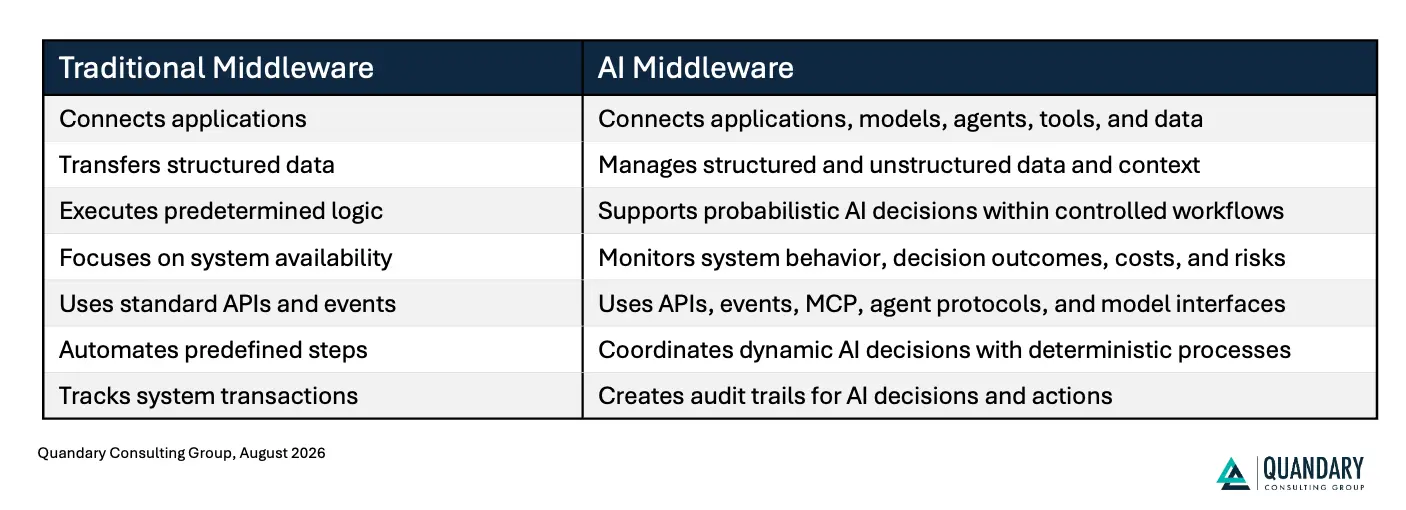
These two categories are not entirely separate. Modern integration and automation platforms already provide much of the foundation needed for AI middleware. However, AI introduces additional requirements, including context management, agent governance, model flexibility, observability, risk controls, and human oversight.
The Role of Workato in an AI Middleware Strategy
Workato can serve as a central orchestration and integration layer within a broader AI middleware architecture.
The platform helps enterprises connect AI capabilities with applications, APIs, databases, business events, and established workflows. This allows organizations to move from AI-generated suggestions to governed operational outcomes.
With Workato, organizations can:
- Connect AI models and agents to enterprise applications
- Build reusable integrations and automated workflows
- Coordinate activity across cloud and legacy systems
- Expose approved business capabilities to AI agents
- Incorporate employees into high-risk approval processes
- Apply security and governance controls
- Monitor executions and maintain workflow auditability
- Transform and route data between systems
- Support MCP-enabled tools and agentic workflows
- Replace isolated point-to-point integrations with reusable orchestration
Workato does not have to replace every component in the enterprise AI stack. Its value comes from providing a governed execution layer that helps models, agents, data, and business systems work together.
Enterprise AI Middleware Use Cases and Case Studies
1. Healthcare Prior Authorization
An AI agent can extract clinical information from incoming documents, identify missing requirements, and prepare a prior-authorization request.
The middleware layer can retrieve patient and coverage information from authorized systems, validate required fields, submit the request through the appropriate payer workflow, update the case record, and route exceptions to staff.
This reduces manual processing while preserving human review for uncertain or sensitive cases.
To see how we have helped a regional healthcare provider modernize prior authorization/onboarding, please see our case study: Regional Healthcare Provider Modernizes Referral Operations with Quickbase, Claude, and Workato
2. Intelligent Customer Support
An AI support agent can interpret a customer’s issue and gather context from the CRM, order-management platform, billing system, and knowledge base. Middleware controls which records the agent can access and which actions it can perform. The agent may be authorized to provide order status or initiate a standard return, while refunds above a certain amount require employee approval.
3. Financial Services Onboarding
AI can review onboarding documents, extract client information, identify missing fields, and flag potential compliance issues. Middleware can validate data against authorized sources, coordinate KYC workflows, update systems of record, trigger approval processes, and maintain a traceable record of each action.
To see how we have helped a Chicago-based Financial firm, please see our case study: AI Agents Reduce Financial Crime Investigation Backlogs for 900-Employee Firm
4. Construction Project Operations
An AI agent can review daily reports, schedules, labor data, procurement records, and project correspondence to identify potential delays or cost risks.
The orchestration layer can create an issue in the project-management platform, notify the responsible manager, update a dashboard, and escalate high-risk findings without giving the agent unrestricted control over project systems.
5. Employee Onboarding
AI can interpret a new employee’s role and determine which resources may be required.
Middleware can coordinate HR, IT, identity management, payroll, facilities, and training systems. Access requests can be automatically completed when they meet policy requirements and routed to managers when additional approval is necessary.
6. Sales and Revenue Operations
An AI agent can research an account, summarize recent interactions, identify missing CRM information, and recommend a next action.
Middleware can pull approved data from sales and marketing systems, update CRM records, initiate enrichment workflows, create follow-up tasks, and route customer-facing content to a salesperson for review.
The Risk of Agent Sprawl
As departments adopt specialized copilots and agents, enterprises may quickly lose visibility into what has been deployed, what each agent can access, and how those agents interact.This creates a new form of technology sprawl. Without a unified governance and orchestration strategy, organizations may face:
- Duplicate agents performing similar work
- Conflicting business rules
- Uncontrolled access to sensitive information
- Inconsistent audit trails
- Unexpected model and infrastructure costs
- Unsupported point-to-point connections
- Unclear ownership
- Limited visibility into agent performance
- Shadow AI deployed outside approved environments
AI middleware helps organizations create an inventory of agents, standardize access to enterprise tools, apply risk-based controls, and establish consistent monitoring across the AI environment.
Orchestration and Governance Must Work Together
AI orchestration without governance allows agents to act without sufficient control. Governance without orchestration creates policies that may not be consistently applied during real business processes and enterprises need both. Every AI action should operate within a controlled execution framework that determines:
- What the agent is allowed to access
- Which actions it can take independently
- Which decisions require human approval
- What information must be recorded
- How failures and exceptions are handled
- Which security policies apply
- How performance and cost are measured
This combination allows organizations to increase automation without surrendering accountability.
How to Build an AI Middleware Strategy
Organizations do not need to design their entire AI architecture at once. A practical approach begins with one valuable, well-defined workflow.
1. Start With a Business Process: Choose a process with a measurable operational problem, such as long processing times, excessive manual entry, frequent errors, poor visibility, or inconsistent customer experiences.
2. Map the Systems and Data: Identify every application, document source, database, API, employee, and approval involved in the process. Determine which system owns each critical record.
3. Separate Intelligence From Execution: Define what the AI will interpret, generate, classify, or recommend. Then define which workflow and integration services will execute the resulting actions. This separation makes the architecture easier to govern and modify.
4. Establish Permission Boundaries: Give agents the minimum access needed to perform their assigned functions. Treat reading information, preparing an action, and completing an action as separate permission levels.
5. Keep Humans in High-Risk Decisions: Human review should remain part of workflows involving clinical decisions, large financial transactions, regulatory obligations, unusual exceptions, or low-confidence AI output.
6. Build Reusable Capabilities: Create reusable connections, data services, policies, and business actions that can support multiple AI use cases. This reduces duplication and helps maintain consistent governance.
7. Measure Business Outcomes: Technical measures such as latency and model accuracy are important, but they do not tell the complete story. Organizations should also track:
- Processing time
- Cost per transaction
- Error and exception rates
- Employee time saved
- Customer or patient experience
- Adoption rates
- Escalation frequency
- Compliance performance
- Revenue impact
- Return on AI investment
How Quandary Helps Organizations Build AI-Ready Operations
Implementing AI middleware is not simply an integration project. It requires organizations to align business processes, enterprise systems, data architecture, security policies, automation, and AI governance.
As a Workato Partner and AI-first consulting firm, Quandary Consulting Group helps organizations design the connected operating foundation required to deploy enterprise AI responsibly.
Our team helps clients:
- Assess AI readiness across processes, systems, and data
- Identify high-value automation and agentic AI use cases
- Design scalable AI middleware architectures
- Implement Workato integrations and orchestration
- Connect AI models and agents to enterprise applications
- Develop reusable APIs, workflows, and business capabilities
- Establish human-in-the-loop controls
- Modernize fragmented or manual processes
- Create monitoring, auditability, and governance frameworks
- Measure the operational and financial impact of AI initiatives
Our approach begins with the business outcome rather than the novelty of the technology. We help organizations determine where AI should make a recommendation, where automation should execute a predictable process, and where an employee must remain in control.
AI Middleware Is the Foundation for Enterprise AI at Scale
The next phase of enterprise AI will not be defined solely by which organization selects the most advanced model. It will be defined by which organizations can connect intelligence to execution securely, reliably, and at scale.
AI middleware provides that foundation. It connects AI agents to the applications and information they need, coordinates actions across complex processes, applies governance at runtime, and gives leaders visibility into performance, risk, and cost.
Without this layer, AI remains a collection of isolated tools and experiments. With it, AI can become a trusted participant in enterprise operations and for organizations ready to move from AI experimentation to measurable business execution, the first step is not deploying more agents. It is building the connected, governed architecture those agents need to succeed.
Top FAQs about AI Middleware
What is AI middleware in simple terms?
AI middleware is the technology layer that connects AI models and agents to business applications, enterprise data, workflows, and security controls. It allows AI to retrieve approved information and take governed action inside real business processes.
Why do enterprises need AI middleware?
Enterprises need AI middleware because AI models cannot safely operate business systems on their own. Middleware provides the integration, orchestration, monitoring, permissions, and auditability required to use AI reliably at scale.
Is AI middleware a single software platform?
No. AI middleware is an architectural category made up of several capabilities, including integration, orchestration, data preparation, agent development, security, observability, cost management, and governance. A platform such as Workato can provide a central foundation within that broader architecture.
How is AI middleware different from an iPaaS?
An integration platform as a service, or iPaaS, connects applications and automates data movement. AI middleware builds on those capabilities by supporting AI models, autonomous agents, dynamic context, model interactions, AI-specific governance, and protocols such as MCP.
What is the relationship between AI middleware and MCP?
Model Context Protocol, or MCP, provides a standardized way for AI systems to interact with tools and data sources. AI middleware governs and orchestrates those interactions by managing identity, permissions, workflows, monitoring, and connections to existing APIs and enterprise applications.
Can Workato function as AI middleware?
Workato can provide a central orchestration, integration, and governance layer within an enterprise AI middleware strategy. It can connect AI capabilities with applications, APIs, workflows, business events, and human approvals while maintaining visibility into execution.
Does AI middleware replace human oversight?
No. Effective AI middleware makes human oversight easier to enforce. Organizations can automatically route sensitive, high-value, unusual, or low-confidence decisions to an employee before an action is completed.
What industries benefit from AI middleware?
AI middleware can benefit any industry operating across multiple systems and data sources. It is particularly valuable in healthcare, financial services, construction, manufacturing, logistics, retail, government, and other regulated or operationally complex environments.