Healthcare
How Rural Healthcare Organizations Can Maximize $50 Billion in Federal Funding Through AI, Data Modernization, and Value-Based Care


TL;DR
- $50 Billion in Federal Funding: The Centers for Medicare & Medicaid Services (CMS) Rural Health Transformation (RHT) Program provides $50 billion in federal funding from fiscal year 2026 through 2030 to strengthen rural healthcare delivery across the United States.
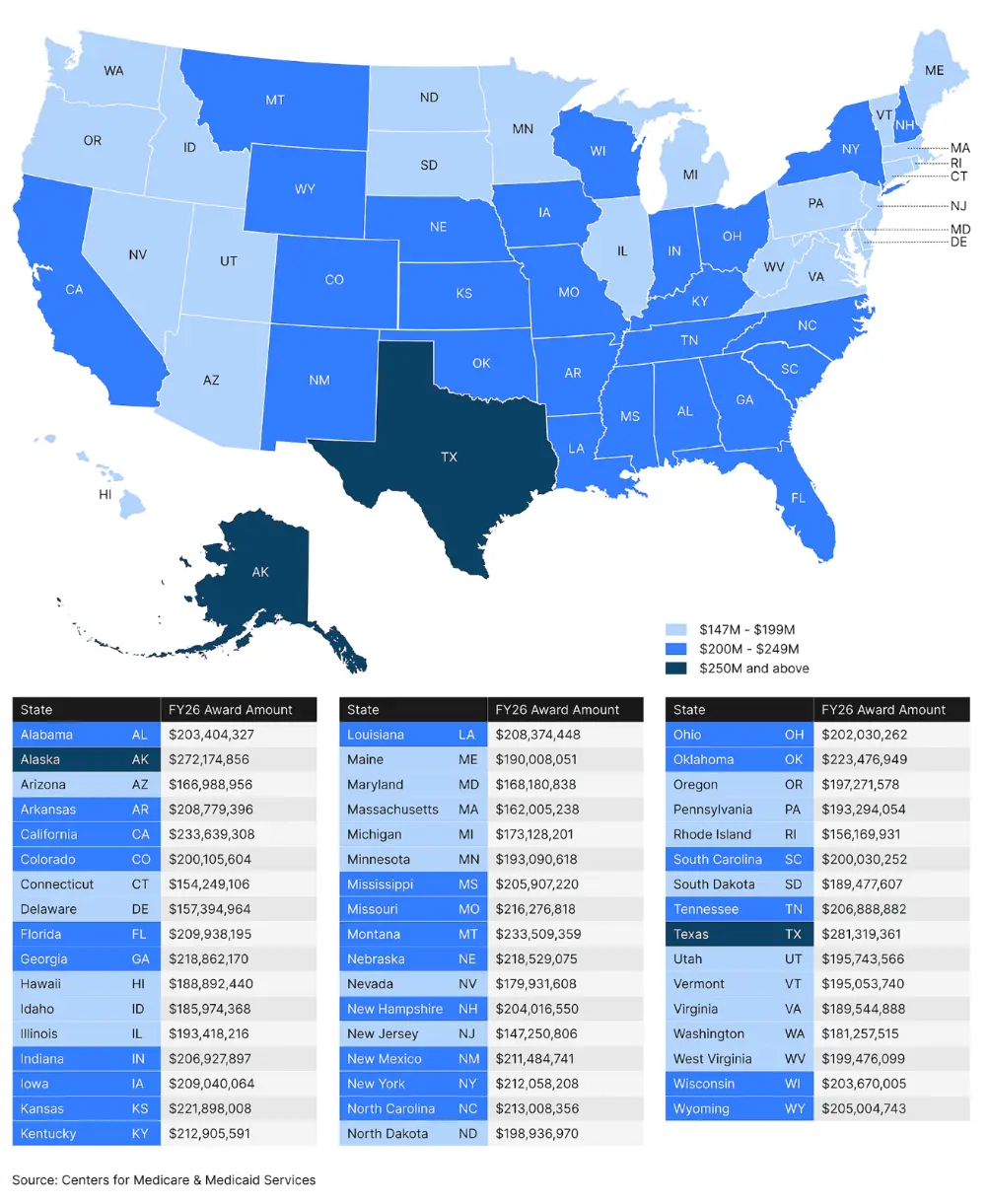
- Funding Available Across All 50 States: Every state received a fiscal year 2026 award, with allocations ranging from approximately $147 million to $281 million. Funding supports improved access to care, healthcare workforce development, technology modernization, and more sustainable care delivery models.
- Technology Modernization Is a Strategic Priority: Rural healthcare organizations can use eligible funding opportunities to strengthen data engineering, electronic health record (EHR) interoperability, artificial intelligence (AI), workflow automation, remote patient monitoring, and performance analytics to support more efficient operations and value-based care.
- Technology Readiness Must Come Before Implementation: Funding alone does not guarantee successful transformation. Healthcare organizations must first assess their existing technology infrastructure, data quality, system interoperability, cybersecurity requirements, administrative inefficiencies, and opportunities for measurable improvement.
- AI and Automation Must Deliver Measurable Value: Successful healthcare modernization requires more than implementing new technologies. Investments should reduce administrative burdens, improve clinical workflows, strengthen operational efficiency, support workforce capacity, and improve patient outcomes.
- A Connected Data Foundation Enables Long-Term Transformation: At Quandary Consulting Group, we believe sustainable healthcare transformation begins by connecting existing systems, improving data quality, and modernizing critical workflows before introducing AI and intelligent automation. This approach helps rural healthcare organizations maximize technology investments while building the operational foundation necessary for scalable, measurable improvements in care delivery.
The Rural Health Transformation Program creates a historic opportunity to modernize healthcare delivery. But turning federal investment into sustainable improvements requires more than purchasing new technology. It requires a connected foundation of reliable data, interoperable systems, intelligent automation, and measurable patient outcomes.
A $50 Billion Opportunity to Modernize Rural Healthcare
Rural healthcare providers face a difficult operating environment.
Geographic barriers complicate access to care. Workforce shortages place additional pressure on clinicians and administrative teams. Disconnected technology systems make it harder to coordinate services, exchange patient information, and measure performance across the continuum of care.
For home health, hospice, and post-acute care organizations, these challenges become especially visible during transitions between hospitals, referral sources, community providers, and patients' homes.
The Rural Health Transformation Program creates an opportunity to address these issues at a systemic level.
The program provides:
- $50 billion in total federal funding.
- 50 states receiving fiscal year 2026 funding awards.
- Five federal fiscal years, spanning 2026 through 2030.
The program supports five broad strategic objectives:
- Preventive health
- Sustainable access
- Workforce development
- Innovative care models
- Technology innovation
These priorities create opportunities for states to support initiatives involving:
- Telehealth
- Remote patient monitoring
- AI
- Secure data exchange
- Technology-enabled care coordination
Importantly, federal awards go to states rather than directly to every rural provider. Hospitals, home health agencies, and other organizations must understand their state's approved initiatives, funding distribution mechanisms, eligibility requirements, and application processes.
For healthcare leaders, the central question is: How to invest in technology that improves healthcare delivery today while creating a sustainable operating model for the future?
Why Value-Based Care Depends on a Modern Data Foundation
Value-based care changes how healthcare organizations define and measure success.
Traditional fee-for-service models primarily reimburse providers based on the volume of services delivered. Value-based payment arrangements introduce financial incentives tied to measures such as quality, patient outcomes, utilization, and cost performance.
For rural healthcare organizations, these arrangements can create opportunities to strengthen financial sustainability while improving care coordination and patient outcomes.
But value-based care introduces an important operational requirement: providers must be able to reliably collect, connect, validate, and analyze the information used to measure performance.
Consider a rural home health agency managing patients across multiple counties. Clinical documentation may exist in an EHR. Referral information may arrive through fax, email, or a hospital portal. Scheduling occurs in another application. Billing and revenue cycle information live in separate financial systems. Patient outcomes are captured through assessments and follow-up encounters.
Each system contains valuable information, but none necessarily provides a complete view of the patient's care journey and without an integrated data foundation, answering basic performance questions becomes unnecessarily difficult.
Healthcare leaders may struggle to determine whether referrals are processed promptly, whether patients receive timely follow-up, which workflows contribute to avoidable delays, or how operational performance influences quality measures.
Data Interoperability Turns Disconnected Information Into Actionable Intelligence
A modern healthcare data foundation connects information across systems without requiring organizations to replace every application.
Through technologies such as Workato, Quickbase, secure APIs, HL7, and FHIR-based integrations, healthcare organizations can establish controlled data exchanges between clinical, financial, administrative, and operational platforms.
This creates opportunities to:
- Reduce duplicate data entry and manual reconciliation.
- Improve visibility into patient referrals and care transitions.
- Connect clinical activity with operational and financial performance.
- Establish consistent reporting across departments and locations.
- Support more accurate quality measurement and value-based payment reporting.
- Create governed, reusable data pipelines for future AI initiatives.
The objective is not simply to move data faster. It is to make healthcare information accurate, accessible to authorized users, and useful for decision-making.
Five Technology Investments That Can Help Rural Providers Maximize Transformation Funding
The strongest modernization strategies prioritize operational problems that are measurable, repeatable, and closely connected to patient access, quality, workforce capacity, or financial sustainability.
1. Healthcare Data Engineering and EHR Interoperability
Healthcare organizations frequently operate across disconnected clinical, administrative, and financial platforms.
When information cannot move reliably between systems, staff become responsible for manually transferring, validating, and reconciling records.
Data engineering and interoperability initiatives help establish a more connected environment.
For example, an integration architecture can connect an EHR with referral management, provider credentialing, scheduling, and revenue cycle platforms. Automated data validation can identify missing fields, inconsistent records, or failed transactions before those issues create downstream delays.
For rural healthcare organizations, this can reduce administrative work while improving the availability of information needed for care coordination and reporting.
2. AI-Powered Referral Intake and Patient Onboarding
Referral management is a particularly valuable opportunity for home health and post-acute care modernization.
Incoming referrals often contain information from multiple sources, including hospital discharge summaries, physician orders, insurance records, and clinical documentation.
When these records arrive through different channels, intake coordinators must manually review information, identify missing documentation, verify requirements, and determine whether the organization can accept the patient.
AI-assisted intake workflows can help classify incoming documents, extract relevant information, flag missing requirements, and route referrals for appropriate review.
When connected to workflow automation platforms, these capabilities can reduce repetitive administrative tasks and help intake teams respond more consistently.
Clinical acceptance decisions, payer requirements, and other consequential determinations should remain subject to appropriate human oversight.
3. Workforce Optimization and Intelligent Scheduling
Workforce constraints affect nearly every rural healthcare organization.
Clinicians may travel significant distances between patients. Scheduling teams must balance geographic coverage, provider availability, credentials, patient needs, and operational capacity.
Disconnected scheduling and workforce management processes make this work more difficult.
Modern workflow platforms can connect staffing availability, credentialing records, geographic coverage, and scheduling requirements.
Automation can then help identify eligible resources, flag scheduling conflicts, and route exceptions to the appropriate team.
For home health organizations, improving these workflows can help reduce scheduling administration, improve operational visibility, and make better use of limited workforce capacity.
4. Revenue Cycle Management and Prior Authorization Automation
Financial sustainability is a central concern for rural providers.
Administrative delays in prior authorization, incomplete documentation, billing reconciliation, and claims processing can place additional pressure on already constrained operating budgets; automation can help organizations standardize these processes.
For example, a connected revenue cycle workflow can validate required documentation, identify missing information, route authorization requests, monitor outstanding tasks, and provide visibility into unresolved billing issues.
AI can assist with document classification and information extraction, while business rules and human review support controlled decision-making.
The objective is to reduce avoidable administrative friction while maintaining the accuracy, compliance, and oversight required for healthcare financial operations.
5. Remote Patient Monitoring and Connected Care Coordination
For rural patients, geographic distance can create barriers to timely care. Remote patient monitoring and virtual care technologies offer ways to extend care beyond traditional clinical facilities; however, collecting remote patient data is only part of the challenge.
Healthcare organizations also need reliable processes for reviewing information, identifying clinically relevant changes, assigning follow-up responsibilities, and documenting interventions.
Integrating remote monitoring platforms with clinical workflows can help ensure information reaches the appropriate care team; this is particularly important for organizations managing chronic disease, post-discharge follow-up, and patients receiving care in their homes.
Technology should strengthen the connection between patients and clinicians, rather than create another disconnected source of information.
From Federal Funding to Sustainable Value-Based Healthcare
One of the most important questions surrounding the Rural Health Transformation Program is what happens after the federal funding period ends.
A five-year investment can help organizations acquire new capabilities. However, technology purchases alone do not guarantee sustainable improvements in access, efficiency, quality, or financial performance. For rural healthcare organizations, long-term value depends on whether those investments fundamentally improve how work gets done.
A referral automation initiative, for example, should not be evaluated solely on whether the software is successfully deployed.
Healthcare leaders also need to have a deep understanding about whether the investment reduces referral processing time, improves documentation completeness, increases staff capacity, or helps patients access services sooner.
Similarly, a new data platform should not be considered successful simply because it consolidates information from multiple systems. The true value of this type investment comes from improving the organization's ability to measure performance, identify operational problems, support reimbursement requirements, and make better decisions.
Establishing Measurable Performance Indicators
Rural healthcare organizations should define performance baselines before implementing new technology.
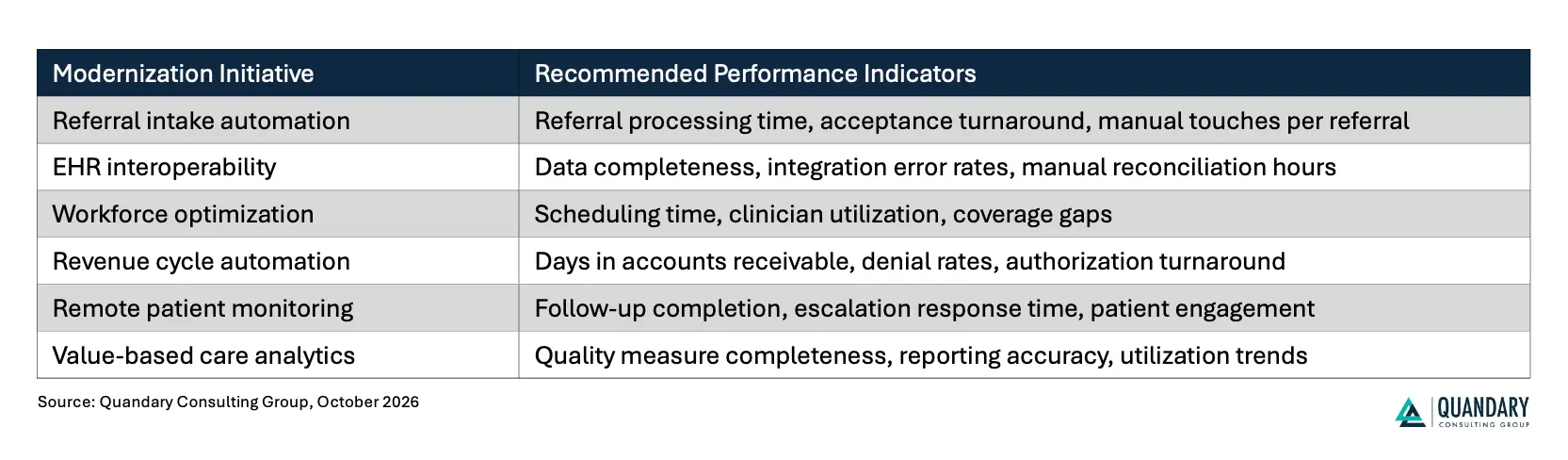
These indicators provide a practical way to connect technology spending with operational improvements and broader value-based care objectives. They also help organizations demonstrate progress to state administrators, funding partners, and other stakeholders.
A Practical Roadmap for Rural Healthcare Technology Transformation
At Quandary Consulting Group, we believe healthcare modernization should begin with an assessment of the organization's existing operating environment, followed by a phased implementation strategy.
This approach helps organizations identify where technology investments can produce meaningful improvements without introducing unnecessary complexity.
Step 1: Assess AI and Data Readiness
Evaluate existing applications, data quality, integration capabilities, cybersecurity controls, AI governance, and workflow maturity.
Step 2: Prioritize High-Impact Use Cases
Identify operational processes where modernization can improve patient access, administrative efficiency, workforce capacity, or quality performance.
Step 3: Build the Data and Integration Foundation
Connect existing systems, establish reliable data pipelines, standardize information, and implement appropriate access controls.
Step 4: Deploy Automation and AI
Introduce intelligent workflows in carefully selected areas, beginning with measurable use cases and appropriate human oversight.
Step 5: Measure, Govern, and Scale
Monitor results, validate performance improvements, strengthen governance, and expand successful capabilities across the organization.
This phased approach also helps providers avoid a common modernization mistake: investing in advanced AI applications before resolving the underlying data and process problems that limit their effectiveness.
Why AI Governance and Healthcare Data Security Must Be Part of the Strategy
As rural healthcare organizations introduce AI and connected technologies, they must also address the security, privacy, and governance requirements associated with sensitive patient information.
Healthcare AI governance needs to define how AI systems are approved, deployed, monitored, and evaluated.
Organizations should establish clear policies for protected health information (PHI), role-based access, vendor risk management, auditability, and human oversight.
For AI applications that process PHI, leaders should determine whether applicable HIPAA requirements, business associate agreements, and data protection obligations are satisfied before deployment.
A practical governance framework should also account for model accuracy, automation failures, data retention, and procedures for escalating consequential decisions to qualified personnel.
AI readiness is not simply a question of whether an organization can deploy AI. It is whether that organization can deploy AI safely, responsibly, and effectively within its existing healthcare environment.
How Quandary Consulting Group Helps Rural Healthcare Organizations Modernize
Quandary Consulting Group helps healthcare organizations translate modernization priorities into actionable technology strategies and successful implementations.
We work with rural hospitals, home health agencies, hospice providers, post-acute care organizations, and healthcare networks to assess existing technology environments, identify operational inefficiencies, and implement solutions that support more connected healthcare delivery.
Our approach combines healthcare workflow knowledge with hands-on expertise in integration, low-code application development, data engineering, AI, and enterprise automation.
Rather than treating AI, interoperability, and process improvement as separate initiatives, we help organizations understand how these capabilities work together.
Our healthcare modernization capabilities include:
- AI Readiness Assessments: Evaluating organizational preparedness for AI adoption, including use cases, governance, security, and implementation requirements.
- Data Foundation Assessments: Identifying data quality, interoperability, integration, and governance gaps that limit operational performance.
- Healthcare Technology Strategy: Developing phased modernization roadmaps aligned with organizational priorities, available resources, and applicable funding requirements.
- Healthcare Systems Integration: Connecting EHRs, referral systems, credentialing applications, financial platforms, and operational tools.
- Workflow Automation: Modernizing referral intake, provider onboarding, prior authorization, scheduling, and administrative processes.
- AI Governance and Implementation: Establishing appropriate controls and deploying AI-assisted workflows with security, auditability, and human oversight.
- Custom Healthcare Applications: Developing purpose-built operational solutions using platforms such as Quickbase.
- Data Engineering and Performance Analytics: Improving data reliability, reporting, and visibility into operational and financial performance.
Our role is to help healthcare organizations determine what technology to invest in, establish the right infrastructure, and implement solutions that deliver measurable operational results.
Connecting Healthcare Systems: A Practical Example
Consider a healthcare organization that must coordinate patient encounters, provider eligibility, credentialing information, and assignment decisions across several technology platforms.
Without integration, administrative teams may need to manually review multiple systems before assigning an eligible provider; however, a connected architecture can improve that process.
In Quandary's work with Array Behavioral Health, Workato supports integrations involving Epic, MDStaff, and other systems used in provider assignment workflows. The architecture enables automated eligibility checks, provider ranking, assignment processing, and the creation of an auditable decision trail.
This illustrates how integration and automation can support more consistent operational processes without requiring healthcare organizations to abandon their existing technology investments.
For rural healthcare organizations, similar principles can be applied to referral coordination, provider credentialing, workforce management, and other workflows where disconnected information creates delays.
Quandary Case Study: Array Behavioral Health Automates On-Demand Patient Encounter Assignment With Workato
Understanding Rural Health Transformation Funding Eligibility
Although the Rural Health Transformation Program supports technology modernization, individual healthcare organizations should not assume every proposed technology investment qualifies for reimbursement or grant funding.
States control implementation through their approved transformation plans, and specific opportunities may differ significantly by location, provider type, and initiative.
Organizations considering funding-supported modernization should evaluate:
- Whether the proposed initiative aligns with their state's approved RHT priorities
- Whether the organization meets applicable eligibility requirements
- Whether technology, implementation, training, and ongoing support expenses are allowable
- What procurement, application, and reporting requirements apply
- How the investment will demonstrate measurable improvements in healthcare delivery
CMS also establishes restrictions on allowable expenditures, including requirements intended to prevent duplication of existing funding and limitations on certain provider payments.
A practical next step is to review the state's approved implementation plan and current funding opportunities before finalizing the technology scope or budget.
While Quandary does not administer grants or manage funding applications, we help healthcare organizations develop technology strategies, assess implementation readiness, and execute modernization initiatives that align with their operational priorities.
The Future of Rural Healthcare Depends on What Organizations Build Today
The Rural Health Transformation Program represents an important opportunity to strengthen healthcare delivery in communities that have historically faced significant barriers to access, workforce capacity, and technology investment; but, the lasting impact of this investment will depend on what organizations build with it.
A new application cannot solve a fragmented workflow on its own, an AI model cannot compensate for unreliable data and a modern reporting platform cannot improve healthcare performance if the information it depends on remains disconnected or incomplete.
Sustainable transformation requires healthcare organizations to address these challenges together, which really boils down to creating reliable connections between systems, eliminating unnecessary administrative work, strengthening data governance, and introducing automation that supports the people responsible for delivering care.
This also means building technology environments capable of supporting new care delivery models, evolving reimbursement requirements, and increasingly sophisticated AI capabilities.
At Quandary Consulting Group, we help healthcare organizations move from disconnected systems and manual processes toward more connected, intelligent, and scalable operations.
By combining healthcare data engineering, enterprise integration, AI governance, and workflow automation, we help organizations establish the technical and operational foundations needed to make modernization investments meaningful.
Our work begins with understanding an organization's existing technology environment, identifying opportunities for improvement, and developing an actionable implementation roadmap. From there, we help connect systems, automate workflows, and introduce AI capabilities that support measurable operational improvements.
The opportunity is not simply to spend federal funding on new technology. It is to build a healthcare operating environment that continues delivering value long after the funding period ends.
Start With an AI and Data Foundation Assessment
Before investing in new healthcare technology, organizations need to understand whether their existing systems, data, processes, and governance structures can support it.
Quandary's AI Readiness Assessment and Data Foundation Assessment help healthcare leaders identify modernization priorities, evaluate technical readiness, and establish a practical roadmap for implementation.
Interested in taking this assessment for yourself? Please reach out directly to Blair Binder, at bbinder@quandarycg.com and she will email you a copy of the assessment, along with additional information to you get started on your journey!
Build the foundation for more connected, intelligent, and sustainable rural healthcare delivery with Quandary Consulting Group.
Sources and Further Reading
- CMS Announces $50 Billion in Awards to Strengthen Rural Health Across All 50 States
- Center for Medicare & Medicaid Services (CMS)'s Rural Health Transformation Program
- Centers for Medicare & Medicaid Services (CMS) Rural Health Transformation Program: Frequently Asked Questions
- How Value-Based Payment Can Help States Maximize Rural Health Funding (Guidehouse)
Frequently Asked Questions About Rural Health Transformation Funding
What is the Rural Health Transformation Program?
The Rural Health Transformation Program is a $50 billion federal initiative administered by CMS to strengthen rural healthcare delivery across the United States. Funding is allocated to states over fiscal years 2026 through 2030 to support initiatives involving healthcare access, workforce development, technology modernization, innovative care models, and long-term sustainability.
Can rural hospitals use transformation funding for artificial intelligence?
AI-related initiatives may qualify when they align with a state's approved Rural Health Transformation Plan and applicable funding requirements. CMS identifies advanced technologies, including artificial intelligence and remote monitoring, among the technology-enabled capabilities contemplated by the program. Eligibility depends on the specific project, funding category, and state requirements.
Can home health and hospice organizations benefit from Rural Health Transformation funding?
Potentially. Home health, hospice, and post-acute care organizations may participate in qualifying state initiatives when they meet applicable eligibility requirements. Opportunities may involve care coordination, remote services, technology adoption, workforce development, or other approved activities. Participation is not automatic and varies by state.
How does data modernization support value-based healthcare?
Data modernization helps healthcare organizations integrate clinical, operational, and financial information to support more reliable performance measurement. Connected systems can improve quality reporting, care coordination, utilization analysis, and the accuracy of information used in value-based payment arrangements.
What healthcare workflows should organizations automate first?
High-priority candidates often include referral intake, provider onboarding, credentialing verification, prior authorization, scheduling, documentation routing, and revenue cycle processes. Organizations should prioritize workflows based on administrative burden, patient impact, implementation feasibility, compliance requirements, and measurable financial or operational value.
What is the difference between AI readiness and data readiness in healthcare?
Data readiness evaluates whether an organization's information is accurate, accessible, integrated, governed, and suitable for operational or analytical use. AI readiness builds on that foundation by assessing whether the organization has the technology, processes, security controls, workforce capabilities, and governance necessary to deploy AI responsibly.
How can rural healthcare organizations measure technology ROI?
Organizations can measure return on investment by comparing implementation and operating costs with improvements in processing time, administrative workload, staff productivity, data accuracy, reimbursement performance, and other relevant outcomes. Patient access and quality measures should also be considered, even when those benefits are not easily converted into financial returns.
How can healthcare organizations prepare for Rural Health Transformation funding opportunities?
Healthcare organizations should review their state's approved funding initiatives, assess existing technology and data capabilities, identify measurable modernization opportunities, and develop implementation plans with defined costs, timelines, governance requirements, and performance indicators.