
Knowledge Base
Articles In This Section
What is Generative AI What are Large Language Models (LLMs) What Is Artificial Intelligence (AI)?What is Model Context Protocol (MCP) The Ultimate AI Glossary: 300+ Terms Every Leader Should KnowWhat Are the Main Types of AI? A Practical Guide for EnterprisesAgentic AI OverviewWhat is What is an AI Model and What are the Different Types?Sections
What is Specialized AI and Specialized AI Models?
At Quandary Consulting Group (QCG), we view specialized AI models as essential tools for driving automation, integration, and enterprise-scale intelligence. As organizations increasingly adopt AI to optimize operations, understanding the distinctions between model types is critical for aligning technology with business strategy.
Each AI model—ranging from language-based to multimodal systems—offers unique capabilities, limitations, and use cases that impact decision-making, workflow automation, and customer engagement.
This guide provides an in-depth overview of what specialized AI and the different specialized AI model types, their functionalities, and brief list of practical applications that organizations can apply to harness AI strategically.
What is a Specialized AI Model?
A Specialized AI Model (also called a narrow AI model) is an artificial intelligence system designed to perform a specific task or a narrow set of tasks extremely well, rather than having general intelligence across multiple domains like a human.
These models are optimized for particular applications and are trained on data relevant to that task; here is a detailed breakdown:
Focus: Unlike general AI, which aims to reason and solve a wide variety of problems, specialized AI focuses on one domain—for example, language translation, fraud detection, or image recognition.
Training: It is trained on task-specific datasets, which allows it to achieve high accuracy and efficiency in that domain.
Capabilities: While it can outperform humans in its specific task, it cannot generalize beyond it. For example, a model trained to detect cancer in medical images cannot play chess or compose music.
Use Cases
- Chatbots trained for customer service in banking.
- Image recognition systems that identify defects in manufacturing.
- Recommendation engines on e-commerce sites.
- Organizations use specialized AI to automate repetitive tasks, improve decision-making, and integrate AI into workflows without needing full general intelligence.
From our point-of-view here at Quandary Consulting Group, breaking AI into specialties means faster progress - one size does not fit all, especially with something as complex as intelligence.
Specialized AI models are critical for driving automation, integrating into existing IT systems, and applying GenAI where it adds the most immediate business value.
Key Differences Between Specialized AI Models from General-Purpose AI models?
General-purpose Generative AI models (such as ChatGPT or Gemini) are trained on vast datasets that span multiple domains. Their objective is broad: to perform reasonably well across a wide range of tasks and topics. While this flexibility is impressive, it also introduces key limitations.
These models may hallucinate facts, misinterpret specialized terminology, and struggle to comply with the rules and expectations of regulated industries.
Specialized AI models are built with a more focused purpose. They lead to AI systems designed to perform specific tasks within a well-defined scope where precision, context, and compliance are essential. This specialization can take several forms:
- Fine-tuning large models on domain-specific datasets
- Training smaller models from the ground up on curated data
- Integrating structured retrieval systems and APIs for real-time, fact-based responses
By narrowing the scope and tuning performance to specific needs, specialized models offer increased accuracy, transparency, and practical value, particularly in scenarios where general-purpose models fall short. This growing demand for precision and domain-awareness has led to the rise of specialized AI models across various fields.
List of Specialized AI Models
- LLM – Large Language Model
- LCM – Large Concept Model
- LAM – Large Action Model
- MoE – Mixture of Experts
- VLM – Vision-Language Model
- SLM – Small Language Model
- MLM – Medium Language Model
- SAM – Segment Anything Model
Below, we explore these 8 specialized AI Models [listed above], accompanied by practical project ideas that highlight how these models can be applied in real-world scenarios.
Specialized AI Models
LLM – Large Language Models
Large Language Models (LLMs) are AI systems trained on massive text corpora to understand, generate, and reason over natural language. They excel at interpreting context, summarizing information, and generating human-like text across diverse domains.
LLMs can integrate with enterprise systems to automate documentation, customer interactions, and content generation. Their strength lies in understanding subtle nuances, idioms, and domain-specific language, making them highly adaptable for multiple industries.
QCG leverages LLMs to help clients streamline communication workflows and scale AI-driven decision support.
Use Cases:
- Automated customer support chatbots for 24/7 query resolution.
- Enterprise report and document generation from raw data inputs.
- Intelligent email triaging and summarization for knowledge workers.
LCM – Large Conversational Models
LCMs are a specialized subset of LLMs designed for dialogue-heavy tasks and multi-turn conversations. They focus on maintaining context, understanding intent, and producing coherent responses over extended interactions. LCMs enable enterprises to deliver personalized experiences at scale while reducing human workload in service and support.
QCG applies LCMs to integrate conversational AI with CRM and ERP systems for intelligent client engagement. They are optimized for dynamic interaction, making them ideal for coaching, advisory, and internal knowledge management applications.
Use Cases:
- AI-driven virtual advisors for internal employee support.
- Customer service agents handling complex troubleshooting and follow-ups.
- Interactive training assistants for onboarding and continuous learning.
LAM – Large Action Models
Large Action Models (LAMs) focus on decision-making and task execution rather than purely language understanding. They translate intent into actions across digital workflows, integrating with applications, APIs, and robotic process automation (RPA). LAMs can automate repetitive or rule-based processes while learning to optimize execution over time.
QCG leverages LAMs for enterprise workflow automation, connecting AI with actionable business outcomes. They provide measurable operational efficiency improvements while ensuring compliance with organizational policies.
Use Cases:
- Automating order processing and supply chain coordination.
- Intelligent workflow orchestration across SaaS and on-prem systems.
- Real-time decision support for resource allocation in operations.
MoE – Mixture of Experts Models
MoE models dynamically route tasks to specialized sub-models (experts) within a larger network for optimized performance. They combine high computational efficiency with the ability to handle multiple domains or tasks simultaneously. MoEs are ideal for large-scale enterprises with diverse datasets requiring flexible, task-specific intelligence.
QCG employs MoEs to balance performance and resource utilization while scaling AI solutions enterprise-wide. These models can improve prediction accuracy and reduce latency in real-time AI-driven decision systems.
Use Cases:
- Financial risk analysis across multiple asset classes.
- Personalized recommendation engines for e-commerce platforms.
- Multi-domain predictive maintenance in industrial IoT networks.
VLM – Vision-Language Models
VLMs combine image and text understanding, enabling AI to interpret and describe visual content in natural language. They are foundational for multimodal AI solutions that bridge visual data and textual analysis. VLMs empower enterprises to automate inspection, visual search, and content moderation workflows.
QCG applies VLMs to integrate computer vision with document intelligence and asset tracking solutions. These models are essential for enhancing situational awareness, decision-making, and compliance monitoring in visual-heavy industries.
Use Cases:
- Automated document digitization with visual-text extraction.
- AI-assisted medical imaging analysis for diagnostics.
- Visual inventory management and quality inspection in manufacturing.
SLM – Small Language Models
Small Language Models (SLMs) are compact, resource-efficient language models designed for lightweight tasks. They enable rapid deployment on edge devices, IoT systems, or internal tools with constrained resources. SLMs are ideal for focused domain applications where latency and privacy are priorities.
QCG leverages SLMs for embedded enterprise solutions and micro service-driven AI applications. Despite their smaller size, SLMs maintain strong performance in task-specific language comprehension and generation.
Use Cases:
- On-device voice assistants for mobile or IoT platforms.
- Localized text summarization and alert generation.
- Real-time conversational AI in internal dashboards with low latency.
MLM – Multimodal Language Models
MLMs integrate multiple types of data—text, images, audio, or video—into a unified understanding framework. They can reason across modalities, providing richer insights than single-modality models. MLMs support enterprise applications where diverse data types converge, like marketing analytics or product intelligence.
QCG leverages MLMs to unlock actionable insights from complex datasets spanning text, visuals, and audio sources. These models drive innovation in predictive analytics, knowledge extraction, and cross-domain decision support.
Use Cases:
- Marketing campaign optimization combining social media text, images, and video engagement.
- Automated video captioning and content tagging.
- AI-driven customer sentiment analysis integrating call transcripts and social media visuals.
SAM – Segment Anything Models
SAMs focus on object detection, segmentation, and identification within images or video streams. They enable highly granular analysis of visual content, often serving as pre-processing for downstream AI tasks. SAMs are widely applicable in industries requiring precise image understanding, such as healthcare, manufacturing, and security.
QCG integrates SAMs into workflows for asset tracking, anomaly detection, and digital twin creation. These models accelerate visual data processing, reduce human labor, and enhance decision-making accuracy.
Use Cases:
- Automated defect detection in manufacturing production lines.
- Satellite imagery analysis for environmental monitoring or urban planning.
- Medical imaging segmentation for tumor or organ identification
At Quandary Consulting Group (QCG), we recognize that the rapid proliferation of specialized AI models has fundamentally transformed how enterprises approach automation, integration, and intelligence at scale.
From natural language understanding to multimodal reasoning, each model type offers unique capabilities that can be strategically applied to solve complex business challenges.
Understanding these distinctions is critical for CTOs, CIOs, and enterprise leaders who aim to leverage AI effectively while minimizing risk and maximizing ROI.
CHART: Specialized AI Models
This chart provides a concise overview of eight key AI model types, highlighting their core strengths and practical applications.
By organizing these models in a clear, structured format, QCG enables decision-makers to quickly identify which AI capabilities align with specific organizational objectives, whether that’s improving operational efficiency, enhancing customer engagement, or driving data-driven insights.
The chart also includes three representative use cases for each model, demonstrating real-world applications across industries such as manufacturing, healthcare, finance, and enterprise IT.
These examples illustrate how enterprises can translate AI potential into actionable business outcomes, providing a roadmap for targeted AI adoption.
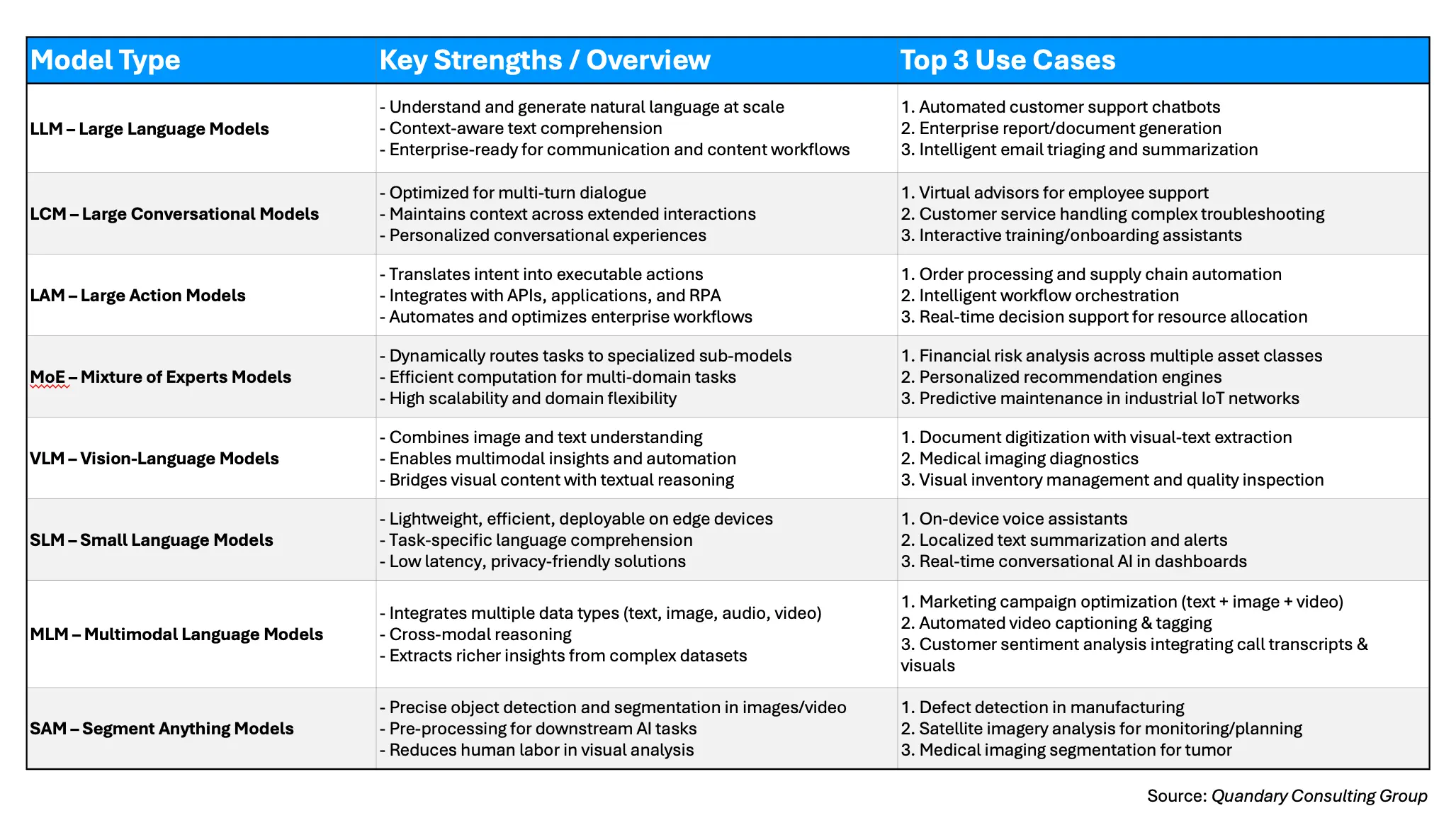
By leveraging these resource, enterprise leaders can make informed decisions about AI investments, ensuring that the selected model types not only meet technical requirements but also align with broader strategic goals.
At QCG, our goal is to empower organizations to harness AI thoughtfully, driving innovation and measurable business value across every level of the enterprise.
- By: Kevin Shuler
- Title: CEO
- Email: kevin@quandarycg.com
- Date: 02/09/2026
Frequently Asked Questions About Specialized AI Models
1. What is a specialized AI model?
A specialized AI model is designed and trained to perform a specific task or operate within a defined domain, such as fraud detection, image recognition, customer service, or workflow automation.
2. How does specialized AI differ from general-purpose AI?
General-purpose AI handles a broad range of tasks, while specialized AI focuses on a narrower scope. This focus can provide greater accuracy, efficiency, control, and industry-specific relevance.
3. What are the main types of specialized AI models?
Common types include Large Language Models (LLMs), Large Action Models (LAMs), Mixture of Experts models (MoEs), Vision-Language Models (VLMs), Small Language Models (SLMs), multimodal models, and image-segmentation models.
4. What are specialized AI models used for?
Businesses use specialized AI for customer support, document processing, predictive maintenance, fraud detection, visual inspection, content generation, workflow automation, and decision support.
5. What are the benefits of specialized AI for businesses?
Specialized AI can increase accuracy, reduce operating costs, automate repetitive work, improve response times, and integrate intelligence into existing business processes.
6. Are specialized AI models more accurate than general AI models?
They can be more accurate within their intended domain because they use focused training data, rules, tools, and workflows. However, performance depends on the quality of the data and implementation.
7. Can specialized AI integrate with existing enterprise systems?
Yes. Specialized models can connect with CRM, ERP, data platforms, APIs, and automation tools to analyze information and execute tasks within existing workflows.
8. Are specialized AI models suitable for regulated industries?
They can be well suited to regulated environments because organizations can design them around specific compliance, privacy, security, and auditability requirements. Human oversight is still essential.
9. How do organizations choose the right specialized AI model?
The right model depends on the business objective, required data types, accuracy expectations, integration needs, privacy requirements, infrastructure, and available budget.
10. What is the first step in implementing specialized AI?
Start with a clearly defined, high-value use case. Then assess the relevant data, risks, technical requirements, success metrics, and integration points before selecting a model.


Services
Industries

© 2026 Quandary Consulting Group 2026. All Rights Reserved.
Privacy Policy