
Knowledge Base
Articles In This Section
What are Large Language Models (LLMs) What Is Artificial Intelligence (AI)?What is Model Context Protocol (MCP) The Ultimate AI Glossary: 300+ Terms Every Leader Should KnowWhat is Specialized AI and Specialized AI Models?What Are the Main Types of AI? A Practical Guide for EnterprisesAgentic AI OverviewWhat is What is an AI Model and What are the Different Types?Sections
What is Generative AI
Generative AI is a type of artificial intelligence designed to create new content, rather than just analyze or process existing data. Unlike traditional AI, which might classify data, predict trends, or detect anomalies, generative AI can produce text, images, audio, video, code, and even 3D models that resemble human-created work. It “learns” patterns from large datasets and uses them to generate outputs that are original, coherent, and contextually relevant.
Generative AI models, like large language models (LLMs) or generative adversarial networks (GANs), are trained on massive datasets.
They learn statistical patterns, relationships, and structures within the data so they can produce new content that aligns with what they’ve learned.
- Text generation: Chatbots, automated reports, marketing copy, or creative writing.
- Image and video creation: AI-generated art, realistic deepfakes, or product design mockups.
- Code generation: Tools like GitHub Copilot help developers write software faster.
- Data augmentation: Creating synthetic data for training other AI systems.
From an Enterprise Perspective - Generative AI is a powerful tool for automation, creativity, and efficiency, particularly when integrated into workflows, marketing, software development, and knowledge management systems.
How Does Generative AI Work?
Generative AI is a type of artificial intelligence that creates new content — text, images, audio, video, code, and more — by learning patterns from large amounts of existing data.
Here’s a clear, step-by-step explanation of how it works.
1. Training: Learning Patterns from Data
Generative AI systems are trained on massive datasets (books, websites, images, audio, etc.).
During training, the model:
- Looks at millions or billions of examples
- Learns patterns, structures, and relationships
- Adjusts internal parameters (often billions of them)
- Improves its predictions over time
This does not mean that Generative AI memorize everything; it learns statistical relationships like:
- Which words tend to follow other words
- What shapes and textures form a cat
- What melodies sound harmonious
- What code structures are common in Python
At its core, it learns: "Given this input, what is most likely to come next?”
2. Neural Networks: The Engine
Most modern generative AI uses deep neural networks.
These are layered mathematical systems that:
- Take input (text, image pixels, etc.)
- Transform it through many layers
- Output a prediction
For text systems like ChatGPT, the key architecture is called a: Transformer
- Transformers are especially good at understanding context — meaning they don’t just look at the last word, but at the entire sentence or conversation.
- Example: “The bank was near the river.”
The model understands "bank" means riverbank, not financial bank — because it processes context.
3. The Core Task: Prediction
For text models, training is usually based on:
Next-word prediction
- Example Input: "The sky is...."
The model calculates probabilities:
- blue (72%)
- cloudy (12%)
- falling (0.0001%)
- green (0.3%)
The AI model picks one based on probability rules. By predicting billions of next words during training, it becomes good at generating coherent text.
4. Generation: Creating New Content
When you prompt a model: "Write a poem about space."
The system:
- Converts your words into numerical representations
- Predicts the next word
- Adds it to the sentence
- Repeats this process rapidly
- Produces full text one token at a time
It’s essentially doing very advanced predictive completion.
What Are the Different Types of Generative AI?
The main types of generative AI include text, image, audio, video, and code generation models, each designed to create specific kinds of content.
Text Generation Models (LLMs)
Text-based generative AI creates written content such as articles, emails, and summaries.
Examples:
Use cases:
- Content writing
- Chatbots
- Research summaries
Image Generation Models
These models generate images from text prompts or existing visuals.
Examples:
Use cases:
- Graphic design
- Marketing visuals
- Concept art
Audio and Music Generation Models
These create speech, sound effects, or music.
Examples:
Use cases:
- Voiceovers
- Podcasts
- Music production
Video Generation Models
Video AI generates or edits video content from prompts or images.
Examples:
Use cases:
- Video marketing
- Animation
- Training content
Code Generation Models
These tools generate, debug, or optimize code.
Examples:
Use cases:
- Software development
- Debugging
- Automation scripts
Multimodal Generative AI
Multimodal models can handle multiple types of content (text, images, audio) at once.
Examples:
Use cases:
- Complex workflows
- Cross-media content creation
- AI assistants
Specialized Generative Models (Advanced)
These include more technical architectures:
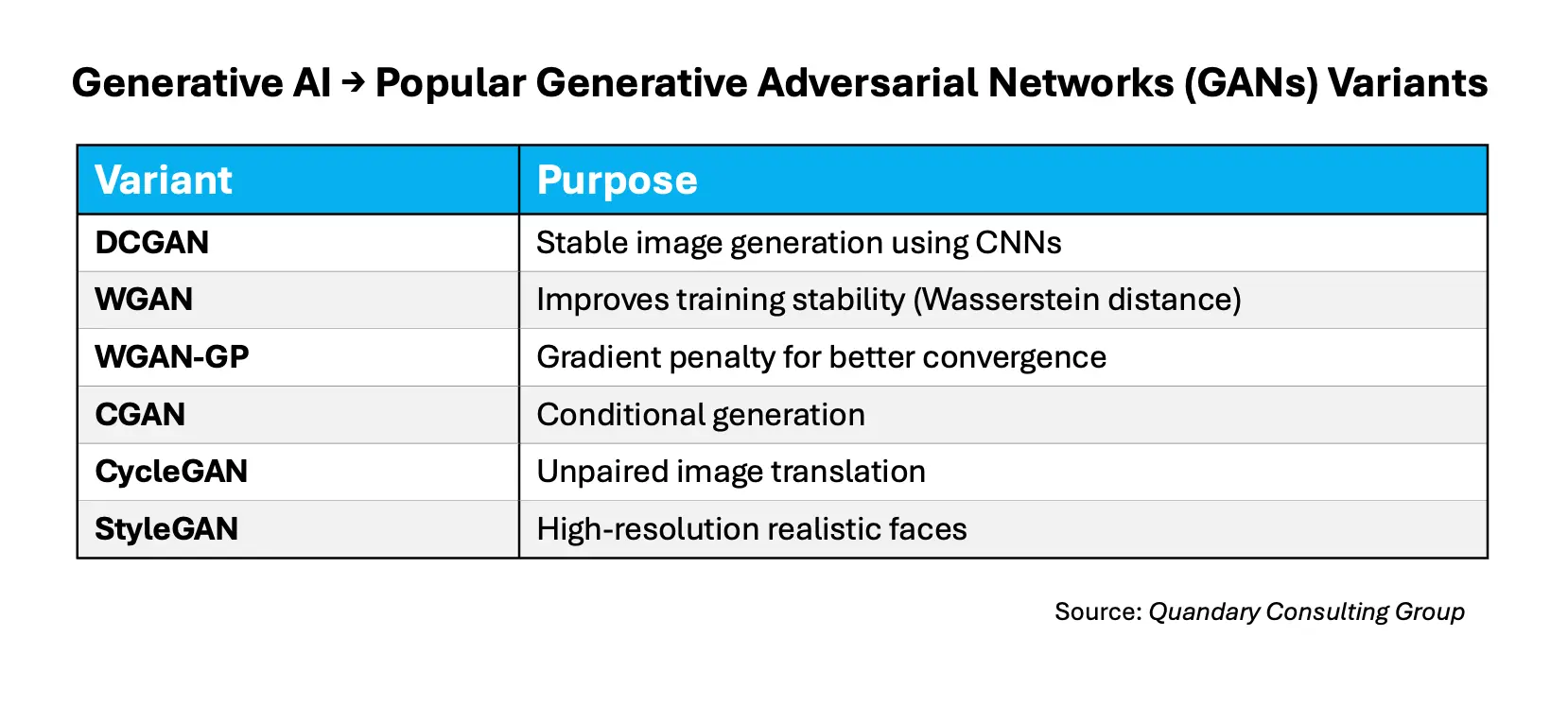
- GANs (Generative Adversarial Networks): Often used for realistic images
- VAEs (Variational Autoencoders): Used for data generation and compression
- Diffusion Models: Power many modern image generators
What are the Benefits & Risks of Generative AI
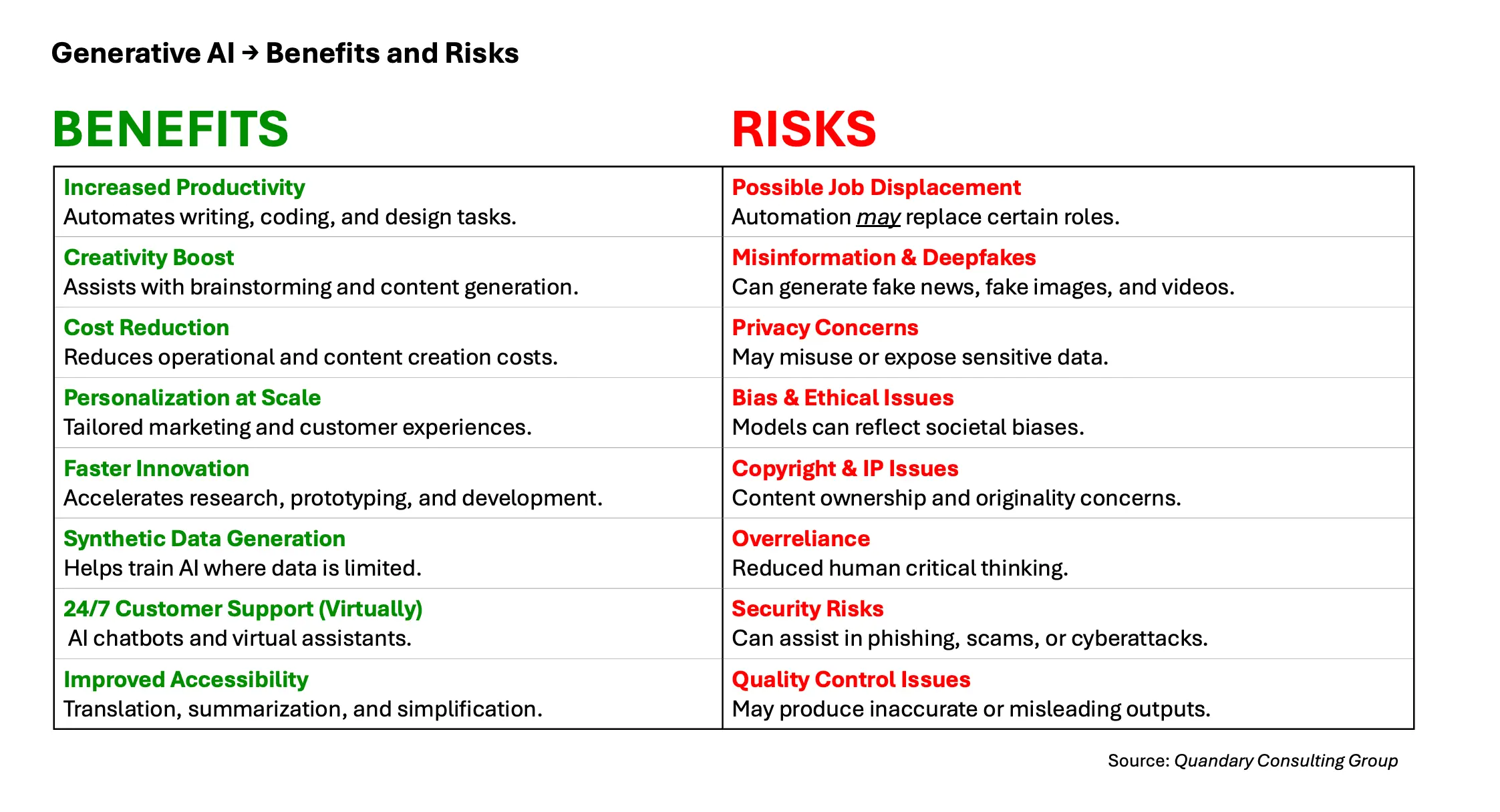
Generative AI is rapidly transforming how organizations create content, automate processes, and innovate at scale.
By enabling systems to generate text, images, code, and other digital assets, it offers significant benefits such as increased productivity, cost efficiency, enhanced creativity, and personalized user experiences.
However, alongside these advantages come important risks, including data privacy concerns, misinformation, bias, intellectual property challenges, and potential job displacement.
Understanding both the opportunities and the limitations of generative AI is essential for responsible adoption, effective governance, and long-term value creation.
Top 10 Generative AI Real World Use Cases
Generative AI ('Gen AI') and its ability to 'create' new data has proven to be useful across all industries. There are hundreds of use cases that Generative AI can be applied to.
Here are our top 10 Generative AI real world use cases that we have seen provide immediate ROI to some of our clients:
Content Creation & Copywriting
- Description: Automatically generate articles, marketing copy, social media posts, product descriptions, and blogs.
- Enterprise benefit: Saves time, ensures consistency, and scales content marketing.
- Example: AI writes personalized email campaigns for different customer segments.
Code Generation & Software Development
- Description: Generate code snippets, auto-complete functions, or even full software modules.
- Enterprise benefit: Accelerates development cycles and reduces human error.
- Example: GitHub Copilot suggests code while developers write.
Chatbots & Conversational AI
- Description: Power customer support, internal help desks, or virtual assistants with human-like responses.
- Enterprise benefit: Reduces support costs, increases response speed, and improves user experience.
- Example: A bank uses AI to answer routine customer inquiries 24/7.
Image & Video Generation
- Description: Create realistic images, graphics, animations, or video content from text prompts.
- Enterprise benefit: Cuts design costs, accelerates creative projects, and allows rapid prototyping.
- Example: Fashion companies generate virtual product visuals for e-commerce without photography.
Data Augmentation & Synthetic Data
- Description: Produce synthetic datasets to train other AI models where real data is scarce or sensitive.
- Enterprise benefit: Improves AI model performance, ensures privacy, and reduces data collection costs.
- Example: Self-driving car companies generate synthetic road scenarios for training.
Personalized Recommendations
- Description: Generate tailored suggestions for products, services, or content based on user behavior.
- Enterprise benefit: Increases engagement, conversion rates, and customer loyalty.
- Example: Streaming platforms suggest new movies with AI-generated summaries or visuals.
Knowledge Management & Document Summarization
- Description: Summarize, rewrite, or extract insights from large volumes of text or documents.
- Enterprise benefit: Improves decision-making, speeds research, and enhances productivity.
- Example: AI digests legal contracts and highlights key clauses automatically.
Design & Product Prototyping
- Description: Generate design concepts for architecture, industrial products, or digital interfaces.
- Enterprise benefit: Speeds ideation cycles and reduces cost of physical prototypes.
- Example: Automotive designers generate new car models with AI-assisted CAD tools.
Marketing & Advertising Optimization
- Description: Generate ad copy, visuals, and campaigns tailored to audience segments.
- Enterprise benefit: Enhances engagement, boosts ROI, and allows rapid A/B testing.
- Example: AI creates multiple ad variations and tests them for effectiveness automatically.
Scientific Research & Drug Discovery
- Description: Generate chemical compounds, simulate experiments, or suggest hypotheses.
- Enterprise benefit: Accelerates R&D cycles and reduces trial-and-error costs.
- Example: Pharma companies use AI to propose molecules for new drugs or vaccines.
Key Benefits of Generative AI
Increases Productivity and Efficiency
Generative AI automates tasks like writing, coding, design, and data analysis. This allows individuals and businesses to complete work faster and at lower cost.
Expands Creativity and Accessibility
It enables people without technical or creative expertise to produce high-quality content, such as images, text, and software prototypes.
Drives Business Innovation
Companies use generative AI to:
- Personalize customer experiences
- Automate customer support
- Speed up product development
- Generate insights from large datasets
Accelerates Problem-Solving
Generative AI can quickly explore multiple solutions, helping industries like healthcare, engineering, and marketing discover new ideas faster.
Why Generative AI Matters Today
Generative AI is transforming how work gets done by acting as a “force multiplier” for human capabilities. It allows one person to do the work of many, making businesses more competitive and individuals more effective.
In Conclusion
Generative AI represents a transformative force for modern enterprises. It is not just a tool for automation or creativity—it is a strategic lever that can accelerate innovation, streamline operations, and unlock entirely new business models.
From content generation and product design to data augmentation and knowledge management, these technologies enable organizations to work faster, smarter, and with greater precision. However, realizing the full potential of generative AI requires intentional strategy, robust governance, and thoughtful integration into enterprise workflows.
Leaders must consider ethical implications, data privacy, and alignment with long-term business objectives, ensuring that AI-generated outputs enhance decision-making rather than introduce risk.
In addition, by embedding AI capabilities into processes, systems, customer experiences, etc., companies can achieve measurable efficiency gains, improved innovation pipelines, and a competitive edge in increasingly dynamic markets.
The opportunity is very clear: Adopt generative AI not as a novelty, but as a strategic asset, one that scales human ingenuity, informs critical decisions, and accelerates enterprise transformation. Quandary Consulting Group is dedicating to helping leaders navigate this journey, ensuring AI initiatives deliver tangible business outcomes while maintaining operational resilience and governance rigor.
FAQs About Generative AI
1. What is Generative AI in simple terms?
Generative AI is a type of artificial intelligence that creates new content—such as text, images, code, or audio—based on patterns learned from existing data.
- It works by predicting and generating outputs that resemble human-created content.
2. How is Generative AI used in real life?
Generative AI is used across many industries, including:
- Marketing (content creation, ad copy, personalization)
- Software development (code generation and debugging)
- Healthcare (drug discovery and medical research)
- Customer service (chatbots and virtual assistants)
3. What are the benefits of Generative AI?
The main benefits of generative AI include:
- Increased productivity and automation
- Faster content and product creation
- Enhanced creativity and idea generation
- Cost savings for businesses
4. What are the risks or limitations of Generative AI?
Generative AI can have several limitations, such as:
- Producing inaccurate or misleading information
- Bias in generated outputs
- Copyright and ethical concerns
- Dependence on high-quality training data
5. Will Generative AI replace human jobs?
Generative AI is more likely to augment jobs rather than fully replace them.
- It automates repetitive tasks, allowing humans to focus on strategic, creative, and decision-making work. However, some roles may evolve or change significantly.
- By: Kevin Shuler
- Email: kevin@quandarycg.com
- Date: 01/08/2026


Services
Industries




© 2026 Quandary Consulting Group 2026. All Rights Reserved.
Privacy Policy