Quickbase
Quickbase FastField AI Form Builder: Closing the Data Gap Between the Field and Enterprise AI

TL;DR
- Quickbase FastField AI Form Builder uses generative AI to accelerate field data collection, allowing teams to create mobile forms from natural-language prompts, voice input, paper forms, PDFs, and existing processes.
- AI is changing low-code development by moving business users closer to application creation. Instead of manually translating every operational requirement into fields, rules, calculations, and conditional logic, subject-matter experts can describe what they need and refine the AI-generated result.
- Better field data capture can create a stronger foundation for automation, analytics, and enterprise AI. When operational information is captured consistently and digitally at the source, organizations have better structured context to connect with downstream systems and workflows.
- FastField is designed for the realities of frontline and field operations, including mobile devices, photographs, signatures, GPS information, timestamps, workflow routing, and offline data collection when internet connectivity is unavailable.
- The larger opportunity is intelligent field operations. Field data can move beyond simply documenting what happened and become structured operational information that helps trigger workflows, surface insights, coordinate teams, and support faster decisions.
The next frontier of enterprise AI may not begin with an agent, a copilot, or a large language model - It may just begin with a simple inspection.
A technician documenting a repair, a superintendent recording job site conditions, a quality manager identifying a defect, a maintenance team inspecting an asset, or a field employee photographing a safety issue. These moments generate some of the most consequential data inside an organization; yet too often, that information remains trapped in paper forms, spreadsheets, photographs, PDFs, disconnected applications, and manual processes.
The result is a persistent gap between where work happens and where business decisions are made. Quickbase's September 2026 launch of FastField AI Form Builder is noteworthy because it addresses that gap at its source.
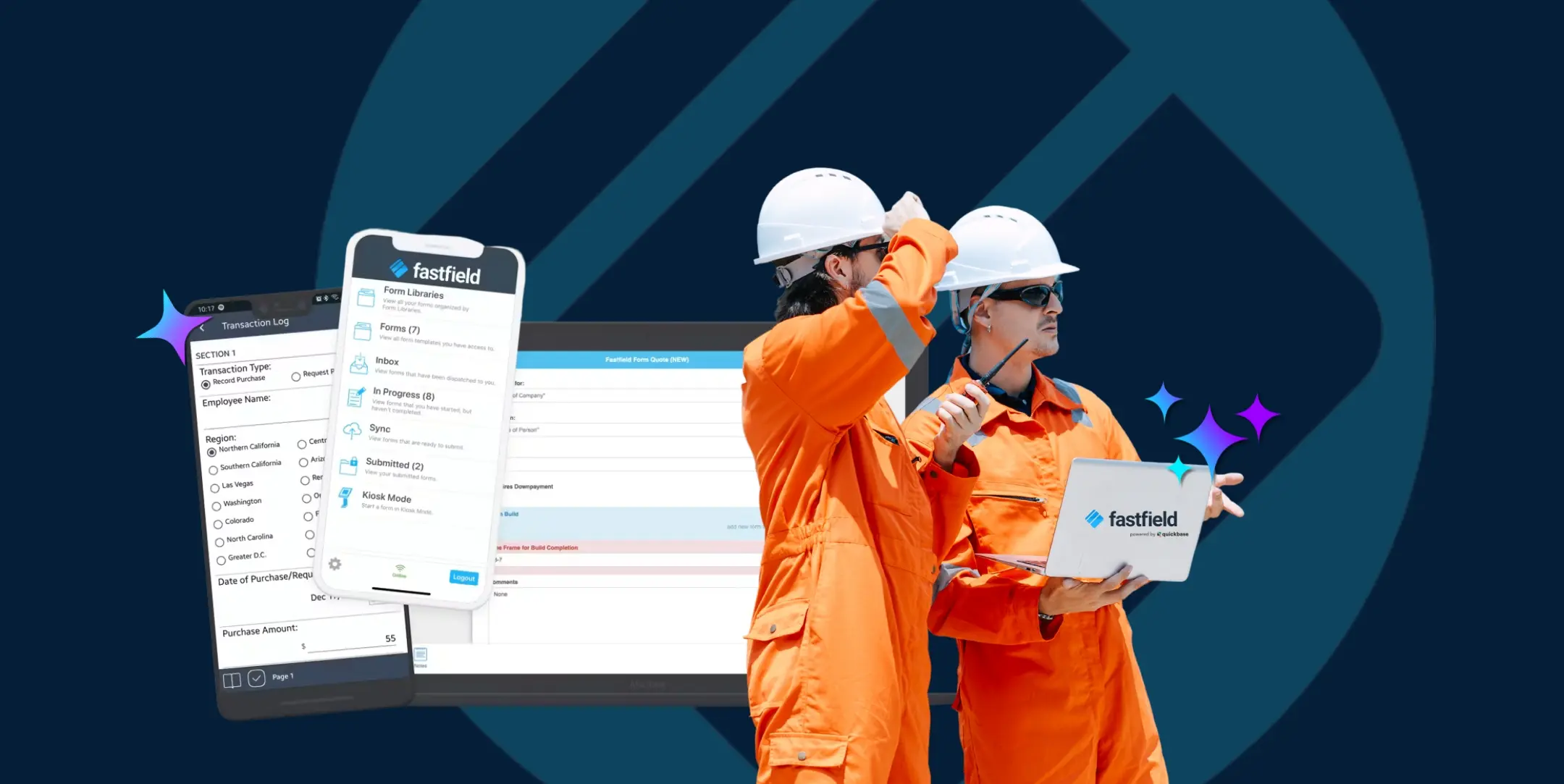
This new capability allows users to describe a form through text or voice—or provide an existing PDF, spreadsheet, photograph, or paper form—and use AI to generate a working mobile form with fields, rules, calculations, and conditional logic. Existing FastField forms can also be modified conversationally from a phone or tablet.
Quickbase is positioning the capability as a faster way for field teams to create and maintain forms; that is certainly part of the value proposition, but the larger opportunity is more strategic.
FastField AI Form Builder can make it substantially easier to convert physical activity into structured enterprise data—and structured data is what automation, analytics, and AI ultimately need to work.
The Field Data Problem Is Bigger Than Forms
For all the investment businesses have made in digital transformation, frontline operations remain surprisingly manual. Salesforce surveyed U.S. mobile workers in 2025 and found that tradespeople and technicians estimate they lose more than seven hours every week to inefficient or low-value work such as manual data entry and job summarization.
For an organization employing 1,000 full-time technicians, Salesforce estimated the lost productivity at more than $260,000 per week.
Construction illustrates the problem particularly well; Procore's Future State of Construction research found that 18% of project time is lost searching for data, while another 28% is lost to rework. More than half—55%—of construction leaders expect automation to disrupt the industry within five years.
Quickbase's own construction research tells a similar story, among more than 430 construction operations, IT, and project leaders:
- 48% experienced project delays or missed deadlines during the previous 12 months.
- 41% struggled to develop a holistic view of projects because information was scattered across multiple systems.
- 29% struggled to share accurate, real-time information across distributed teams.
Meanwhile, Quickbase's broader 2025 Gray Work Report found that
- 80% of organizations had increased their investment in productivity software
- Yet 59% of professionals said it had become harder to be productive.
- This same study found that 59% spend more than 11 hours per week searching for information
- While 56% said the amount of manual work in their jobs had actually increased.
This is an important contradiction, because businesses have more technology than ever in 2026; but technology has not necessarily eliminated operational friction - In many organizations, it has simply just 'digitized' portions of it.
What Quickbase Is Trying to Solve With FastField AI Form Builder
Traditional digital transformation often begins downstream, organizations implement an ERP, CRM, project management platform, data warehouse, analytics environment, or increasingly, an enterprise AI platform; but, those systems depend on something happening upstream:
Someone has to capture reliable information about the work and that is particularly difficult in field-intensive industries. Just consider the volume of information generated across a large construction program:
- Daily field reports
- Safety inspections
- Equipment inspections
- Quality observations
- Material deliveries
- Subcontractor activity
- Punch-list items
- Change conditions
- Asset information
- Photos and videos
- Signatures
- GPS locations
- Maintenance records
- Incident reports
- Corrective actions
Each data point may ultimately influence scheduling, safety, compliance, billing, forecasting, resource allocation, asset management, or executive decision-making. Yet the first mile of that data journey—where information is initially captured in the field—often remains remarkably manual.
That is precisely the problem Quickbase designed FastField AI Form Builder to address. By improving how information is captured at the point of inception, organizations can create more structured, consistent, and usable data from the very beginning. Instead of relying on manual forms, fragmented inputs, or information that must later be cleaned and reconciled, teams can establish a stronger data foundation at the source—before that information begins moving through workflows, systems, analytics, automation, and AI.
From Hours of Configuration to Just a Simple Conversation
Historically, digitizing a field process required someone to first translate that process into software. Every field had to be created. Business rules needed to be defined. Calculations had to be configured. Conditional logic had to be mapped. The form then had to be tested, deployed, and continually modified as operational requirements changed.
FastField AI Form Builder fundamentally changes that interaction; instead of constructing a form field by field, the person who understands the business process can begin by simply describing what the process requires.
A construction safety manager, for example, might ask: "Create a daily construction safety inspection that captures the project, location, superintendent, weather conditions, PPE compliance, observed hazards, corrective actions, photographs, employee signature, and supervisor approval. Require an explanation and photo whenever an inspection item fails."
From that description, FastField AI Form Builder can generate the underlying form—including fields, rules, calculations, and conditional logic—for the user to review, refine, and publish. Importantly, organizations do not have to start from scratch; existing paper forms can be photographed and used as a starting point; PDFs and Excel files can be uploaded.
The practical implication is significant: The people closest to the work can now play a much more direct role in building the technology that supports it.
This represents an important evolution in low-code development; low-code platforms dramatically reduced the amount of traditional programming required to build business applications. Generative AI is now removing another layer of complexity by reducing the need to manually translate business requirements into technical configurations.
Instead, users can describe what a process needs to accomplish, while AI helps transform that operational knowledge into the fields, logic, rules, and workflows required to support it and for field operations in particular, this distinction matters:
- A safety manager understands what constitutes a failed inspection
- A superintendent understands what needs to be documented before a project can move forward
- A field service manager understands which information technicians need to capture before a work order can be closed
FastField AI Form Builder gives those subject-matter experts a more direct path from process knowledge to functional technology—shortening the distance between identifying an operational need and deploying a digital solution to address it.
AI Is Changing the Economics of Digitizing the Long Tail of Business Processes
Large enterprise workflows usually receive technology investment first because their business cases are obvious.
- ERP modernization
- CRM transformation
- Financial automation
- Supply chain systems
- Customer service platforms
Enterprises contain thousands of smaller operational processes that rarely receive the same attention.
- A weekly equipment inspection
- A facility walkthrough
- A vehicle checklist
- A commissioning report
- A quality-control inspection
- A service technician's completion report
- A site-specific safety audit
Individually, these processes may not justify a traditional development project, but collectively, they can represent thousands of hours of administrative work and enormous quantities of operational data. This is where generative AI could materially change the economics of application development.
If building a specialized form previously required hours of configuration and technical expertise, organizations naturally prioritized only the most important workflows; or, if a subject-matter expert can instead describe what is required and generate the foundation of that application in seconds, the cost of digitizing smaller workflows falls dramatically.
That creates the potential to digitize what might be called the long tail of operational work and that is where FastField AI Form Builder becomes more strategically interesting than its name suggests.
Better Data Capture Creates Better Automation
A digital form becomes substantially more valuable when submission is the beginning of a workflow rather than the end of one.
For example, just consider an equipment inspection:
- A technician completes an inspection through FastField.
- The inspection identifies an abnormal vibration reading.
- A photograph is attached.
- The asset number and location are captured.
Instead of that information sitting in a report waiting for someone to review it, a connected environment could:
- Capture the event in FastField.
- Update the corresponding asset or operational record in Quickbase.
- Use workflow automation to determine whether the reading exceeds an established threshold.
- Create a maintenance task automatically.
- Notify the appropriate supervisor.
- Update an ERP or enterprise asset management system.
- Store supporting documentation in the appropriate repository.
- Make the inspection history available for analytics or AI-assisted analysis.
One field event has now become an enterprise workflow and this distinction matters, because the objective of digital field operations should not be to replace a old school clipboard with an iPad - It should be to reduce the distance between an event and the organization's response to that event.
The AI Opportunity Begins With Data Architecture
There is an uncomfortable reality behind the current enterprise AI race: many organizations are attempting to deploy sophisticated AI capabilities on top of fragmented operational environments that were never designed to support them; this is difficult to scale—and even harder to sustain.
An AI agent may be capable of reasoning across the information it can access. But it cannot reliably reason over information that was never captured in the first place. It cannot reconcile data it cannot find, confidently interpret information defined differently across departments, or act on operational knowledge that remains trapped in paper forms, spreadsheets, email threads, and disconnected systems.
Quickbase research found that 73% of workers say critical data is trapped in disconnected tools and this statistic deserves far more attention in the enterprise AI conversation because the effectiveness of AI is ultimately constrained by the quality, accessibility, and structure of the enterprise context available to it.
In practice, the path to enterprise AI increasingly looks something like this: Physical Work -> Digital Data Capture -> Structured, Trusted Operational Data -> Connected Systems -> Automated Workflows -> Analytics + Enterprise AI -> Decision + Action
Organizations understandably want to begin near the bottom of this architecture, where AI agents, copilots, predictive analytics, and intelligent automation promise visible business value; but, the integrity of everything downstream depends on what happens upstream. If information is captured inconsistently at the source, AI inherits that inconsistency.
If critical operational data never enters a digital system, AI cannot use it. If systems remain disconnected, AI operates with an incomplete view of the business. And if the underlying data lacks sufficient structure, governance, or context, increasingly sophisticated models do not necessarily produce increasingly reliable outcomes.
This is why the first mile of enterprise data is becoming one of the most important—and frequently overlooked—components of AI readiness. Before an organization can ask what its AI should know, predict, recommend, or automate, it must first answer a more fundamental question: Are we reliably capturing the information our AI will eventually need to understand the business?
That is where technologies such as FastField become strategically important. Digital field data capture is no longer simply about replacing paper forms or improving administrative efficiency. It is increasingly about creating structured operational context at the moment work happens—giving the automation, analytics, and AI systems downstream better information to work with.
Construction Demonstrates the Scale of the Opportunity
Few industries make the case for better frontline data more clearly than construction. McKinsey estimates global construction output reached approximately $15 trillion in 2025 and could approach $22 trillion by 2040 - Yet productivity remains a persistent structural problem. Between 2000 and 2022, construction productivity increased only 10%—approximately 0.4% annually.
Manufacturing productivity increased approximately 90%, or 3% annually, during the same period. McKinsey estimates that if the industry's productivity trajectory does not improve, cumulative construction output could fall as much as $40 trillion short of demand by 2040.
Technology alone will not close that gap; but, the numbers illustrate why seemingly modest operational improvements matter at scale.
- Reducing time spent searching for information.
- Eliminating duplicate data entry.
- Capturing accurate information once.
- Identifying exceptions sooner.
- Connecting field activity with project controls.
- Automating administrative handoffs.
- Making current information available to decision-makers.
- These improvements are individually incremental.
Across hundreds of projects, thousands of employees, and millions of field interactions, this become structural.
The Next Step: Moving From Forms to Intelligent Field Operations
Quickbase's FastField itself is also evolving beyond basic mobile data collection. Quickbase has been expanding the platform with capabilities designed to capture and interpret different forms of field information, including AI-assisted workflows, visual data, asset information, and mobile operational processes.
This evolution points toward a broader model of intelligent field operations, where technology does more than digitize information after work occurs—it becomes an active participant in how operational data is captured, interpreted, and acted upon.
A field worker is no longer simply entering information into a database. Increasingly, AI-enabled technology can help determine what information should be captured, how it should be structured, what that information means in context, and what action should happen next. This distinction is important. Traditional field data capture was primarily about creating a digital record of what happened. The next generation of field technology is moving toward something far more dynamic: turning information captured at the point of work into immediate operational intelligence.
This shift opens several important possibilities:
- Construction: A superintendent completes a daily report. Project information updates automatically. Delays are flagged. Photographs are associated with the correct project and location. Exceptions are routed to project leadership.
- Manufacturing: An operator records a quality deviation. The system identifies the affected production line, initiates a nonconformance workflow, alerts quality leadership, and preserves the information for trend analysis.
- Field Service: A technician documents a failed component. Asset history is updated, required parts are identified, follow-up work is scheduled, and customer records are synchronized.
- Facilities Management: An inspection identifies a safety issue. The condition is photographed, geolocated, assigned a severity level, routed to the responsible team, and tracked through remediation.
- Utilities and Infrastructure: Distributed field teams collect inspection and maintenance information even in environments with limited connectivity. The information synchronizes when connectivity returns and becomes available to centralized operations teams.
The common thread is not the form, it is the creation of a closed loop between observation, data, decision, and action.
Mobile-First Technology Has Become an Operational Requirement
The shift toward intelligent field operations is already well underway. Geotab's 2025 State of Field Service research found that 85% of surveyed field service workforces use mobile applications with real-time data access and updates, while 76% use AI-powered scheduling and dispatch systems.
Separate research from WBR Insights and Zuper found that 80% of organizations had adopted mobile-first strategies for technicians, but only 17% were fully satisfied with their existing technology - They already are.
The more consequential question is whether those digital tools actually make frontline work easier—or simply introduce another system employees are expected to navigate, update, and maintain.
That distinction matters. A technology can be powerful in theory and still fail operationally if using it creates more friction than the process it was intended to replace. For field teams, adoption depends on whether technology fits naturally into the environment where the work is actually happening.
FastField's approach reflects an important principle of frontline technology: Technology must adapt to the realities of field work—not force field workers to adapt their work around the technology.
Which means supporting phones and tablets employees already carry, accommodating existing forms and operational processes, capturing photographs, signatures, location data, and other rich field information, and continuing to function when connectivity is limited or unavailable. The best field technology should ultimately become almost invisible to the employee using it. The goal is not to give frontline teams another application to manage. It is to remove the administrative friction standing between the work being performed and the data the organization needs from it.
Faster Development Makes Governance More Important - Not Less
There is, however, a counterweight to easier application creation; If AI makes it possible for more employees to create forms and operational applications, organizations need stronger standards governing how those applications fit into the broader technology environment.
Otherwise, AI can simply accelerate the creation of a new generation of disconnected tools and organizations deploying AI-assisted field applications at scale should therefore think beyond individual forms; they need a framework for:
- Data architecture: What information is being collected, and where should the authoritative record live?
- Data standards: Are projects, assets, locations, vendors, customers, and other entities represented consistently?
- Application governance: Who can create, modify, approve, publish, and retire operational applications?
- Integration architecture: How should information move between FastField, Quickbase, ERP, CRM, EAM, project management, document management, and analytics platforms?
- Security and permissions: Who should be able to capture, access, modify, and act on operational information?
- AI governance: Which AI-generated configurations require review, testing, approval, or ongoing monitoring?
- Lifecycle management: How will organizations prevent redundant, outdated, or conflicting forms from proliferating?
This is especially important because Quickbase maintains a human review step in AI Form Builder:
- AI drafts and modifies the form.
- A person still reviews the output and determines what gets published.
For operational environments, human-in-the-loop architecture is not a limitation. it is a key feature.
From Field Data to Enterprise Intelligence
Enterprise AI will only be as useful as the operational reality it can see; for organizations with employees working across job sites, plants, facilities, customer locations, warehouses, infrastructure, and distributed assets, a substantial portion of that reality begins outside the traditional enterprise system.
It all begins in the field and FastField AI Form Builder gives organizations another mechanism for capturing that reality quickly and structuring it for what comes next and capturing the data is only the first step, the larger opportunity is connecting that information with Quickbase applications, workflow automation, enterprise systems, analytics platforms, and eventually AI agents capable of helping organizations interpret events and coordinate responses.
- The progression is straightforward:
- Capture better data.
- Connect it to the business.
- Automate what happens next.
- Build intelligence on top of it.
That is how a mobile form the first mile of an intelligent operation.
How Quandary Helps Organizations Build Connected Field Operations
As a Quickbase Elite Partner, Quandary Consulting Group works with organizations to move beyond isolated applications and build connected operational environments around the way their businesses actually work.
This includes FastField implementation, Quickbase application development, workflow design, system integration, data engineering, process automation, AI governance, and connections between Quickbase and enterprise platforms through technologies such as Workato. The goal is not simply to digitize an existing paper process, it is to examine the entire lifecycle of the information:
- Where is it created?
- How should it be captured?
- Where does it need to go?
- Who needs to know about it?
- What action should it trigger?
- And how can the resulting data become part of the organization's broader automation and AI strategy?
Quickbase has made the first step easier with FastField AI Form Builder and for business leaders, the opportunity is to think several steps beyond the form; the real value does not come from collecting more data, it comes from turning better data into faster, better-informed action.
Additional Resources:
- PRESS RELEASE: Quickbase Launches Form Builder to Help Field Teams Create Mobile Forms in Minutes (Quickbase, September 2026)
- The State of Construction – Key Questions for Your Firm in 2025 (Quickbase)
- The Mobile Worker Crisis: Solving Turnover and Disconnection in the Field (Salesforce)
- The Future State of Construction (Procore)
- 2025 Gray Work Research: Our Annual Look at the State of Productivity (Quickbase)
- Trim the Tail! Understanding Lead Time Distribution with Kanban (David J Anderson School of Management)
- Disconnect Between Your Field and Office? It’s Costing You More Than You Think (Quickbase)
- Delivering on construction productivity is no longer optional (McKinsey & Company)
- 7 things that are blocking productivity gains in construction (KHL Group)
- Geotab Report: AI Already Boosting Uptime and Fix Rates for Field Service Fleets (Geotab)
- Mobile technology and the field service workforce (Zuper)
- Humans in the Loop: The Design of Interactive AI Systems (Stanford University)
Top FAQs about Quickbase FastField AI Form Builder
What is Quickbase FastField AI Form Builder?
Quickbase FastField AI Form Builder is an AI-powered mobile form builder that allows users to describe the form they need in natural language, use voice input, or upload an existing document or paper form. FastField can then generate fields, sections, calculations, and conditional logic for the user to review, refine, and publish.
How does FastField AI Form Builder work?
Users describe the information they need to collect or provide an existing form, and FastField generates a working mobile form. The user remains responsible for reviewing and approving the generated form before it is published, maintaining human oversight of the final configuration.
Can FastField convert paper forms into digital forms?
Yes. FastField can use photographs of paper forms or uploaded documents as the starting point for creating editable digital mobile forms, reducing the need to manually rebuild existing field processes from scratch.
Can FastField convert PDFs and Excel files into mobile forms?
Yes. Quickbase says users can upload existing digital files, including PDFs and Excel files, and use FastField AI Form Builder to create mobile forms that can then be reviewed and refined.
Can FastField forms work offline?
Yes. FastField mobile forms can be completed without a reliable internet connection. Offline submissions are stored on the device and can synchronize after connectivity returns, making the platform useful for construction sites, inspections, maintenance operations, remote facilities, and other field environments.
What types of field processes can FastField automate?
FastField can support processes such as inspections, audits, safety checklists, site reports, maintenance records, service documentation, equipment inspections, timesheets, asset documentation, signatures, photographs, and other field data collection workflows.
How is AI changing field data collection?
AI can reduce the manual effort required to design, structure, and maintain digital field processes. Instead of manually configuring every component of a form, users can increasingly describe operational requirements in natural language and use AI to help translate those requirements into structured digital experiences.
How does AI improve mobile form creation?
AI can accelerate mobile form development by translating natural-language requirements into fields, sections, business rules, calculations, and conditional logic. This allows the people who understand an operational process to participate more directly in creating the technology that supports it. FastField still requires users to review generated forms before publishing them.
What is intelligent field data collection?
Intelligent field data collection combines mobile forms, structured data capture, automation, integration, and increasingly AI to turn information collected during frontline work into usable operational data. Rather than simply replacing paper, the goal is to capture reliable information at the source and make it available to the systems, workflows, analytics, and people that need it.
Why is field data important for enterprise AI?
Enterprise AI depends on having access to accurate, structured, accessible, and context-rich business information. When important operational information remains on paper, in spreadsheets, or across disconnected systems, AI systems may lack the context necessary to produce reliable insights or support downstream decisions.
What is the relationship between field data collection and AI readiness?
Field data collection can be an important component of AI readiness because it determines how operational information enters the digital environment. Capturing consistent, structured data at the point where work occurs can create stronger inputs for downstream integrations, workflow automation, analytics, copilots, and AI agents.
How does FastField integrate with Quickbase?
FastField can connect field data collection with Quickbase applications and workflows. Quickbase administrators can connect FastField and Quickbase so that form responses flow into Quickbase tables and can become part of broader workflows connecting field and office operations.
Can FastField automatically capture photos, GPS locations, and timestamps?
Yes. FastField supports rich field data including photographs, GPS information, timestamps, annotations, drawings, and other information that can provide additional context and documentation around field activity.
What industries can use AI-powered field data collection?
AI-powered field data collection can be valuable across industries with distributed or frontline operations, including construction, manufacturing, utilities, facilities management, healthcare, logistics, field service, property management, energy, and other industries where employees regularly collect operational information away from a traditional desk.
What is the difference between digital forms and intelligent field operations?
Digital forms primarily replace manual methods of recording information. Intelligent field operations go further by connecting that information with business rules, workflows, integrations, analytics, and AI so captured data can help determine what happens next.
Can AI replace manual field data entry?
AI can reduce many manual steps involved in creating forms, extracting information, structuring data, and processing field submissions, but it does not eliminate the need for human oversight. FastField's AI Form Builder, for example, generates and modifies forms while leaving review and publishing decisions with the user.
How can companies modernize paper-based field processes?
Organizations can begin by identifying paper forms, spreadsheets, inspection sheets, checklists, and other manual processes used by frontline teams. These processes can then be converted into mobile data collection workflows, standardized around consistent data requirements, integrated with core business systems, and connected to automation and analytics.
What are the benefits of AI-powered mobile forms?
AI-powered mobile forms can reduce form-development effort, accelerate process digitization, improve consistency in field data capture, make it easier to update forms as requirements change, and help organizations move operational information into digital workflows more quickly.
How can field data be used for workflow automation?
Once field information is captured digitally, it can be connected to workflows that distribute reports, update records, initiate approvals, notify stakeholders, assign follow-up work, or move information into other business systems. FastField supports workflow and data delivery capabilities, while its Quickbase integration can connect field submissions with broader operational applications.
What is the future of AI in field operations?
The future of AI in field operations is likely to extend beyond digitizing forms toward systems that help workers capture the right information, interpret field conditions, identify exceptions, initiate workflows, and provide organizations with structured operational context for analytics and enterprise AI.