How Healthcare Organizations Are Combining AI, Low-Code, and Secure Automation to Modernize Operations

Healthcare organizations have never faced greater operational complexity. Rising patient volumes, staffing shortages, cybersecurity threats, changing regulatory requirements, and growing expectations from patients and providers are placing unprecedented pressure on clinical and administrative teams.
In many organizations, the greatest barrier to better care is not a lack of clinical expertise. It is the fragmented operational infrastructure surrounding care delivery.
Hospitals, home health agencies, outpatient clinics, rehabilitation networks, behavioral health providers, hospice organizations, and telehealth companies still rely on spreadsheets, email chains, disconnected applications, and manual approvals to manage critical work. Electronic health record (EHR) systems are essential for documenting care, but they were not designed to automate every operational process that supports the patient journey.
Referral management, prior authorization, provider credentialing, workforce onboarding, compliance tracking, equipment management, quality reporting, contract administration, and executive reporting frequently occur outside the EHR. As organizations grow, these disconnected processes create delays, duplicate work, inconsistent data, compliance exposure, and employee frustration.
Artificial intelligence can help reduce that burden, but AI needs a secure operational environment in which to work. A model can extract information, summarize documents, identify missing data, and recommend a next action. It still needs governed workflows, trusted data, role-based access, auditability, and human oversight.
That is where Quickbase and Anthropic’s Claude can work together.
Quickbase provides a configurable operational platform for managing workflows, records, approvals, permissions, and reporting. Claude adds an intelligence layer capable of interpreting unstructured information and supporting knowledge-intensive administrative work. Workato or another enterprise integration platform can securely orchestrate data and actions across Quickbase, EHRs, payer systems, Microsoft 365, HR platforms, and other applications.
At Quandary Consulting Group, we help healthcare organizations design connected solutions that bring these capabilities together. Instead of replacing platforms such as Epic, athenahealth, Oracle Health, PointClickCare, MatrixCare, Microsoft 365, Salesforce, or Workday, we extend them with a secure operational layer built around each organization’s workflows.
The result is a more connected healthcare ecosystem that improves visibility, reduces administrative work, strengthens governance, and helps teams move patients through care more efficiently.
Why Healthcare Organizations Need More Than an EHR
Most healthcare leaders quickly discover that an EHR cannot solve every operational challenge. Clinical systems are built to document encounters, maintain medical records, schedule appointments, and support care delivery. They perform those functions well, but they often lack the flexibility required to manage complex operational processes spanning multiple departments and systems.
Leaders still need timely answers to questions such as:
- Where are referrals being delayed?
- Which referral packets are missing required documentation?
- What prior authorization requests are still pending?
- Which patients are waiting for discharge information?
- Which providers have licenses or credentials approaching expiration?
- Which clinicians have not completed required training?
- Where are staffing or equipment shortages developing?
- Which quality initiatives are behind schedule?
- Which administrative cases require immediate human review?
Answering these questions often requires searching multiple applications, contacting department managers, or combining spreadsheet exports. Even when the information exists, it may not be available in a form that supports immediate action.
Quickbase can serve as an operational command center that connects information across systems and presents it through role-specific applications, queues, and dashboards. Claude can then help teams interpret the documents and narrative information attached to those workflows.
For example, a referral coordinator may use Quickbase to see every new referral, its current status, assigned owner, missing requirements, and due date. Claude can review the incoming referral packet, extract relevant information, summarize the documentation, and flag potential gaps. The coordinator remains responsible for validating the information and deciding how the case should proceed.
This combination allows AI to reduce administrative effort without removing accountability.
What Makes Quickbase Valuable in Healthcare?
Quickbase is a configurable low-code platform that enables organizations to build applications around their actual operational processes. Applications can be developed and updated more quickly than many traditional custom software projects, while remaining flexible enough to evolve as workflows, payer requirements, organizational structures, and regulations change.
Healthcare organizations use Quickbase to:
- Automate multistep workflows
- Centralize operational data
- Standardize intake and approvals
- Coordinate work across departments
- Track compliance requirements
- Build executive dashboards
- Connect legacy and cloud applications
- Reduce duplicate data entry
- Replace fragile spreadsheets
- Improve reporting accuracy
- Maintain workflow histories
- Route exceptions to the appropriate person
Quickbase does more than store information. It gives AI-generated insights a structured place to land.
When Claude identifies a missing document, summarizes a referral, classifies an intake request, or drafts an appeal, that output can be written to the appropriate Quickbase record. The system can then assign an owner, initiate an approval, establish a deadline, preserve an audit history, and require human verification before the workflow advances.
How Claude Adds Intelligence to Healthcare Operations
Much of healthcare administration depends on unstructured information contained in referral packets, clinical notes, payer policies, emails, PDFs, contracts, credentialing files, and other documents. Traditional workflow automation is effective when data is already structured and the rules are predictable. AI becomes valuable when the process requires teams to read, interpret, summarize, compare, or classify information before taking action.
Claude can support these tasks by:
- Extracting structured information from documents and correspondence
- Summarizing lengthy referral or case documentation
- Identifying missing or inconsistent information
- Classifying requests and routing them to the correct workflow
- Comparing documentation with predefined policies or checklists
- Drafting patient communications for staff approval
- Preparing first drafts of prior authorization or appeal materials
- Summarizing regulatory, policy, or quality documents
- Converting operational data into plain-language executive briefings
- Helping employees find approved information across governed knowledge sources
Anthropic has introduced Claude for Healthcare and healthcare-focused capabilities designed to support use cases such as prior authorization, claims appeals, care coordination, and healthcare data interoperability. However, healthcare organizations should evaluate the specific Claude product, deployment architecture, data flow, contractual terms, security controls, and availability of an appropriate Business Associate Agreement before sending protected health information to any AI service.
AI should not independently diagnose patients, establish treatment plans, approve or deny care, or make other consequential clinical decisions. In a well-designed operating model, Claude assists qualified employees by organizing information and preparing recommendations. Authorized people review the output, resolve exceptions, and remain accountable for the final decision.
A Connected Architecture for Quickbase, Claude, and Workato
The strongest healthcare AI solutions assign a clear responsibility to every component:
- Systems of record retain authoritative clinical, financial, workforce, or customer information.
- Quickbase manages operational records, workflows, assignments, permissions, approvals, exceptions, and dashboards.
- Workato securely orchestrates data and actions across connected enterprise systems.
- Claude interprets unstructured information, generates summaries, identifies gaps, and prepares draft outputs.
- Human reviewers validate AI-generated content and make clinical, regulatory, financial, or other consequential decisions.
Consider an AI-assisted referral workflow:
- A referral arrives from a hospital through an approved integration.
- Workato creates or updates the operational case in Quickbase.
- Claude extracts relevant information from the referral packet and produces a structured summary.
- Quickbase compares the case with required intake fields and displays missing items.
- The workflow assigns the case to the appropriate intake or clinical reviewer.
- A qualified employee verifies the extracted data, reviews any AI-generated flags, and approves the next action.
- Quickbase records the decision, time stamp, reviewer, status change, and follow-up tasks.
- Approved information is synchronized with the appropriate system of record.
This architecture turns AI output into governed work rather than leaving it isolated in a chat window or document.
Building a HIPAA-Compliant Operations and AI Platform
HIPAA compliance is not a feature that can be switched on by purchasing a particular platform. It depends on how the organization, its vendors, and its workforce protect PHI across the entire environment.
Quickbase states that it enables customers to build applications that comply with the HIPAA Security Rule and describes a shared-responsibility model: Quickbase protects the underlying platform, while customers remain responsible for designing, configuring, and maintaining their applications appropriately. Organizations that store or process PHI must also determine whether a Business Associate Agreement is required and ensure the applicable service and contract support their intended use.
The same diligence applies to Claude, Workato, and every connected system. Before PHI enters an AI-enabled workflow, the organization should confirm:
- The approved product and deployment are eligible for the intended healthcare use
- Required BAAs and data-processing agreements are in place
- Data is not routed through unapproved consumer accounts or tools
- Access is limited according to job responsibilities
- Data retention and model-training terms align with organizational policy
- Audit, monitoring, and incident-response requirements are addressed
- Human review is required for consequential outputs
- The organization has tested the system for accuracy, security, and failure modes
Building a HIPAA-Compliant Operations and AI Platform
HIPAA compliance is not a feature that can be switched on by purchasing a particular platform. It depends on how the organization, its vendors, and its workforce protect PHI across the entire environment.
Quickbase states that it enables customers to build applications that comply with the HIPAA Security Rule and describes a shared-responsibility model: Quickbase protects the underlying platform, while customers remain responsible for designing, configuring, and maintaining their applications appropriately.
Organizations that store or process PHI must also determine whether a Business Associate Agreement (BAA) is required and ensure the applicable service and contract support their intended use.
The same diligence applies to Claude, Workato, and every connected system. Before PHI enters an AI-enabled workflow, the organization should confirm:
- The approved product and deployment are eligible for the intended healthcare use
- Required BAAs and data-processing agreements are in place
- Data is not routed through unapproved consumer accounts or tools
- Access is limited according to job responsibilities
- Data retention and model-training terms align with organizational policy
- Audit, monitoring, and incident-response requirements are addressed
- Human review is required for consequential outputs
- The organization has tested the system for accuracy, security, and failure modes
Managing Protected Health Information
Organizations should carefully evaluate what information belongs in operational workflows and ensure appropriate safeguards are in place whenever protected health information (PHI) is involved.
A common design pattern is to store detailed clinical records within the EHR while using Quickbase to orchestrate operational workflows, task management, approvals, and status tracking. Where PHI must be referenced, organizations should apply appropriate security controls, access restrictions, and governance consistent with their compliance program and vendor agreements.
Role-Based and Field-Level Security
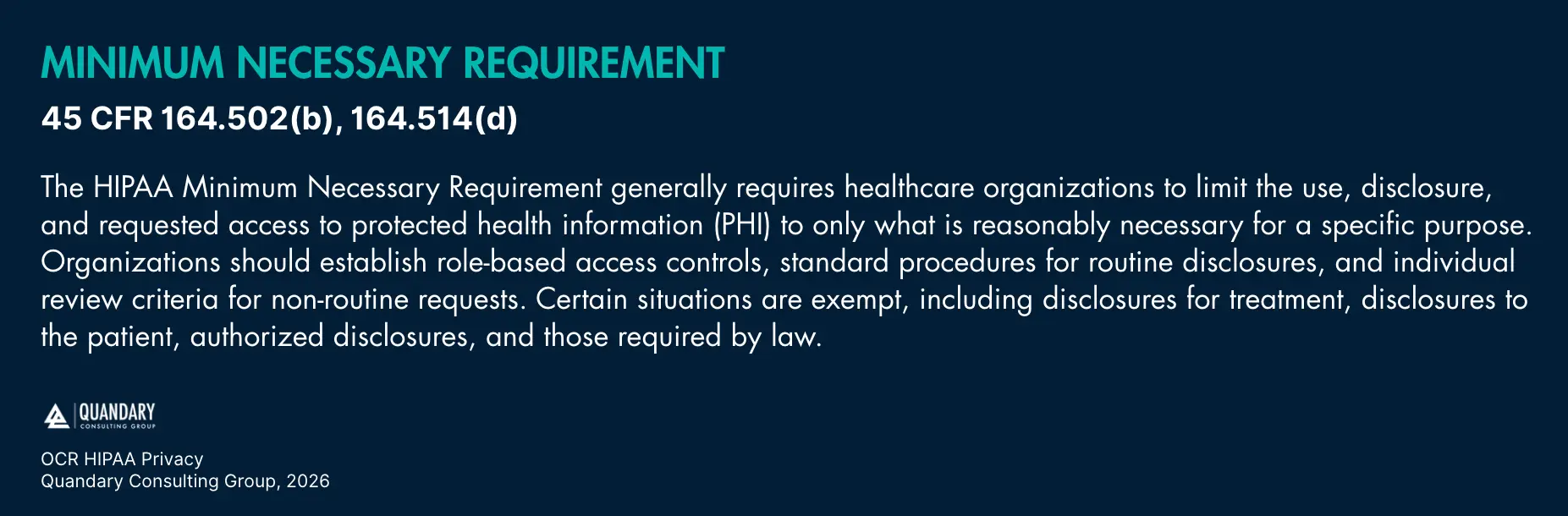
Not every user should be able to access every record or field. Limiting access reduces organizational risk while supporting the HIPAA "minimum necessary" principle.
Applications should also be designed so clinicians, intake coordinators, billing specialists, managers, executives, and contractors see only the information required for their responsibilities.
Permissions should govern who can:
- View records or sensitive fields
- Create and modify information
- Upload or download documents
- Approve requests
- Export reports
- Delete records
- Configure workflows
- Initiate an AI action
- View, accept, modify, or reject AI-generated output
These controls support least-privilege access and the HIPAA minimum necessary standard.
Auditability and Traceability
Healthcare organizations need to understand not only what happened, but also who or what initiated it. A governed platform can capture:
- User activity
- Status changes
- Approvals and rejections
- Time stamps
- Process history
- Documentation updates
- AI requests and outputs, where appropriate
- Human edits to AI-generated content
- Exception routing and resolution
This history improves accountability and helps organizations investigate errors, evaluate performance, and prepare for audits.
Human-in-the-Loop Controls
Generative AI can produce incomplete or inaccurate information. Every AI-enabled workflow should therefore define:
- Which outputs require human review
- Who is qualified to complete that review
- What evidence the reviewer must consider
- When an item must be escalated
- Which actions AI is prohibited from taking
- How rejected or corrected outputs are documented
High-risk decisions should never advance solely because an AI system generated a confident answer.
Data Minimization
Organizations should send only the information required to complete the approved task. A common design pattern keeps the detailed clinical record in the EHR while Quickbase manages operational status, tasks, approvals, and limited supporting data.
When Claude does not need direct identifiers to complete a task, workflows can remove or mask them. When PHI is necessary, the organization should use an approved architecture with appropriate access, contractual, security, and governance controls.
Secure Workflow Automation
Manual handoffs introduce delays and can expose sensitive information through uncontrolled channels. Governed automation can route work between approved systems while preserving access controls and process history.
Common examples include:
- Referral intake and review
- Prior authorization preparation
- Credential renewals
- Equipment requests
- Compliance reviews
- Policy acknowledgments
- Quality investigations
- Claims and denial workflows
Automation should improve consistency without allowing sensitive actions to bypass established approvals.
Connecting the Healthcare Technology Stack
Healthcare organizations often operate dozens of specialized platforms. A modern operations strategy does not require replacing all of them. It requires connecting them through governed workflows.
Depending on each vendor’s supported interfaces and the organization’s architecture, Quickbase can be integrated with systems such as:
- Epic
- athenahealth
- Oracle Health
- PointClickCare
- MatrixCare
- Microsoft 365
- Microsoft Teams
- SharePoint
- Salesforce Health
- Workday
- DocuSign
- QuickBooks
- Snowflake
- Microsoft Azure
- AWS
- Workato
- HL7 interfaces
- FHIR APIs
- Approved Claude products and APIs
Microsoft 365 integrations can help employees work through familiar tools such as Outlook, Teams, SharePoint, Power BI, Excel, and Microsoft Entra ID while maintaining standardized operational processes.
Workato can coordinate events across the technology stack, such as creating an operational case after a referral, synchronizing provider data, updating an HR system, launching a Claude-powered document review, sending an approved notification, or routing an exception to a supervisor.
Examples of Possible High-Value AI Use Cases for Quickbase and Claude
- AI-Assisted Referral Intake: Claude can review approved referral documents, extract relevant fields, summarize the case, and identify missing information. Quickbase records the case, manages assignments and deadlines, and routes the referral to a qualified reviewer.
- Prior Authorization Preparation: Claude can help organize patient documentation, coverage requirements, and supporting materials. It can prepare a draft summary or checklist for review. Quickbase tracks submission status, aging, payer communications, approvals, denials, and appeals.
Provider Credentialing: AI can extract license numbers, effective dates, expiration dates, and other information from credentialing documents. Quickbase manages verification, approval, renewal reminders, and workforce-readiness reporting.
Claims and Denial Management
Claude can summarize denial correspondence, classify common reasons, and draft appeal materials using approved source information. Quickbase assigns cases, tracks deadlines, documents reviews, and reports recurring denial patterns.
Compliance and Policy Management
Claude can summarize policies, identify differences between document versions, and help employees locate approved guidance. Quickbase manages attestations, review cycles, ownership, approvals, and evidence.
- Executive Operations Reporting: Quickbase dashboards provide structured operational metrics. Claude can translate approved data into plain-language summaries that explain trends, exceptions, and potential areas requiring leadership attention.
Three Quandary Client Case Studies that Highlight Benefits of Claude, Quickbase and Workato
Case Study 1: National Home Healthcare Provider Modernizes Referral Operations
- Industry: Home Healthcare
- Organization size: 1,200 employees
A rapidly growing home healthcare organization, based in Lexington, KY, receives referrals from more than 150 hospital systems across 12 states (Kentucky, Illinois, Indiana, Michigan, Ohio, Wisconsin, North Dakota, South Dakota, Idaho, Minnesota, Missouri, and Nebraska). Every referral required coordination among intake coordinators, clinical reviewers, insurance specialists, schedulers, and field clinicians.
The organization relied on spreadsheets, email, and manual status updates. Referral packets were frequently incomplete, duplicate work was common, and leadership could not see where patients were being delayed. Employees spent significant time reviewing documents, contacting hospitals for missing information, and checking payer requirements.
Quandary designed a custom Quickbase application that became the centralized referral operations platform. Each referral entered a standardized workflow covering documentation, insurance verification, clinical review, scheduling, and admission readiness.
Claude was incorporated as an assistive document-intelligence layer. It extracted information from approved referral packets, created a concise case summary, and flagged potentially missing information for employee review. Staff validated the output before information was finalized or the case advanced.
Workato connected the workflow with the organization’s EHR and Microsoft 365 environment. Quickbase notifications alerted the appropriate team when action was required, while dashboards gave leadership real-time visibility into volume, bottlenecks, turnaround time, and pending tasks.
Key Results
- Reduced referral processing time by 58%
- Improved referral visibility across all locations
- Eliminated spreadsheet-based tracking
- Reduced time spent manually reviewing referral packets
- Increased patient admissions without adding administrative staff
- Improved executive reporting and operational planning
CASE STUDY 1 | To review this entire case study, please visit: National Home Healthcare Provider Modernizes Referral Operations
Case Study 2: Regional Outpatient Network Accelerates Prior Authorization
- Industry: Outpatient Rehabilitation practice
- Organization size: 1,100 employees
A multi-location outpatient rehabilitation provider struggled to manage prior authorizations across thousands of patient visits each month. Requirements varied by payer, documentation was frequently incomplete, and staff had no centralized way to monitor request status.
Quandary implemented a Quickbase operations platform integrated with Workato to coordinate the authorization lifecycle. Requests were routed to the appropriate specialists, documentation checklists adapted to payer requirements, and exceptions were escalated before they affected scheduled care.
Claude supported the administrative review by summarizing approved documentation, comparing available materials with established checklists, and preparing draft authorization narratives for specialists. Qualified employees verified every AI-generated output and retained authority over submissions and escalations.
Leadership dashboards displayed authorization volumes, aging requests, denial trends, and staff workloads. Role-based security, detailed histories, and standardized approvals strengthened governance across the network.
Key Results
- Reduced authorization turnaround time by 46%
- Decreased delayed patient appointments
- Improved payer documentation accuracy
- Increased staff productivity through AI-assisted workflow automation
- Strengthened compliance and audit readiness
CASE STUDY 2 | To review this entire case study, please visit: Regional Outpatient Network Reduced Time for Prior Authorization by 46%
Case Study 3: Orthopedic Practice Modernizes Hospital Referral Management with HL7 & Quickbase
- Industry: Regional Orthopedic Healthcare
- Location: Colorado
A multi-location orthopedic surgery practice in Colorado relied heavily on patient referrals from hospitals, emergency departments, primary care providers, and other healthcare organizations. Each referral required employees to collect patient demographics, insurance information, clinical documentation, imaging records, diagnosis details, and provider orders before scheduling care.
The practice relied on faxes, email, spreadsheets, and manual data entry to coordinate referrals. Employees frequently reentered information from hospital systems into the practice’s internal applications, increasing the risk of errors and duplicate records. Incomplete referral packets required time-consuming follow-up, while leadership lacked a centralized view of referral status, scheduling readiness, and operational bottlenecks.
Quandary designed a centralized Quickbase referral management platform that standardized the referral lifecycle from intake through scheduling. HL7 integrations securely transferred patient and clinical data from referring hospitals into the platform, reducing manual entry and improving consistency between systems.
Each referral entered a structured workflow covering intake, documentation review, insurance verification, clinical triage, specialist assignment, and scheduling. Automated validation rules identified missing or inconsistent information, while notifications and exception workflows routed cases requiring follow-up to the appropriate employees.
Quickbase dashboards gave intake teams, practice managers, and leadership real-time visibility into referral volume, outstanding documentation, processing times, scheduling readiness, and referral-source performance. Detailed activity histories and role-based permissions also strengthened accountability, data governance, and HIPAA-aligned operations.
Key Results
- Centralized hospital referrals in one secure platform
- Reduced manual data entry through HL7 integration
- Accelerated referral intake and appointment scheduling
- Improved the completeness and accuracy of patient records
- Reduced duplicate work and administrative follow-up
- Gave employees real-time visibility into referral status
- Strengthened accountability, auditability, and HIPAA compliance
- Improved reporting on referral sources, bottlenecks, and conversion trends
CASE STUDY 3 | To review this entire case study, please visit: Orthopedic Practice Modernizes Hospital Referral Management with HL7 & Quickbase
Governance Matters as Much as Technology
Technology alone does not create compliance, trustworthy AI, or sustainable transformation. Strong governance keeps applications secure, accurate, and manageable as they grow.
Healthcare organizations should establish:
- Data and workflow ownership
- AI acceptable-use policies
- Approved models and use cases
- Human-review requirements
- Security and privacy assessments
- Change-management standards
- Documentation requirements
- Model and workflow testing
- User training
- Periodic access reviews
- Vendor-risk management
- Incident-response procedures
- Ongoing performance and accuracy monitoring
The organization should also measure whether an AI-enabled process delivers a meaningful operational result. Useful measures include processing time, exception rate, rework, accuracy, staff hours saved, patient delays, denial rates, and user adoption.
Looking Ahead
Healthcare organizations will continue investing in AI, automation, and digital transformation. Success will depend on more than adopting a powerful model. Organizations need an operational foundation that connects people, processes, systems, and AI securely.
Quickbase provides the flexibility to modernize workflows without replacing core clinical systems. Workato connects applications and coordinates actions across the enterprise. Claude helps teams interpret documents and information that traditional rule-based automation cannot easily process. Human oversight ensures consequential decisions remain with qualified professionals.
At Quandary Consulting Group, we design these capabilities as one connected operating model. As a Quickbase Elite Partner and member of the Claude Partner Network, we help healthcare organizations identify the right AI use cases, prepare their data and workflows, build secure applications, integrate enterprise systems, and establish the governance required for responsible adoption.
The objective is not to add AI everywhere. It is to apply AI where it can safely reduce administrative burden, improve consistency, and help healthcare professionals act on the right information sooner.
Additional References
- Quickbase Compliance and HIPAA Security Rule
- Quickbase Healthcare Operations Management
- Anthropic: Advancing Claude in Healthcare and the Life Sciences
- U.S. Department of Health and Human Services: HIPAA Security Rule
- U.S. Department of Health and Human Services: Business Associate Agreement (BAA) Provisions
- Health Level Seven (HL7), Interfaces, & Interface Engines
- What is Considered PHI Under HIPAA?
Top FAQs about HIPAA-Compliant AI Healthcare AI with Quickbase, Claude, and Workato
What is Quickbase, and how is it used in healthcare?
Quickbase is a low-code platform used to build configurable operational applications. Healthcare organizations use it for referral management, prior authorization, credentialing, workforce onboarding, compliance tracking, equipment management, quality initiatives, and executive reporting. It can extend an EHR by managing operational workflows that fall outside the clinical record.
Is Quickbase HIPAA compliant?
Quickbase states that it enables customers to build applications compliant with the HIPAA Security Rule and operates under a shared-responsibility model. The customer remains responsible for proper configuration, governance, access management, workforce practices, and compliance with its legal obligations.
Please note: Organizations handling PHI need to confirm service eligibility and execute a BAA when applicable.
Can Claude be used in HIPAA-regulated healthcare workflows?
Claude can support healthcare use cases through eligible products and properly governed deployments. An organization should verify the specific service, architecture, contractual terms, security controls, retention practices, and availability of a BAA before processing PHI. Consumer AI accounts should not be assumed appropriate for regulated healthcare data.
How do Quickbase and Claude work together?
Quickbase manages structured records, workflow states, permissions, assignments, approvals, and dashboards. Claude can interpret unstructured documents, extract information, create summaries, and prepare drafts. Quickbase turns those AI outputs into governed tasks and requires authorized employees to validate them.
Does Claude make clinical decisions?
Claude should not independently diagnose patients, determine treatment, approve or deny care, or make other consequential clinical decisions. It can assist qualified professionals by organizing and summarizing information, but appropriately trained people should review the underlying evidence and make the final decision.
Can Quickbase and Claude integrate with Epic and other EHRs?
Yes! They can be incorporated into architectures that connect with EHRs through supported APIs, FHIR resources, HL7 interfaces, or enterprise integration platforms such as Workato. Available methods depend on the EHR, licensing, interface capabilities, security requirements, and approved implementation.
What healthcare workflows can be improved with AI?
High-value opportunities include referral intake, prior authorization preparation, claims appeals, credential-document extraction, compliance review, patient-message routing, policy summarization, and executive reporting. The best starting points are high-volume processes with clear rules, measurable delays, reliable source data, and defined human reviewers.
Why use Quickbase instead of spreadsheets?
Spreadsheets are difficult to govern at scale and provide limited workflow automation, permissions, auditability, and real-time reporting. Quickbase centralizes operational information, standardizes processes, automates assignments and approvals, and gives leadership current visibility across departments and locations.
How does AI-assisted referral management work?
Claude can review an approved referral packet, extract relevant information, create a summary, and flag missing documents. Quickbase creates the operational case, assigns an owner, tracks deadlines, and records decisions. A qualified employee verifies the AI output before the referral advances.
How does Quickbase support healthcare compliance?
Quickbase can support compliance programs through role-based and field-level permissions, standardized workflows, audit histories, automated reminders, approval records, and operational reporting. These capabilities do not replace the administrative, physical, and technical safeguards the organization is responsible for maintaining.
What is the role of Workato?
Workato acts as an orchestration layer between Quickbase, Claude, EHRs, Microsoft 365, HR platforms, payer systems, and other applications. It can transfer approved data, trigger workflows, synchronize records, and route exceptions according to defined business rules.
What should a healthcare organization automate first?
Start with repetitive, high-volume administrative processes that have clear ownership and measurable bottlenecks. Referral intake, prior authorization, provider credentialing, employee onboarding, compliance documentation, and denial management are common candidates. Organizations should establish the workflow and governance foundation before adding AI.
How should healthcare organizations govern generative AI?
Organizations should maintain an inventory of approved tools and use cases, define prohibited activities, restrict access, minimize data sharing, require human review, test accuracy and failure modes, monitor performance, train users, document decisions, and maintain incident-response procedures.
What are the greatest benefits of combining Quickbase and Claude?
The greatest benefits of combining Quickbase and Claude is that this can reduce document-review time, decrease duplicate data entry, accelerate case routing, improve visibility, standardize approvals, and help employees focus on exceptions and higher-value work. Quickbase provides operational control, while Claude helps interpret the unstructured information that slows many healthcare processes.
How does workflow automation improve patient outcomes?
Automation can reduce the administrative delays surrounding care. Faster referral processing can shorten the time between discharge and the start of home health services. Better prior authorization workflows can prevent avoidable appointment delays. Credential monitoring helps ensure qualified providers remain available. These operational improvements support more timely and coordinated care.
What are the biggest benefits of using Quickbase in healthcare?
Healthcare organizations choose Quickbase because it helps them:
- Improve operational efficiency
- Automate repetitive workflows
- Reduce manual data entry
- Increase visibility across departments
- Strengthen compliance
- Connect disconnected systems
- Improve executive reporting
- Accelerate patient onboarding
- Scale operations without adding administrative staff
- Support continuous process improvement
Ultimately, Quickbase enables healthcare organizations to spend less time managing operations and more time delivering exceptional patient care.
What is the best low-code platform for healthcare?
There is no single "best" low-code platform for every healthcare organization, but Quickbase is one of the strongest options for operational workflow automation because it combines flexibility, rapid application development, enterprise-grade security, and extensive integration capabilities.
Unlike platforms that focus primarily on software development, Quickbase allows healthcare organizations to quickly build custom applications for referral management, provider credentialing, patient intake, compliance tracking, quality reporting, and operational dashboards without replacing existing EHR systems.
When implemented by an experienced consulting partner like Quandary Consulting Group, Quickbase becomes a centralized healthcare operations platform that connects people, processes, and enterprise systems while supporting digital transformation initiatives.
Can Quickbase replace Microsoft Excel?
Yes, it can! Quickbase can replace Microsoft Excel for many healthcare operational processes while providing significantly greater visibility, security, collaboration, and automation.
Although spreadsheets are commonly used for tracking referrals, credentialing, compliance, staffing, and equipment, they often create duplicate data, version control issues, and manual reporting challenges. Quickbase centralizes information into a secure cloud application where multiple users can collaborate in real time, automate workflows, generate dashboards, and maintain complete audit histories.
For healthcare organizations managing complex operational workflows, Quickbase offers a far more scalable and reliable alternative to spreadsheets.
Can Quickbase integrate with Epic?
Yes. Quickbase can integrate with Epic and many other electronic health record systems using APIs, HL7 interfaces, FHIR standards, or integration platforms like Workato.
Rather than replacing Epic, Quickbase extends its capabilities by managing operational workflows that often fall outside the EHR, including referral management, provider credentialing, equipment tracking, compliance initiatives, project management, staffing coordination, and executive reporting.
This approach allows healthcare organizations to maintain Epic as the clinical system of record while using Quickbase to improve operational efficiency across the organization.
What healthcare processes should be automated first?
Most healthcare organizations achieve the fastest return on investment by automating repetitive, high-volume administrative workflows that consume significant staff time.
Common starting points include:
- Patient referral management
- Prior authorization workflows
- Provider credentialing
- Employee onboarding
- Compliance documentation
- Incident reporting
- Equipment requests
- Patient intake
- Scheduling coordination
- Executive approvals
Automating these operational processes reduces delays, improves consistency, and creates immediate productivity gains across clinical and administrative teams.
How do hospitals use low-code applications?
Hospitals use low-code platforms like Quickbase to rapidly build custom operational applications without lengthy software development projects.
These applications support functions such as project management, capital planning, compliance tracking, patient referral management, quality improvement initiatives, construction oversight, staffing coordination, inventory management, and executive reporting.
Because every hospital operates differently, low-code platforms allow organizations to build workflows that reflect their specific operational requirements while integrating with existing enterprise systems.
Can Quickbase manage provider credentialing?
Yes. Quickbase is frequently used to manage provider credentialing and workforce compliance.
Healthcare organizations can create centralized applications that track licenses, certifications, training requirements, continuing education, insurance documents, expiration dates, and approval workflows. Automated reminders help providers renew credentials before expiration, while dashboards allow leadership to monitor compliance across multiple facilities and departments.
This significantly reduces manual tracking while improving organizational readiness for accreditation and regulatory reviews.
How does workflow automation improve patient outcomes?
Workflow automation improves patient outcomes by reducing delays, improving communication, eliminating administrative bottlenecks, and ensuring critical operational tasks are completed consistently.
For example, automating referral management can shorten the time between hospital discharge and the first home health visit. Automated prior authorization workflows reduce treatment delays, while provider credential tracking ensures qualified clinicians remain available to deliver care.
When healthcare staff spend less time managing paperwork and repetitive administrative tasks, they can devote more attention to patient care and clinical decision-making.
What is healthcare operations management software?
Healthcare operations management software helps organizations coordinate the administrative and operational activities that support patient care.
Unlike electronic health record systems, which primarily manage clinical information, healthcare operations platforms oversee workflows such as referral management, staffing, compliance, project management, credentialing, quality initiatives, scheduling, equipment tracking, financial approvals, and executive reporting.
Platforms like Quickbase allow healthcare organizations to build customized operational applications that connect departments, automate processes, and improve organizational visibility.
What is the difference between an EHR and an operational workflow platform?
An electronic health record (EHR) is designed to manage patient medical information, clinical documentation, treatment plans, medication records, and encounters.
An operational workflow platform like Quickbase focuses on the business processes that support healthcare delivery. It automates referrals, approvals, staffing coordination, credentialing, compliance tracking, equipment management, quality initiatives, and executive reporting.
Many healthcare organizations use both systems together, allowing the EHR to manage clinical data while Quickbase streamlines operational workflows across the enterprise.
Can Quickbase be used for HIPAA-regulated workflows?
Yes. Quickbase can be used as part of HIPAA-regulated operational workflows when organizations implement appropriate security controls, governance practices, and compliance procedures.
Many healthcare organizations use Quickbase to automate referral management, provider onboarding, credential tracking, compliance documentation, and quality reporting while integrating with clinical systems that maintain the official patient record.
Organizations should carefully evaluate their specific compliance requirements and configure Quickbase accordingly to protect sensitive healthcare information.
How can healthcare organizations reduce administrative costs?
Healthcare organizations reduce administrative costs by eliminating manual processes, automating repetitive work, integrating disconnected systems, and providing employees with centralized operational tools.
Solutions like Quickbase allow organizations to replace spreadsheets, reduce duplicate data entry, automate approvals, improve reporting accuracy, and streamline communication across departments.
These efficiencies reduce administrative burden while enabling healthcare professionals to spend more time supporting patients and delivering high-quality care.
What are the benefits of healthcare systems integration?
Healthcare systems integration connects previously disconnected software applications so information flows automatically between departments without requiring manual data entry.
Integrated healthcare environments improve operational efficiency, reduce errors, increase data accuracy, accelerate decision-making, strengthen reporting, and improve collaboration across clinical and administrative teams.
Platforms like Quickbase, combined with integration technologies such as Workato, help organizations connect EHRs, HR systems, CRM platforms, financial software, Microsoft 365, and other enterprise applications into a unified operational ecosystem.
Why are healthcare organizations investing in low-code platforms?
Healthcare organizations are investing in low-code platforms because they enable faster digital transformation while reducing software development costs and increasing organizational agility.
Rather than waiting months or years for custom software, healthcare providers can quickly build applications that automate workflows, improve compliance, integrate enterprise systems, and solve operational challenges as they arise.
Low-code platforms like Quickbase empower organizations to continuously improve processes, respond to changing regulatory requirements, and support long-term innovation without replacing existing technology investments.