
Wilson Truck Lines Reduced HR Administration by 50% and Accelerated Workforce Operations with Apex HR, EMDECS, ADP, and Quickbase
TL;DR
Quandary Consulting Group helped Wilson Truck Lines modernize transportation workforce management through custom Quickbase development, HR workflow automation, and enterprise integrations with ADP and EMDECS.
The solution reduced manual HR administration by 50%, accelerated PTO approvals by 60%, improved workforce scheduling by 45%, and enabled 55% faster access to employee and driver information.
By connecting critical HR, scheduling, safety, and operational workflows, Quandary improved efficiency, reduced administrative bottlenecks, and established a scalable foundation for future AI-powered workforce management and intelligent automation.
The Client Profile: Wilson Truck Lines
- Client: Wilson Truck Lines
- Industry: Transportation, Trucking, Logistics & Grocery Distribution
- Geographic Focus: Ontario, Canada
- Technology: Quickbase, Apex HR Module, ADP, EMDECS, SFTP
- Services: Quickbase Consulting, Custom Application Development, HR Workflow Automation, Driver Management, Workforce Scheduling, Data Integration, Asset Tracking and Safety Management
Wilson Truck Lines is a family-owned Canadian transportation and logistics company specializing in grocery distribution throughout Ontario. At the time of the 2020 engagement, the company described a nearly 83-year relationship supporting Metro grocery stores and Food Basics, transporting products from distribution centers to retail locations.
Their operating model involved collecting loaded trailers from five Metro distribution centers in the Toronto area and one in Ottawa, delivering goods to multiple stores along scheduled routes. Supporting a grocery distribution network of this scale required dependable transportation operations, coordinated driver assignments, and efficient communication across warehouse, dispatch, human resources, and safety teams.
According to the company's project requirements, Wilson Truck Lines managed approximately 215 drivers and 150 hourly employees across its transportation and operational workforce. Its driver population included owner-operators, corporate drivers, and external cartage resources, each with different administrative and operational requirements.
Managing employee information, driver records, time-off requests, shift schedules, safety incidents, equipment assignments, and HR documentation across multiple systems created an opportunity to modernize its back-office operations.
To address these requirements, Wilson Truck Lines partnered with Quandary Consulting Group to expand its Quickbase environment into a more connected workforce and operations management platform.
The Challenges
1. Fragmented Employee and Driver Information Across Transportation Operations
Wilson Truck Lines identified the absence of a comprehensive back-office application for managing employee information across its organization.
Driver information was maintained in EMDECS, while payroll and vacation accrual information was associated with ADP; additional HR and operational records were managed through separate processes and document repositories.
This created a need for a consolidated employee information structure that could support multiple departments without requiring each team to maintain independent records; the company, also, needed a practical way to view, manage, report on, and update information about its workforce.
2. Manual Vacation Requests and PTO Approval Processes
Managing paid time off across a transportation workforce presents challenges when supervisors lack timely visibility into employee accrual information.
Wilson Truck Lines needed a process that would allow supervisors to submit vacation requests, review available PTO information, and manage approvals, they also wanted vacation accrual data from ADP to inform the approval process.
Without connected information, employees and supervisors could face additional administrative steps when coordinating time-off requests.
3. Complex Employee Scheduling Across Warehouses and Locations
Transportation and warehouse operations depend on reliable staffing schedules. Wilson Truck Lines required the ability to create weekly shift schedules for specific warehouses and operating locations.
Supervisors needed flexibility to assign employees to individual shifts, modify assignments, and add new shifts as operational requirements changed.
The company also wanted employees to receive their schedules electronically and confirm their availability and this requirement was especially important because the organization wanted scheduling functionality without requiring every employee to become a Microsoft Teams user.
4. Disconnected Safety, Incident, and Asset Records
Safety and accountability are critical in transportation operations. Wilson Truck Lines needed to expand incident tracking and connect incident records with relevant employees and company assets.
The organization also required a more structured approach to maintaining information about assets assigned to employees, these three requirements included:
- Equipment ownership
- Asset assignments
- Operational visibility
Connecting these records could help teams investigate incidents, maintain documentation, and understand which employees and assets were involved.
5. Inconsistent HR Documentation and Performance Review Tracking
The organization needed more structured processes for managing employee documentation and performance reviews, their requirements included maintaining knowledge documents with version control, publishing information, and review dates.
Wilson Truck Lines also wanted recurring reminders for performance reviews and notifications to supervisors and these capabilities were intended to reduce reliance on informal tracking and help maintain consistent HR processes.
6. Integration Challenges Between Quickbase, ADP, and EMDECS
Wilson Truck Lines used existing systems that remained important to its operations. So, rather than replacing these applications, the company wanted Quickbase to receive and organize information from them.
The proposed architecture included recurring SFTP-based file transfers for ADP vacation accrual information and EMDECS driver and contact records.
The challenge was to create a more connected information environment while preserving the existing systems' responsibilities.
The Solutions
1. Quickbase Workforce Management and HR Application Modernization
Quandary Consulting Group was engaged to customize and expand Wilson Truck Lines' Quickbase environment using its Apex HR Module. The scope included enhancements to existing HR functionality, employee records, reporting structures, and related operational modules.
A central objective was to establish a more consistent employee information framework that could support HR, operations, safety, and other departments.
The application design included employee records, departmental information, supervisor relationships, and additional driver-specific fields. This approach was intended to reduce fragmentation while allowing each department to access information relevant to its responsibilities.
2. Centralized Employee and Driver Records
The project included updates to the existing employee list module to reflect Wilson Truck Lines' terminology and operational requirements.
The proposed enhancements expanded employee records to include safety and driver information and this created a framework for connecting general workforce information with transportation-specific records.
The requirements also emphasized differentiated access permissions so departments could work with appropriate information while maintaining restrictions around sensitive employee data.
3. ADP Integration for Vacation Accrual and PTO Management
Quandary's scope included receiving recurring ADP PTO accrual files through an SFTP-based process.
The proposed integration would associate imported accrual information with the corresponding employee record in Quickbase and this information would support supervisor-managed PTO requests and approval workflows.
The goal was to give supervisors a more structured process for reviewing time-off requests while referencing the accrual information maintained in ADP.
The architecture preserved ADP as the source of the supplied accrual data rather than presenting Quickbase as a replacement payroll system.
4. Automated Shift Scheduling and Employee Confirmations
The proposed scheduling module was designed to support weekly schedules for individual warehouses and operating locations.
Supervisors would be able to create schedules from templates, assign employees to shifts, and modify assignments as needed. Once a schedule was completed, employees would receive an email containing their upcoming assignments.
Quandary's scope also included the ability for employees to validate and confirm their schedules through a web link and this created a proposed workflow for connecting supervisor scheduling decisions with employee acknowledgment.
The broader requirements workbook also explored SMS-based communication and more advanced schedule-confirmation behavior. These were requirements and design considerations rather than independently verified completed features.
5. Incident Management and Safety Tracking
Quandary's engagement included expanding incident tracking functionality and establishing relationships between incident records and the asset log.
The supporting requirements identified additional opportunities to connect incidents with employee records, supervisor notes, coaching activities, and safety documentation.
This approach was designed to help the organization maintain a more organized record of operational and safety events and the signed scope specifically established incident tracking expansion and its connection to asset records.
6. Asset Logging and Employee Equipment Accountability
The proposed solution included setup and updates for basic asset logging within Quickbase.
The requirements called for tracking company assets and associating them with employees where appropriate and this could help Wilson Truck Lines maintain visibility into equipment assignments and ownership.
The broader planning documents also described potential workflows for issuing assets during onboarding and collecting them when employees leave the organization.
These requirements provided a foundation for connecting asset management with HR lifecycle processes.
7. Performance Review Management and Supervisor Reminders
Quandary's scope included updates to the performance review process.
The proposed enhancements incorporated recurring reminders and communication alerts for supervisors; this functionality was intended to support more consistent review scheduling and reduce reliance on manual follow-up.
By connecting performance management activities with employee records, the organization could establish a more organized framework for tracking reviews.
8. Knowledge Document Management and Version Control
The project included a knowledge-document structure within Quickbase and Wilson Truck Lines employees would be responsible for entering and maintaining the documents.
The proposed functionality included versioning, publishing, review dates, and additional document tracking. This provided a framework for maintaining operational and HR reference materials in a more structured environment.
9. EMDECS Driver and Contact Data Integration
The signed statement of work included an SFTP-based integration for EMDECS driver and contact information.
Wilson Truck Lines would provide the recurring source files, and Quandary's scope included receiving the information into Quickbase for reporting. This approach was designed to improve access to driver-related information while maintaining the existing EMDECS environment.
The broader requirements workbook discussed potential additional synchronization capabilities, but the signed scope was limited to the specified file-based integration.
10. Role-Based Permissions, Reporting, and User Training
Since the application would support multiple departments, access controls were an important part of the design. Quandary's scope included establishing roles and permissions to support appropriate access to application functionality and information.
The engagement also included basic training on reporting, notifications, and communication templates.
This was intended to help Wilson Truck Lines maintain and use the application more effectively after development.
The Results
Measurable Improvements in Transportation Workforce Management
By modernizing its Quickbase applications and connecting critical workforce processes, Wilson Truck Lines achieved measurable improvements across human resources, employee scheduling, driver information management, safety documentation, and administrative operations.
Working with Quandary Consulting Group, the transportation company streamlined manual workflows, improved access to operational information, and strengthened coordination between HR, supervisors, and operations teams.
50% Reduction in Manual HR Administration
Wilson Truck Lines reduced manual HR administration by 50% through centralized employee information management and streamlined Quickbase workflows.
Previously, maintaining employee records, locating workforce information, and coordinating administrative activities required significant manual effort.
Quandary helped modernize the company's Quickbase environment to create a more organized and accessible employee management system. By consolidating employee information and improving how HR activities were managed, Wilson Truck Lines reduced repetitive administrative tasks and improved operational efficiency.
- Business Impact: HR teams spend less time managing administrative processes and more time supporting employees, supervisors, and business operations.
60% Faster PTO Request and Approval Processing
Wilson Truck Lines accelerated PTO request and approval processing by 60% by improving how vacation accrual information and employee requests were managed.
Through Quickbase enhancements and the integration of ADP vacation accrual information, supervisors gained a more efficient way to access relevant employee information, review time-off requests, and coordinate approvals.
The improved workflow reduced administrative delays and created a more consistent process for managing employee availability.
- Business Impact: Faster PTO approvals improve workforce planning, reduce administrative bottlenecks, and help supervisors make more informed scheduling decisions.
45% Faster Weekly Workforce Scheduling
Wilson Truck Lines improved weekly workforce scheduling speed by 45% through template-based scheduling and electronic employee confirmations.
Quandary enhanced the company's Quickbase scheduling capabilities to simplify the creation, distribution, and management of weekly work schedules.
Standardized scheduling templates reduced repetitive setup activities, while electronic confirmations improved communication between employees and supervisors. These improvements helped operational teams coordinate workforce availability more efficiently.
- Business Impact: Faster scheduling reduces supervisor workload, improves employee communication, and supports more consistent workforce coordination across transportation operations.
55% Faster Access to Employee and Driver Information
Wilson Truck Lines achieved 55% faster access to employee and driver information by consolidating workforce records and improving data connectivity.
Quandary expanded the company's Quickbase employee management capabilities, enhanced driver-specific information fields, and supported data synchronization with EMDECS.
The improved environment made it easier for authorized personnel to locate employee records, review driver information, and access operational data without navigating disconnected systems.
- Business Impact: Faster information retrieval improves administrative productivity, supports operational decision-making, and provides greater visibility into workforce information.
40% Reduction in Manual Performance Review Follow-Ups
Wilson Truck Lines reduced manual performance review follow-ups by 40% through automated reminders and supervisor notifications.
Quandary improved the company's performance review workflows by introducing more structured tracking and recurring notification capabilities within Quickbase.
Rather than relying entirely on manual reminders, HR personnel and supervisors gained a more consistent approach to managing review schedules and related communications.
- Business Impact: Automated follow-ups reduce administrative effort, improve process consistency, and help supervisors maintain visibility into employee performance review activities.
50% Faster Incident Documentation and Tracking
Wilson Truck Lines improved incident documentation and tracking speed by 50% through enhanced Quickbase safety management workflows.
Quandary strengthened the connection between incident records, employee information, and relevant asset data, creating a more organized framework for documenting and monitoring operational incidents.
By centralizing related information, safety and operations teams could record incidents, retrieve documentation, and review relevant details more efficiently.
- Business Impact: Faster incident management improves administrative responsiveness, strengthens documentation consistency, and gives operational teams better access to safety-related information.
45% Reduction in Manual Data Reconciliation
Wilson Truck Lines reduced manual data reconciliation effort by 45% through improved connectivity between Quickbase, ADP, and EMDECS.
Quandary helped streamline how workforce information moved between the company's existing business systems.
By incorporating recurring data files into Quickbase workflows, the organization reduced the manual effort required to transfer, compare, and maintain employee and operational information.
The improved integration framework supported more consistent data availability while allowing Wilson Truck Lines to continue using its established payroll and fleet-related systems.
- Business Impact: Reduced reconciliation effort improves administrative efficiency, minimizes repetitive data handling, and supports more dependable information sharing across departments.
Strategic Business Impact
Creating a Connected Transportation Workforce Management Platform
Wilson Truck Lines' Quickbase modernization initiative demonstrates how transportation and logistics companies can achieve measurable operational improvements without replacing their existing enterprise systems.
Rather than introducing another disconnected application, Quandary Consulting Group helped the organization extend its Quickbase investment and improve connectivity between workforce management, payroll, driver information, scheduling, safety, and operational processes.
The engagement delivered improvements across seven critical business functions.
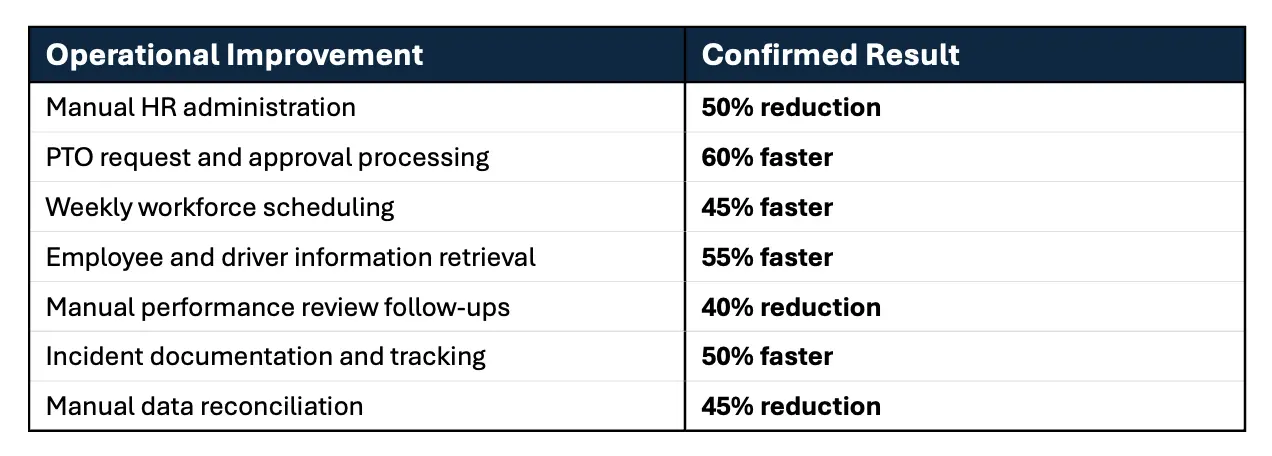
These results highlight the business value of connecting operational workflows through a configurable low-code platform.
For transportation and logistics organizations, workforce information is often distributed across payroll systems, fleet management applications, scheduling tools, spreadsheets, and departmental databases.
This fragmentation can create administrative bottlenecks, limit operational visibility, and make routine workforce activities unnecessarily complex; but, modernizing its Quickbase environment, Wilson Truck Lines established a more connected approach to managing employee and operational information.
The project also demonstrates an important principle of enterprise application modernization: organizations do not always need to replace existing systems to achieve meaningful digital transformation.
Through targeted Quickbase development, workflow automation, and enterprise integration, companies can improve the value of their existing technology investments while creating a more scalable foundation for future innovation.
Why Wilson Truck Lines Partnered With Quandary Consulting Group
As a Quickbase Elite Partner, Quandary Consulting Group helps transportation, logistics, construction, and other operationally complex organizations modernize business applications, automate manual processes, and connect enterprise systems.
Our approach goes beyond application development. We work with organizations to understand how their business processes operate, identify opportunities to improve efficiency, and develop technology solutions that support real operational requirements.
For Wilson Truck Lines, this meant enhancing its existing Quickbase environment to improve workforce management across HR administration, PTO approvals, employee scheduling, driver records, performance reviews, safety documentation, and enterprise data integration.
The results demonstrate how targeted application modernization can produce measurable improvements across multiple departments.
By combining custom Quickbase development, workflow automation, and enterprise integration, Quandary helped Wilson Truck Lines achieve faster processes, reduce manual administration, and improve access to critical workforce information.
The engagement also illustrates how a well-designed low-code application environment can support future innovation, including additional integrations, intelligent automation, and AI-enabled operational workflows.
Future-State Opportunity
Extending Quickbase Workforce Management With AI and Intelligent Automation
Wilson Truck Lines' modernization initiative also creates an opportunity to explore the next generation of transportation workforce management: AI-enabled operational intelligence.
With employee information, scheduling workflows, safety documentation, and connected enterprise systems already supported by Quickbase, the organization has established important building blocks for more advanced automation.
Although artificial intelligence was not included in the original engagement, the modernized Quickbase environment was arlhiectured as the foundation for future AI capabilities.
Through additional assessment, integration, and development, Quandary Consulting Group could help Wilson Truck Lines extend its existing platform using enterprise AI, intelligent agents, and predictive analytics.
1. AI-Powered Workforce Scheduling and Predictive Resource Planning
Transportation companies must continuously balance workforce availability, operational requirements, time-off requests, and scheduling changes.
AI-enabled scheduling capabilities could analyze authorized workforce information, historical scheduling patterns, employee availability, and operational requirements to identify potential conflicts before they disrupt operations.
Potential capabilities include:
- Predicting workforce coverage gaps based on historical staffing patterns.
- Identifying scheduling conflicts involving PTO requests and employee availability.
- Recommending staffing adjustments based on operational requirements.
- Highlighting recurring scheduling inefficiencies.
- Providing supervisors with AI-generated workforce planning summaries.
Future Business Value: More proactive scheduling, improved resource utilization, and reduced manual coordination.
2. AI-Powered Safety Incident Analysis and Risk Identification
Wilson Truck Lines' enhanced incident management workflows create an opportunity to apply AI to safety documentation and operational risk analysis.
With appropriate data access and governance, AI could review historical incident records, identify recurring patterns, and help safety teams recognize emerging concerns.
Potential capabilities include:
- Automatically summarizing incident reports.
- Identifying recurring incident categories and contributing factors.
- Detecting trends across locations, employees, or operational activities.
- Flagging incomplete incident documentation.
- Generating safety reports and management summaries.
AI-generated findings would remain subject to human review, particularly when they could affect employee safety or compliance decisions.
Future Business Value: Faster safety reporting, improved visibility into incident trends, and more proactive risk management.
3. AI-Powered HR and Employee Knowledge Assistants
A future AI assistant could help authorized HR personnel, supervisors, and employees retrieve information from approved workforce records and company knowledge resources.
Using enterprise AI technology such as Claude, combined with secure integrations, Wilson Truck Lines could explore conversational access to HR policies, scheduling procedures, and employee documentation.
For example, authorized users could ask:
- "What is our current PTO approval process?"
- "Which performance reviews require follow-up this month?"
- "What documentation is required for a new driver?"
- "Summarize outstanding workforce administration tasks."
The assistant could retrieve relevant information, provide source references, and help users navigate existing processes without requiring them to search multiple systems manually.
Role-based access, data privacy safeguards, and appropriate security controls would be essential.
Future Business Value: Faster knowledge retrieval, reduced routine HR inquiries, and improved employee self-service.
4. Intelligent Employee Document Processing
Transportation workforce management frequently involves employee records, onboarding documents, certifications, policy acknowledgments, and other administrative materials.
AI-powered document processing could help Wilson Truck Lines automate portions of document intake, classification, and information extraction.
Potential applications include:
- Classifying incoming employee documentation.
- Extracting relevant information from approved forms.
- Identifying missing or incomplete records.
- Routing documents to the appropriate HR workflow.
- Alerting authorized personnel when documentation requires review.
These capabilities could be integrated with Quickbase and existing document management systems, subject to technical and security assessment.
Future Business Value: Reduced document processing effort, improved record completeness, and more efficient administrative workflows.
5. AI Agents for Cross-System Workforce Automation
A particularly valuable future opportunity involves extending the company's existing Quickbase, ADP, and EMDECS connectivity with intelligent workflow automation.
Using an enterprise integration platform such as Workato alongside AI capabilities, Quandary could evaluate opportunities to develop governed AI agents that support approved administrative processes across connected systems.
Potential applications include:
- Identifying discrepancies between authorized workforce records.
- Preparing reconciliation summaries for HR review.
- Flagging incomplete employee information.
- Creating follow-up tasks when records require attention.
- Generating operational reports from connected business systems.
- Routing exceptions to the appropriate personnel for resolution.
Rather than granting AI unrestricted access to enterprise applications, these workflows could operate through defined permissions, validation rules, audit trails, and human approval checkpoints.
Future Business Value: Reduced repetitive work, faster exception management, and more coordinated workforce operations.
The Bigger Opportunity: Moving From Workflow Automation to Workforce Intelligence
Wilson Truck Lines has already demonstrated the value of connecting workforce information and automating administrative processes.
The next opportunity is to explore how that connected information could support more intelligent, proactive decision-making.
Traditional workflow automation helps organizations complete established processes more efficiently; but, an AI-enabled workforce intelligence could build on those processes by helping teams identify patterns, anticipate operational needs, retrieve information, and prioritize activities requiring human attention.
For transportation and logistics organizations, this evolution represents a potential path from reactive workforce administration toward more predictive and data-driven operations.
Quandary's approach is to evaluate AI readiness first, establish appropriate data governance and security controls, and prioritize use cases with clear operational value before introducing new AI capabilities.
Please note: These future-state opportunities are not represented as capabilities delivered in the original Wilson Truck Lines engagement. Any implementation would require a separate technical assessment, agreed project scope, and validation of business requirements.
Our Latest Projects


Services
Industries
© 2026 Quandary Consulting Group 2026. All Rights Reserved.
Privacy Policy