Workflow Automation
Business Process Improvement in 2026: Why AI Changes Everything


TL;DR: Key Takeaways
- Business process improvement is foundational to enterprise AI. Organizations must simplify workflows, standardize data, and establish clear business rules before introducing complex automation and AI agents.
- Process redesign creates more value than simply deploying technology. McKinsey's research identifies workflow redesign as a key differentiator among organizations generating significant value from AI.
- Integration and orchestration connect fragmented operations. Platforms such as Quickbase and Workato help organizations connect data, applications, workflows, and automated processes.
- AI agents expand what organizations can automate. However, autonomous execution requires defined permissions, reliable data, human oversight, and measurable business outcomes.
- Continuous process improvement is essential. Organizations should measure cycle time, transaction costs, exception rates, adoption, and AI performance to ensure improvements deliver sustained results.
How modern organizations are redesigning workflows, eliminating operational inefficiencies, and building the foundation for intelligent automation and enterprise AI.
Business process improvement is entering a new era. For decades, organizations have used business process improvement (BPI) to reduce operating costs, eliminate bottlenecks, standardize workflows, and improve productivity. Those objectives remain important; but, in 2026, the challenge is considerably larger.
Enterprises are investing in generative AI, intelligent automation, AI agents, low-code development, and enterprise integration. Yet many are introducing these technologies into processes that were never designed to support them.
The result? Faster execution of inefficient workflows, more disconnected systems, inconsistent data, and automation that creates as many operational challenges as it solves.
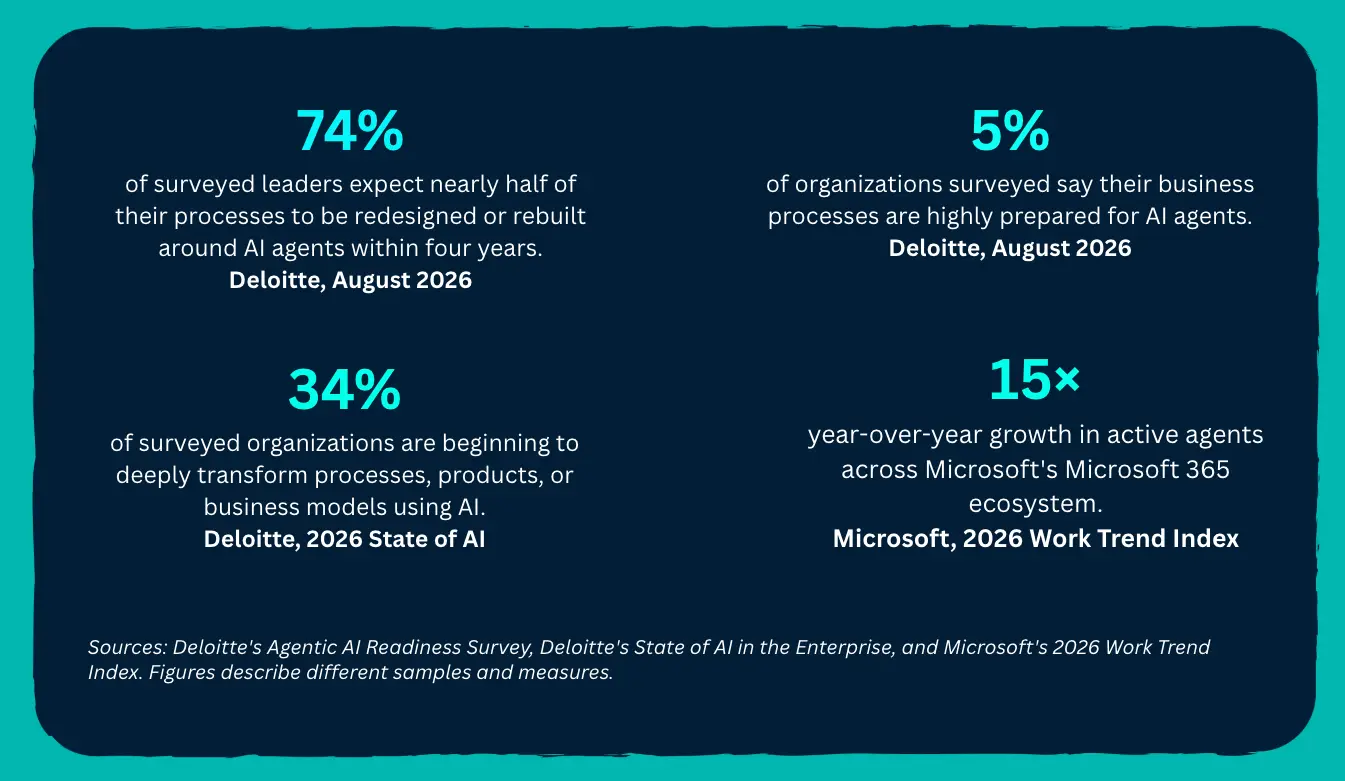
These findings reveal an important distinction: Enterprise AI adoption is accelerating much faster than the business process transformation required to support it.
At Quandary Consulting Group, we see business process improvement as the foundation of intelligent operations. Before an organization automates another task, deploys an AI agent, or introduces another enterprise application, it needs to understand how work actually happens—and whether that process should exist in its current form.
This guide examines the business process improvement methodologies, technologies, and strategies organizations need to modernize operations in 2026 and prepare for 2027.
What Is Business Process Improvement?
Business process improvement (BPI) is the systematic practice of analyzing, redesigning, and optimizing business workflows to improve efficiency, reduce costs, increase quality, strengthen compliance, and deliver measurable business outcomes.
A business process is any repeatable series of activities that produces an operational outcome.
Examples include customer onboarding, procurement, invoice processing, employee credentialing, patient referrals, insurance authorization, project management, vendor management, and financial reporting.
Traditional BPI focuses on reducing waste, eliminating unnecessary steps, improving consistency, and standardizing execution.
Modern business process improvement extends those principles across an increasingly complex technology environment.
Organizations must consider how work moves between employees, enterprise applications, data platforms, integrations, automation tools, AI models, and AI agents.
The objective is no longer simply to make an individual task faster. It is to redesign the entire process around the desired business outcome.
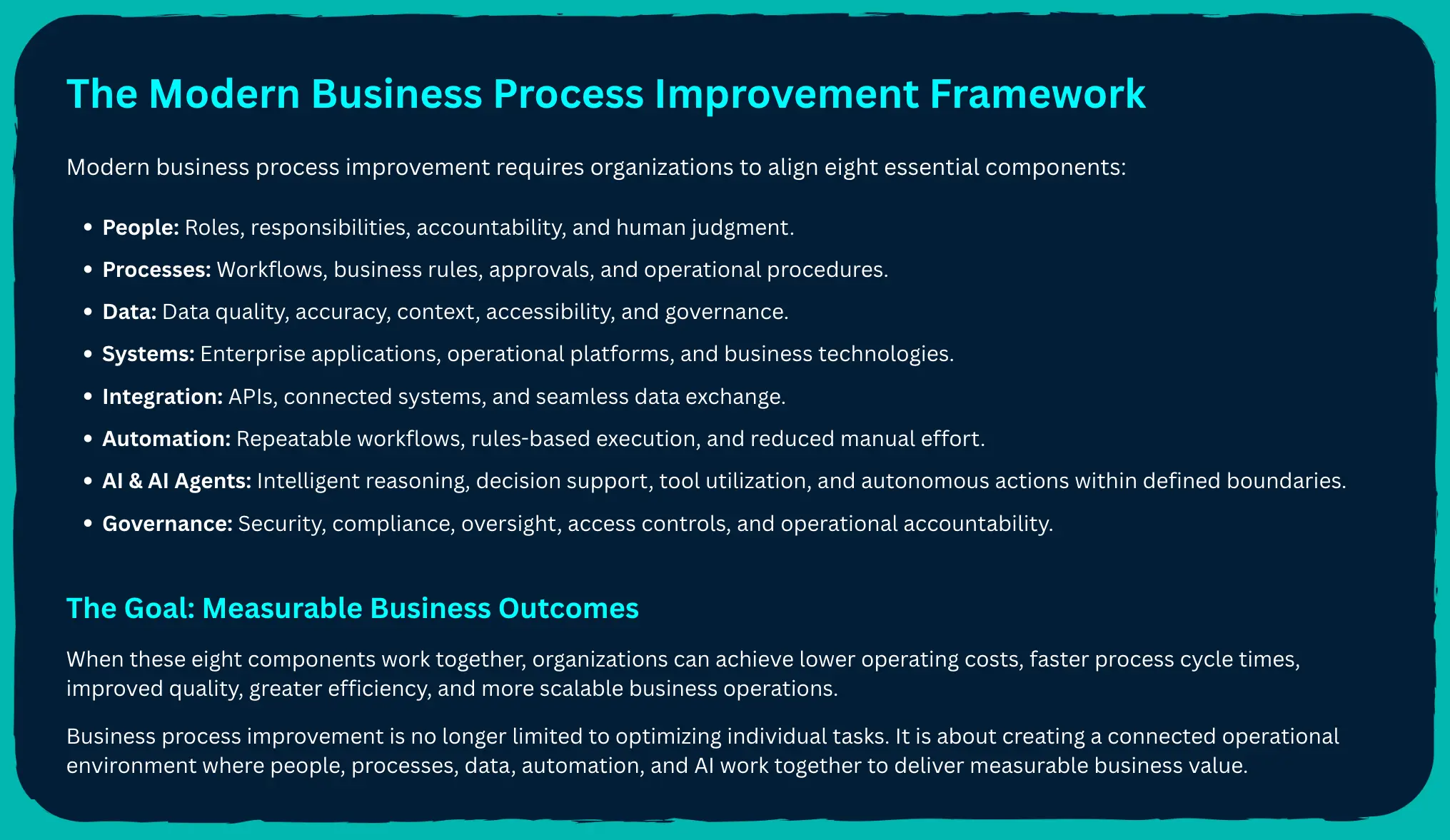
This is why business process improvement increasingly overlaps with enterprise architecture, data strategy, workflow automation, and AI transformation.
Why Business Process Improvement Matters More in the Age of AI
One of the biggest mistakes organizations make with enterprise AI is assuming that new technology will resolve existing operational inefficiencies (and, heads up, It rarely works that way.)
AI can summarize documents, extract information, interpret requests, recommend decisions, and execute certain multistep workflows; but, it cannot automatically resolve conflicting business rules, eliminate unnecessary approvals, determine which disconnected database is authoritative, or establish accountability where none exists.
In fact, deploying AI into fragmented operations can amplify those problems. McKinsey's 2025 State of AI research found that 55% of AI high performers had fundamentally redesigned workflows, compared with just 20% of other surveyed organizations using AI.
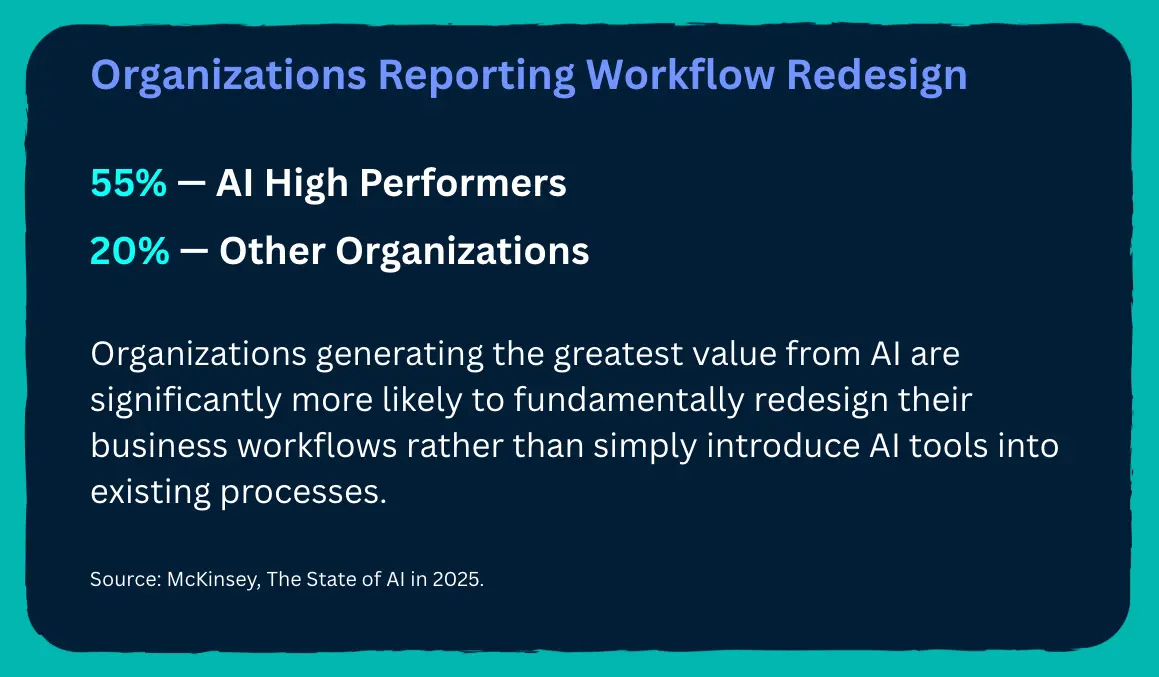
The implication is significant. Organizations achieving greater value from AI are not necessarily the ones deploying the most tools. They are more likely to be redesigning the underlying workflows in which those tools operate.
Consider a traditional procurement process: An employee submits a purchase request. A manager reviews it. Finance verifies the budget. Procurement validates the supplier. Another employee enters the information into an ERP. Someone sends the purchase order, and Finance manually reconciles the invoice later.
Automating individual tasks may reduce administrative effort, but it does not necessarily improve the end-to-end process.
Business process improvement asks a more valuable question:"How should procurement operate if we design the entire workflow around speed, accuracy, compliance, and visibility?"
The redesigned process might automatically validate approved suppliers, retrieve budget information from an ERP, apply rules-based approval thresholds, use AI to extract invoice information, and route exceptions to the appropriate employee.
An AI agent could assist with investigating missing information or coordinating approved follow-up actions, while higher-risk decisions remain subject to human approval.
The result is not simply faster data entry, it is a more connected, measurable, and scalable procurement operation.
BPI vs. BPM vs. BPR vs. Business Process Automation
These terms are related, but they describe different approaches to operational improvement.
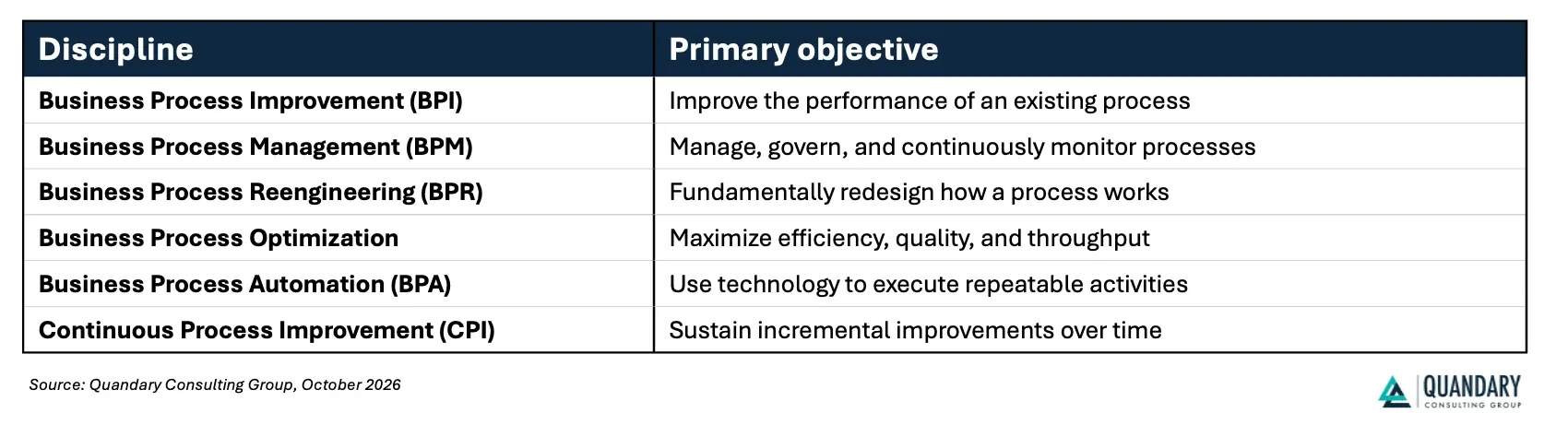
The distinction becomes increasingly important as organizations introduce AI.
A company might use BPI to eliminate unnecessary procurement approvals, BPM to govern the purchasing lifecycle, automation to route purchase orders, and AI agents to assist with exceptions.
These disciplines work best when applied together rather than treated as competing approaches.
How AI Is Changing Business Process Improvement
The introduction of generative AI and agentic AI changes one of the most fundamental questions in process design.
Previously, organizations asked: How can we make this process faster and more efficient? Today, they must also ask: Which parts of this process should be performed by humans, traditional automation, generative AI, or AI agents?
Each has a different role
Humans: Judgment, accountability, and oversight
Employees remain essential for complex decisions, relationship management, negotiations, strategic judgment, regulatory accountability, and high-risk exceptions.
Traditional automation: Consistency and speed
Rules-based automation is effective for predictable tasks such as transferring data, updating records, routing approvals, generating notifications, and synchronizing applications.
Generative AI: Interpretation and knowledge work
Generative AI supports processes involving unstructured information, including document classification, summarization, information extraction, knowledge retrieval, and drafting.
AI agents: Multistep execution
AI agents can select tools, interpret context, coordinate steps, and perform permitted actions across connected applications.
Unlike a traditional automation script, an agent may dynamically determine which approved actions are needed to complete a task; however, greater flexibility introduces additional requirements for security, evaluation, monitoring, and human oversight.
Microsoft's 2026 Work Trend Index, based on research including 20,000 surveyed AI users across ten countries, describes a workplace in which AI agents increasingly support execution while employees direct work and remain accountable for outcomes.
For business leaders, this creates a new operational design challenge: determining the right division of responsibility between people and technology.
From Business Process Automation to Intelligent Process Orchestration
Business process automation and process orchestration are not the same thing.
- Automation executes individual tasks or defined workflows.
- Orchestration coordinates the sequence of work across applications, departments, data sources, integrations, and automation systems.
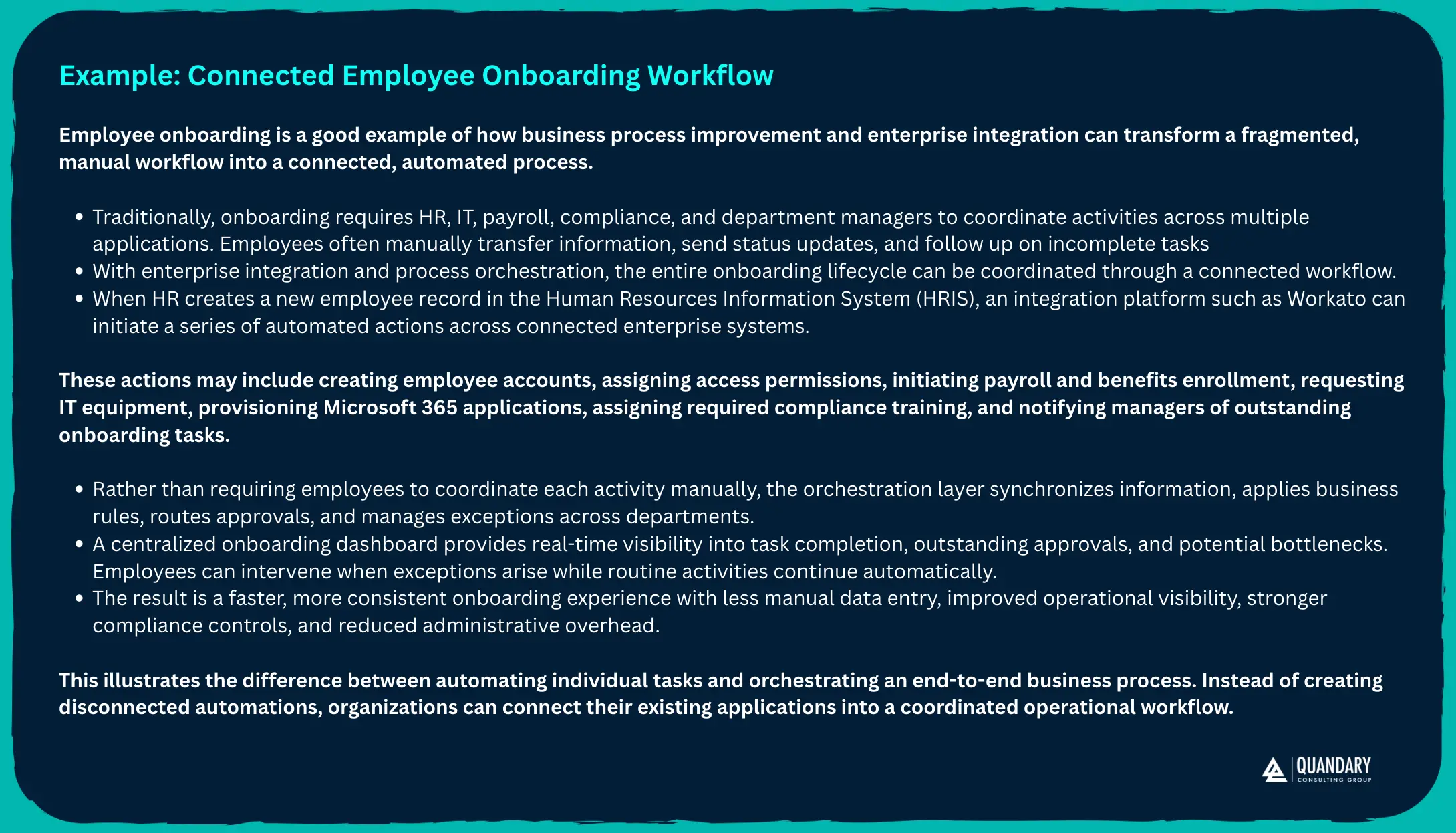
Without orchestration, each department may automate its own activities while employees continue coordinating the overall process through email and spreadsheets.
With orchestration, a new employee record can initiate a coordinated sequence of approved actions across connected enterprise systems.
This is where platforms such as Workato become important. Workato supports integration, API-driven automation, and cross-system workflow orchestration. Its agentic capabilities can extend these workflows with governed AI-driven actions.
The value comes from connecting the entire operational lifecycle rather than automating isolated activities.
Key Signs Your Organization Needs Business Process Improvement
Operational inefficiencies often become normalized as organizations grow. For example, an employees create workarounds, managers add approvals, departments purchase additional applications, and disconnected spreadsheets become permanent fixtures.
Common indicators include:
- Repeated manual data entry: Employees transfer the same information between multiple applications.
- Disconnected spreadsheets: Critical workflows rely on individual files rather than shared operational systems.
- Slow approvals: Transactions remain stalled while employees wait for information or authorization.
- Limited process visibility: Teams cannot determine where work stands without contacting multiple departments.
- Inconsistent data: Different systems maintain conflicting versions of the same customer, vendor, or project information.
- High exception volumes: Employees repeatedly resolve problems that should be addressed through better rules or integration.
- Dependence on individual employees: Essential workflows rely on undocumented institutional knowledge.
- Stalled AI initiatives: AI pilots work in controlled demonstrations but struggle with production data, permissions, and system integration.
The final point deserves particular attention. Deloitte's August 2026 research found that only 15% of surveyed organizations had scaled orchestrated, cross-functional multi-agent adoption.
Most importantly, this challenge is not exclusively AI capability, it is also whether organizations have the process architecture, governance, and connected systems necessary to make that capability operational.
The Business Cost of Inefficient Processes
Poorly designed business processes create costs that extend well beyond employee productivity.
- Manual work increases labor requirements
- Disconnected systems create duplicate records
- Approval bottlenecks delay revenue and procurement
- Inconsistent information introduces compliance risk
- Poor visibility weakens customer experience.
These costs frequently compound across departments. For example, a delay in supplier onboarding may affect procurement, project scheduling, accounts payable, financial forecasting, and vendor relationships.
The true cost of an inefficient process therefore includes both the direct expense of completing a task and the downstream consequences of delays, errors, and rework.
Organizations should evaluate inefficiency across five dimensions: operational cost, cycle time, quality, customer experience, and business risk.
AI readiness adds a sixth dimension: When business processes are fragmented, organizations must spend additional time reconciling data, connecting systems, defining permissions, and establishing reliable execution paths before AI can produce meaningful results.
The Most Effective Business Process Improvement Methodologies
Established improvement methodologies remain highly relevant in 2026. What has changed is the technology available to support their application.
Lean Process Improvement: Lean focuses on eliminating activities that do not create value for the customer or business. It is especially effective for identifying unnecessary handoffs, waiting periods, duplicate activities, excessive approvals, and rework.
Six Sigma and DMAIC: Six Sigma focuses on reducing variation and improving quality through measurement and statistical analysis. Its DMAIC framework—Define, Measure, Analyze, Improve, Control—provides a structured approach to identifying and correcting process problems. Organizations can strengthen DMAIC with process mining, operational analytics, and automation performance data.
Kaizen (aka Continuous Improvement): Kaizen emphasizes ongoing incremental improvements rather than relying exclusively on large transformation projects. This approach is particularly valuable because employees closest to a process often identify operational friction before leadership sees it in reporting.
Root cause analysis and the 5 Whys: Root cause analysis and the 5 Whys helps organizations distinguish symptoms from underlying problems. For example, delayed invoice approvals may appear to be a staffing issue. Further investigation might reveal missing supplier information, disconnected systems, or inconsistent approval rules. Adding employees would address the symptom. Improving the process would address the cause.
Value stream mapping and process mining: Value stream mapping documents the flow of work and information required to deliver a business outcome. Process mining uses event logs from enterprise applications to analyze how workflows actually execute. Together, these approaches help organizations compare documented procedures against operational reality and identify where automation or AI could create measurable value.
Nine Steps to Improve Business Processes in 2026
Effective business process improvement requires more than identifying inefficiencies and selecting new software. It requires a structured approach that connects operational strategy, technology architecture, implementation, and measurement.
1. Define the business outcome: Establish the specific problem and desired improvement. Examples include reducing invoice processing time, improving referral conversion, shortening employee onboarding, or lowering cost per transaction.
2. Map the end-to-end workflow: Document employees, departments, systems, approvals, business rules, integrations, exceptions, and customer touch points. Include how work actually happens, not just how standard operating procedures describe it.
3. Measure current performance: Establish baseline cycle times, processing costs, error rates, throughput, employee hours, and exception volumes. Without a baseline, organizations cannot reliably quantify improvement.
4. Identify root causes: Use process mining, employee interviews, data analysis, Lean, and root cause analysis to determine why inefficiencies exist.
5. Simplify before automating: Eliminate unnecessary steps, consolidate approvals, standardize rules, and reduce duplicate data entry before introducing new technology.
6. Assign work to humans, automation, and AI: Use deterministic automation for predictable tasks, generative AI for suitable unstructured information, agents for governed multistep work, and employees for accountability and higher-risk judgment.
7. Connect enterprise systems: Establish reliable integration between ERP, CRM, HRIS, financial systems, operational applications, data platforms, and AI tools.
8. Deploy with governance and monitoring: Introduce redesigned workflows in controlled stages. Define access permissions, audit trails, escalation procedures, human approvals, and AI evaluation requirements.
9. Continuously measure and improve: Monitor whether the process is delivering the intended outcomes. Identify new bottlenecks, measure adoption, and refine automation and AI capabilities as operational requirements change.
The sequence matters, because organizations that automate before understanding the underlying process risk institutionalizing unnecessary complexity.
How Quickbase, Workato, and AI Support Modern Process Improvement
Business process improvement increasingly requires an integrated technology architecture rather than a single application. At Quandary Consulting Group, our approach connects business process analysis with the systems and technologies needed to operationalize the redesigned workflow.
Quickbase: Operational applications and process visibility; Quickbase supports the development of tailored operational applications, structured workflows, approval processes, dashboards, and centralized records. It can be especially useful when unique business requirements do not fit neatly within standard enterprise software.
Workato: Enterprise integration and orchestration. Workato connects applications, APIs, data sources, and workflows. It helps organizations reduce manual data movement and coordinate processes across otherwise disconnected systems.
Generative AI: Information processing and decision support. AI can assist with document extraction, classification, knowledge retrieval, summarization, and recommendations when appropriate data quality and evaluation controls are in place.
Enterprise MCP and AI agents: Governed access and execution. Model Context Protocol (MCP) provides a standardized interface through which AI applications can interact with tools and resources. Combined with enterprise identity, authorization, integration, and governance controls, it can help organizations expose approved business capabilities to AI agents.
These technologies are all complementary.
Quickbase can provide the operational application. Workato can coordinate the connected workflow. AI can interpret information. An agent can perform approved multistep actions. Human employees retain accountability and control.
The objective is not to introduce more technology into the business, it is to create a connected operating environment in which technology supports a better-designed process.
Three Real-World Business Process Improvement Examples
The value of process improvement becomes clearer when organizations measure what changes after implementation.
1. Procurement: Connecting a $600 Million Purchasing Environment
In a procurement environment supporting approximately $600 million in annual purchasing, Quandary's work with Jacobs involved connecting processes and technologies including Quickbase, Workato, Microsoft 365, Oracle, and document-processing capabilities.
The objective was to support more connected procurement operations across systems and stakeholders. Rather than treating approvals, purchasing, document handling, and reporting as isolated activities, the approach supported a more integrated procurement lifecycle.
The lesson: Procurement improvement requires visibility and coordination across the entire process—not simply faster purchase-order entry.
To read the full Quandary Case Study, visit: Jacobs Procurement Automation Cuts Operational Headcount by 57% While Managing $600M in Annual Spend
2. Financial Services: Reducing Due Diligence Reporting Time by 50%
A private-equity due diligence workflow involved document-intensive analysis and reporting.
Quandary's AI-enabled approach used retrieval-augmented generation and redesigned information workflows to support document analysis and report preparation.
The project material reports approximately:
- 50% Reduction in Reporting Time
- 3× Analyst Capacity
This illustrates how process improvement can extend beyond repetitive administrative tasks into complex knowledge work.
To read the full Quandary Case Study, visit: AI-Powered Financial Due Diligence Cuts Reporting Time by 50% for a San Francisco PE Firm
3. Vendor Management: Approximately $72,000 in Annual Savings
A facilities-management organization working with more than 5,000 vendors needed greater visibility into invoicing and vendor-related processes.
A centralized invoicing portal replaced fragmented manual activities and improved operational visibility. The project material reports approximately $72,000 in annual savings.
The value came from centralizing information, reducing process fragmentation, and improving the way employees managed vendor transactions.
To read the full Quandary Case Study, visit: Jacobs Saves $72K Annually With Custom Invoice Workflow Automations Using Workato + Quickbase
Why Business Process Improvement Initiatives Fail
Even well-funded improvement initiatives can struggle to deliver lasting results.
The most common problems are not necessarily technical. Organizations frequently select technology before defining the business problem, automate unnecessary steps, exclude employees from process design, or measure implementation activity instead of operational outcomes.
Other initiatives fail because data quality, integration dependencies, security, and governance are addressed too late.
AI introduces additional complexity. Deloitte's 2026 State of AI research reports that only about one in five surveyed organizations has mature governance for autonomous AI agents.
This creates a significant risk for organizations attempting to move from AI experimentation to production execution. Successful process improvement requires alignment between business leadership, operational employees, IT, data owners, security teams, and implementation partners.
Technology is one component of the solution and organizational readiness is another.
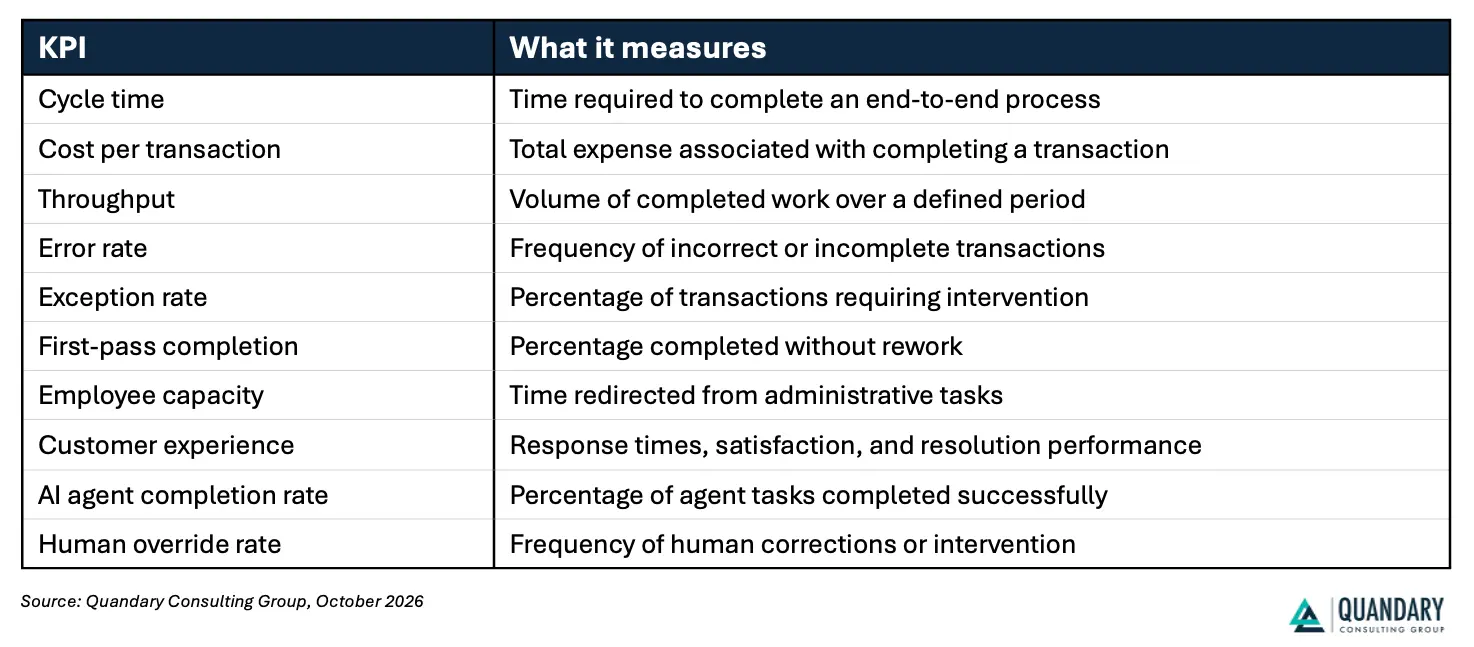
How to Measure Business Process Improvement ROI
Organizations should evaluate process improvement using operational and financial outcomes—not the number of workflows or AI agents deployed.
Business Process Improvement ROI Formula: ROI (%) = [(Annual Benefits − Annualized Costs) ÷ Annualized Costs] × 100
For example, an organization that realizes $250,000 in annual measurable benefits from a redesigned process at an annualized cost of $100,000 would generate a calculated ROI of 150%.
Please note: This example is illustrative, not a Quandary client result.
For AI-enabled workflows, measurement should also include accuracy, evaluation performance, escalation rates, policy violations, and cost per successfully completed transaction.
The goal is to determine whether the business process performs better—not simply whether the technology functions.
Preparing for 2027: From Workflow Automation to Intelligent Operations
As enterprises plan for 2027, business process improvement will increasingly become a prerequisite for scaling agentic AI.
Deloitte's August 2026 research found that 75% of surveyed leaders believe human collaboration with AI agents creates more value than agent-powered automation alone.
This reinforces an important point: The future of process improvement is not simply removing employees from workflows.
It is designing more effective collaboration between people, systems, automation, and AI. Organizations preparing for the next stage of enterprise AI should prioritize process standardization, data quality, integration architecture, AI governance, and measurable operational performance.
They should also establish clear ownership for AI-enabled workflows, including which decisions require approval, what actions agents can perform, and how exceptions are escalated.
The companies best positioned to scale AI will be those capable of continuously redesigning work as business requirements and technology evolve.
Business Process Improvement Is Becoming an Enterprise AI Capability
Business process improvement has always been about helping organizations operate more effectively; but, hat has changed is the range of capabilities available to redesign work.
- Low-code platforms can support tailored operational applications
- Enterprise integration can connect fragmented systems
- Intelligent automation can eliminate repetitive activities
- Generative AI can support information-intensive work
- AI agents can coordinate and execute approved multistep tasks.
But none of these capabilities eliminates the need to understand the underlying business process.
At Quandary Consulting Group, we help organizations assess, redesign, integrate, automate, and continuously improve business operations through connected technology and practical implementation.
Our work spans business process analysis, Quickbase development, Workato integration, intelligent automation, enterprise AI, and agentic orchestration.
The goal is never to automate more work, it's to eliminate unnecessary work, improve the work that remains, and build operations capable of adapting to what comes next.
Ready to improve your business processes? Connect with Quandary Consulting Group to identify operational bottlenecks, evaluate automation opportunities, and build a practical roadmap for connected, AI-ready operations.
References and Additional Resources:
- Microsoft 2026 Work Trend Index Annual Report (Microsoft, May 2026)
- The State of AI in the Enterprise, Deloitte's 2026 AI report tracking adoption and impact (Deloitte, January 2026)
- The state of AI in 2025: Agents, innovation, and transformation (Deloitte, January 2025)
- Governing workforce data as a product: From oversight to ownership (Deloitte, August 2026)
- What is the Model Context Protocol (MCP)? (Version 2026-07-28)
- What is process mining? (IBM)
- Value Stream Mapping (Lean Enterprise Institute)
- Continuous Improvement (Lean Enterprise Institute)
- The Five Whys: Understanding the Root Cause of a Problem (Six Sigma US)
- DMAIC: Approach to Continuous Improvement (Six Sigma US)
- Lean process improvement: What is it and how to apply it to projects (Atlassian)
- AI Agents are Only the Beginning: Deloitte Survey Examines the AI Readiness Gap and Reveals How Enterprises Can Prepare for Agentic Success (Deloitte, August 2026)
- Six Sigma Simplified: Understanding Its Principles for Business Excellence (Six Sigma Online)
- The Practical Guide to Maintenance Excellence: A Modern Playbook for Operations (IBM)
Frequently Asked Questions About Business Process Improvement
What is business process improvement?
Business process improvement (BPI) is the structured practice of analyzing, redesigning, and optimizing workflows to reduce costs, eliminate inefficiencies, improve quality, and deliver measurable business outcomes. Modern BPI also considers how integration, automation, and AI can improve end-to-end operations.
What are the five basic steps of business process improvement?
The five basic steps are mapping the existing process, measuring performance, identifying root causes, redesigning and implementing improvements, and continuously monitoring results. More complex enterprise initiatives also require data integration, change management, and governance.
What is an example of business process improvement?
An accounts payable department might replace manual invoice entry and email approvals with an integrated workflow that extracts invoice data, validates purchase orders, routes approvals automatically, and escalates exceptions. The redesigned process can reduce processing time, improve accuracy, and provide better financial visibility.
What is the difference between BPI and BPM?
Business process improvement focuses on improving specific workflows, while business process management governs the broader lifecycle of process design, execution, monitoring, and continuous optimization. BPI is often one component of an organization's BPM strategy.
How does AI improve business processes?
AI can improve business processes by interpreting documents, classifying information, retrieving knowledge, generating recommendations, and assisting with decisions. AI agents can also coordinate multistep tasks across connected applications when appropriate permissions, controls, and oversight are established.
What is the difference between business process improvement and automation?
Business process improvement determines how work should be performed. Business process automation uses technology to execute repeatable activities within that process. Organizations should generally simplify and improve workflows before automating them.
What business processes should companies automate first?
Organizations should prioritize high-volume, repetitive workflows with measurable costs, frequent errors, predictable business rules, and significant manual handoffs. Common candidates include invoice processing, customer onboarding, procurement approvals, employee onboarding, and reporting.
What is process mining?
Process mining analyzes event logs from enterprise applications to reconstruct and evaluate how business processes actually execute. It helps organizations identify bottlenecks, rework, process variations, compliance deviations, and opportunities for improvement or automation.
How do AI agents change business process improvement?
AI agents expand process improvement beyond fixed rules-based automation by supporting contextual reasoning, tool selection, and approved multistep execution. Their effectiveness depends on reliable enterprise data, clear business rules, connected systems, governance, and human oversight.
Why should organizations improve processes before implementing AI?
Organizations should improve processes before implementing AI because inconsistent data, unnecessary approvals, disconnected applications, and unclear responsibilities can undermine AI performance. Process redesign establishes the operational structure needed for reliable and measurable AI execution.
Can Quickbase improve business processes?
Yes. Quickbase can help organizations digitize workflows, centralize operational information, manage approvals, develop custom business applications, and provide real-time process visibility. It is particularly useful for processes that require more flexibility than standard enterprise applications provide.
How does Workato support business process improvement?
Workato supports business process improvement by connecting enterprise applications, automating data movement, coordinating workflows, and orchestrating processes across systems. Its AI and agentic capabilities can extend those workflows with governed AI-driven actions.
How do you calculate business process improvement ROI?
Business process improvement ROI compares measurable financial benefits with implementation and ongoing operating costs. Benefits may include labor savings, reduced errors, shorter cycle times, improved revenue conversion, and avoided expenses. Organizations should establish baseline metrics before implementation and measure results after deployment.
When should a company hire a business process improvement consultant?
A company may benefit from a process improvement consultant when workflows span multiple departments, employees rely heavily on manual work, systems are disconnected, operational costs are rising, or internal teams lack the capacity to redesign and implement improvements. Consulting support is also valuable when organizations are preparing complex workflows for automation or AI.