Artificial Intelligence (AI)
The Role of AI in Healthcare Revenue Cycle Management


TL;DR
- AI is transforming healthcare revenue cycle management by automating repetitive financial workflows, analyzing complex data, improving accuracy, and enabling staff to focus on higher-value activities.
- Technologies such as machine learning, OCR, natural language processing, generative AI, and agentic AI can improve eligibility verification, prior authorization, coding, claims processing, denial prevention, payment collection, compliance, and patient communication.
- Healthcare organizations can achieve stronger cash flow, lower administrative costs, and better patient experiences when AI adoption is supported by clear strategy, system integration, governance, human oversight, and continuous performance measurement.
Artificial intelligence (AI) is rapidly transforming revenue cycle management (RCM) by enabling healthcare organizations to streamline, automate, and enhance core financial workflows. At its core, AI leverages advanced algorithms and machine learning to reduce reliance on manual, time-intensive processes that are often prone to error. In doing so, it allows revenue cycle teams to redirect their efforts toward higher-value, strategic activities.
Beyond automation, AI offers the ability to analyze large and complex datasets at scale. This enables organizations to uncover actionable insights, optimize revenue capture, and improve overall cash flow performance.
A range of AI technologies—including machine learning, optical character recognition (OCR), large language models (LLMs), generative AI, and emerging agentic AI—can be applied across the revenue cycle. Each plays a distinct role in improving efficiency, accuracy, and decision-making. This paper outlines key use cases and demonstrates how the thoughtful deployment of AI can materially enhance RCM performance.
AI is rapidly transforming revenue cycle management by enabling healthcare organizations to streamline, automate, and enhance core financial workflows.
At its core, AI leverages advanced algorithms and machine learning to reduce reliance on manual, time-intensive processes that are often prone to error. In doing so, it allows revenue cycle teams to redirect their efforts toward higher-value, strategic activities.Beyond automation, AI offers the ability to analyze large and complex datasets at scale. This enables organizations to uncover actionable insights, optimize revenue capture, and improve overall cash flow performance.
A range of AI technologies—including machine learning, optical character recognition (OCR), large language models (LLMs), generative AI, and emerging agentic AI—can be applied across the revenue cycle. Each plays a distinct role in improving efficiency, accuracy, and decision-making.
This post outlines key use cases and demonstrates how the thoughtful deployment of AI can materially enhance RCM performance.
How AI is Used in Revenue Cycle Management
Healthcare providers are increasingly leveraging AI to automate processes, improve accuracy, and enhance workforce productivity across the revenue cycle. Common applications include eligibility verification, patient engagement, claims processing, compliance monitoring, and fraud detection.
AI-driven analytics further support financial performance by enabling organizations to forecast revenue, predict payment behavior, and proactively reduce claim denials. These capabilities allow teams to move from reactive to predictive revenue cycle management.
By automating repetitive and time-consuming tasks, AI enables staff to focus on more complex and strategic responsibilities, such as resolving high-value claims, improving patient financial experiences, and negotiating with payers. The result is a more efficient and resilient RCM function that integrates human expertise with technological precision.
The growing interest in AI is also driven by broader industry challenges, including workforce shortages, rising costs of care, declining reimbursement rates, and increasing pressure to reduce administrative expenses. AI presents a viable pathway to address these structural issues while improving operational outcomes.
What is Revenue Cycle Management (RCM)?
Revenue Cycle Management (RCM) is the process businesses—most commonly in healthcare—use to track and manage the financial flow from the moment a service is provided to when payment is fully collected.
At its core, it connects clinical/operational work to actual revenue. For example, a simple breakdown of a full RCM workflow in healthcare can look similar to:
- Patient Registration / Customer Intake: Collect basic info (name, insurance, demographics).
- Insurance Verification & Eligibility: Confirm coverage and what’s billable.
- Coding & Charge Capture: Translate services into standardized billing codes.
- Claim Submission: Send the bill to the insurance company (or payer).
- Adjudication (Processing by Payer): Insurance decides what they’ll pay vs. what they won’t.
- Payment Posting: Payments are recorded in the system.
- Denial Management: Fix and resubmit rejected claims.
- Patient Billing & Collections: Bill the patient for remaining balances and collect payment.
The Emergence of Agentic AI in Revenue Cycle Management (RCM)
While traditional AI tools have delivered incremental improvements, the emergence of agentic AI represents a step-change in capability. Unlike earlier solutions that rely heavily on human oversight or provide decision support, agentic AI systems can autonomously execute tasks, interact across systems, and manage workflows end-to-end.
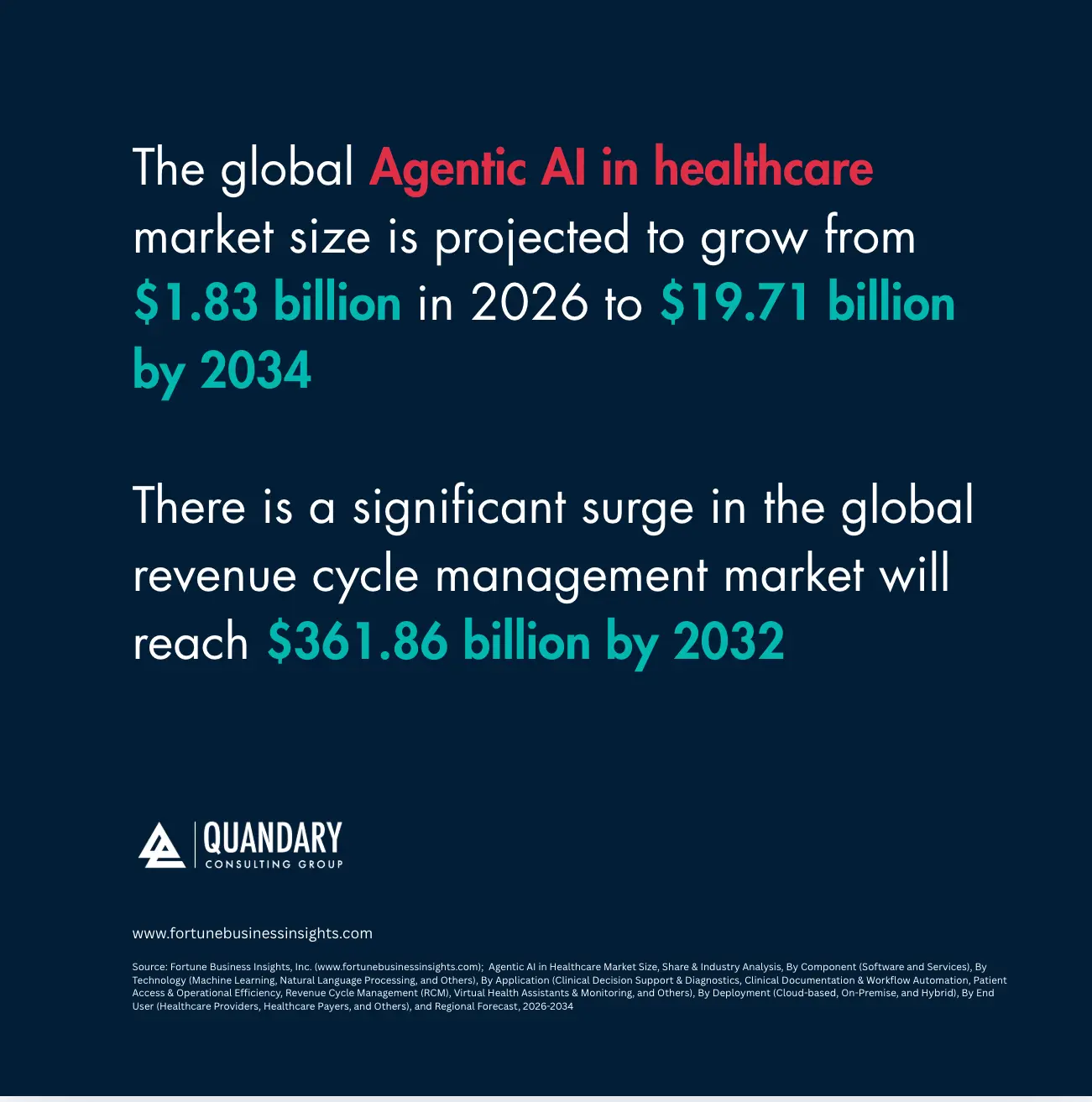
This capability is particularly valuable in high-volume, rules-driven areas of the revenue cycle, such as patient billing inquiries, insurance verification, and payment follow-ups. By autonomously managing these processes, agentic AI can significantly reduce administrative burden, accelerate cycle times, and deliver measurable return on investment.
As a result, agentic AI is becoming a focal point for RCM leaders seeking scalable, sustainable efficiency gains.
RCM Automation vs. AI
Traditional revenue cycle automation focuses on executing predefined, rule-based tasks with minimal human intervention. Technologies such as robotic process automation (RPA) are well-suited for structured activities like data entry, eligibility checks, and claim scrubbing. These solutions have already demonstrated significant cost-saving potential across the healthcare system.
However, many RCM processes (such as denial management) are inherently complex and cannot be fully addressed through static rules alone.
AI extends beyond automation by introducing learning, adaptability, and decision-making capabilities. AI systems can continuously analyze data, identify patterns, and adjust their behavior over time without explicit programming. This enables them to handle more nuanced and dynamic workflows.
For example, while automation can reduce data entry errors through predefined validations, AI can proactively identify claims at risk of denial and recommend corrective actions before submission. Together, automation and AI create a more intelligent and proactive revenue cycle function.
Strategic Objectives of AI in Revenue Cycle Management
In an environment characterized by rising costs and declining reimbursements, healthcare organizations are prioritizing efficiency, accuracy, and financial performance. AI supports these objectives across several dimensions:
- Revenue acceleration: Enhancing payer and patient collections through automated follow-ups, intelligent workflows, and personalized billing strategies
- Cash flow optimization: Reducing days in accounts receivable (A/R), improving point-of-service collections, and minimizing missed charges
- Data-driven decision-making: Leveraging predictive analytics to identify revenue leakage and optimize financial performance in real time
- Operational efficiency: Streamlining administrative processes such as insurance verification and financial data review
- Workforce enablement: Reducing manual workload and burnout while enabling staff to focus on higher-value activities
- Patient experience improvement: Simplifying billing, increasing transparency, and offering flexible payment options
- Accuracy and compliance: Reducing errors, improving claim quality, and strengthening fraud detection and regulatory adherence
- Enhanced oversight: Enabling real-time monitoring of key performance indicators and faster identification of anomalies
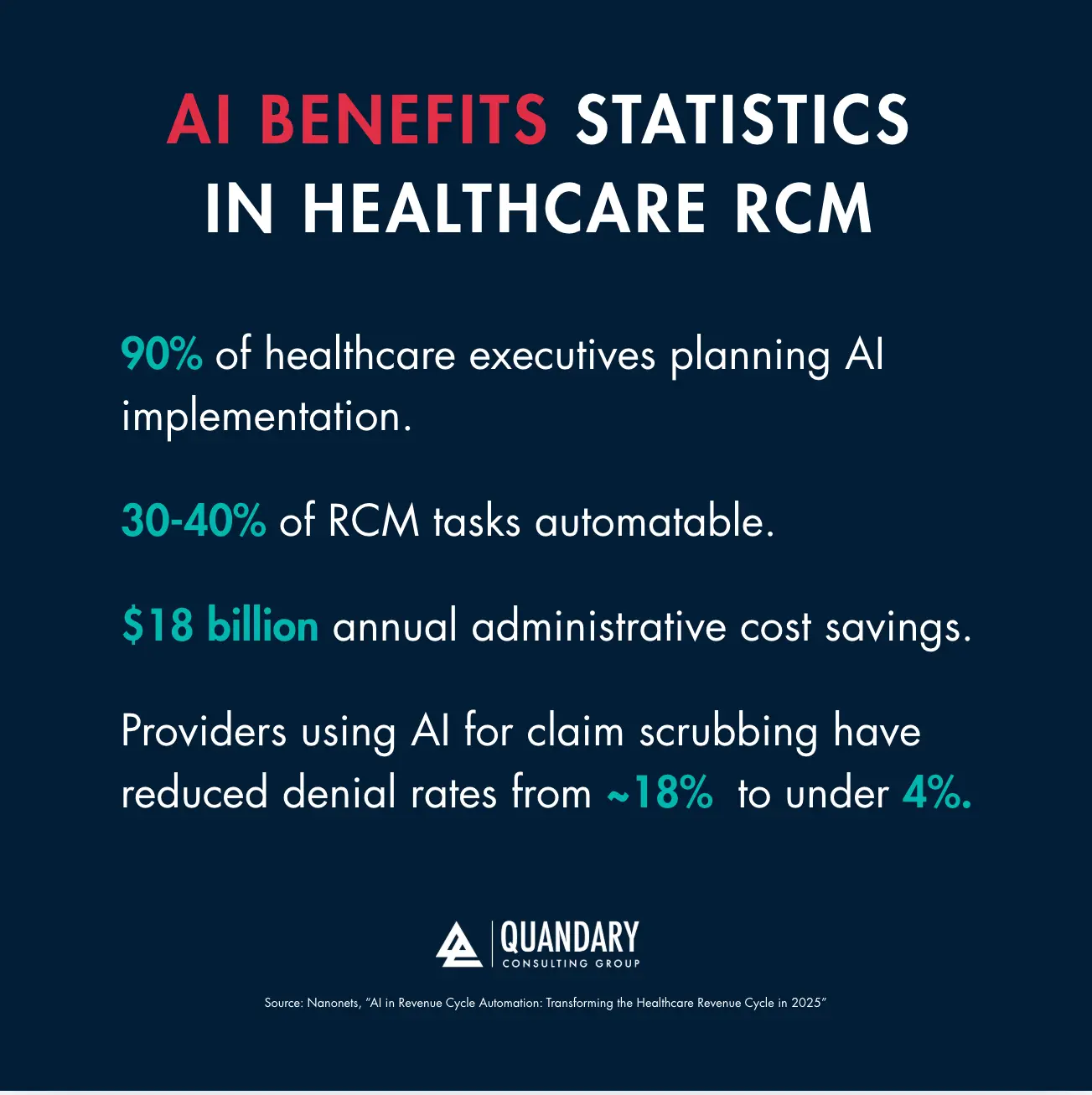
AI has the potential to significantly reduce administrative costs across the healthcare system, with estimates suggesting savings of up to $175 billion annually.
Key AI Technologies Used in Revenue Cycle Management
Healthcare organizations use a suite of AI technologies to enhance RCM. These include automation, machine learning, document processing, and intelligent agents.
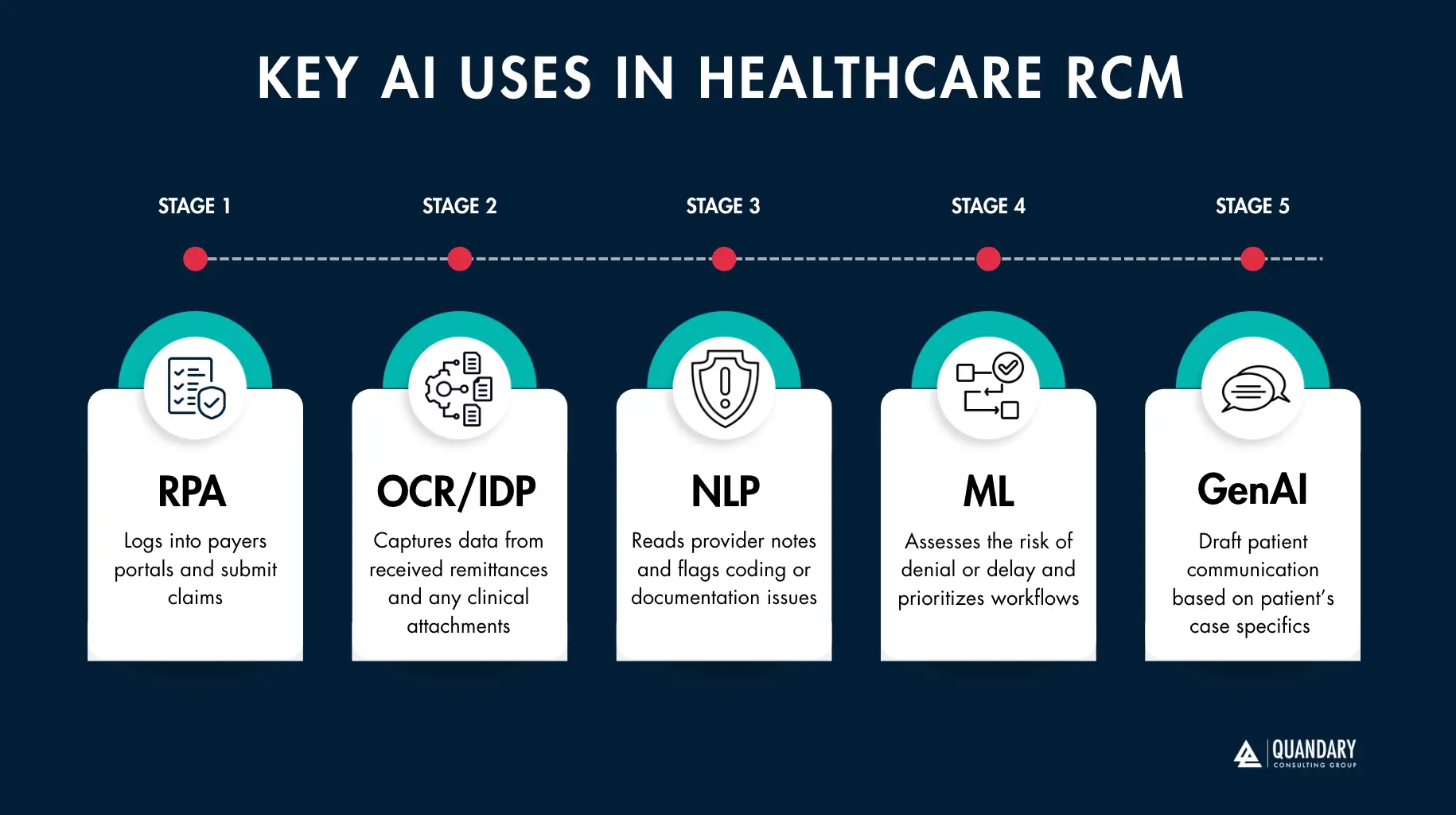
Robotic Process Automation: Uses software bots to copy data, enter information into portals, or click through workflows. It handles repetitive tasks and keeps them fast and consisten
Machine Learning (ML) adds prediction. It looks at past data to spot likely denials, underpayments, or patients who may not pay. This helps staff focus on targeting problems even before they arise.
Natural Language Processing (NLP) Reads notes, charts, and documents. It pulls out key details like diagnoses and procedures to support coding and documentation.
Optical Character Recognition (OCR) and Intelligent Document Processing: Turns messy files into usable data. They work on PDFs, faxes, and images. These tools pull patient and claim details from EOBs, referral letters, and other documents.
Generative AI: Helps write foundational text. It generates appeal letters, prior authorization narratives, and patient communications. Human reviewers check and approve the content before it’s submitted.
Modern RCM: Uses a combination of these AI technologies to reduce manual effort and increase accuracy.
The technologies work together, creating smarter, faster, and more adaptable revenue workflows that speeds up payment and improves the overall patient experience.
Regulatory and Industry Changes Driving AI Adoption
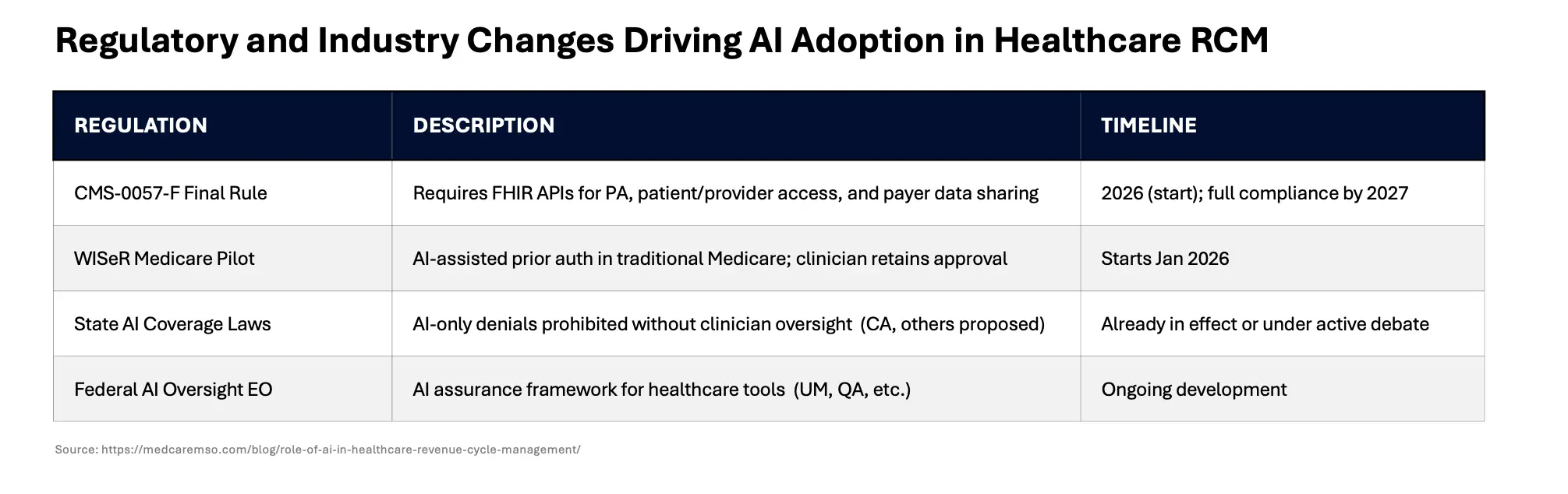
New rules are shaping how healthcare uses AI in revenue cycle management. Here are the key updates:
CMS Interoperability & Prior Authorization (CMS-0057-F): Payers must implement FHIR‑based Patient and Provider Access APIs that include prior authorization data (excluding drugs), with full compliance by January 1, 2027; Some operational requirements begin in 2026.
Medicare Pilot (WISeR Model): Starting January 2026, CMS will run the WISeR model in Arizona, New Jersey, Ohio, Oklahoma, Texas, and Washington, using AI tools plus clinician oversight to expedite prior authorization decisions on select procedures.
Federal Oversight: A 2023 Executive Order directed HHS to create an AI assurance policy for healthcare, setting expectations for safe and responsible AI deployment.
Key Applications of AI Across the Revenue Cycle
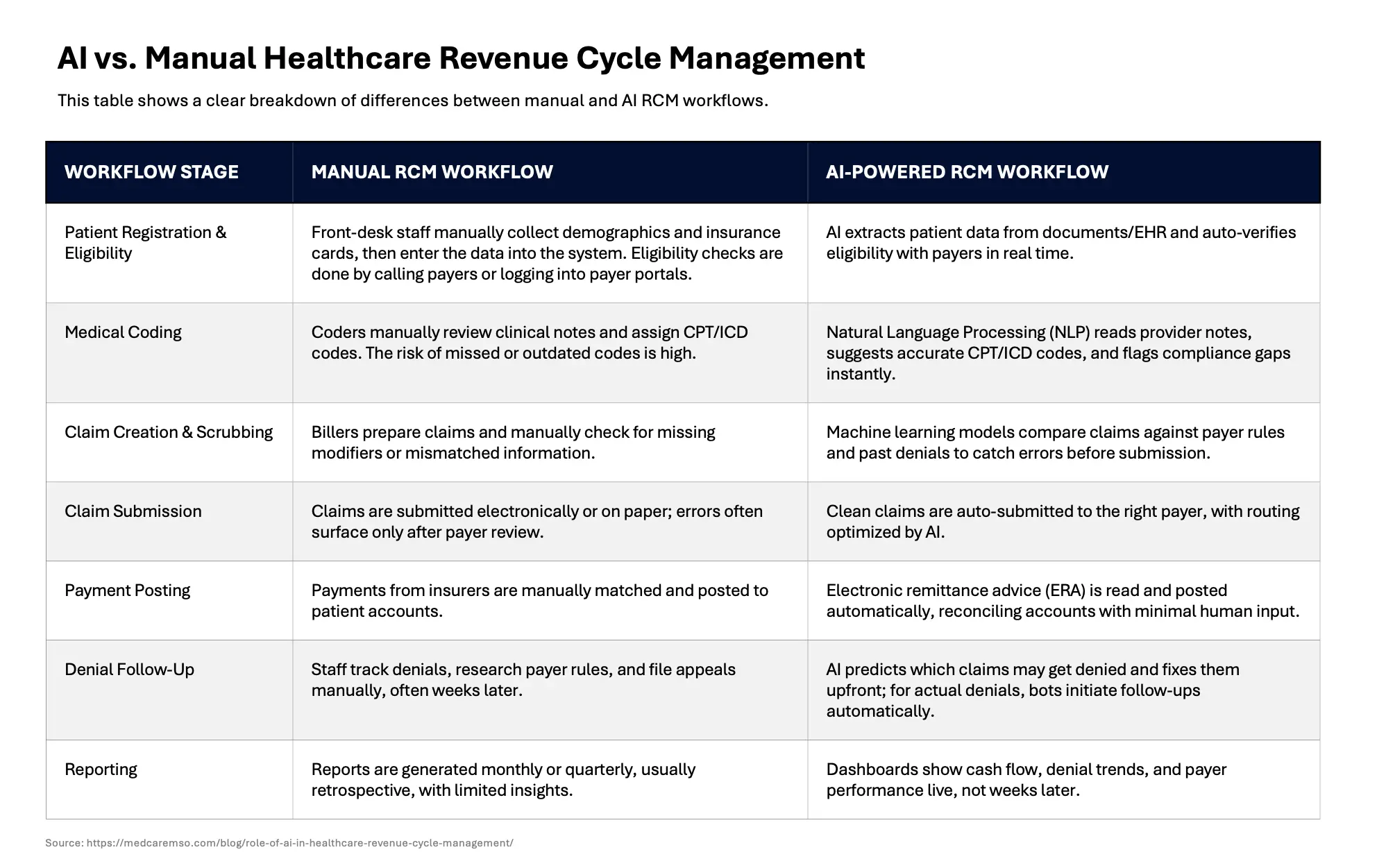
AI is increasingly embedded across every stage of the revenue cycle, from patient access through final payment. Common applications include:
Patient Billing Accuracy: AI improves billing accuracy by automating workflows such as eligibility verification, prior authorization, and payment posting. It reduces errors, enhances charge capture, and enables real-time monitoring of billing performance. Additionally, AI can identify patterns in denials and recommend corrective actions to prevent recurrence.
Medical Coding Efficiency: AI-powered coding solutions analyze clinical documentation to recommend accurate codes and identify missed charges. These tools improve coding consistency, increase productivity, and enhance key metrics such as clean claim rates and days in A/R. They can also support workforce training by providing real-time feedback and education.
Patient Payment Estimation: By analyzing historical and real-time data, AI enables more accurate patient payment predictions. It can identify patients at risk of non-payment and recommend tailored financial solutions, improving both patient satisfaction and revenue realization.
Benefits Verification and Prior Authorization: AI enhances data accuracy and reduces administrative friction by automating insurance verification and prior authorization processes. These tools help ensure that coverage details, deductibles, and copayments are accurate and accessible to both staff and patients.
Patient Billing Support: AI-powered chatbots and virtual agents extend support capabilities beyond traditional hours, providing real-time assistance to patients. Advanced AI agents can resolve inquiries, collect payments, and even establish personalized payment plans with minimal human intervention.
Personalized Patient Communications: AI enables targeted, timely communication with patients, including appointment reminders, payment notifications, and cost estimates. These capabilities improve transparency, increase engagement, and reduce confusion around healthcare costs.
Claims Processing: AI streamlines claims submission and management by identifying errors, tracking claim status, and predicting denial risk. OCR and automation technologies further reduce manual workload by digitizing and standardizing claim data.
RCM Operations and Workforce Enablement: AI also supports internal operations by improving training, performance management, and decision-making. For example, AI-driven tools can help standardize best practices and elevate the performance of less experienced staff.
The Future of AI in Revenue Cycle Management
Adoption of AI in RCM is accelerating, with a majority of healthcare organizations actively evaluating new technologies. While the potential benefits are substantial, successful implementation requires a disciplined approach, including strong governance, integration with existing systems, and ongoing oversight.
When deployed effectively, AI has the potential to fundamentally transform revenue cycle operations—delivering improved financial performance, enhanced patient experiences, and more sustainable workforce models.
How Quandary Consulting Group Can Help
Realizing the full value of AI in revenue cycle management requires more than technology—it demands a clear strategy, thoughtful implementation, and ongoing optimization. Many organizations struggle not with identifying opportunities, but with operationalizing them in a way that delivers measurable and sustainable results.
Quandary Consulting Group partners with healthcare organizations to bridge this gap. By combining deep revenue cycle expertise with a pragmatic approach to digital transformation, Quandary helps clients identify high-impact use cases, select and implement the right technologies, and redesign workflows to maximize efficiency and performance.
From initial assessment through implementation and continuous improvement, Quandary works alongside your team to ensure AI initiatives are aligned to your strategic priorities, integrated seamlessly into your existing ecosystem, and positioned to deliver tangible ROI.
To learn about how Quandary Consulting Group has helped Healthcare clients implement AI into their RCM, please visit our Case Studies
Top FAQs About Using AI in Healthcare Revenue Cycle Management
What is AI in revenue cycle management?
AI in revenue cycle management uses technologies such as machine learning, natural language processing, generative AI, and intelligent automation to improve healthcare billing and payment workflows. It can support eligibility verification, medical coding, prior authorization, claims processing, denial prevention, payment posting, patient billing, and financial forecasting.
How is AI used in healthcare revenue cycle management?
Healthcare organizations use AI to automate administrative work, analyze revenue-cycle data, predict claim denials, recommend medical codes, verify insurance coverage, estimate patient costs, and generate billing communications. AI can be applied throughout the revenue cycle—from patient registration and preauthorization to claim submission, payment collection, and denial management.
What are the benefits of using AI in revenue cycle management?
The primary benefits of AI in RCM include faster workflows, fewer billing errors, lower administrative costs, improved clean-claim rates, reduced denials, and faster payment collection. AI can also help decrease days in accounts receivable, strengthen compliance monitoring, improve the patient financial experience, and allow staff to focus on complex accounts requiring human judgment.
How does AI help prevent claim denials?
AI helps prevent claim denials by analyzing historical claims, payer rules, clinical documentation, and coding patterns to identify claims at risk before submission. It can flag missing information, eligibility problems, coding inconsistencies, authorization gaps, and payer-specific requirements so revenue-cycle teams can correct issues before they delay or prevent reimbursement.
Can AI improve medical billing and coding accuracy?
Yes. AI can analyze clinical documentation, recommend billing codes, identify missing charges, and flag inconsistencies before claims are submitted. These capabilities can improve coding accuracy and clean-claim rates while reducing manual review. Human oversight remains important for validating recommendations, resolving ambiguous documentation, and ensuring compliance with payer and regulatory requirements.
How does AI improve prior authorization and eligibility verification?
AI can retrieve coverage information, validate patient benefits, identify authorization requirements, and organize the documentation needed for payer review. Automating these steps reduces manual portal work and helps prevent delays caused by incomplete or inaccurate information. More advanced AI systems can also track authorization requests and alert staff when follow-up is required.
What is the difference between AI and automation in healthcare RCM?
Traditional automation follows predefined rules to complete repetitive tasks such as data entry, eligibility checks, and claim-status updates. AI can analyze patterns, interpret unstructured information, make predictions, and adapt recommendations based on new data. When used together, automation executes routine steps while AI helps manage more complex decisions and exceptions.
What is agentic AI in revenue cycle management?
Agentic AI refers to AI systems that can plan and execute multistep revenue-cycle workflows with limited human intervention. An AI agent may retrieve information, communicate across systems, perform follow-ups, document its actions, and escalate exceptions. Potential applications include eligibility verification, claim-status follow-up, patient billing support, and payment-plan administration.
Will AI replace healthcare revenue-cycle employees?
AI is more likely to change revenue-cycle roles than eliminate the need for people. It can handle repetitive, high-volume tasks while employees focus on complex denials, payer negotiations, patient concerns, compliance, and process improvement. Healthcare organizations still need human oversight to review exceptions, validate AI outputs, manage risk, and make sensitive financial decisions.
How can AI improve the patient financial experience?
AI can improve the patient financial experience by providing earlier cost estimates, clearer billing explanations, personalized payment reminders, and around-the-clock support. AI-powered assistants may also answer common billing questions or recommend payment options. These tools are most effective when patients can easily reach a person for complex, sensitive, or disputed issues.
What are the risks of using AI in healthcare RCM?
The main risks include inaccurate outputs, biased decisions, privacy breaches, cybersecurity threats, weak system integration, and insufficient human oversight. AI may also create compliance or financial problems when it relies on incomplete data. Healthcare organizations should establish governance, access controls, validation procedures, audit trails, monitoring, and escalation processes before deploying AI broadly.
Is AI in revenue cycle management HIPAA compliant?
AI is not automatically HIPAA compliant. Compliance depends on how a healthcare organization selects, configures, and uses the technology. Organizations should evaluate how protected health information is collected, transmitted, processed, retained, and accessed; establish appropriate agreements with vendors; restrict access; secure data; and continuously monitor the system’s use.
Can generative AI be used in healthcare billing?
Yes. Generative AI can help draft appeal letters, prior-authorization narratives, patient messages, account summaries, and internal guidance. Because generated content may be incomplete or inaccurate, healthcare organizations should require human review for consequential communications and establish rules governing protected health information, approved tools, data retention, and output validation.
How does AI reduce days in accounts receivable?
AI can reduce days in accounts receivable by identifying claims likely to be delayed, prioritizing accounts based on recovery potential, automating claim-status checks, and recommending the next best collection action. Faster exception detection and more focused follow-up help revenue-cycle teams resolve outstanding claims and collect payments sooner.
How should a healthcare organization begin implementing AI in RCM?
A healthcare organization should begin by assessing its revenue-cycle performance and selecting a measurable, high-impact problem. Leaders should evaluate data quality, workflow requirements, integration needs, compliance risks, and employee readiness before selecting a platform. A limited pilot can validate results before the solution is expanded to additional teams or workflows.
Which RCM processes should healthcare organizations automate first?
Strong starting points are high-volume, repetitive processes with consistent data and measurable outcomes. Examples include eligibility verification, claim-status checks, payment posting, document processing, and basic patient inquiries. More complex applications, such as autonomous denial appeals or coding decisions, generally require stronger governance, better data, and more extensive human oversight.
How can healthcare organizations measure the ROI of AI in RCM?
Healthcare organizations can measure AI ROI using metrics such as clean-claim rate, denial rate, days in accounts receivable, cost to collect, staff hours saved, authorization turnaround time, coding productivity, collection rate, and patient satisfaction. Results should be compared with a documented baseline and include technology, integration, training, maintenance, and governance costs.
What is the future of AI in revenue cycle management?
The future of AI in RCM will involve more predictive, conversational, and agentic systems operating across connected healthcare platforms. These systems will increasingly anticipate denials, coordinate multistep workflows, personalize patient communications, and assist employees in real time. Successful adoption will still depend on reliable data, system integration, regulatory compliance, and accountable human oversight.