Artificial Intelligence (AI)
The Rise of Vertical AI: Why Industry-Specific Intelligence Will Define the Agentic Enterprise

TL;DR
- Vertical AI represents the next stage of enterprise AI adoption, delivering systems tailored to the workflows, data, risks, and regulatory requirements of specific industries.
- Its value extends beyond the AI model itself, combining trusted enterprise data, workflow orchestration, governance, security, and human oversight.
- Sustainable competitive advantage will come from securely integrating AI into core business processes to produce reliable, coordinated, and measurable outcomes.
Artificial intelligence has crossed an important threshold and it is no longer confined to experiments, isolated copilots, or small productivity gains. It is becoming part of the operating architecture of the enterprise.
The organizations pulling ahead are not simply adding AI tools to existing processes. They are redesigning how work moves across people, data, applications, and decisions. That means connecting AI to enterprise systems, giving it the right business context, controlling what it can access and do, and measuring whether it produces a reliable outcome.
This shift is driving demand for vertical AI: AI systems designed around the language, workflows, data structures, risks, and regulatory obligations of a specific industry or business function.
General-purpose large language models (LLMs) remain powerful foundations. But a model that can discuss almost any topic is not automatically equipped to coordinate a prior authorization, support an underwriting decision, reconcile a construction change order, or take action across regulated systems. Those tasks require more than fluent language. They require domain context, governed access, workflow orchestration, auditability, and clearly defined boundaries.
That distinction is becoming critical as enterprises move from AI that generates content to AI that participates in operations.
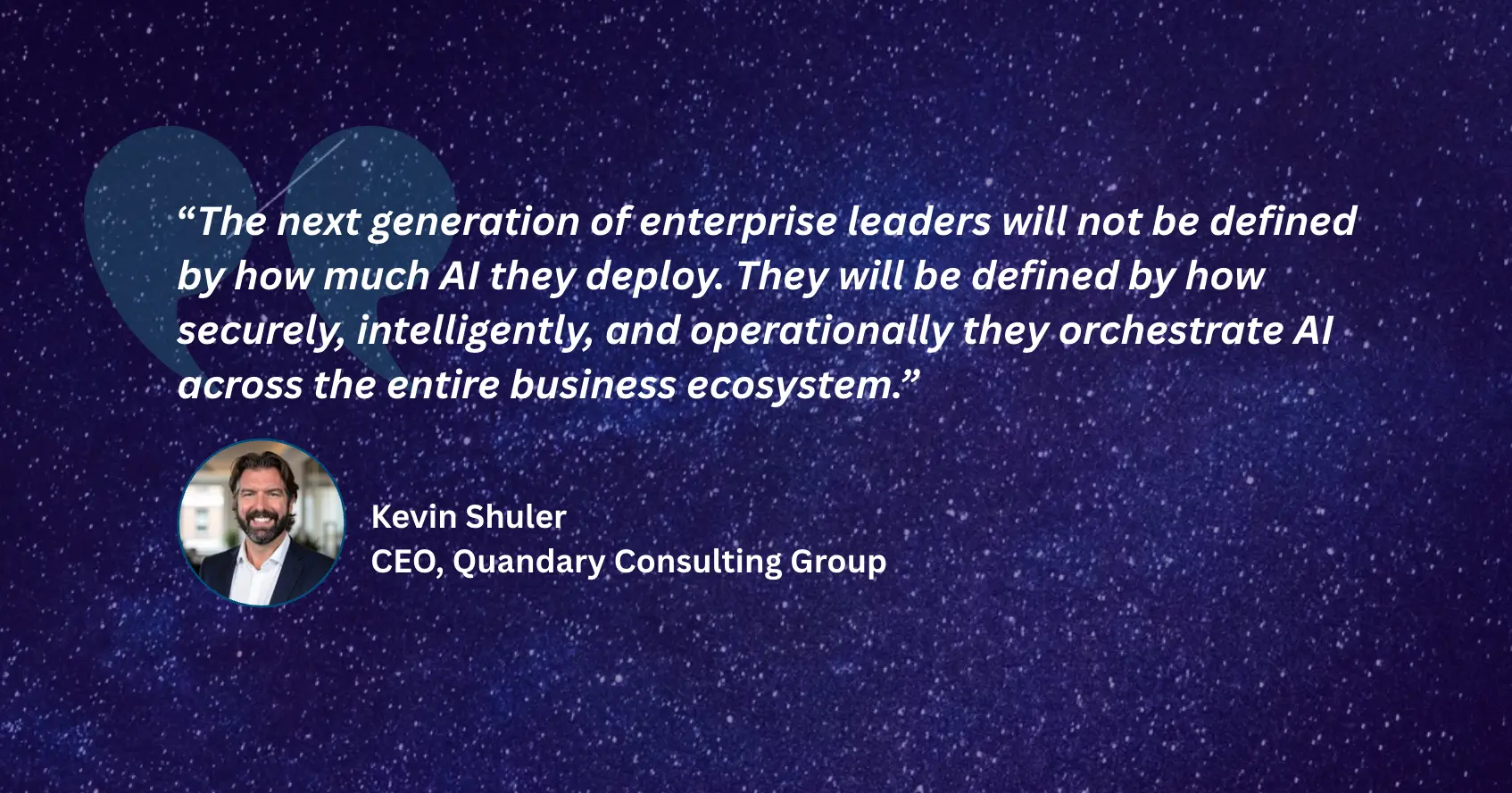
At Quandary Consulting Group, we believe the future belongs to organizations that can operationalize AI securely, intelligently, and in the context of their industry—especially in complex environments such as healthcare, financial services, and commercial construction.
Enterprise AI Has Entered Its Operational Era
AI adoption is accelerating, but operational maturity is uneven. Stanford’s 2026 AI Index reports that 88% of surveyed organizations used AI in at least one business function in 2025, while 70% used generative AI. Yet agent deployments remained in the single digits across nearly every business function. The gap between experimentation and scaled execution is still substantial.
This gap exists because enterprise AI must do more than produce an intelligent response. It must work safely within a larger operating environment.
To create measurable value, an enterprise AI system needs to:
- Understand the organization’s terminology, policies, and operating context
- Retrieve current, permissioned information from trusted systems
- Coordinate actions across applications and teams
- Apply business rules and escalation thresholds
- Preserve data lineage and an auditable record of activity
- Keep humans involved when judgment, approval, or exception handling is required
- Monitor quality, risk, cost, and business outcomes over time
In other words, enterprises do not simply need better models. They need a reliable execution layer around those models. This is why the conversation is shifting from general-purpose AI to vertical AI, and from standalone assistants to governed AI teammates and agents.
What Is Vertical AI?
Vertical AI refers to AI systems designed for the requirements of a particular industry, function, or class of workflows. These systems may use a general-purpose LLM underneath, but they add the specialized context and controls required to perform useful work in a specific environment.
The term verticalized LLM is often used to describe a model that has been adapted to a domain through specialized training, fine-tuning, or domain-specific datasets. That is one component of vertical AI, but the two terms are not interchangeable.
A production-ready vertical AI system typically includes several layers:
- A foundation model capable of language, reasoning, classification, extraction, or generation.
- Enterprise and domain context supplied through retrieval-augmented generation (RAG), structured data, knowledge graphs, policies, and approved content.
- Workflow orchestration that connects the AI to applications, APIs, databases, documents, and human approvals.
- Security and governance controls that regulate identity, permissions, data handling, logging, testing, and oversight.
- Evaluation and observability that measure accuracy, reliability, drift, latency, cost, exceptions, and business impact.
This broader architecture matters because specialized knowledge alone does not make an AI system safe or operational. A healthcare model may understand clinical terminology, but it still needs authorization controls before accessing protected health information.
A financial model may understand lending language, but it still needs transparent decision logic, supervisory review, and an audit trail. A construction model may understand submittals and RFIs, but it still needs access to the current project record and a controlled way to route actions. Vertical AI therefore represents a move from general intelligence in isolation to contextual intelligence embedded in work.
Why Horizontal AI Only Will Always Fall Short
Horizontal AI tools are useful because they support common activities across many industries: drafting, summarizing, searching, brainstorming, translating, and analyzing text.
They can improve individual productivity and accelerate low-risk tasks. However, the closer AI gets to a regulated decision or a mission-critical workflow, the more its limitations matter. Generic tools frequently lack:
- Access to current enterprise data and system-of-record context
- Knowledge of organization-specific policies and terminology
- A reliable mechanism for taking action across systems
- Industry-specific evaluation criteria
- Permission-aware retrieval and execution
- Traceability from source data to output and action
- Defined exception handling and human approval paths
- Controls aligned to the risk of the use case
This does not mean every enterprise should build or train its own LLM. In many cases, that would be expensive and unnecessary. The right approach may combine an existing model with RAG, rules, structured workflows, integration, and targeted human review. Fine-tuning may be valuable when an organization needs consistent domain language, specialized classification, or repeatable behavior, but it is not a substitute for accurate source data or workflow governance.
Orchestration Is the Bridge Between Intelligence and Execution
AI can interpret, recommend, and generate. Orchestration allows it to participate in a business process. Consider an AI agent asked to resolve a billing exception. It may need to retrieve a customer record, interpret contract terms, compare an invoice to an order, check an approval policy, update an ERP, create a case, notify an account owner, and escalate an exception. No single model performs that end-to-end process on its own.
The value comes from coordinating intelligence with deterministic systems and governed actions. That orchestration layer should define:
- Which data and tools the AI can access
- What actions it may perform autonomously
- Which decisions require human approval
- How identity and permissions are enforced
- What happens when data is missing or confidence is low
- How every action is logged, monitored, and reversed when appropriate
- Which metrics determine whether the workflow is succeeding
This is the direction reflected in Workato’s enterprise AI strategy. Workato positions Otto as an enterprise AI teammate that can coordinate work across teams and systems, while the broader Workato ONE platform brings together integration, automation, agent orchestration, enterprise search, data orchestration, and security capabilities.
For Quandary, this evolution is a natural extension of nearly a decade of Workato implementation and enterprise automation experience. Connecting systems, governing workflows, managing exceptions, and designing for scale were essential before agentic AI arrived. They are even more important now.
Governance Is Not a Barrier to AI, It Is What Makes AI Be Able to Scale Possible
As AI moves closer to operational decisions, governance cannot be added after deployment. It must be designed into the architecture. The National Institute of Standards and Technology’s AI Risk Management Framework organizes AI risk management around four functions: Govern, Map, Measure, and Manage.
Its generative AI profile expands that guidance for risks such as confabulation, data privacy, information security, harmful bias, human over-reliance, and third-party dependencies.
For enterprise leaders, governance should translate into practical controls, including:
- A documented inventory of models, agents, data sources, integrations, and owners
- Risk classification based on the use case and potential impact
- Role-based access, least-privilege permissions, and identity-aware execution
- Approved data sources and clear rules for sensitive information
- Testing for accuracy, bias, security, and failure modes before release
- Human review requirements for high-impact decisions and exceptions
- Version control for prompts, models, workflows, and policies
- Continuous monitoring for drift, anomalous behavior, and changing costs
- Incident response and rollback procedures
- Vendor and third-party risk management
- Outcome metrics tied to business value, not just model performance
The principle is simple: AI without governance creates operational risk. Governance without an execution strategy creates competitive risk. The goal is not to eliminate autonomy. It is to make autonomy bounded, observable, and appropriate to the risk of the task.
Why Industry Context Changes the Architecture
Vertical AI is not merely a change in vocabulary or user experience. Different industries create different requirements for data, decisions, integrations, controls, and accountability.
That is why Quandary’s AI Centers of Excellence are structured around the operating realities of healthcare, financial services, and commercial construction. Each center combines AI strategy with integration architecture, workflow automation, governance, human oversight, intelligent document processing, and measurable operational transformation.
Healthcare: Intelligent Workflows Inside a High-Trust Environment
Healthcare organizations face pressure from rising administrative costs, workforce shortages, clinician burnout, fragmented systems, prior authorization delays, claims complexity, cybersecurity threats, and growing expectations for connected patient experiences.
AI can reduce friction in many of these areas, but healthcare implementations must account for privacy, safety, interoperability, authorization, and the difference between administrative support and clinical decision-making.
The U.S. Department of Health and Human Services emphasizes responsible AI adoption, governance, oversight, cybersecurity, privacy, and public trust in its AI strategy. HIPAA obligations continue to apply when regulated entities and their business associates use technology that creates, receives, maintains, or transmits protected health information.
High-value healthcare opportunities include:
- Prior authorization intake, document collection, status updates, and routing
- Revenue cycle exception detection and follow-up coordination
- Claims document extraction, classification, and validation
- Patient contact-center assistance grounded in approved information
- Referral, scheduling, and care coordination workflows
- Provider onboarding and credentialing support
- Compliance monitoring and audit preparation
- Secure interoperability across EHR, CRM, ERP, payer, and engagement platforms
The strongest healthcare AI systems do not simply “know healthcare.” They understand who is requesting an action, which data may be used, where the authoritative record lives, what the policy allows, when a person must intervene, and how the outcome should be documented.
Using Workato as an orchestration and integration layer, Quandary can connect platforms such as Epic, Oracle Health, Salesforce Health Cloud, payer systems, contact-center platforms, ERPs, and patient engagement applications. The objective is not autonomy for its own sake. It is faster, more consistent operations with clear accountability.
Financial Services: AI Under Supervision
Banks, lenders, wealth managers, insurers, and fintech companies are using AI to improve service, accelerate operations, detect anomalies, and modernize legacy processes. Yet the same capabilities can introduce risk when outputs affect customers, financial decisions, communications, or regulatory obligations.
FINRA has reminded member firms that existing regulatory obligations continue to apply when they use generative AI and LLMs. Its guidance highlights areas such as supervision, communications, recordkeeping, fair dealing, vendor management, cybersecurity, and model risk.
Potential financial-services use cases include:
- KYC and AML document intake, enrichment, and exception routing
- Customer onboarding and account-servicing workflows
- Underwriting support with documented human decision authority
- Fraud and anomaly investigation assistance
- Regulatory reporting preparation and evidence collection
- Policy and procedure search grounded in approved sources
- Intelligent document classification and data extraction
- Compliance monitoring and case triage
- Secure integration across core platforms, CRMs, loan systems, ERPs, data environments, and third-party services
Here, vertical AI must be designed for supervision. The system should make sources visible, distinguish recommendations from decisions, retain required records, and escalate ambiguous or high-impact cases. Accuracy matters, but so do explainability, consistency, and the ability to reconstruct what happened.
Commercial Construction: Turning Fragmented Project Data Into Coordinated Action
Commercial construction has enormous potential for AI because critical information is distributed across project-management platforms, drawings, contracts, schedules, field reports, email, accounting systems, subcontractor portals, and spreadsheets.
The opportunity is not limited to generating summaries. Vertical AI can help transform scattered project data into coordinated action. Autodesk’s 2025 construction research found that industry leaders were increasing AI investment even as trust declined, underscoring the need for credible data practices and practical governance alongside innovation.
High-value construction use cases include:
- RFI, submittal, and change-order intake and routing
- Contract and specification extraction
- Procurement and subcontractor onboarding workflows
- Schedule, cost, and project-risk monitoring
- Field-report summarization and issue escalation
- Safety and compliance documentation support
- Project financial reconciliation
- Automated status reporting across owners, contractors, and internal teams
- Integration across Procore, Autodesk, Viewpoint, Oracle, SAP, Salesforce, and related systems
A construction AI system is only as reliable as the project information it can access. If it uses an outdated drawing, misses a revised specification, or acts without the proper approval, speed becomes risk. Successful implementation therefore depends on document versioning, source attribution, permissions, project-specific context, and structured review paths.
The Quandary AI Center of Excellence Model
An AI Center of Excellence should not become a committee that slows adoption or a lab disconnected from operating teams. Its job is to create a repeatable path from use-case selection to governed production deployment.
Quandary’s industry-focused CoE model brings together six connected disciplines:
- Strategy and use-case economics: Identify workflows where AI can improve a meaningful business outcome. Prioritize opportunities based on value, feasibility, data readiness, risk, time to impact, and organizational capacity.
- Data and knowledge readiness: Determine which systems hold authoritative information, who owns the data, how access should be controlled, and whether the content is accurate enough to support the proposed use case.
- Integration and orchestration architecture: Connect models to applications, APIs, documents, events, and human approvals. Separate probabilistic AI tasks from deterministic controls and transactions.
- Governance and security engineering: Define ownership, permissions, testing standards, risk tiers, audit requirements, escalation paths, incident response, and approved operating boundaries.
- Product delivery and adoption: Design the experience around the people who perform and manage the work. Pilot with real users, document changed responsibilities, provide training, and make feedback part of the operating model.
- Measurement and continuous improvement: Track business and technical metrics such as cycle time, exception rate, rework, accuracy, escalation frequency, adoption, latency, cost per transaction, compliance outcomes, and user satisfaction.
This model turns scattered experimentation into an enterprise capability.
A Practical Roadmap From Pilot to Production
Many AI initiatives stall because organizations start with a model demonstration instead of an operational problem. A more durable path begins with the workflow.
Step 1. Select a bounded, measurable workflow: Choose a process with a clear owner, sufficient volume, identifiable friction, accessible data, and a measurable outcome. Avoid beginning with a broad objective such as “deploy AI across the enterprise.”
Step 2. Map the current state: Document systems, data sources, handoffs, approvals, exceptions, control points, failure modes, and baseline performance. This reveals whether AI is actually the right intervention.
Step 3. Classify the risk: Assess the sensitivity of the data, the impact of an incorrect output or action, the applicable obligations, and the level of human oversight required. The governance model should be proportional to the risk.
Step 4. Design the vertical AI stack: Select the model based on the task, then define retrieval sources, orchestration logic, identity controls, human checkpoints, system actions, evaluation criteria, logging, and fallback behavior.
Step 5. Test with real-world exceptions: Do not evaluate only ideal inputs. Test incomplete documents, conflicting records, adversarial prompts, stale information, permission failures, ambiguous requests, and downstream system outages.
Step 6. Deploy with controlled autonomy: Begin with observation, recommendations, or approval-based execution. Expand autonomy only when performance data supports it and accountability remains clear.
Step 7. Measure the operating outcome: Monitor whether the solution reduces cycle time, cost, rework, or risk. A high benchmark score does not matter if the workflow fails to improve.
Build, Buy, or Configure? The Better Answer Is Often “Compose”
Organizations frequently frame AI strategy as a choice between buying a generic application and building a custom model. In practice, most successful enterprise solutions will be composed from multiple capabilities.
An organization may use:
- A commercial or open foundation model
- RAG over approved enterprise knowledge
- A smaller specialized model for extraction or classification
- Rules for deterministic decisions
- Workato for integration, events, workflow orchestration, and approvals
- Human review for material exceptions or high-impact outcomes
- Monitoring and evaluation services for ongoing control
This composable approach helps organizations use the best capability for each part of the workflow while avoiding unnecessary model development. It also makes components easier to test, replace, and govern.
The Competitive Advantage Is the Operating Model
Models will continue to improve, become less expensive, and spread across the market. Access to AI alone will not create a lasting advantage.
The more defensible advantage lies in an organization’s ability to combine:
- Proprietary operational knowledge
- Trusted and well-governed data
- Industry-specific workflows
- Deep integration across systems
- Security and compliance controls
- Rapid experimentation with disciplined evaluation
- Employees who know when and how to work with AI
- An operating model that turns learning into repeatable execution
That is why vertical AI is more than a technology category. It is an enterprise design principle.
For almost a decade, Quandary has helped organizations connect applications, automate workflows, and modernize operations with Workato. That foundation is directly relevant to the agentic era because AI cannot deliver enterprise value while disconnected from the systems where work happens.
Quandary’s next chapter builds on that experience: industry-specific AI Centers of Excellence for healthcare, financial services, and commercial construction; secure orchestration architectures; governed AI workflows; and implementation strategies designed around measurable business outcomes.
The future will not belong to the companies with the most AI tools, it will belong to the companies that can turn intelligence into trusted, coordinated action.
Ready to Move From AI Experimentation to Enterprise Execution?
Quandary Consulting Group helps organizations identify high-value AI opportunities, assess data and integration readiness, design governance, and build secure, industry-specific workflows with Workato.
Whether your priority is reducing administrative friction in healthcare, strengthening supervised automation in financial services, or connecting project intelligence across commercial construction, the first step is the same: choose a meaningful workflow and design the full operating system around it.
Talk with Quandary about building a practical roadmap for vertical AI and enterprise orchestration.
Top FAQs about Industry-Specific Vertical AI
What is vertical AI?
Vertical AI is artificial intelligence designed for a specific industry, business function, or workflow. Unlike general-purpose AI, vertical AI incorporates specialized terminology, data, regulations, processes, and operating requirements. It can support industry-specific work such as healthcare prior authorizations, financial compliance reviews, and construction change-order management.
What is a verticalized large language model?
A verticalized large language model is an LLM adapted for a particular industry or domain. It may use specialized training, fine-tuning, retrieval-augmented generation, or proprietary business data to produce more relevant responses. A verticalized LLM is usually one component of a broader vertical AI system that also includes integrations, workflows, security controls, and human oversight.
How is vertical AI different from general-purpose AI?
General-purpose AI supports broad activities such as writing, summarizing, searching, and brainstorming. Vertical AI is configured for specific operational environments and industry requirements. It combines AI models with trusted enterprise data, business rules, system integrations, governance, and workflows to produce more reliable and actionable results.
What are the benefits of vertical AI for enterprises?
Vertical AI can improve accuracy, accelerate workflows, reduce administrative work, strengthen compliance, and deliver more relevant insights. Because it is designed around a specific industry or process, it can address operational requirements that generic AI tools often overlook. Its greatest value comes from connecting specialized intelligence to governed enterprise workflows.
What industries benefit most from vertical AI?
Industries with complex workflows, specialized data, and significant regulatory requirements are strong candidates for vertical AI. These include healthcare, financial services, insurance, commercial construction, manufacturing, logistics, and legal services. Vertical AI is especially valuable when decisions require domain expertise, secure data access, traceability, and human oversight.
How is vertical AI used in healthcare?
Healthcare organizations can use vertical AI to support prior authorization, revenue-cycle management, claims processing, patient engagement, referral coordination, provider onboarding, and compliance monitoring. Effective healthcare AI must protect sensitive information, use approved data sources, maintain auditability, and comply with applicable privacy and security requirements.
How is vertical AI used in financial services?
Financial institutions can use vertical AI for customer onboarding, KYC and AML workflows, fraud investigation, underwriting support, document processing, regulatory reporting, compliance monitoring, and customer service. These systems should include supervisory controls, transparent sources, recordkeeping, cybersecurity protections, and human review for material decisions.
How is vertical AI used in commercial construction?
Commercial construction companies can use vertical AI to process RFIs, submittals, contracts, change orders, field reports, procurement documents, and safety records. When connected to platforms such as Procore, Autodesk, Viewpoint, Oracle, SAP, and Salesforce, vertical AI can help coordinate project information, identify risks, and accelerate reporting.
What role does AI orchestration play in vertical AI?
AI orchestration connects models with the applications, data, APIs, documents, rules, and people involved in a business process. It determines what information an AI system can access, which actions it can perform, when approval is required, and how activity is recorded. Orchestration turns AI-generated intelligence into controlled enterprise execution.
Why is governance important for vertical AI?
Governance helps ensure that vertical AI operates securely, consistently, and within defined boundaries. A strong governance program addresses data access, privacy, model risk, testing, human oversight, audit trails, vendor management, incident response, and regulatory obligations. Governance makes it possible to expand AI responsibly without creating uncontrolled operational risk.
Does a company need to build its own industry-specific AI model?
Most companies do not need to build an LLM from scratch. A more practical approach often combines an existing foundation model with approved enterprise data, retrieval-augmented generation, specialized models, business rules, system integrations, and human review. The architecture should be selected according to the workflow, risk level, and desired business outcome.
What is an AI Center of Excellence?
An AI Center of Excellence is a cross-functional operating model that helps an organization prioritize, govern, implement, and measure AI initiatives. It typically establishes standards for use-case selection, data readiness, architecture, security, testing, deployment, employee adoption, and performance measurement. Industry-focused Centers of Excellence can also address sector-specific regulations and workflows.
How should an organization begin implementing vertical AI?
Organizations should begin with a bounded workflow that has a clear owner, measurable friction, accessible data, and a meaningful business outcome. They should map the current process, classify its risks, identify authoritative data, design appropriate controls, test real-world exceptions, and deploy with limited autonomy before expanding the system.
How does Workato support vertical AI and AI orchestration?
Workato can connect AI systems with enterprise applications, APIs, data, documents, events, and approval workflows. Its integration and orchestration capabilities help organizations control how AI accesses information and executes actions across systems. This allows companies to build industry-specific AI workflows without relying on disconnected models or isolated copilots.
How can Quandary Consulting Group help organizations implement vertical AI?
Quandary Consulting Group helps organizations identify high-value AI use cases, assess data and integration readiness, establish governance, and implement secure AI-powered workflows with Workato. Quandary focuses on industry-specific orchestration for healthcare, financial services, and commercial construction, connecting AI strategy to measurable operational outcomes.