Citizen Development
How to Overcome the Software Developer Shortage in 2026: 8 Strategies for Enterprise Leaders


TL;DR: What Enterprise Technology Leaders Need to Know
- The software developer shortage is increasingly a capacity and skills challenge. Organizations need specialized engineering expertise while managing technical debt, disconnected applications, growing IT backlogs, and accelerating AI adoption.
- Hiring additional developers is only part of the solution. Enterprises can expand development capacity by eliminating repetitive work, modernizing legacy applications, and improving integration architecture.
- AI-assisted development can accelerate software delivery, but secure deployment still depends on experienced engineers, automated testing, human oversight, and established governance.
- Low-code platforms such as Quickbase and integration technologies such as Workato can reduce unnecessary custom development while improving application delivery and operational efficiency.
- Preparing for 2027 requires a different approach to IT capacity. Organizations that invest in developer enablement, reusable architecture, governed automation, and strategic technology partnerships can scale more sustainably.
How AI-assisted development, low-code platforms, enterprise integration, and intelligent automation are helping organizations expand development capacity without continuously increasing IT headcount.
The Software Developer Shortage Is Exposing a Bigger Enterprise Technology Problem
The software developer shortage has become one of the more persistent challenges facing enterprise technology leaders today; but, the underlying problem extends beyond finding enough qualified programmers.
Organizations are managing larger application portfolios, increasingly complex integrations, aging infrastructure, cybersecurity requirements, and growing expectations for AI-enabled operations. Meanwhile, CIOs and CTOs are expected to accelerate digital transformation without proportionally increasing technology budgets or headcount.
For years, the conventional response to development backlogs was straightforward: hire additional engineers, expand internal IT teams, or outsource software development.
These strategies remain relevant, but they do not necessarily address why development demand continues to grow.
Consider how much engineering capacity is consumed by maintaining legacy applications, repairing integrations, reconciling inconsistent data, troubleshooting recurring issues, and developing custom solutions for processes that could be automated.
These activities compete directly with the strategic initiatives organizations need their most experienced engineers to deliver.
The central challenge is no longer simply finding more developers. It is creating an enterprise technology environment that requires less unnecessary development work.
At Quandary Consulting Group, we see this challenge across healthcare, financial services, construction, manufacturing, and other complex industries. Many organizations already have talented technical teams. What they lack is the connected architecture, automation infrastructure, and operational visibility needed to use those teams effectively.
Addressing the software developer shortage requires organizations to rethink how applications are built, how systems communicate, and where engineering expertise creates the greatest business value.
Is There Really a Software Developer Shortage in 2026?
Yes, although the situation is more accurately described as a shortage of specific technical capabilities rather than a universal lack of programmers.
Hiring conditions vary considerably by geographic market, experience level, industry, and technical specialization. Organizations may encounter strong applicant volumes for some development roles while struggling to recruit experienced engineers with expertise in enterprise architecture, cybersecurity, cloud infrastructure, data engineering, AI, and complex system integration.
The long-term demand for software development expertise remains significant. According to the U.S. Bureau of Labor Statistics, employment across software developers, quality assurance analysts, and testers is projected to grow substantially faster than the average for all occupations through 2034.
This demand reflects the continued expansion of software-intensive business operations, including artificial intelligence, automation, connected devices, cybersecurity, and enterprise application modernization.
However, workforce availability tells only part of the story. An enterprise operating dozens of disconnected applications may need developers to maintain custom scripts, build point-to-point integrations, troubleshoot inconsistent records, and support manual workarounds.
Adding another engineer can help manage the workload, but the underlying complexity remains.
For enterprise leaders, reducing avoidable demand for custom development can be just as important as expanding the engineering workforce.
8 Strategies to Overcome the Software Developer Shortage
1. Retain Experienced Developers by Eliminating Low-Value Technical Work
Experienced software developers bring more to an organization than coding expertise. They understand the architecture of existing applications, the dependencies between systems, the business rules embedded in legacy technology, and the operational risks associated with making changes; this institutional knowledge can be difficult and expensive to replace.
Yet organizations often overlook one of the most important factors influencing developer retention: the quality of the work engineers are expected to perform.
When highly skilled developers spend their days resolving repetitive support issues, maintaining fragile integrations, and manually reconciling data, they have less capacity for architecture, modernization, security, and innovation.
Technology leaders should examine where engineering time is actually being spent and identify opportunities to reduce recurring maintenance demands. This includes automating routine monitoring, improving integration reliability, prioritizing high-impact technical debt, clarifying business requirements, and establishing stronger application ownership.
Development teams also need opportunities to expand their capabilities in AI, cloud architecture, automation, and emerging enterprise technologies.
The objective is to protect engineering capacity for work that requires technical expertise and produces meaningful business outcomes.
At Quandary, we view developer retention and technology modernization as closely connected. When organizations eliminate unnecessary manual processes and reduce system fragmentation, they create a more productive environment for both technical teams and the employees they support.
2. Expand the Talent Pool Through Skills-Based Hiring and Flexible Workforce Models
Organizations that rely on narrow hiring requirements may be limiting access to qualified engineering talent. A more effective recruitment strategy begins by identifying the technical capabilities a role genuinely requires, rather than relying exclusively on traditional credentials, job titles, or years of experience.
For example, enterprise integration specialists may need demonstrated experience with APIs, authentication, data transformation, error handling, and application architecture. Those skills can be acquired through formal education, certifications, professional experience, and hands-on technical work.
Remote and hybrid arrangements can also expand access to candidates beyond a company's immediate geographic market.
Equally important is the hiring process itself. Lengthy interview cycles, unclear technical requirements, and slow decision-making can make it harder to secure qualified candidates.
Enterprise leaders should also distinguish between capabilities that require permanent internal ownership and specialized expertise that may be needed only for particular projects.
A blended workforce model can combine internal engineering teams with external specialists in areas such as AI implementation, low-code development, enterprise integration, and application modernization.
This approach allows organizations to maintain institutional knowledge internally while accessing additional technical capabilities when business requirements demand them.
3. Invest in Developer Upskilling, AI Literacy, and Modern Engineering Capabilities
The technical skills required to support enterprise software environments are changing faster than most organizations can recruit new specialists.
Traditional programming expertise remains important, but engineering teams increasingly need to understand AI-assisted development, API architecture, cloud infrastructure, data engineering, automation orchestration, cybersecurity, and AI governance.
The 2025 Stack Overflow Developer Survey highlights the growing role of AI tools in developer workflows, alongside continued concerns about the reliability of AI-generated output.
For enterprise technology leaders, this creates an opportunity to improve existing workforce capabilities rather than depending entirely on external recruitment.
Effective up-skilling programs should be connected to real operational needs. For example, developers can learn how to use AI to generate documentation, accelerate test creation, analyze unfamiliar code, or troubleshoot integration issues.
Integration specialists can strengthen their expertise in reusable APIs, event-driven architecture, and workflow orchestration. Application teams can learn how low-code platforms support operational requirements without rebuilding common functionality from scratch.
Training must also address security, data protection, code validation, and responsible AI use.
AI literacy is becoming an important engineering competency, but the ability to evaluate and govern AI-generated output is just as valuable as the ability to produce it.
Quandary approaches AI enablement as an enterprise capability initiative. Training delivers the greatest value when employees can apply new skills within approved workflows, connected systems, and clearly defined governance structures.
4. Increase Software Development Productivity With AI-Assisted Engineering
Artificial intelligence is changing how enterprise applications are designed, developed, tested, documented, and maintained.
AI-assisted software development tools can help engineers generate code, explain unfamiliar functions, identify potential defects, create test cases, and accelerate selected debugging activities.
These capabilities can reduce time spent on repetitive tasks and allow developers to concentrate on complex architecture, integration, security, and business logic.
However, faster code generation does not automatically produce better software.
AI Adoption Is Growing Faster Than Developer Confidence
The 2025 Stack Overflow Developer Survey demonstrates an important distinction between AI adoption and trust. Developers are increasingly incorporating AI tools into their workflows, but concerns about accuracy and reliability remain.
Google's 2025 DORA research reached a related conclusion. Drawing on research involving nearly 5,000 technology professionals, the report characterized AI as an amplifier of existing organizational strengths and weaknesses.
Organizations with mature engineering practices, reliable testing, clear ownership, and effective governance are better positioned to benefit from AI-assisted development.
Those operating with significant technical debt, inconsistent development standards, or unreliable deployment processes may simply accelerate the creation of additional complexity.
For enterprise organizations, AI development tools should therefore operate within established engineering controls.
This includes secure access management, version control, automated testing, human code review, documented approvals, and continuous monitoring after deployment.
How Quandary Supports Enterprise AI Development
Quandary Consulting Group helps organizations identify practical opportunities to introduce AI into software development and business operations while maintaining the controls required for enterprise deployment.
Through AI consulting, integration architecture, and technologies such as Anthropic Claude, Workato, and Quickbase, we help organizations connect AI capabilities to existing systems and workflows.
The goal is to increase engineering productivity without sacrificing application security, reliability, maintainability, or operational accountability.
5. Reduce Development Backlogs With Low-Code Application Platforms
Not every business application needs to be developed from scratch.
Traditional custom software development remains essential for highly specialized applications, complex technical requirements, and differentiated business capabilities. However, many enterprise workflows share common requirements that can be delivered more efficiently through configurable technology platforms.
Low-code development uses visual interfaces, reusable components, structured data models, and configurable workflows to reduce the amount of manual coding required.
This makes it particularly useful for operational applications involving approvals, resource management, field reporting, project tracking, compliance documentation, and departmental workflows.
Platforms such as Quickbase allow organizations to create and manage business applications without rebuilding standard application functionality for every new requirement.
For IT teams managing growing development backlogs, this can create additional delivery capacity while preserving experienced engineers for more complex work.
Real-World Example: BrandSafway Modernizes Workforce Operations
BrandSafway operates a complex workforce environment spanning more than 360 locations.
Quandary helped modernize staffing operations using Quickbase integrated with Workday through APIs.
The solution supported high-volume workforce onboarding, including the ability to process more than 100 workers in minutes.
Rather than relying on disconnected manual processes, the organization gained a configurable operational application connected to its enterprise HR environment.
The broader lesson is that low-code development becomes particularly valuable when it is supported by sound integration architecture.
Low-code does not eliminate the need for experienced engineers. It allows organizations to apply engineering expertise where it creates the greatest value.
Explore Quandary's Quickbase consulting and application development services.
Quandary Use Case: BrandSafway Automates High-Volume Employee Onboarding With Quickbase and Workday Integration
6. Automate Enterprise Integrations to Reduce Repetitive Engineering Work
One of the largest hidden contributors to software development backlogs is the ongoing effort required to connect and maintain enterprise applications.
Modern organizations rely on ERP systems, CRM platforms, HR applications, financial software, data warehouses, and industry-specific technologies.
When these systems cannot exchange information reliably, employees compensate through spreadsheets, manual exports, duplicate data entry, and custom workarounds; unfortunately, for IT teams, they are the ones that, ultimately, inherit the resulting problems.
Developers are tasked with maintaining point-to-point integrations, resolving failed data transfers, reconciling inconsistent records, and troubleshooting recurring operational exceptions.
Over time, this work can consume significant engineering capacity.
Enterprise integration and automation platforms address these challenges by establishing reusable, monitored processes for connecting systems and coordinating business activities.
The Role of Quickbase, Workato, and Claude
Each technology supports a distinct layer of modern enterprise operations.
- Quickbase provides configurable business applications, structured operational records, approval workflows, and process visibility.
- Workato connects enterprise applications, orchestrates cross-system workflows, applies business rules, and automates data movement and operational events.
- Anthropic Claude can support appropriate AI-enabled activities such as document interpretation, information extraction, classification, and contextual analysis, subject to organizational governance.
Together, these technologies can reduce dependence on repetitive custom development while improving the reliability and scalability of enterprise workflows.
Real-World Example: Jacobs Modernizes Procurement Operations
Quandary supported a procurement modernization initiative for Jacobs involving approximately $600 million in annual purchasing activity.
The solution combined Quickbase, Workato, Microsoft 365, Oracle, and optical character recognition technology to streamline processes spanning vendor activity, invoicing, and payment.
The modernization initiative was associated with a reduction in operational staffing requirements from approximately 140 to 60 people, alongside movement toward near-touchless processing.
Although this is not a direct measurement of developer productivity, it illustrates the broader operational value of connecting enterprise applications and automating complex workflows.
When integration, application development, and automation are designed as one architecture, organizations can reduce the recurring technical work required to support everyday operations.
Quandary Use Case: Jacobs Procurement Automation Cuts Operational Headcount by 57% While Managing $600M in Annual Spend
7. Extend Engineering Capacity Through Strategic Technology Partnerships
Maintaining every specialized technology capability internally can be expensive, particularly as enterprise software environments become more complex.
Organizations may need expertise across low-code platforms, enterprise integration, AI implementation, data engineering, cloud infrastructure, application security, and legacy system modernization.
Those requirements do not always justify hiring a dedicated full-time specialist.
Strategic consulting and managed services partnerships allow organizations to access technical expertise based on actual business needs; however, the distinction between conventional outsourcing and a long-term technology partnership matters.
Traditional outsourcing often focuses on delivering a defined set of development tasks; but, a strategic technology partner evaluates the underlying business problem, existing architecture, integration requirements, long-term operating model, and internal team's ability to maintain the solution.
The objective is not simply to complete development work. It is to improve the sustainability of the broader technology environment.
Real-World Example: Pine State Trading Improves Cross-System Support
Pine State Trading required specialized support across an interconnected environment involving Quickbase, Microsoft SQL, data transformation processes, Microsoft Fabric, and Power BI.
Quandary's managed services approach addressed the broader technology environment rather than treating individual applications as isolated systems.
The engagement produced measurable operational improvements:
- 50% faster cross-system issue resolution
- 40% fewer handoffs
These results demonstrate how coordinated technical support can reduce operational friction and improve the efficiency of complex application environments.
For organizations facing persistent IT backlogs, managed services can provide additional technical capacity while allowing internal engineering teams to focus on strategic priorities.
Quandary Use Case: Pine State Trading Companies Strengthens Enterprise Application Support with Microsoft Data Technologies with Quandary
8. Establish a Governed Citizen Development Program
Business users often understand operational problems more intimately than the technology teams responsible for solving them.
Citizen development allows employees outside traditional IT roles to create or configure approved business applications using low-code and no-code platforms.
An operations manager, for example, may be able to configure a resource-request application, approval workflow, or departmental reporting process without requiring a software engineer to develop every component.
This can reduce the number of straightforward requests entering the IT backlog.
However, decentralized application development introduces risks when organizations lack appropriate oversight.
Unmanaged citizen development can create duplicate applications, inconsistent data, security vulnerabilities, unclear ownership, and additional technical debt.
A successful program requires clearly defined standards for application ownership, data access, approved integrations, documentation, testing, and maintenance.
IT should continue to establish architectural standards and govern higher-risk technical decisions, while business teams receive appropriate authority to improve their workflows.
The objective is not to replace professional developers with business users. It is to establish a more effective division of responsibility between IT and the departments it supports.
How AI, Low-Code, and Enterprise Integration Work Together
AI-assisted development, low-code platforms, and enterprise automation are often evaluated as separate technology investments. Their combined value becomes clearer when organizations consider how these capabilities support a complete business process.
Imagine an enterprise attempting to modernize a manual workforce approval workflow. A traditional approach might require developers to build a custom application, design the underlying database, connect HR systems, implement approval logic, configure notifications, and maintain the integrations.
A modern architecture can distribute those responsibilities across purpose-built technologies.
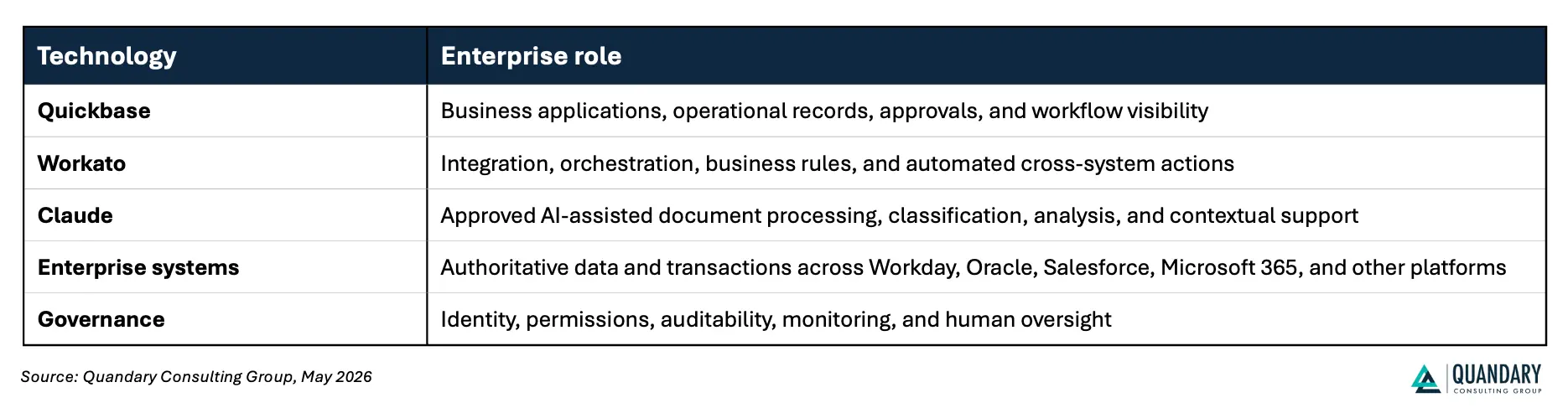
This approach does not eliminate the need for software engineers. It allows them to focus on complex technical requirements while reusable platforms handle more standardized components.
The result can be faster application delivery, reduced custom-code maintenance, and greater consistency across enterprise operations.
Why Hiring More Developers Will Not Fix Broken IT Operations
Organizations cannot hire their way out of every technology problem. Adding developers may increase short-term delivery capacity, but it does not automatically resolve fragmented data, unclear processes, unreliable integrations, or poorly designed applications.
If multiple departments maintain conflicting versions of the same customer information, developers must still reconcile those inconsistencies.
If applications lack reliable interfaces, new business requirements may continue to generate custom integration work.
If development requests arrive without clear ownership or requirements, technical teams may spend significant time rebuilding solutions that never addressed the underlying operational problem; and, when automation is implemented without monitoring or accountability, IT teams can inherit additional maintenance responsibilities instead of reducing them.
At Quandary, we believe sustainable modernization begins with a connected operational foundation: People → Process → Data → Systems → Integration → Governance → AI
Each layer influences the effectiveness of the next.
AI and low-code technologies can accelerate delivery, but their value depends on reliable data, well-defined processes, connected applications, and appropriate governance.
The most effective technology investments reduce operational complexity rather than introducing another layer of systems to maintain.
How Long Will the Software Developer Shortage Last?
There is no single projected end date for the software developer shortage. Demand for specialized technical expertise is expected to remain significant throughout the coming decade, although the types of skills organizations require will continue to evolve.
U.S. Bureau of Labor Statistics employment projections through 2034 indicate continued growth in software development-related occupations. Meanwhile, AI-assisted development is changing how engineering work is performed.
Some routine coding, documentation, testing, and troubleshooting activities can increasingly be supported by AI tools. Responsibilities involving enterprise architecture, complex integration, security, system reliability, and production accountability still require experienced technical judgment.
The more important question is how organizations will adapt as development tools and enterprise requirements continue to change.
Businesses that invest in workforce development, reusable architecture, integration, and governed automation will be better positioned to manage future demand.
Preparing for 2027: Five Priorities for CIOs and Technology Leaders
Enterprise technology leaders planning for 2027 should evaluate development capacity as part of a broader operational modernization strategy.
1. Quantify the True Cost of the IT Backlog
Identify which development requests require specialized engineering expertise and which could be resolved through configuration, process improvement, or automation. Measure how long requests remain unresolved and where delays affect business operations.
2. Reduce Application and Integration Complexity
Assess where systems depend on manual data transfers, fragile custom scripts, duplicate records, and unsupported point-to-point connections. Prioritize opportunities to establish reusable integrations and reduce recurring maintenance demands.
3. Establish Enterprise AI Development Standards
Evaluate where AI-assisted coding, testing, documentation, and operational AI can deliver measurable value. Implement policies covering secure access, data protection, code review, testing, deployment approval, and ongoing monitoring.
4. Expand Governed Low-Code Development
Identify operational applications that can be delivered through approved low-code platforms. Establish clear standards for application ownership, permissions, integration, maintenance, and business continuity.
5. Measure Engineering Effectiveness Through Business Outcomes
Developer headcount and ticket volume alone do not provide a complete picture of IT performance. Organizations should measure how effectively technology teams deliver reliable capabilities that improve business operations.
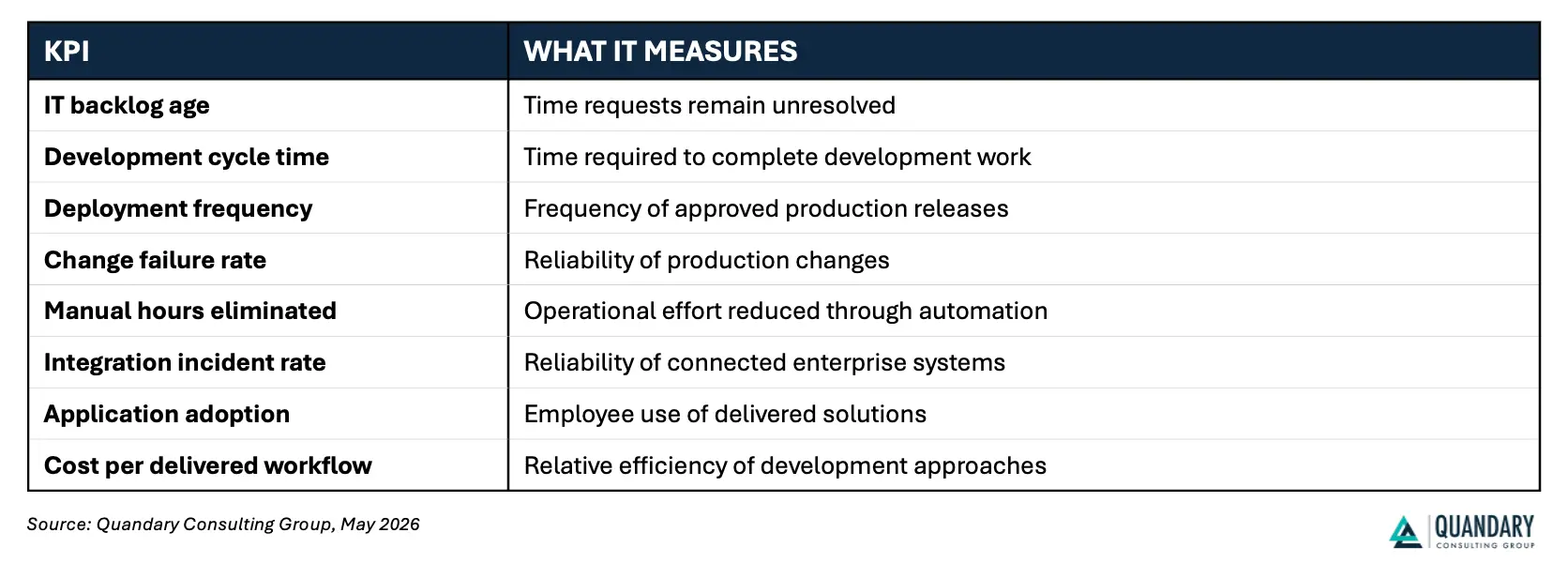
These measures help organizations determine whether modernization investments are increasing delivery capacity, improving reliability, and reducing operational costs.
How Quandary Consulting Group Helps Enterprises Scale Technology Delivery
The software developer shortage reflects a larger challenge facing modern enterprises: delivering more technology capabilities without continuously increasing the cost and complexity of their environments.
Quandary Consulting Group helps organizations address this challenge through enterprise application development, integration architecture, intelligent automation, AI enablement, and managed services.
As a Quickbase Elite Partner, Workato Gold Partner, and Anthropic Claude Certified Partner, Quandary works across the technologies that support modern, connected business operations.
Our approach begins by understanding the processes, applications, data dependencies, and operational constraints creating demand for technical resources. From there, we help organizations determine where custom engineering is necessary, where low-code development can accelerate delivery, where enterprise integration can eliminate repetitive work, and where AI can responsibly improve productivity.
The goal is to establish technology environments that are easier to operate, maintain, and scale.
The organizations best positioned for 2027 will not necessarily have the largest engineering teams. They will be the organizations that use their technical expertise most effectively.
For enterprises facing growing IT backlogs, disconnected applications, or limited development capacity, Quandary helps identify the architectural and operational improvements needed to support sustainable growth.
References and Resources:
- 2025 Developer Survey (Stack Overflow.co)
- Jacobs Procurement Automation Cuts Operational Headcount by 57% While Managing $600M in Annual Spend (Quandary Consulting Group)
- Pine State Trading Companies Strengthens Enterprise Application Support with Microsoft Data Technologies with Quandary (Quandary Consulting Group)
Frequently Asked Questions About the Software Developer Shortage
1. What is causing the software developer shortage in 2026?
The software developer shortage is driven by demand for specialized technical expertise, competition for experienced engineers, and growing complexity across enterprise technology environments. AI, cybersecurity, cloud computing, data engineering, and enterprise integration contribute to demand. Hiring challenges vary by industry, location, and specialization.
2. Can AI solve the software developer shortage?
AI can reduce the time required for certain coding, documentation, testing, and debugging activities, but it cannot fully replace experienced software engineers. Enterprise applications still require architecture, security, integration, validation, and ongoing maintenance. AI is most effective when used to augment developers within established engineering practices.
3. How can organizations reduce IT backlogs without hiring more developers?
Organizations can reduce IT backlogs by automating repetitive processes, improving system integrations, adopting low-code development platforms, eliminating duplicate work, and using specialized technology partners. The first step is identifying which requests require custom engineering and which can be addressed through configuration or automation.
4. What is the difference between low-code and traditional software development?
Low-code development uses visual interfaces, configurable components, and reusable functionality to accelerate application delivery. Traditional software development typically requires more manual coding and offers greater flexibility for highly specialized requirements. Enterprises often benefit from combining both approaches.
5. How do Quickbase and Workato help reduce development demands?
Quickbase provides configurable business applications and operational workflows, while Workato connects enterprise systems and automates cross-platform processes. Together, they can reduce repetitive custom application and integration work while allowing engineering teams to concentrate on more complex requirements.
6. Will AI replace software developers by 2030?
AI is expected to change software development responsibilities, but there is insufficient evidence to conclude that it will eliminate the profession by 2030. Experienced developers will remain important for architecture, cybersecurity, integration, code validation, reliability, and complex problem-solving.
7. Is outsourcing software development more cost-effective than hiring internally?
Outsourcing can be cost-effective when organizations require specialized expertise, temporary development capacity, or ongoing technical support. The financial benefits depend on project complexity, partner capabilities, governance, knowledge transfer, and long-term maintenance costs. Organizations should evaluate total cost of ownership rather than hourly rates alone.
8. How can businesses prepare their IT teams for 2027?
Businesses should assess application portfolios, measure development backlogs, modernize enterprise integrations, establish AI governance policies, invest in developer training, and identify opportunities for low-code development. A successful strategy should improve delivery speed, application reliability, employee productivity, and long-term operational scalability.