Artificial Intelligence (AI)
Second-Order Thinking Is the Difference Between AI That Works… and AI That Fails


TL;DR
- Second-order thinking helps organizations build AI that creates sustainable business value, not just short-term efficiency gains. Instead of asking only what AI can automate, leaders evaluate how those changes will affect customers, employees, workflows, data, systems, governance, risk, and long-term business performance.
- Successful AI development requires looking beyond the proof of concept. An AI pilot can technically work while still failing to scale because of fragmented data, disconnected systems, poor employee adoption, weak governance, downstream bottlenecks, or operational complexity. Second-order thinking helps identify those consequences before they undermine ROI.
- Chesterton’s Fence provides an important rule for AI and business process automation: understand a process before changing it. Approvals, human reviews, business rules, legacy workflows, and other apparent inefficiencies may serve important functions, so organizations should understand the underlying purpose before eliminating or automating them.
- Enterprise AI should optimize the entire business system—not isolated tasks or departments. Second-order thinking considers upstream and downstream dependencies, human-in-the-loop requirements, feedback loops, data quality, integrations, change management, and AI governance to build more resilient and scalable solutions.
- The long-term competitive advantage of AI will come from how organizations design the systems around it. Companies that connect AI with reliable data, intelligent workflows, enterprise integrations, human oversight, governance, and measurable business outcomes are better positioned to move from experimentation to scalable AI transformation.
Most artificial intelligence (AI) and business process automation (BPA) initiatives do not fall short because the technology itself fails. They fall short because organizations optimize for the immediate outcome without considering what happens next.
A workflow is automated. Processing time decreases. Costs decline. Productivity increases. By traditional measures, the initiative looks successful.
But those first-order improvements tell only part of the story.
Over time, the same automation can create unintended consequences elsewhere in the organization. Customer experiences may become less personal. Employees can encounter new friction or disengage from poorly designed processes. Point solutions accumulate. Data becomes fragmented across systems. New dependencies emerge. And the ROI that looked compelling during implementation begins to plateau.
The problem is not automation itself. It is optimizing one part of the business without understanding how that change will affect the larger system.
This is where second-order thinking becomes critical. Instead of asking only, “What will happen if we automate this process?” organizations must also ask, “And then what happens?”
That shift forces leaders to consider how an AI or automation decision will affect people, processes, customers, data, systems, governance, risk, and business performance over time—not simply whether it can make one workflow faster today.
The most successful AI and automation strategies are therefore not built around isolated efficiency gains. They are designed around the second- and third-order effects of transformation, creating improvements that can scale without introducing new problems somewhere else in the business.
What Is Second-Order Thinking?
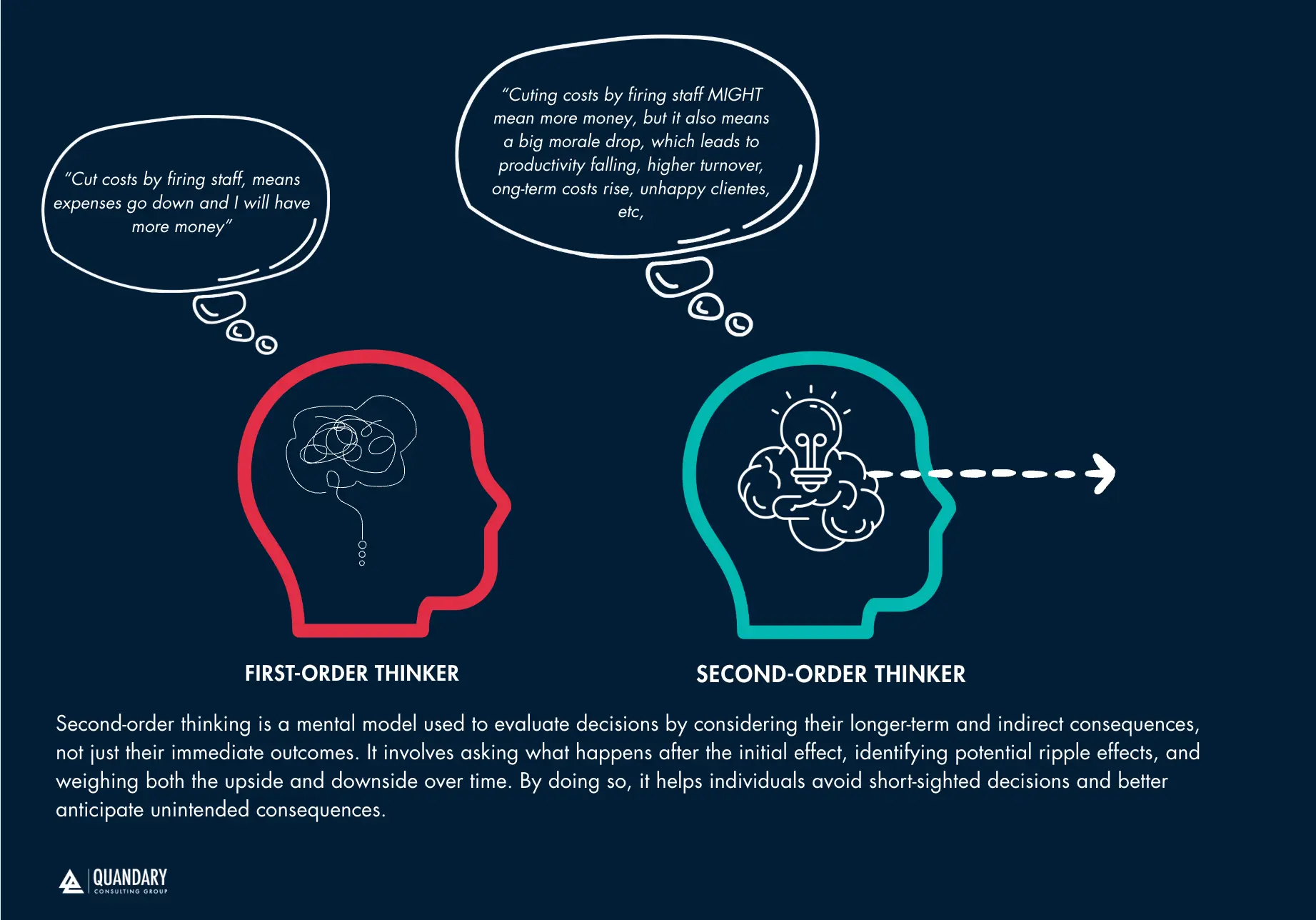
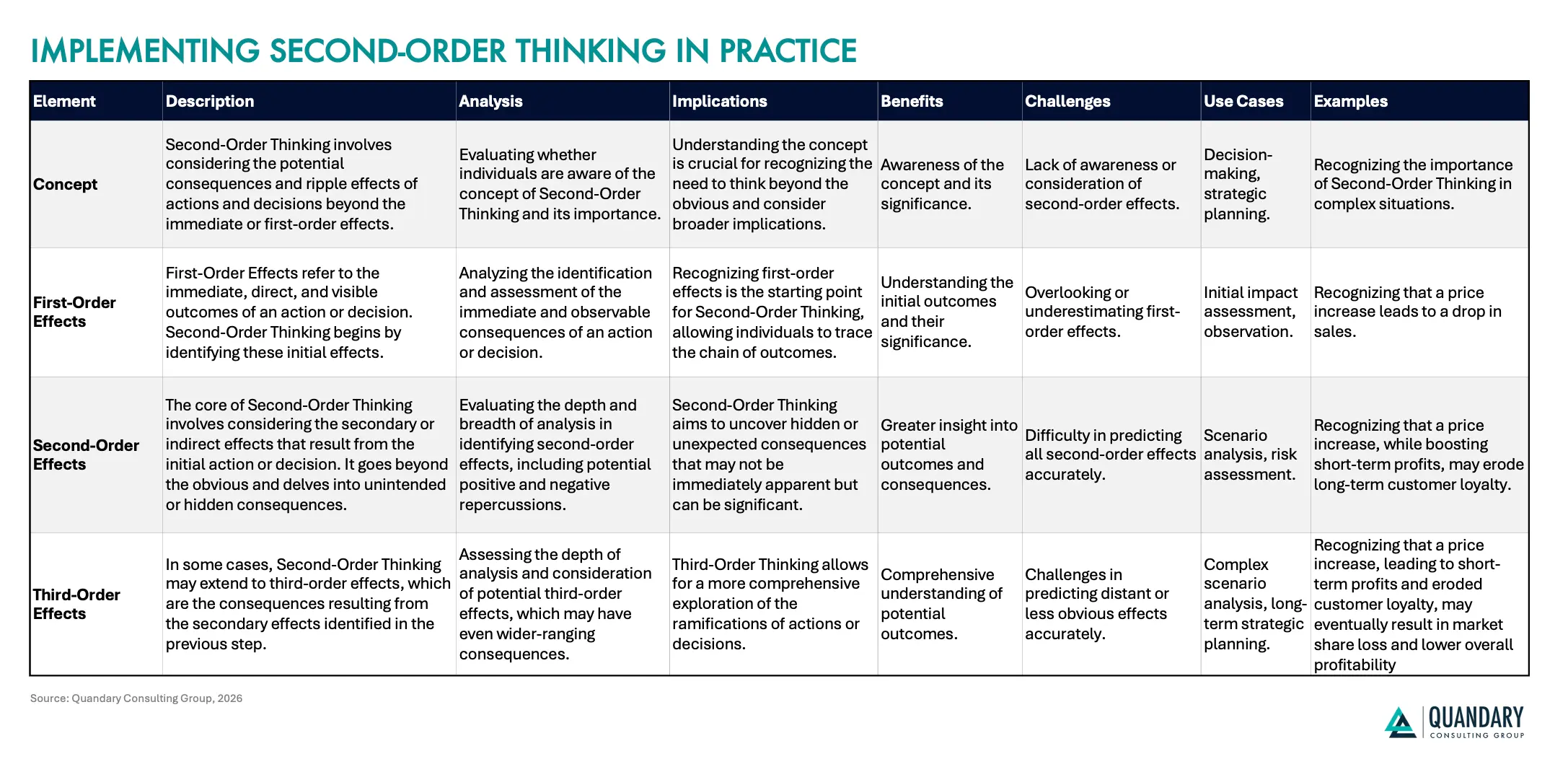
Second-order thinking is the practice of looking beyond the immediate outcome of a decision and considering what happens next—and what happens after that. It examines how a decision can create downstream consequences across people, processes, technology, customers, risk, and business performance over time.
First-order thinking focuses on the most immediate and obvious result:
“If we do X, Y will happen.”
Second-order thinking takes the analysis further:
“If we do X, Y will happen. What will Y change? How will employees, customers, systems, or processes respond? What new opportunities or risks could that create? And what happens next?”
Consider a company automating its customer service operation with AI.
First-order thinking might conclude:
AI handles more customer inquiries → fewer interactions require employees → operating costs decrease.
Second-order thinking asks what happens beyond that initial efficiency gain:
AI handles more inquiries → employees handle fewer routine interactions → remaining cases become more complex → employee roles and training requirements change → escalation workflows become more important → customer experience depends increasingly on how effectively AI and humans work together.
The automation itself may be successful, but its second-order effects determine whether that success is sustainable.
This distinction becomes particularly important with AI, business process automation, and digital transformation because these technologies rarely affect only one workflow. Changes to one process can influence upstream and downstream systems, data quality, employee responsibilities, customer experiences, compliance requirements, operating costs, and future technology decisions.
Second-order thinking therefore shifts the question from:
“Can we automate this?”
to:
“What happens to the rest of the business when we do?”
That is the difference between implementing technology for an immediate efficiency gain and designing transformation that continues creating value as the organization evolves.
What Is Second-Order Thinking in AI and Business Process Automation?
Second-order thinking in artificial intelligence (AI) and business process automation (BPA) means evaluating not only what a technology or automation will accomplish immediately, but also how that change will affect the broader organization over time.
A first-order approach asks: “What happens if we automate this process?”
The answer might be straightforward: processing becomes faster, repetitive work decreases, costs decline, and employees gain additional capacity.
Second-order thinking asks a more important question: “What happens next?”
If AI eliminates repetitive work, how will employee roles change? If customers receive faster service, will their expectations for responsiveness increase? If one workflow is automated, will it create new bottlenecks somewhere else? If AI generates more data or makes decisions autonomously, what governance, security, and oversight will be required? If transaction volume increases, can the surrounding systems and processes scale with it?
These downstream effects can influence:
- Customer experience: Faster automation may improve service, but poorly designed experiences can create frustration or eliminate valuable human interaction.
- Employee roles and adoption: Removing repetitive work changes responsibilities, skill requirements, workloads, and how employees interact with technology.
- Operational complexity: Automating one process can expose bottlenecks or dependencies in upstream and downstream workflows.
- Data and integration: AI and automation depend on reliable, accessible data and connected systems. Scaling without the right foundation can amplify existing data problems.
- Risk and governance: As AI assumes greater responsibility within business processes, organizations need appropriate controls, monitoring, security, accountability, and human oversight.
- Long-term ROI: An automation that generates immediate savings may create additional costs or limitations later if it cannot integrate, adapt, or scale with the organization.
This is why successful AI development and business process automation consulting require more than identifying tasks that technology can perform faster.
Organizations must understand how each automation decision affects the larger operating environment—and design for those consequences from the beginning.
First-order thinking asks whether AI can improve a process. Second-order thinking asks whether that improvement will continue creating value as the business evolves.
That distinction can determine whether an AI or automation initiative becomes an isolated efficiency gain or the foundation for sustainable business transformation.
What Percentage of AI Projects Fail, and Is the Rate Getting Worse?
There is no single universally accepted AI project failure rate because studies define “failure” differently. Some measure projects that never reach production, while others measure an inability to scale, generate measurable value, or achieve expected ROI.
What the research does show consistently is a significant AI pilot-to-production and pilot-to-value gap. S&P Global Market Intelligence found that the percentage of organizations abandoning the majority of their AI initiatives before production increased from 17% to 42% year over year. The average organization reported scrapping approximately 46% of AI projects between proof of concept and broad adoption. That suggests organizations are launching AI initiatives faster than many can successfully operationalize and scale them.
Boston Consulting Group has identified a similar value gap. In its research of 1,000 senior executives across 59 countries, BCG found that 74% of companies had yet to demonstrate tangible value from AI, while only 26% had developed the capabilities necessary to move beyond proofs of concept and generate meaningful value.
More recent research suggests the challenge continues even as enterprise adoption accelerates. Deloitte's 2026 State of AI in the Enterprise reports that while 66% of organizations are already seeing productivity and efficiency improvements from AI, only 20% report increased revenue. In other words, organizations are increasingly proving that AI can make individual tasks faster, but translating those improvements into broader financial and business outcomes remains significantly more difficult.
The problem is also not primarily the AI model itself, BCG found that approximately 70% of the challenges organizations encounter when implementing AI are related to people and processes, compared with 20% related to technology and data and just 10% related to AI algorithms - and, that distinction matters.
Organizations can successfully deploy an AI model and still fail to create meaningful business value if the surrounding processes, data, integrations, governance, employee roles, adoption strategies, and performance metrics are not designed to support it. The emerging pattern is clear: AI adoption is accelerating faster than many organizations' ability to operationalize AI effectively.
The organizations that succeed will therefore need to look beyond whether an AI pilot works technically. They must ask whether the surrounding business can support what happens when that pilot moves into production, reaches thousands of users, interacts with enterprise data, changes employee workflows, affects customers, and begins making or influencing decisions at scale.
That is precisely where second-order thinking becomes essential.
How Does Second-Order Thinking Impacts AI and BPA Implementation Outcomes?
1. Automation Changes Customer Expectations
When companies automate customer service or internal workflows, the immediate benefit is typically reduced cost and faster response times. However, second-order effects often include a shift in customer expectations. As AI-driven responses become faster, customers begin to expect instant and highly accurate interactions as the baseline experience. At the same time, human interaction becomes less frequent and more valuable.
If organizations do not account for this shift, they risk degrading customer satisfaction despite improving operational efficiency.
2. AI Reshapes Workforce Roles
AI implementation often improves individual productivity in the short term. However, it also changes how work is distributed across teams. Second-order effects include evolving job responsibilities, emerging skill gaps, and potential resistance to adoption. Research on AI change management shows that uncertainty around roles is a leading barrier to successful implementation, even when the underlying technology performs well.
Without a structured approach to workforce enablement, organizations frequently experience low adoption rates and underutilized systems.
3. Scaling AI Without Process Alignment Creates Complexity
Many organizations encourage rapid experimentation with AI tools across departments. While this can accelerate innovation initially, it often leads to fragmentation.
Second-order effects include duplicated systems, inconsistent data usage, and increased governance risk. This phenomenon, often referred to as “AI sprawl,” creates long-term technical debt that limits scalability and increases operational risk. Without a unified process and data strategy, early gains can quickly become constraints.
4. Individual Productivity Does Not Guarantee Business Impact
AI tools often improve the productivity of individual employees. However, this does not automatically translate into organizational performance gains.
Studies have shown that while employees may complete tasks faster using AI, companies frequently struggle to convert those gains into measurable revenue growth or operational efficiency at scale. This disconnect occurs when AI is applied at the individual level rather than embedded into end-to-end business processes.
Top 10 Benefits of Second-Order Thinking for AI Development
The value of second-order thinking in AI development and business process automation is not simply that it helps organizations predict problems. It changes how AI initiatives are designed in the first place.
Instead of optimizing a model, agent, or automated workflow for one immediate outcome, second-order thinking considers how that change will interact with the broader organization over time. That includes its impact on employees, customers, data, systems, compliance, security, operating models, and financial performance.
For organizations investing in enterprise AI, intelligent automation, and AI agents, that broader perspective can mean the difference between a successful proof of concept and an AI capability that creates sustainable business value.
1. Avoids Short-Sighted Automation Mistakes
First-order thinking asks:“Can we automate this task and save time?”
Second-order thinking asks: “If we automate this task, what changes upstream and downstream—and what could break as a result?”
This distinction is critical because business processes rarely operate independently. Automating one step can change the volume, speed, format, or quality of information flowing into the next.
For example, automating customer intake might dramatically increase processing capacity. But if fulfillment, operations, or customer support cannot accommodate the increased volume, the organization has not eliminated a bottleneck—it has simply moved it somewhere else.
Second-order thinking helps organizations identify potential consequences such as broken downstream workflows, duplicate or inconsistent data, overwhelmed teams, new system dependencies, poor exception handling, and customer experience degradation before they become operational problems. The goal is not to automate individual tasks. It is to improve the performance of the entire business process.
2. Improves Long-Term AI ROI
AI initiatives often begin with easily measurable efficiency metrics: hours saved, tasks automated, transactions processed, or headcount capacity created. Those metrics matter, but they do not necessarily demonstrate sustainable ROI.
Second-order thinking evaluates what happens after the initial efficiency gain. Can the solution support additional users? Can it handle increasing transaction volumes? Will it require extensive maintenance? Can it integrate with future systems? Will changing business rules require rebuilding the automation? Does it create additional costs somewhere else?
By considering these questions during AI strategy and development, organizations can build solutions that scale more efficiently, require less rework, adapt to changing requirements, and continue producing value over time.
Instead of pursuing isolated automation wins, the organization begins building reusable capabilities—data pipelines, integrations, governance frameworks, AI services, workflow components, and operating models—that can support future AI initiatives; and, that is where AI ROI can begin to compound.
3. Identifies Hidden Operational and AI Risks
Some of the most significant risks associated with AI do not appear during a controlled proof of concept. They emerge after the technology begins interacting with real employees, customers, systems, and data at scale. Second-order thinking forces organizations to consider how an AI system could create or amplify risks such as:
- Bias within automated decisions
- Incorrect or incomplete AI-generated outputs
- Excessive reliance on automated recommendations
- Unauthorized access to sensitive information
- Data privacy or cybersecurity exposure
- Regulatory and compliance violations
- Inconsistent decision-making across workflows
- Automation of flawed business rules
- Insufficient auditability or accountability
It also encourages teams to ask an important question: “What happens if this system performs exactly as designed—but the design itself creates an unintended outcome?”
That question moves AI risk management beyond technical performance and toward the broader business consequences of deploying AI.
4. Creates More Resilient AI Systems
Enterprise AI should not be designed under the assumption that everything will always work perfectly.
Models will occasionally produce incorrect outputs. APIs can fail. Data sources change. integrations break. Business rules evolve. Vendors experience outages. Employees encounter situations the original workflow never anticipated.
Second-order thinking assumes these scenarios will eventually occur and designs around them.
Teams can proactively determine: What happens if the AI is wrong? What happens if confidence is low? What happens if required data is unavailable? What happens if an integration fails? When should the AI stop and escalate to a person?
Answering those questions leads to stronger architectures with fallback workflows, exception management, confidence thresholds, monitoring, audit trails, human-in-the-loop controls, and clearly defined escalation paths.
The result is not merely an AI system that performs well under ideal conditions. It is an AI system designed to remain reliable when conditions are not ideal.
5. Improves AI Decision Intelligence
The real potential of enterprise AI extends beyond automating repetitive tasks. Increasingly, AI systems help organizations interpret information, recommend actions, identify patterns, prioritize work, and support or execute decisions.
That makes the consequences of those decisions increasingly important. Second-order thinking evaluates not only whether an AI recommendation is accurate, but also what happens when employees or systems act on that recommendation.
For example, an AI model may correctly identify customers most likely to convert. But repeatedly prioritizing those customers could change the organization's sales behavior, alter the data being collected, neglect emerging customer segments, and ultimately influence what the model learns in the future.
Effective AI development therefore requires feedback loops that measure both the accuracy of the AI output and the business outcomes those outputs create.
That allows organizations to continuously refine models, workflows, rules, and decision criteria based on real-world results.
6. Prevents Local Optimization From Hurting the Larger Business
One of the most common automation mistakes is optimizing a single department without considering the end-to-end process.
Sales automates lead generation and suddenly produces twice as many qualified opportunities—but operations cannot support the volume. Procurement accelerates purchase approvals—but finance receives incomplete coding information.
Customer service automates ticket resolution—but customers begin contacting the company repeatedly because their underlying problems were never actually solved. Each department may appear more efficient according to its own KPIs while the overall organization becomes less efficient.
Second-order thinking encourages organizations to evaluate AI and automation across the complete value chain, including upstream inputs, downstream dependencies, cross-functional handoffs, system integrations, and shared business outcomes.
The question becomes less about whether one department is moving faster and more about whether the entire organization is performing better.
7. Builds Stronger, AI-Ready Data Ecosystems
AI consumes data—but it also creates data. Every automated workflow, AI interaction, recommendation, exception, approval, and user correction generates new information that can influence future decisions. Second-order thinking treats that data as part of a continuously evolving ecosystem.
Organizations must consider where new data will be stored, how it will be governed, which systems need access to it, how quality will be maintained, and whether feedback from employees and customers should be incorporated into future models.
This creates an opportunity to build closed-loop learning systems where operational activity continuously improves the data foundation supporting future automation and AI.
Over time, organizations move beyond simply using data to automate processes. They begin creating an AI-ready data architecture capable of supporting increasingly sophisticated analytics, automation, and decision intelligence.
8. Improves Change Management and Employee Adoption
AI transformation is as much an organizational change initiative as it is a technology initiative. Automating work changes how employees spend their time, what decisions they make, which skills they need, and how they interact with customers and technology.
First-order thinking may focus on whether the AI works and Second-order thinking asks: “How will people respond when it does?”
Employees may resist automation they do not understand. They may distrust AI recommendations. Teams may create workarounds if new workflows introduce friction. Managers may struggle to redefine responsibilities when AI begins performing work previously assigned to employees.
Considering these reactions early allows organizations to incorporate change management, training, communication, user experience, governance, and role redesign directly into the AI implementation strategy.
When employees understand what AI is doing, why it is being introduced, when they should trust it, and when human judgment should take precedence, adoption becomes significantly more sustainable.
9. Creates a More Sustainable Strategic Advantage
Many organizations will eventually have access to similar AI models, platforms, copilots, and automation technologies. Simply having AI will not necessarily create a lasting competitive advantage. The differentiator will increasingly be how effectively an organization integrates AI into its operating model.
Second-order thinking encourages organizations to build capabilities that become stronger over time: connected enterprise data, reusable integrations, intelligent workflows, institutional knowledge, feedback loops, governance frameworks, AI-enabled employees, and continuously improving processes.
Those capabilities are much harder for competitors to replicate than access to a particular AI model.
While competitors chase individual AI use cases, organizations applying second-order thinking can build an interconnected AI operating system for the business—one in which data, systems, employees, workflows, and intelligent agents continuously work together and this creates a more durable form of competitive advantage.
10. Strengthens Responsible AI and AI Governance
Responsible AI cannot be addressed as a compliance exercise after development is complete. Organizations need to consider the potential consequences of AI decisions throughout the entire AI lifecycle—from use-case selection and data preparation to model deployment, monitoring, and continuous improvement.
Second-order thinking encourages teams to proactively evaluate questions surrounding:
- Fairness and bias
- Transparency and explainability
- Data privacy
- Cybersecurity
- Regulatory compliance
- Decision accountability
- Human oversight
- Model monitoring
- Data retention
- Auditability
- Long-term customer and employee impact
It also helps organizations distinguish between decisions that can be safely automated and those that should remain under meaningful human supervision. This reduces regulatory, legal, operational, cybersecurity, and reputational risk while creating clearer accountability for how AI is used across the enterprise.
Ultimately, responsible AI governance should not exist to slow innovation. It should create the guardrails organizations need to deploy AI confidently and scale it responsibly.
Second-Order Thinking Turns AI Projects Into Business Transformation
The central benefit of second-order thinking is that it changes the objective of AI development. The question is no longer simply: “How much can we automate?”
It becomes: “How do we use AI and automation to improve the performance of the entire organization over time?”
That shift changes how organizations approach AI strategy, business process automation, data architecture, system integration, governance, change management, and measurement.
The most successful AI initiatives will not necessarily be the ones with the most sophisticated models or the greatest number of automated tasks. They will be the ones designed with a clear understanding of how technology changes the broader system around it.
At Quandary Consulting Group, this means looking beyond the immediate AI use case. We evaluate the processes, integrations, data, people, governance requirements, and downstream dependencies surrounding an initiative so organizations can build AI and automation solutions that do more than work in a proof of concept.
They are designed to integrate, scale, adapt, and continue creating measurable business value over time.
Key Benefits of Encouraging Second-Order Thinking
Encouraging second-order thinking—looking beyond immediate outcomes to consider downstream effects—can noticeably raise the quality of decisions and execution on a team. Here’s what that unlocks in practice:
Better long-term decisions: Teams stop optimizing for quick wins that create hidden problems later. Instead of “Does this work now?”, the question becomes “What happens next… and after that?” This reduces rework, technical debt, and strategy whiplash.
Fewer unintended consequences: Second-order thinking forces people to map ripple effects. That means fewer surprises like a “successful” change that hurts another team, breaks a process, or damages customer experience down the line.
Stronger strategic alignment: People connect their work to broader goals. They’re more likely to consider how a decision impacts revenue, brand, operations, and customer retention—not just their immediate KPI.
Improved risk management: By thinking in chains of cause and effect, teams naturally surface risks earlier. This leads to better contingency planning and more resilient execution.
Higher ownership and accountability: It shifts the mindset from “I completed my task” to “I understand the impact of my work.” That tends to produce more thoughtful, self-directed contributors.
More thoughtful prioritization: Teams get better at distinguishing between actions that feel productive and those that actually compound value over time.
Better cross-functional collaboration: When people consider second-order effects, they’re more likely to loop in stakeholders early and think about dependencies—reducing friction between teams.
Compounding learning and insight: Over time, the team builds intuition about patterns and consequences. Decisions get faster and smarter because people recognize how similar situations have played out before.
Chesterton’s Fence: Why Understanding a Process Comes Before Automating It
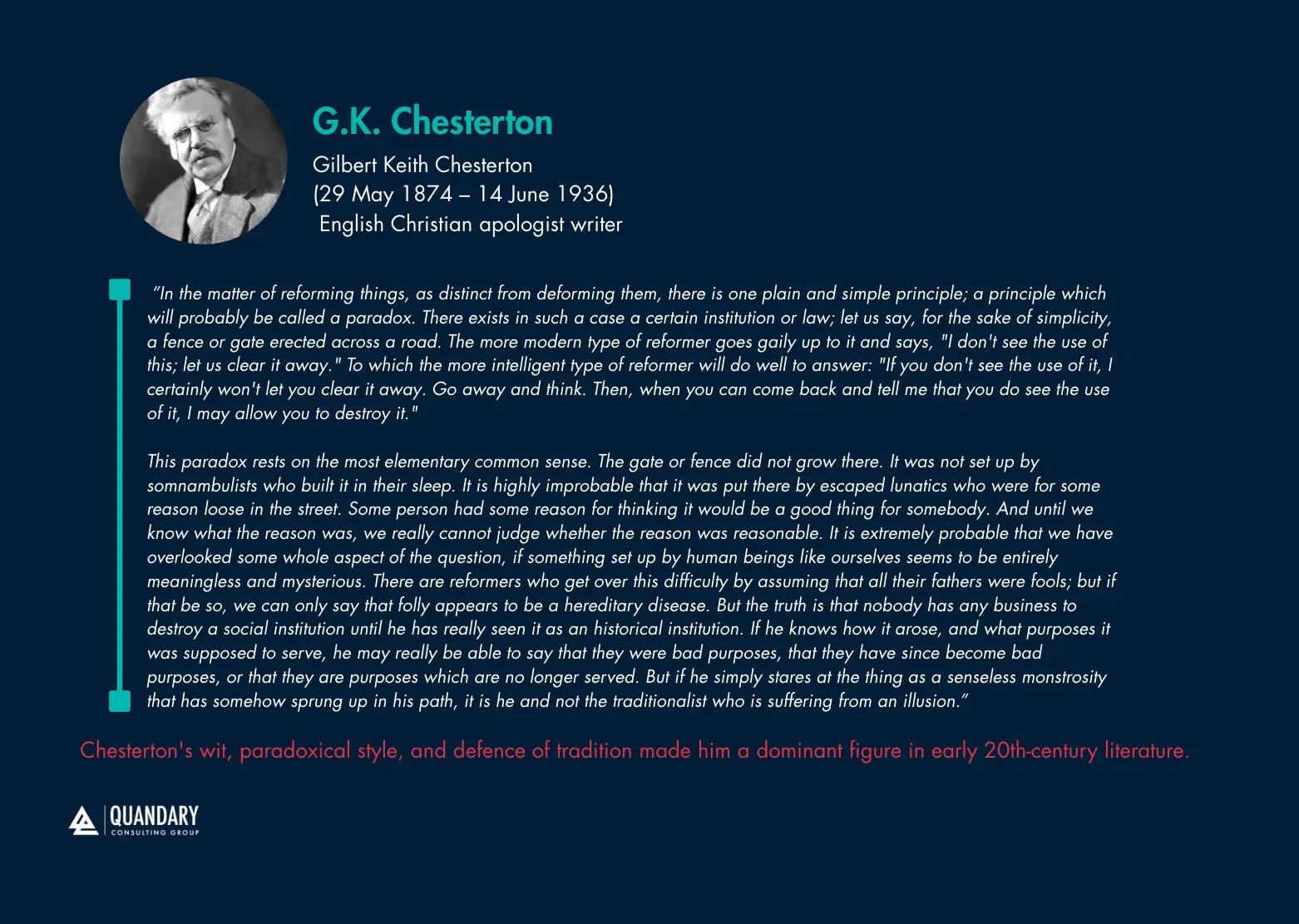
Chesterton’s Fence is a principle that teaches a deceptively simple lesson: before changing or removing something, understand why it exists in the first place.
The idea comes from British writer G.K. Chesterton, who argued that if you encounter a fence blocking a road, you should not immediately tear it down simply because you cannot see its purpose. The fact that you do not understand why the fence exists is precisely why you are not yet qualified to remove it.
Only after understanding why it was built, what problem it was intended to solve, and what might happen if it disappears can you make an informed decision about whether it should remain. That principle has significant implications for AI development, business process automation, digital transformation, and process optimization.
Organizations frequently encounter workflows that appear unnecessarily complicated:
- Multiple approval requirements
- Manual verification steps
- Duplicate-looking data entry
- Human review checkpoints
- Legacy business rules
- Exception-handling procedures
- Segregation-of-duties requirements
- Documentation requirements
- Long-established operational processes
From the outside, these steps can look like obvious candidates for elimination or automation.
Sometimes they are - But sometimes that apparent inefficiency exists because of a regulatory requirement, historical failure, fraud-control measure, customer commitment, financial control, safety requirement, data dependency, or exception that is invisible when looking only at the surface-level process.
Automating the workflow without understanding that context can make an inefficient process faster while simultaneously removing the safeguard that made it reliable and that is Chesterton's Fence applied to AI.
Why Chesterton’s Fence Matters More in the Age of AI
Businesses today face enormous pressure to move faster. Executives want AI deployed. Employees want inefficient processes fixed. Customers expect immediate service. Technology vendors promise rapid implementation. And generative AI makes it increasingly easy to build applications, agents, and automated workflows in weeks—or sometimes days.
That speed creates tremendous opportunity and It also introduces a new risk: The ability to change a system can move faster than the organization's ability to understand that system.
An AI development team may look at a ten-step process and conclude that it can be reduced to four. But why were the other six steps there?
Perhaps two exist because of outdated technology and genuinely should disappear. Another may satisfy a compliance requirement. One may validate information before it reaches an ERP. Another may prevent duplicate payments; and the final step may exist because five years ago the organization experienced a failure that cost millions of dollars.
Without understanding those dependencies, aggressive optimization can inadvertently remove critical controls. This is why process discovery should come before process automation.
Before eliminating, automating, or redesigning a step, organizations should understand: What purpose does this step serve? Why was it introduced? Who depends on its output? What risk does it mitigate? What data does it create or validate? What exceptions does it catch? What happens downstream if it disappears?
Only then can the organization determine whether the step should be eliminated, redesigned, automated, augmented with AI, or intentionally preserved.
Chesterton’s Fence Is Second-Order Thinking in Practice
Chesterton's Fence and second-order thinking are closely connected.
- First-order thinking sees an inefficient process and asks: “How can we remove this step?”
- Second-order thinking asks: “Why does this step exist, and what happens to the rest of the system if we remove it?”
That difference is fundamental to successful AI and business process automation.
The objective should never be to preserve inefficient processes simply because “that's how we've always done it.” Legacy processes absolutely should be challenged.
But they should be challenged with context. The strongest transformation teams distinguish between accidental complexity and intentional controls. They determine which processes are genuinely obsolete, which exist because technology limitations once required them, and which continue protecting the organization from meaningful operational, financial, regulatory, security, or customer risk - Only then should automation begin.
Understand First. Optimize Second. Automate Third.
This creates a much stronger framework for AI transformation: Understand → Challenge → Redesign → Automate → Measure → Improve
Instead of simply automating the current state, organizations first understand why the current state exists. They challenge outdated assumptions, redesign the process around the desired business outcome, and then determine where AI, automation, integration, and human judgment should each play a role.
That approach may take slightly more thinking at the beginning; but it can prevent considerably more expensive problems later. Because in enterprise AI and business process automation, the most dangerous question is not always: “Why are we still doing this?”
Sometimes it is: “What did we fail to understand before we stopped?”
The Core Lesson: You Must Understand Before You Change
Many people approach problems like this: “This doesn’t make sense. Let’s remove it.” Chesterton flips that thinking: “This doesn’t make sense yet. Let’s understand it first.”
Key Insight:
- Systems evolve for reasons
- Rules often solve past problems
- Removing them blindly can recreate those problem
Three Real-World Chesterton’s Fence Examples in Business
Chesterton's Fence appears constantly in business. Processes, controls, policies, and even pieces of technology can look inefficient when viewed in isolation. But removing them without understanding their original purpose can create consequences far more costly than the inefficiency an organization was trying to eliminate.
Here are three examples of how this principle applies to business process automation, software development, and enterprise AI.
1. Business Process Automation: Removing an “Unnecessary” Approval
A growing organization wants to accelerate its purchasing process. During process mapping, leadership discovers that certain purchase requests require an additional approval before a purchase order can be issued.
The step appears redundant and to reduce approval time, the company eliminates it and automates the remaining workflow.
Initially, the project looks successful. Purchase requests move faster, employees spend less time waiting for approvals, and procurement cycle times improve.
Then the second-order effects appear.
Unauthorized purchases increase. Certain transactions bypass budget controls. Procurement discovers more contract exceptions. Finance spends additional time correcting coding errors. Compliance teams have less visibility into higher-risk transactions.
The supposedly redundant approval was actually performing several important functions that were not documented clearly in the workflow.
The lesson: Do not automate a process based solely on how it appears today. Determine why each control exists, what risk it mitigates, and what downstream processes depend on it before deciding whether to eliminate, redesign, or automate it.
The better solution might not have been removing the approval at all. It could have been using rules-based automation or AI to determine which transactions genuinely required additional review, allowing low-risk purchases to move automatically while exceptions continued receiving human oversight.
That is the difference between simply making a process faster and intelligently redesigning it.
2. Software Development: Deleting “Redundant” Legacy Code
A development team modernizing an enterprise application discovers a block of legacy code that appears unnecessary.
There is little documentation explaining it. The original developer is no longer with the organization. The code seems redundant with newer functionality, so the team removes it during modernization.
Everything initially appears to work - then an unusual transaction occurs. A particular combination of customer data triggers an error that begins affecting downstream systems. The team eventually discovers that the supposedly obsolete code handled a rare edge case introduced years earlier after a production incident.
The code was not elegant, but it had a purpose.
The lesson: Legacy technology frequently contains institutional knowledge that organizations no longer recognize as knowledge.
Before removing old code, integrations, database fields, business rules, or system dependencies, teams need to understand what they do, why they were introduced, and which edge cases they protect against.
This becomes even more important when using AI-assisted development. AI can help teams analyze, refactor, document, and modernize legacy systems much faster—but increasing the speed of development does not eliminate the need to understand the consequences of a change.
AI can accelerate the change. Second-order thinking helps determine whether the change should be made.
3. Enterprise AI: Automating Away the Human Review
An organization introduces an AI agent to analyze incoming customer requests, determine the appropriate response, and automatically initiate downstream workflows.
During the pilot, the results are impressive. The AI handles the majority of routine requests correctly, response times fall dramatically, and employees spend significantly less time performing repetitive work.
Leadership sees the human review step as unnecessary friction and removes it to capture additional efficiency and for most transactions, nothing goes wrong; but the remaining percentage contains the organization's most complicated cases—unusual customer circumstances, incomplete information, sensitive decisions, regulatory exceptions, or situations the model has rarely encountered.
Now those exceptions are being processed without sufficient oversight and the organization may have successfully automated 95% of the workflow while simultaneously increasing the risk associated with the 5% that matters most.
The lesson: Human involvement in an AI-enabled process should not automatically be viewed as inefficiency.
The right question is not: “Can AI replace this human decision?”
It is: “Under what circumstances should AI make this decision autonomously, and when does the risk or complexity justify human judgment?”
A better architecture might allow AI to process high-confidence, low-risk transactions automatically while using confidence thresholds, business rules, exception detection, escalation workflows, and human-in-the-loop controls for higher-risk decisions.
That creates something far more valuable than maximum automation and creates intelligent automation with appropriate human oversight.
The Core Lesson: You Must Understand Before You Change
The central lesson of Chesterton's Fence is simple:
Understanding should come before optimization.
When people encounter an inefficient process, outdated policy, legacy system, or unnecessary-looking control, the natural reaction is often: “This doesn't make sense. Let's remove it.”
Chesterton's Fence introduces a more disciplined way of thinking: “This doesn't make sense yet. Let's understand why it exists before we change it.”
That single word—yet—makes an enormous difference.
Complex organizations accumulate processes, rules, approvals, integrations, controls, and workarounds over years or even decades. Some absolutely become outdated. Others exist because of regulatory requirements, customer commitments, security concerns, financial controls, operational dependencies, previous failures, or edge cases that may no longer be obvious.
The fact that a process appears inefficient does not necessarily mean it serves no purpose.
1. Context Matters Before Automation Begins
This principle becomes particularly important in AI development and business process automation.
AI makes it increasingly possible to automate, redesign, and eliminate work at unprecedented speed. But the ability to change a process faster does not necessarily mean an organization understands that process better.
Before automating or removing a workflow step, organizations should understand:
- Why does this step exist?
- What business requirement does it satisfy?
- What risk or failure was it designed to prevent?
- What systems, teams, or customers depend on its output?
- What exceptions does it handle?
- What data does it create, validate, or protect?
- What happens upstream and downstream if it disappears?
- Could the purpose of the step be preserved in a better way?
Once those questions are answered, the organization can make a much more intelligent decision.
- A process may need to be eliminated.
- It may need to be redesigned.
- It may be an ideal candidate for automation.
- It may need AI augmentation rather than complete automation.
Or its underlying control may need to remain while the surrounding manual work disappears.
2. The Goal Is Not to Preserve the Past
Chesterton's Fence should not be interpreted as an argument against change, it is an argument against uninformed change. Organizations should challenge legacy processes, outdated assumptions, unnecessary approvals, technical debt, and inefficient ways of working. But effective transformation requires separating historical baggage from institutional knowledge.
That distinction matters. A workaround created because of a software limitation from 15 years ago may no longer be necessary. A verification step introduced after a multimillion-dollar financial error may still be critically important.
Both can look like inefficiencies on a process map and only one should disappear without being replaced.
3. Understand → Challenge → Redesign → Automate → Measure
This creates a practical framework for AI and automation initiatives:
- Understand the current process and why it exists.
- Challenge the assumptions, rules, and constraints behind it.
- Redesign the process around the desired business outcome.
- Automate or augment the appropriate work using AI and technology.
- Measure both the immediate results and downstream consequences.
This is where Chesterton's Fence connects directly with second-order thinking. First-order thinking asks how quickly an organization can remove friction.
Second-order thinking asks why the friction exists, what function it performs, and what new consequences might emerge when it disappears. The objective is not to protect every fence, but more so that it is to make sure you understand what is on the other side before you tear it down.
What Does Chesterton’s Fence Mean for Leadership?
Leaders are constantly under pressure to make organizations faster, leaner, more innovative, and more efficient. They are expected to eliminate unnecessary costs, modernize legacy processes, adopt AI, automate repetitive work, and challenge the status quo.
That pressure makes Chesterton's Fence particularly relevant to leadership. The principle does not suggest that leaders should preserve outdated systems or inefficient processes. It suggests that leaders should understand why something exists before deciding how—or whether—to change it.
Inside an organization, a “fence” might be:
- A policy that appears outdated
- A slow or multi-step approval process
- A recurring meeting everyone complains about
- A manual verification step
- A legacy application or integration
- A compliance or security control
- A reporting requirement
- A workflow employees have followed for years
- A human review embedded within an otherwise automated process
Any of these may genuinely be unnecessary; but they may also represent institutional knowledge that is no longer documented or immediately visible.
An approval may exist because of a previous fraud incident. A manual review may catch an exception that occurs only a few times each year. A recurring meeting may be the only place two departments regularly coordinate critical information. A legacy system may feed data into five downstream applications no one considered when planning its replacement.
What appears to be inefficiency from the executive level can sometimes be a control, dependency, or safeguard at the operational level.
1. Leadership Requires Understanding the System, Not Just the Symptom
This is particularly important during AI transformation and business process automation. A leader might see that employees spend hundreds of hours manually reviewing documents and reasonably conclude: “AI should automate this.”
That may be correct, but second-order leadership asks additional questions:
- Why are employees reviewing these documents?
- What exactly are they looking for?
- Which decisions require judgment?
- What exceptions occur?
- What happens when information is missing?
- What downstream systems depend on the review?
- What regulatory requirements apply?
- What happens when the AI is wrong?
Those questions do not slow transformation, they make transformation more likely to succeed. Understanding the purpose behind the existing process allows leaders to determine which parts should be eliminated, simplified, automated, augmented with AI, redesigned, or intentionally preserved.
The Cost of Removing a Fence Too Quickly
When leaders change systems without understanding why they exist, several second-order consequences can emerge.
Old problems can return. A control originally introduced to prevent compliance violations, financial errors, security incidents, quality problems, or customer issues disappears—and the organization eventually rediscovers why it existed.
Hidden dependencies can break. Changing one workflow can unexpectedly affect another department, system, dataset, customer experience, or business process.
Operational risk can increase. A process becomes faster but less reliable because the organization optimized for efficiency without preserving necessary controls.
Employees can lose trust in transformation efforts. When leadership removes processes without understanding how work actually gets done, frontline employees quickly recognize the disconnect. The perception becomes: “Leadership doesn't understand what happens here.”
Technology investments can underperform. AI or automation may technically work while failing to improve the broader business because the organization automated the visible process without understanding the system surrounding it.
Frontline Employees Often Know Why the Fence Exists
This is also why successful transformation cannot be designed entirely from the executive level.
The people closest to a process frequently understand dependencies, exceptions, workarounds, and failure modes that are invisible in dashboards or process documentation.
A workflow diagram might show ten steps, but the employee performing the work may know that step seven exists because step three occasionally produces incorrect information, that one customer requires a special exception, and that two systems do not synchronize correctly at the end of the month.
That knowledge matters and effective leaders therefore combine executive strategy with operational discovery. They involve the people performing the work, investigate why processes evolved the way they did, and capture institutional knowledge before redesigning the system.
Chesterton's Fence Does Not Mean “Don't Change It”
This distinction is critical. Chesterton's Fence is not an excuse for organizational inertia, “We've always done it this way” is not a sufficient reason to preserve a process.
But neither is “this looks inefficient” a sufficient reason to eliminate one. The stronger leadership approach is: Understand it. Challenge it. Redesign it. Then change it.
Sometimes that analysis confirms that the fence serves no remaining purpose—and it should come down; and sometimes the underlying purpose remains important, but technology provides a dramatically better way to accomplish it - yet, and sometimes leaders discover that the apparent inefficiency is actually protecting the organization from a risk they had not considered.
All three are valuable outcomes because the decision is now being made with context.
The Leadership Principle: Move Fast, But Understand First
In an era of AI, automation, and rapid digital transformation, leaders have more power than ever to change how organizations operate.
That makes understanding consequences more important, not less; and strong leadership is not about preserving every existing process. Nor is it about eliminating everything that appears inefficient.
It is about understanding why the organization works the way it does, identifying what should change, anticipating what that change will affect, and designing a better system intentionally.
Chesterton's Fence ultimately gives leaders a simple rule for transformation: Do not defend complexity simply because it already exists. But do not destroy complexity until you understand what purpose it serves.
That is not resistance to change- It is second-order leadership.
How Quandary Applies Second-Order Thinking to AI Development and BPA
At Quandary Consulting Group, we approach AI and BPA through a systems-thinking lens to ensure long-term success rather than short-term optimization.
Process Before Platform
We begin by analyzing workflows, decision points, and data dependencies before introducing any technology. This approach aligns with broader industry findings that starting with business processes, rather than tools, significantly increases the likelihood of successful AI adoption. By mapping how work flows through an organization, we can anticipate downstream impacts before automation is introduced.
Designing for Scalable AI Deployment
While pilot programs demonstrate feasibility, they do not guarantee scalability. Second-order thinking requires evaluating how systems behave under real-world conditions. We design governance frameworks, data architectures, and ownership models that support enterprise-wide deployment. This ensures that AI solutions remain stable and effective as usage grows.
Human-in-the-Loop System Design
Effective AI systems are not fully autonomous. Instead, they incorporate structured human oversight. We design workflows that include escalation paths, feedback loops, and decision checkpoints. This approach aligns with industry guidance emphasizing that human-AI collaboration leads to more reliable and trustworthy outcomes, particularly in complex business environments.
Measuring What Actually Drives ROI
Many organizations focus on short-term metrics such as cost reduction or time savings. While these are important, they do not capture the full impact of AI. We also measure:
- User adoption rates
- Process consistency
- Customer experience outcomes
- Revenue and margin impact
These metrics provide a more accurate view of long-term success and help identify second-order effects early.
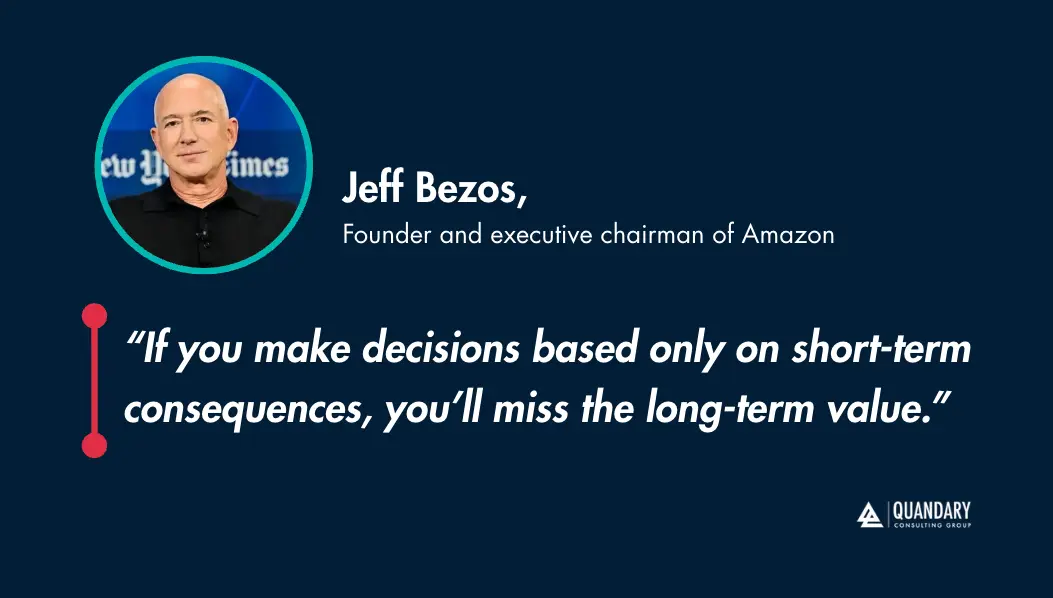
Why Second-Order Thinking Is a Competitive Advantage
As AI, automation, and intelligent technologies become more accessible, simply adopting them will no longer create a meaningful competitive advantage. Most organizations will eventually have access to similar AI models, agents, automation platforms, and development tools. The differentiator will be how intelligently those technologies are applied. Organizations that practice second-order thinking look beyond immediate productivity gains and consider how each decision will affect customers, employees, processes, data, systems, risk, and business performance over time. Instead of asking only how AI can make an existing task faster, they ask how that improvement can strengthen the entire operating model.
That perspective allows organizations to make better investments and avoid many of the problems that cause AI and automation initiatives to stall after early success. They anticipate downstream bottlenecks before increasing capacity, build data and integration foundations before scaling AI, establish governance before autonomous systems assume greater responsibility, and redesign employee roles as automation changes how work gets done. Just as importantly, they create feedback loops that allow AI models, workflows, processes, and decisions to continuously improve based on real-world outcomes. While competitors may accumulate disconnected pilots and point solutions, second-order thinkers build connected capabilities that become more valuable as adoption expands.
Over time, that creates a competitive advantage that is much harder to replicate than access to any individual technology. The real AI advantage is not the model—it is the system an organization builds around it. Connected data, intelligent workflows, reusable integrations, effective governance, institutional knowledge, employee adoption, and well-designed human-AI collaboration can compound into an operating capability competitors cannot simply purchase from a vendor. Organizations that think beyond the first-order benefits of AI are therefore better positioned to adapt faster, manage risk more effectively, scale successful innovations, and turn AI investment into sustained business value. In an environment where everyone can access increasingly powerful technology, the organizations that understand the consequences of change—not simply the possibilities of it—will be the ones best positioned to lead.
Possible Drawbacks and Limitations of Second-Order Thinking:
With everything in life, there is always a possible negative outcome and even though, second-order thinking is very useful, it’s also not a silver bullet. In practice, it comes with real constraints and tradeoffs that are easy to overlook:
Cognitive overload: Thinking through multiple layers of consequences is mentally demanding. For complex decisions, the number of possible second- and third-order effects grows quickly, making it hard to stay clear or decisive.
Analysis paralysis: The more you try to anticipate downstream outcomes, the easier it is to get stuck. People can delay decisions indefinitely while trying to map every possible ripple effect.
Uncertainty compounds over time: Second-order thinking assumes you can reasonably predict future consequences—but the further out you go, the less reliable those predictions become. Small errors early on can lead to completely wrong conclusions.
False sense of control: It can create the illusion that you’ve “thought of everything,” when in reality many variables (market shifts, human behavior, external shocks) are unpredictable.
Time and resource constraints: In fast-moving environments, there often isn’t time to deeply evaluate second-order effects. Overusing this model can slow execution and reduce responsiveness.
Diminishing returns: Beyond a certain point, additional layers of thinking (third-, fourth-order) add complexity without meaningful improvement in decision quality.
Bias amplification: If your initial assumptions are biased, second-order thinking can actually reinforce those biases by building logical—but flawed—chains of reasoning on top of them.
Not all decisions require it: Applying second-order thinking to low-stakes or routine choices is inefficient. It’s most valuable for high-impact, irreversible, or strategic decisions—not everyday ones.
- A practical takeaway: second-order thinking works best when used selectively on decisions where the long-term consequences truly matter while accepting that uncertainty and imperfect foresight are always part of the equation.
Why is Second-Level Thinking Important to AI Development?
Second-level thinking is important in AI because it goes beyond the obvious, immediate answer and considers the consequences, context, and downstream effects of a decision.
At a basic level, an AI system can make “first-level” decisions, which are quick and direct. For example, it might recommend a product based only on what someone clicked on recently. That kind of thinking can miss important factors, like whether the recommendation is actually helpful long-term, whether it creates bias, or whether it leads to unintended outcomes.
Second-level thinking asks, “What happens next?” and “What are the side effects of this decision?” In AI development, this means engineers and designers think more deeply about how the system behaves over time, how users might react, and how the system might be misused. It also includes considering ethical issues, fairness, and long-term impact on people and society.
For implementation, second-level thinking helps teams avoid problems that don’t show up right away. For example, an AI model might perform well in testing but fail in the real world because of changing data or user behavior. By thinking one step further, developers can build safeguards, monitor performance, and design systems that adapt more responsibly.
In short, second-level thinking makes AI systems more reliable, ethical, and useful because it focuses not just on what works now, but on what happens as a result of those decisions over time.
Additional Resources:
- ZJ Hadley: Be Smarter: A Crash Course in Second-Order Thinking
- PEX Network: What is second-order thinking?
- Milap Chavda: What is First Order Thinking? A Guide to Making Smarter Decisions
- Farnam Street Media Inc. | Second-Order Thinking: What Smart People Use to Outperform
- Noah Pepper (Medium) | Second Order Thinking
- Productivity Guy (YouTube Channel) | What is Second Order Thinking | Explained in 2 min
- Second-Order Thinking: Seeing Beyond the Obvious: How to Anticipate Consequences, Avoid Hidden Pitfalls, and Make Smarter Long-Term Decisions (Thinking Better), Author E.M
- David J Johnson | Unintended Consequences and the Power of Second-Order Thinking
Top FAQs About Second-Order Thinking and AI Development
What is second-order thinking in AI development?
Second-order thinking in AI development is the practice of evaluating not only the immediate result of an AI implementation but also its downstream effects on people, processes, systems, data, customers, governance, and business performance. Instead of asking only, “What can AI automate?” second-order thinking asks, “What happens after we automate it, and how will those changes affect the rest of the organization?” This approach helps companies design enterprise AI solutions that scale sustainably and create long-term business value.
Why is second-order thinking important for AI strategy?
Second-order thinking helps organizations avoid optimizing AI initiatives around short-term metrics such as tasks automated, hours saved, or processing speed. A strong enterprise AI strategy also considers how automation will affect employee roles, customer expectations, data requirements, system capacity, cybersecurity, compliance, operating costs, and future technology decisions. Understanding these consequences before scaling AI can reduce rework and improve long-term ROI.
What is the difference between first-order and second-order thinking in AI?
First-order thinking focuses on the immediate consequence of an AI decision: “Automating this workflow will reduce processing time.” Second-order thinking examines what happens next: “If processing time decreases, transaction volume may increase; if volume increases, downstream systems and employees may face additional demand; if those systems cannot scale, we may simply create a new bottleneck.” First-order thinking optimizes the task. Second-order thinking optimizes the larger system.
How does second-order thinking improve AI ROI?
Second-order thinking can improve AI return on investment (ROI) by helping organizations identify downstream costs, dependencies, risks, and scalability requirements before they become expensive problems. It encourages businesses to build reusable integrations, reliable data foundations, scalable workflows, governance frameworks, and feedback loops rather than isolated AI pilots. The result is an AI capability designed to continue generating value as adoption and complexity increase.
How can second-order thinking prevent AI projects from failing?
Second-order thinking cannot guarantee that an AI initiative will succeed, but it can address many of the organizational problems that prevent promising pilots from producing sustainable value. Teams examine data quality, integrations, employee adoption, exception handling, governance, security, process dependencies, performance measurement, and scalability alongside model performance. This helps organizations evaluate whether the entire operating environment is ready for AI, rather than determining only whether the technology works.
How does second-order thinking apply to business process automation?
In business process automation (BPA), second-order thinking means evaluating how automating one part of a workflow will affect everything upstream and downstream. For example, automating sales intake might increase lead-processing capacity but overwhelm fulfillment if the downstream process is not prepared for additional volume. Effective BPA therefore focuses on end-to-end process optimization, not simply automating individual tasks.
What is Chesterton's Fence, and how does it relate to AI and automation?
Chesterton's Fence is the principle that you should understand why something exists before removing or changing it. Applied to AI and automation, it means organizations should understand why a process step, approval, human review, business rule, or legacy control exists before eliminating it. What appears inefficient may be protecting against fraud, compliance violations, data errors, security risks, operational failures, or important exceptions. The goal is not to preserve outdated processes; it is to understand their function before redesigning them.
Why should organizations understand a business process before automating it with AI?
Automating a poorly understood process can make existing problems happen faster and at greater scale. Process discovery and process mapping help organizations identify business rules, exceptions, dependencies, data requirements, bottlenecks, controls, and desired outcomes before AI is introduced. Organizations can then determine which steps should be eliminated, redesigned, automated, augmented with AI, or retained for human review.
What role does human-in-the-loop AI play in second-order thinking?
Human-in-the-loop AI provides human review or intervention when decisions involve uncertainty, exceptions, sensitive information, regulatory requirements, or significant business consequences. Second-order thinking helps organizations determine where AI can operate autonomously and where human judgment remains necessary. Rather than treating human involvement as inefficiency, organizations can design confidence thresholds and escalation workflows that balance speed with accountability and risk management.
How does second-order thinking support responsible AI and AI governance?
Second-order thinking encourages organizations to consider the long-term consequences of AI decisions before and after deployment. This includes bias, fairness, explainability, privacy, cybersecurity, regulatory compliance, data governance, accountability, model monitoring, auditability, and human oversight. Incorporating these considerations into AI development from the beginning can make responsible AI governance part of the architecture rather than an afterthought.
How does second-order thinking help organizations scale AI from pilot to production?
Moving AI from proof of concept to enterprise production requires more than a successful model. Organizations need scalable infrastructure, connected data, enterprise integrations, governance, security, exception management, employee adoption, monitoring, and clear ownership. Second-order thinking forces teams to anticipate these requirements during development so that AI pilots are designed for operational scale rather than demonstration alone.
How can businesses measure the second-order effects of AI?
Organizations should measure more than productivity and cost savings. Depending on the use case, AI performance metrics may also include error rates, exception volumes, customer satisfaction, employee adoption, data quality, compliance incidents, downstream cycle times, revenue impact, operating costs, escalation rates, and overall process performance. Measuring these outcomes helps determine whether AI improved the broader business rather than simply accelerating one task.
Can AI automation create new business problems?
Yes. An AI system can successfully automate its intended task while creating unintended consequences elsewhere. Increased processing capacity can overwhelm downstream teams, automated decisions can introduce new compliance requirements, poor integrations can fragment data, and excessive automation can damage customer or employee experiences. Second-order thinking helps organizations identify these potential consequences before AI is deployed at scale.
How can leaders use second-order thinking when making AI investment decisions?
Leaders should evaluate AI investments based on both immediate value and long-term organizational impact. Before approving an initiative, they should ask what happens if the AI succeeds: Can the surrounding processes scale? Is the data reliable? Which systems must integrate? How will employee roles change? What new risks emerge? How will success be measured? What governance is required? These questions help distinguish attractive AI demonstrations from investments capable of creating sustainable enterprise value.
How can Quandary Consulting Group apply second-order thinking to AI development and automation?
Quandary Consulting Group approaches AI development, intelligent automation, and business process transformation by looking beyond the individual technology or use case. We evaluate the surrounding processes, data, integrations, users, controls, governance requirements, and downstream dependencies to determine how an AI solution will operate within the larger business. By combining AI, business process automation, enterprise integration, data engineering and orchestration, intelligent application development, and AI governance, Quandary helps organizations move beyond isolated pilots and build AI capabilities designed to integrate, scale, and deliver measurable business value.