Artificial Intelligence (AI)
How APIs and MCP Enable Connected Intelligence for Enterprise AI

TL;DR
- Enterprise AI becomes significantly more valuable when it can securely connect to the systems, data, tools, and workflows that run the business. Large language models (LLMs) are powerful reasoning engines, but APIs and integration infrastructure give them access to real-time enterprise context and the ability to take meaningful action across CRM, ERP, analytics, collaboration, automation, and other business platforms.
- APIs and Model Context Protocol (MCP) serve complementary roles in modern enterprise AI architecture. APIs provide the underlying access to application data, services, and functionality, while MCP provides a standardized framework that helps AI models and agents discover, understand, and interact with those connected resources more consistently. MCP does not replace APIs—it can make them easier for AI systems to use at scale.
- MCP can help enterprises move from isolated AI assistants to connected, agentic AI ecosystems. With the right integrations and permissions, AI agents can retrieve organizational knowledge, analyze operational data, update records, trigger workflows, coordinate across applications, communicate with employees, and maintain context throughout complex, multi-system business processes.
- The future of enterprise AI depends on interoperability, orchestration, and trusted data—not simply more powerful AI models. Organizations with fragmented applications, siloed data, inconsistent APIs, and disconnected workflows may struggle to operationalize AI, while businesses investing in modern integration architecture and standardized orchestration can create a stronger foundation for scalable AI automation and intelligent operations.
- Enterprise AI connectivity must be paired with strong AI governance and security. As APIs and MCP give AI agents greater access to enterprise systems, organizations need identity and access management, least-privilege permissions, API governance, monitoring, observability, security validation, auditability, and human approval for sensitive actions. The goal is not simply connected AI—it is secure, governed, scalable connected intelligence.
As enterprises race to operationalize AI, one reality is becoming impossible to ignore: large language models are only as powerful as the systems they can connect to. For the past two years, most AI conversations have centered around model size, prompt engineering, and generative capabilities. But the market is now shifting toward a more important challenge — interoperability.
How do LLMs securely access tools, data, workflows, and business systems in real time? That’s where APIs [and increasingly, the Model Context Protocol (MCP)] are emerging as the connective tissue of modern AI ecosystems.
At Quandary Consulting Group, we see this evolution as a major turning point. The future of enterprise AI will not be built around isolated chatbots. It will be built around connected intelligence: systems where models can retrieve context, interact with platforms, orchestrate workflows, and operate across the digital enterprise seamlessly; and, MCP represents a major step toward making that future scalable.
The Problem with Isolated Enterprise-Level LLMs
On their own, LLMs are fundamentally pretty limited. They can generate content, summarize information, and reason across language remarkably well — but they lack persistent awareness of the systems businesses actually run on.
Without integrations, models cannot:
- Access live customer data
- Retrieve organizational knowledge securely
- Trigger operational workflows
- Maintain consistent context across tools
- Interact dynamically with enterprise platforms
This creates a major gap between AI experimentation and enterprise execution. Organizations quickly discover that standalone AI experiences create friction rather than transformation. Valuable data remains trapped in CRMs, ticketing systems, analytics platforms, document repositories, and internal applications.
To become operationally useful, AI needs infrastructure that enables connection, context, and coordination. That infrastructure increasingly depends on APIs and emerging interoperability standards like MCP.
What is the Model Context Protocol (MCP)?
Model Context Protocol (MCP) is an emerging open standard designed to help AI systems interact with external tools, services, and data sources in a more consistent and scalable way. In simple terms, MCP creates a structured framework for how models:
- Request information
- Access tools
- Receive contextual data
- Execute actions
- Maintain operational awareness across systems
If APIs are the roads connecting applications, MCP acts more like a universal traffic system — standardizing how AI agents navigate those connections intelligently. Rather than building custom integrations for every model and every platform independently, MCP introduces a more unified approach to context sharing and tool interoperability.
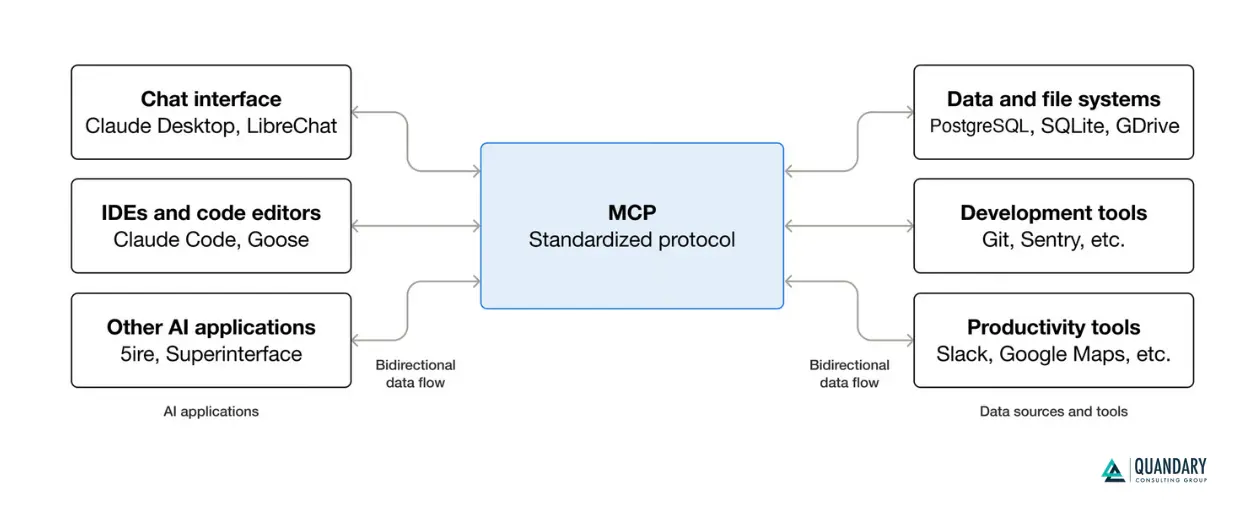
This matters because enterprise AI environments are becoming increasingly complex. A single AI workflow may need to:
- Pull data from Salesforce
- Retrieve documents from SharePoint
- Trigger pipelines in Quickbase
- Access analytics from Snowflake
- Trigger automations in HubSpot
- Communicate through Slack and Teams
- Create project documentation from a record meeting in Notion
- Log outputs into internal systems
Without standardized coordination, these ecosystems become difficult to scale and govern and MCP helps reduce that fragmentation.
MCP Adoption is Accelerating
What makes MCP especially important is the speed at which the ecosystem is growing. According to industry reporting and ecosystem tracking:
- In March 2026, MCP has surpassed 97 million SDK downloads in roughly 16 months
- As of May 26, 2026, PluseMCP (an open source MCP public index), there is currently 16,013 public MCP servers now indexed globally
- Major platforms including OpenAI, Google DeepMind, Microsoft Copilot, Claude, and Cursor, have adopted or integrated MCP support
- One industry analysis reported that 78% of enterprise AI teams already have MCP-backed agents in production environments as of late April 2026
This rapid adoption suggests the market is converging around interoperability as the next critical layer of enterprise AI infrastructure. To us, we believe this signals a broader industry shift: organizations are moving from standalone AI tools toward interconnected AI ecosystems.
Why APIs Still Matter
While MCP is gaining momentum, however, APIs remain the foundational layer enabling all of this connectivity. APIs expose the functionality, data, and services that AI systems depend on. They allow models to move beyond static text generation into operational workflows.
We often describe to our client's that APIs are the nervous system of enterprise AI. They allow LLMs to:
- Access real-time business data
- Interact with operational platforms
- Personalize outputs dynamically
- Trigger downstream workflows
- Integrate into existing business infrastructure
APIs provide the raw connectivity. MCP introduces a standardized way for AI systems to coordinate across those connections.
The relationship is complementary, not competitive. In many ways, MCP is emerging as an orchestration layer sitting on top of APIs — helping models use them more efficiently, securely, and consistently.
From AI Assistants to AI Ecosystems
The rise of MCP signals a broader industry evolution: AI is moving from isolated assistants into interconnected ecosystems. This next generation of AI is less about single prompts and more about multi-system orchestration. Instead of simply answering questions, AI systems are increasingly expected to:
- Understand operational context
- Coordinate across tools
- Maintain workflow continuity
- Execute actions autonomously
- Adapt dynamically to changing data
This is where APIs and MCP together become transformative. Consider a modern enterprise marketing workflow, an AI system might:
- Pull campaign performance data via APIs
- Retrieve historical benchmarks from a knowledge base
- Analyze trends using an LLM
- Recommend optimizations
- Trigger updated campaigns automatically
- Notify stakeholders across collaboration platforms
The intelligence doesn’t live in one model alone. It emerges from the interconnected system. MCP aims to make these interactions more standardized, portable, and scalable.
Security and Governance Will Still Be A Top Priority
As MCP adoption accelerates, governance and security are becoming critical enterprise concerns. Recent research identified vulnerabilities in some MCP server implementations, including prompt injection risks, tool poisoning, and insecure permission handling. One large-scale academic study analyzing nearly 1,900 open-source MCP servers found:
Separate security reporting noted that more than 200,000 MCP server instances and over 150 million downloads may have been exposed to protocol-level vulnerabilities tied to insecure implementations.
This highlights an important reality for enterprise leaders: connected AI systems require enterprise-grade governance. At Quandary, we believe successful AI integration strategies must include:
- API governance
- Identity and access management
- Tool permissions
- Observability and monitoring
- Security validation layers
- Human oversight and approval workflows
Connected intelligence must also be trusted intelligence.
Why This Matters for Enterprises Organizations?
For enterprise leaders, this evolution changes the conversation around AI readiness. Organizations with fragmented systems, inconsistent APIs, and siloed data will struggle to scale AI meaningfully. Meanwhile, companies investing in interoperability, integration architecture, and AI-ready ecosystems will move faster and create more durable advantages.
At Quandary, we believe successful AI adoption depends on three foundational layers:
- Reliable APIs
- Unified data access
- Standardized orchestration frameworks
MCP is beginning to address the third layer and, as AI ecosystems mature, standards like MCP may become increasingly important for governance, scalability, security, and cross-platform coordination.
The Future is Connected Intelligence
We are entering an era where AI systems will interact with hundreds — eventually thousands — of enterprise tools simultaneously. That future requires more than powerful models.
It requires connective infrastructure: APIs will continue serving as the foundational access layer for enterprise functionality and data. MCP and similar standards will help organize how AI systems interact with those resources at scale.
Together, they form the connective tissue that transforms LLMs from conversational interfaces into operational intelligence systems. We see this as the next major evolution of enterprise AI — moving from isolated intelligence to connected intelligence.
Ready to Bring a Connected Foundation to Your AI Strategy?
AI delivers the greatest value when it can securely access the data, systems, tools, and workflows that power your business.
Quandary Consulting Group helps organizations build the infrastructure behind enterprise AI—from API integration and data orchestration to intelligent automation, AI governance, and agentic workflows. Whether you are exploring MCP, connecting AI to existing enterprise systems, or preparing your architecture for autonomous agents, we can help you move from isolated AI experiments to secure, scalable, production-ready solutions.
Build the connected foundation your AI strategy needs to scale; talk to Quandary about your enterprise AI data architecture.
Additional Resources
- What is the Model Context Protocol (MCP)? (Modelcontext protocol.io)
- The API: What It Is and How It boosts Your business (Semrush)
- The rise of small language models in enterprise AI (Red Hat)
- Model Context Protocol Threat Modeling and Analysis of Vulnerabilities to Prompt Injection with Tool Poisoning (MDPI)
- Model Context Protocol (MCP) at First Glance: Studying the Security and Maintainability of MCP Servers (ARXIV.ORG)
- 200,000 MCP servers expose a command execution flaw that Anthropic calls a feature (Venture Beat)
- MCP Horror Stories: The Security Issues Threatening AI Infrastructure (Docker)
Top FAQs About APIs, MCP, and Enterprise AI
What is Model Context Protocol (MCP)?
Model Context Protocol (MCP) is an open standard that provides a consistent way for AI applications and large language models (LLMs) to connect with external tools, enterprise data, applications, and other resources. MCP enables AI systems to access relevant context and use approved tools rather than operating as isolated conversational models.
For enterprises, MCP can provide a more standardized foundation for connecting AI agents to the systems and information they need to support real business processes.
What is the difference between MCP and an API?
An API, or application programming interface, allows applications to exchange data and functionality. Model Context Protocol (MCP) provides a standardized framework for how AI applications discover and interact with tools, resources, and contextual information.
In practical terms, APIs provide much of the underlying connectivity between enterprise systems, while MCP can provide a standardized interface through which AI applications interact with those capabilities. The technologies are complementary rather than competing.
Does MCP replace APIs?
No. MCP does not replace APIs. APIs remain a foundational part of enterprise integration because they expose the data, services, and functionality contained within applications.
MCP can sit alongside existing API infrastructure and make those capabilities easier for AI applications and agents to discover and use consistently. Enterprises therefore need both strong API architecture and an AI integration strategy as they build connected AI environments.
Why are APIs important for enterprise AI?
APIs allow enterprise AI systems to securely connect with the applications, databases, workflows, and services that run the business. Without these connections, an AI model may be able to generate or analyze information but cannot necessarily access current business data or take meaningful action within operational systems.
APIs can enable AI systems to retrieve CRM records, access ERP data, query databases, update applications, trigger workflows, communicate with employees, and coordinate actions across the enterprise.
How does MCP work with enterprise AI agents?
MCP can give AI agents a standardized way to discover and interact with approved tools, resources, and data sources. Instead of building a unique integration between every AI agent and every enterprise application, organizations can expose capabilities through MCP servers that compatible AI applications can access.
This architecture can make agentic AI systems more interoperable, reusable, and scalable as organizations connect AI to a growing number of enterprise systems.
What is an MCP server?
An MCP server is a component that exposes specific resources, tools, or prompts to an MCP-compatible AI application. Depending on its purpose, an MCP server might provide access to a database, enterprise application, document repository, API, workflow, or other business capability.
MCP servers effectively create structured interfaces between AI applications and external systems while allowing organizations to define what capabilities are available.
What can an MCP-connected AI agent do?
An MCP-connected AI agent can potentially retrieve information, access enterprise knowledge, query databases, interact with APIs, use approved tools, and execute actions across connected systems.
For example, an enterprise AI agent could retrieve customer information from a CRM, analyze supporting documents, check operational data, initiate an automated workflow, update a record, and notify an employee—all within a governed process.
The specific actions available to an AI agent depend on the tools, resources, APIs, permissions, and governance controls provided by the organization.
What enterprise systems can AI connect to using APIs and MCP?
APIs and MCP can help AI applications connect with a broad range of enterprise technologies, including CRM systems, ERP platforms, databases, cloud applications, document repositories, analytics platforms, automation platforms, collaboration tools, and custom applications.
Depending on an organization's architecture, connected AI environments may include platforms such as Salesforce, Microsoft 365, Snowflake, Quickbase, Workato, ServiceNow, Workday, SAP, Oracle, and internal business applications.
The objective is not simply to connect AI to more software. It is to give AI governed access to the right data and capabilities required to complete specific business processes.
How does MCP support enterprise AI interoperability?
MCP supports interoperability by creating a common protocol for connecting AI applications with external tools and data sources. This can reduce the need to create separate custom integrations for every combination of AI model, agent, application, and data source.
For large enterprises, greater interoperability can make AI architectures easier to scale, maintain, govern, and adapt as technologies change.
How do APIs and MCP enable agentic AI?
Agentic AI systems need more than a language model. They need access to business context, tools, data, workflows, and systems where actions can actually occur.
APIs provide access to enterprise functionality and information, while MCP can standardize how AI agents discover and interact with those resources. Integration and orchestration platforms can then coordinate workflows across multiple systems.
Together, these technologies can provide the connective infrastructure required for AI agents to move from answering questions to participating in business processes.
Is MCP secure for enterprise use?
MCP can be incorporated into a secure enterprise architecture, but using MCP does not automatically make an AI environment secure.
Organizations still need strong authentication, authorization, identity management, least-privilege access, API security, data governance, monitoring, logging, tool validation, and human oversight. Sensitive or irreversible AI actions may also require explicit approval workflows.
Enterprise MCP security should therefore be treated as part of the organization's broader AI governance and cybersecurity strategy.
What are the biggest security risks of MCP?
Potential MCP security risks include excessive tool permissions, unauthorized data access, prompt injection, malicious or compromised tools, insecure MCP servers, credential exposure, and AI agents taking unintended actions.
Organizations can reduce these risks by implementing least-privilege access, validating MCP servers and tools, securing APIs and credentials, monitoring AI activity, maintaining audit logs, separating sensitive environments, and requiring human approval for high-risk actions.
What is the relationship between MCP, APIs, and AI orchestration?
APIs provide access to applications and services. MCP standardizes how AI applications can discover and interact with tools and contextual resources. AI orchestration coordinates the larger workflow across models, applications, data sources, APIs, agents, and human users.
Together, these layers can create an enterprise AI architecture where intelligence is connected directly to operational processes rather than isolated inside individual AI applications.
How can businesses prepare their technology architecture for MCP and enterprise AI?
Organizations should start by assessing their existing APIs, integrations, data quality, system architecture, identity controls, and business processes.
A strong enterprise AI foundation typically includes reliable APIs, connected systems, governed data, clearly defined system-of-record ownership, integration and orchestration capabilities, identity and access controls, observability, AI governance, and documented human approval requirements.
Organizations should also prioritize specific business processes where connected AI can create measurable operational value rather than deploying AI without a defined business outcome.
Do companies need MCP to build enterprise AI?
Not every enterprise AI use case requires MCP. Organizations can build powerful AI integrations using APIs, integration platforms, automation technologies, retrieval systems, and other established architectures.
MCP becomes particularly valuable when organizations want AI applications and agents to interact with many tools and data sources through a more standardized interface. The right architecture depends on the use case, existing technology environment, security requirements, and long-term AI strategy.
What is connected intelligence?
Connected intelligence is an enterprise AI model in which artificial intelligence can securely access organizational data, applications, tools, and workflows rather than operating in isolation.
In a connected intelligence environment, an AI system can understand business context, retrieve relevant information, reason over that information, interact with enterprise software, and initiate approved actions. APIs, integration platforms, data infrastructure, automation, governance, and standards such as MCP can all contribute to this architecture.
How can enterprises move from AI pilots to production-ready AI?
Moving enterprise AI from pilot to production requires more than selecting an AI model. Organizations need reliable data, scalable integrations, secure APIs, workflow orchestration, identity and access management, observability, AI governance, testing, and clear human oversight.
The most successful enterprise AI strategies connect AI directly to measurable business processes while establishing the technical and governance infrastructure required to operate those systems securely at scale.
How can Quandary Consulting Group help with MCP, API integration, and enterprise AI?
Quandary Consulting Group helps organizations build the connected infrastructure required to move enterprise AI from experimentation into production. This includes API integration, data engineering and orchestration, intelligent automation, AI governance, enterprise application development, and agentic AI architecture.
By connecting AI with the systems, data, and workflows already running the business, Quandary helps organizations create secure, scalable AI solutions designed to deliver measurable operational outcomes.