AI Contact Center
How AI Agents Are Already Reshaping Healthcare Call Centers in 2026


Healthcare organizations are under pressure from every direction. Staffing shortages, rising patient expectations, administrative complexity, and increasing operational costs are exposing the limitations of traditional healthcare call centers. AI agents are quickly emerging as one of the most impactful solutions to address these challenges.
A recent article from Commure highlights how AI-powered healthcare agents are transforming patient communication, scheduling, benefits verification, follow-up coordination, and revenue cycle operations.
Rather than functioning as simple chatbots or scripted IVR systems, modern AI agents can maintain conversational context, integrate with healthcare systems in real time, and automate entire workflows end-to-end.
For healthcare organizations, this shift represents more than operational efficiency. It represents a new model for patient engagement.
At Quandary Consulting Group, we see this evolution happening across industries—especially in highly regulated, service-intensive environments like healthcare. The organizations that succeed with AI will not simply automate tasks. They will redesign customer and patient experiences around intelligent, responsive, always-available systems.
The Healthcare Call Center Is Reaching a Breaking Point
Healthcare call centers are handling far more than appointment scheduling. Teams are now expected to support:
- Insurance verification
- Referral coordination
- Prior authorizations
- Patient follow-ups
- Billing inquiries
- Care navigation
- Multichannel communication
At the same time, labor shortages and burnout continue to strain frontline operations. According to a recent report, "Practical Solutions Driving Healthcare Innovation", that was recently released
put out by Healthcare Information and Management Systems Society, Inc. (HIMSS), AI agents can now automate many structured and repeatable interactions while reducing operational overhead and improving response times.
This is especially important because patients increasingly expect healthcare interactions to mirror the responsiveness and convenience they experience in retail, banking, and travel.
Healthcare organizations that fail to modernize risk creating friction at one of the most important points in the patient journey: communication.
Moving Beyond Automation Toward Intelligent Engagement
One of the biggest misconceptions about AI in customer service is that it simply replaces humans. In reality, the most effective AI deployments augment teams by eliminating repetitive work and enabling staff to focus on higher-value interactions.
Modern AI agents can:
- Handle high-volume inbound calls
- Route complex cases intelligently
- Automate scheduling and rescheduling
- Verify eligibility and benefits
- Conduct outbound follow-ups
- Maintain context across conversations
- Escalate appropriately to human staff
The key differentiator is orchestration.
AI agents are no longer isolated tools. They are becoming operational layers that connect systems, workflows, and patient experiences together.
10 High-Value AI Healthcare Call Center Use Cases and ROI Potential
Healthcare organizations are moving beyond basic call automation and deploying AI agents across the patient journey. The greatest value comes from combining conversational AI with workflow automation, EHR integration, and operational intelligence.
1. Appointment Scheduling and Rescheduling
AI agents can handle inbound scheduling requests, cancellations, waitlist management, and appointment confirmations 24/7.
Potential ROI
- 40–70% reduction in scheduling-related call volume
- Reduced no-show rates through automated reminders
- Faster appointment access improves patient satisfaction
2. Insurance Eligibility Verification
AI agents can verify coverage, benefits, copays, and deductibles before appointments.
Potential ROI
- Reduced staff time spent on verification
- Fewer claim denials
- Faster patient onboarding and registration
3. Prior Authorization Support
AI can collect required information, initiate authorization workflows, and provide status updates to patients.
Potential ROI
- Reduced administrative burden
- Faster treatment approvals
- Improved provider productivity
4. Revenue Cycle and Billing Support
AI agents can answer billing questions, explain balances, process payments, and establish payment plans.
Potential ROI
- Reduced billing call volumes
- Faster collections
- Improved patient financial experience
5. Post-Discharge Follow-Up
AI agents can conduct discharge outreach, medication reminders, symptom monitoring, and care-plan adherence checks.
Potential ROI
- Reduced readmission rates
- Improved patient outcomes
- Lower care coordination costs
6. Referral Management
AI can track referral status, coordinate specialist appointments, and provide updates to patients.
Potential ROI
- Faster referral completion
- Reduced leakage to competing providers
- Increased patient retention
7. Prescription Refill Management
Patients can request refills, check status, and receive medication reminders through AI-powered voice agents.
Potential ROI
- Reduced pharmacy call volumes
- Improved medication adherence
- Increased operational efficiency
8. Patient Intake and Registration
AI agents can collect demographic information, consent forms, and medical history before visits.
Potential ROI
- Reduced registration times
- Improved data accuracy
- More efficient front-office operations
9. Population Health Outreach
AI agents can proactively contact patients regarding preventive screenings, vaccinations, chronic disease management, and wellness programs.
Potential ROI
- Improved quality metrics
- Higher patient engagement rates
- Increased reimbursement opportunities tied to value-based care
10. Nurse Triage and Care Navigation
AI agents can assess symptoms, answer common clinical questions, and route patients to the appropriate care setting.
Potential ROI
- Reduced unnecessary emergency department visits
- Improved care access
- More effective utilization of clinical staff
For many healthcare organizations, AI call center initiatives generate ROI through a combination of labor savings, increased patient retention, reduced no-shows, accelerated revenue collection, and improved clinical outcomes. Organizations frequently see meaningful operational improvements within the first six to twelve months of deployment.
Why AI Governance and Trust Matter Most?
As organizations adopt AI-driven communication, governance becomes critical. Healthcare leaders must ensure any AI systems that they implement must have the following:
- HIPAA compliant
- Secure and auditable
- Transparent in how decisions are made
- Properly integrated into existing workflows
- Aligned with organizational policies and patient expectations
This is where many organizations struggle. Deploying AI technology is not the same as operationalizing AI responsibly.
At Quandary Consulting Group, we help organizations bridge that gap by combining AI strategy, governance, rapid implementation, and customer experience transformation.
The Future of AI in Healthcare Contact Center
The next generation of healthcare AI will extend far beyond simple call handling.
Healthcare leaders are already moving toward AI agents that function as intelligent care coordinators capable of orchestrating entire patient journeys across voice, SMS, chat, email, and mobile applications.
Several trends are shaping the future:
Multimodal Patient Engagement
Patients will interact seamlessly across channels without repeating information. Conversations will persist across voice, text, email, and digital portals.
AI Agent Orchestration
Multiple specialized AI agents will collaborate across scheduling, billing, referrals, care coordination, and revenue cycle workflows.
Real-Time EHR Integration
AI agents will securely access patient records, update information, document interactions, and initiate workflows directly within clinical systems.
Predictive Patient Outreach
Rather than waiting for patients to call, AI will proactively identify care gaps, missed appointments, potential readmissions, and preventive care opportunities.
Agent Assist for Human Staff
AI will increasingly operate alongside employees, providing real-time recommendations, summaries, compliance guidance, and next-best actions during live interactions.
Voice AI Becomes the Primary Interface
Advancements in conversational AI are making voice interactions more natural, contextual, and human-like, enabling organizations to automate increasingly complex healthcare conversations.
Organizations that embrace these capabilities will gain significant advantages in operational efficiency, patient satisfaction, workforce productivity, and long-term scalability.
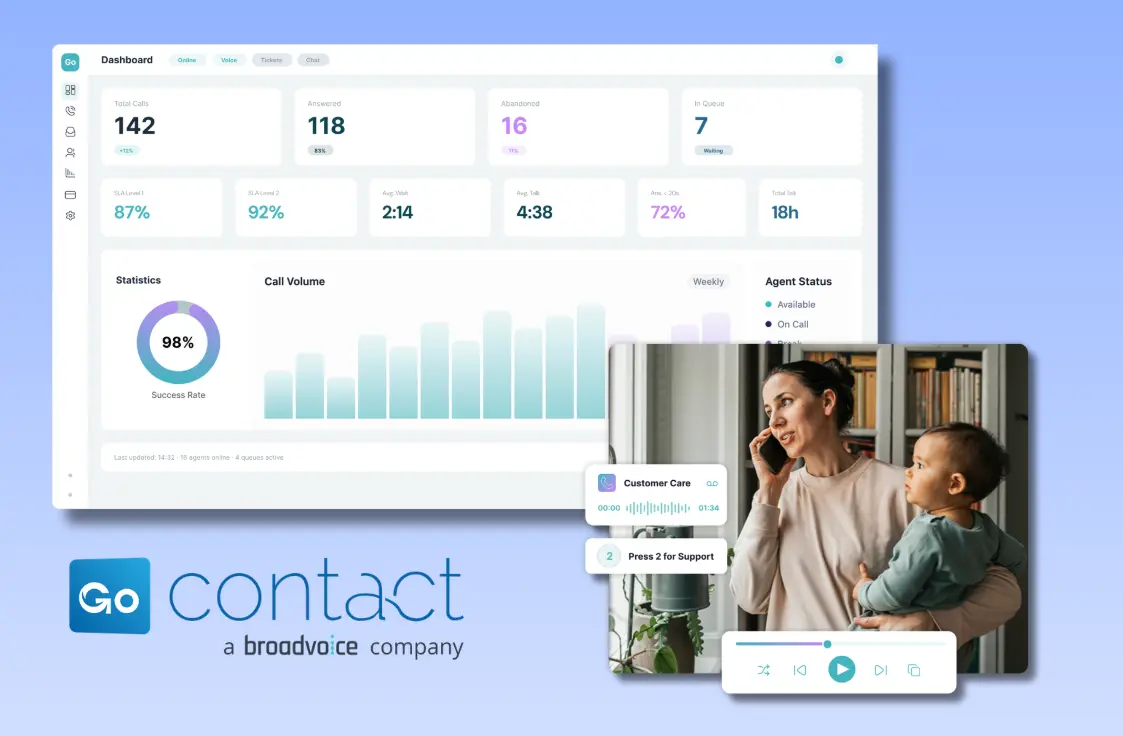
How Broadvoice Helps Organizations Operationalize AI Communication
As AI-powered communication becomes essential, organizations need platforms that can support scalable, intelligent engagement across teams and stakeholders.
That’s where Broadvoice comes in.
Broadvoice provides organizations with a modern communication and engagement solution designed to support real-time collaboration, communication workflows, and intelligent interaction management.
In environments where responsiveness, visibility, and operational coordination matter, platforms like Broadvoice help organizations create more connected and efficient engagement experiences.
Broadvoice GoContact: Powering the Next Generation of AI-Driven Healthcare Engagement
As healthcare organizations modernize communication operations, they need more than AI agents alone. They need a centralized engagement platform capable of managing interactions across patients, providers, staff, and stakeholders.
Broadvoice GoContact provides a modern contact center solution designed to support intelligent, scalable communication at enterprise scale.
By combining omnichannel engagement capabilities with AI-driven workflows, Broadvoice GoContact helps healthcare organizations:
- Manage inbound and outbound communications from a single platform
- Support AI-powered voice, chat, and messaging interactions
- Improve patient responsiveness and service levels
- Enhance care coordination and communication visibility
- Enable intelligent routing and workflow automation
- Provide operational insights through real-time analytics and reporting
- Support governance, compliance, and scalable communication management
As healthcare contact centers evolve from transactional call handling to intelligent patient engagement hubs, platforms such as Broadvoice GoContact can help organizations create a unified communication ecosystem that connects patients, providers, and operational teams.
The future healthcare contact center will not simply answer calls. It will orchestrate patient experiences, automate workflows, surface actionable insights, and create more connected healthcare journeys. Broadvoice GoContact is positioned to help organizations make that transition while maintaining the visibility, governance, and operational control healthcare environments require.
The Quandary Consulting Group + Broadvoice GoContact Partnership
As a certified Broadvoice GoContact partner, Quandary Consulting Group delivers more than just technology—we provide the strategic expertise, implementation guidance, and ongoing support needed to drive measurable business outcomes.
For healthcare organizations, our team combines deep industry knowledge with extensive contact center experience to design and deploy Broadvoice GoContact solutions tailored to your unique patient engagement, operational, and compliance requirements.
Clients benefit from customized implementation services, dedicated user training, workflow optimization, and continuous platform development that ensures the solution evolves alongside their organization.
From improving patient access and reducing administrative burden to maximizing agent productivity and patient satisfaction, Quandary Consulting Group serves as a long-term partner focused on helping healthcare providers achieve the highest possible return on their GoContact investment.
The Future of Healthcare Service Operations
AI agents are no longer experimental technology. They are rapidly becoming foundational infrastructure for modern healthcare operations.
The question is no longer whether AI will reshape healthcare call centers; but, which organizations will adopt these capabilities strategically—and which will fall behind?
Healthcare organizations that successfully combine AI automation with strong governance, intelligent communication systems, and patient-centered design will be positioned to improve operational efficiency while delivering significantly better patient experiences.
At Quandary Consulting Group, we believe the future belongs to organizations that treat AI not as a standalone tool, but as a strategic capability woven into every layer of the business.
Top FAQs about AI Healthcare Call Centers
1. What is an AI healthcare call center?
An AI healthcare call center uses artificial intelligence, voice agents, conversational AI, and workflow automation to manage patient interactions. AI agents can handle appointment scheduling, insurance verification, billing inquiries, prescription refill requests, patient follow-ups, and care navigation while integrating with healthcare systems such as EHRs and CRM platforms.
2. How are AI agents used in healthcare call centers?
Healthcare organizations use AI agents to automate repetitive administrative tasks and improve patient engagement. Common use cases include appointment scheduling, benefits verification, referral management, prior authorization support, billing assistance, post-discharge outreach, medication reminders, and population health campaigns.
3. Can AI replace healthcare call center agents?
AI is not designed to replace healthcare professionals entirely. Instead, AI agents handle high-volume, repetitive interactions while human staff focus on complex patient needs, clinical inquiries, and sensitive conversations. The most successful healthcare organizations use AI to augment their workforce rather than replace it.
4. What is the ROI of implementing AI in a healthcare contact center?
Healthcare organizations often achieve ROI through reduced labor costs, lower call volumes, improved scheduling efficiency, fewer missed appointments, faster revenue cycle processes, and improved patient retention. Many organizations begin realizing measurable operational improvements within six to twelve months of implementation.
5. Is AI in healthcare call centers HIPAA compliant?
Yes, AI solutions can be HIPAA compliant when they are designed with appropriate security controls, data protection measures, access management, encryption, auditing capabilities, and governance frameworks. Healthcare organizations should carefully evaluate vendors to ensure compliance requirements are met.
6. What are the biggest benefits of AI-powered patient communication?
The primary benefits include 24/7 patient support, faster response times, reduced wait times, improved patient satisfaction, increased operational efficiency, better staff productivity, and more consistent patient experiences across communication channels.
7. How does AI improve patient scheduling and appointment management?
AI agents can automatically schedule appointments, confirm visits, manage cancellations, fill open appointment slots, send reminders, and coordinate rescheduling requests. This reduces administrative burden while improving patient access and reducing no-show rates.
8. What is the future of AI in healthcare customer service?
The future of healthcare customer service includes multimodal patient engagement, intelligent care coordination, predictive outreach, real-time EHR integration, AI-assisted human agents, and increasingly sophisticated voice AI systems capable of managing complex patient journeys across multiple channels.
9. What should healthcare organizations consider before implementing AI agents?
Healthcare leaders should evaluate governance, HIPAA compliance, security, integration requirements, workflow design, change management, patient experience goals, and organizational readiness. Successful AI adoption requires both technology implementation and operational transformation.
10. How does Broadvoice GoContact support healthcare AI initiatives?
Broadvoice GoContact helps healthcare organizations modernize patient engagement through omnichannel communication, intelligent routing, workflow automation, AI-enabled interactions, real-time analytics, and centralized communication management. The platform supports scalable patient communication while providing the visibility and governance healthcare organizations require.