Business Transformation
Five Real-World Strategies to Improve Operational Efficiency

TL;DR
- Operational efficiency goes beyond cost-cutting. Sustainable margin improvement comes from eliminating structural inefficiencies, modernizing processes, and improving how work gets done across the organization.
- Automation and AI can reduce manual work at scale. Intelligent workflows, connected systems, and low-code applications help organizations eliminate repetitive tasks, reduce errors, and increase employee productivity.
- The right technology ecosystem matters. Replacing spreadsheets, disconnected applications, and legacy processes with integrated platforms creates better data visibility, faster workflows, and more informed decision-making.
- Prioritize transformation based on measurable business value. Focus first on processes that directly affect operating costs, employee capacity, revenue, cash flow, and customer experience.
- Build operations that can scale. Modern, integrated systems allow organizations to grow without adding unnecessary complexity, administrative overhead, or manual work.
There is a ceiling to incremental cost-cutting. Organizations can only extract so much value from legacy systems and inefficient processes before diminishing returns set in. Sustainable margin improvement and long-term profitability require a fundamental rethinking of how your business operates.
To drive meaningful cost reduction and operational efficiency, organizations must adopt modern systems, eliminate inefficiencies, and align processes with strategic outcomes.
Below are five proven strategies to improve operational efficiency, reduce costs, and accelerate business performance—supported by real-world transformation examples.
Five Proven Strategies to Improve Operational Efficiency
1. Distinguish Between Activity and Productivity
High-performing organizations understand that effort does not equal impact. Long hours and constant activity are not indicators of effectiveness—they are often symptoms of inefficiency.
Sustainable performance is achieved by optimizing output, not maximizing effort. Research consistently shows that productivity declines significantly beyond a certain threshold of working hours, leading to increased errors, burnout, and reduced business outcomes.
Organizations must shift from “busy work” to value-driven execution—enabled by systems that streamline workflows and eliminate manual, redundant tasks.
Case in Point: A national healthcare and retail organization managing over 9,000 locations relied on manual service request processes involving paper forms, email submissions, and duplicate data entry. This fragmented approach created delays, inefficiencies, and significant risk of human error.
Transformation Approach: By implementing a centralized, low-code request management platform, the organization automated intake, approvals, and routing—while ensuring compliance and user access control.
Business Impact: The solution eliminated approximately one hour of manual effort per supervisor per day—delivering substantial productivity gains and measurable cost savings at scale.
2. Prioritize Agility Over Perfection
Many organizations delay transformation initiatives in pursuit of “perfect” systems—often resulting in excessive costs, extended timelines, and missed opportunities.
In today’s environment, speed and adaptability are competitive advantages. Rapid application development and low-code platforms enable organizations to deploy fit-for-purpose solutions quickly—without the burden of traditional development cycles.
Case in Point: A family-owned business operating on paper-based processes and fragmented systems faced significant inefficiencies, including manual data entry errors and an estimated 15% annual revenue loss.
Transformation Approach: A fully customized, low-code business platform was developed to centralize operations across inventory, HR, and customer management—while preserving the organization’s high-touch customer experience.
Business Impact: The organization reduced administrative workload by approximately two hours per employee per day, accelerated deployment timelines, and significantly improved data accuracy and decision-making capabilities.
3. Invest in the Right Technology Ecosystem
Technology misalignment is a leading driver of operational inefficiency. Many organizations rely on tools beyond their intended purpose—most notably spreadsheets functioning as pseudo-databases.
This approach limits scalability, introduces data integrity risks, and prevents real-time insights.
Case in Point: A company operating in a volatile market environment relied on Excel-based reporting to communicate critical data to stakeholders. The result was delayed reporting, inconsistent data, and limited visibility.
Transformation Approach: By implementing a modern data visualization and reporting solution (e.g., Power BI), the organization centralized data sources, automated reporting, and enabled real-time insights across stakeholders.
Business Impact: The organization reduced reporting cycle times, improved data accuracy, and enhanced stakeholder communication—while lowering the labor costs associated with manual reporting processes.
4. Focus on High-Impact Value Drivers
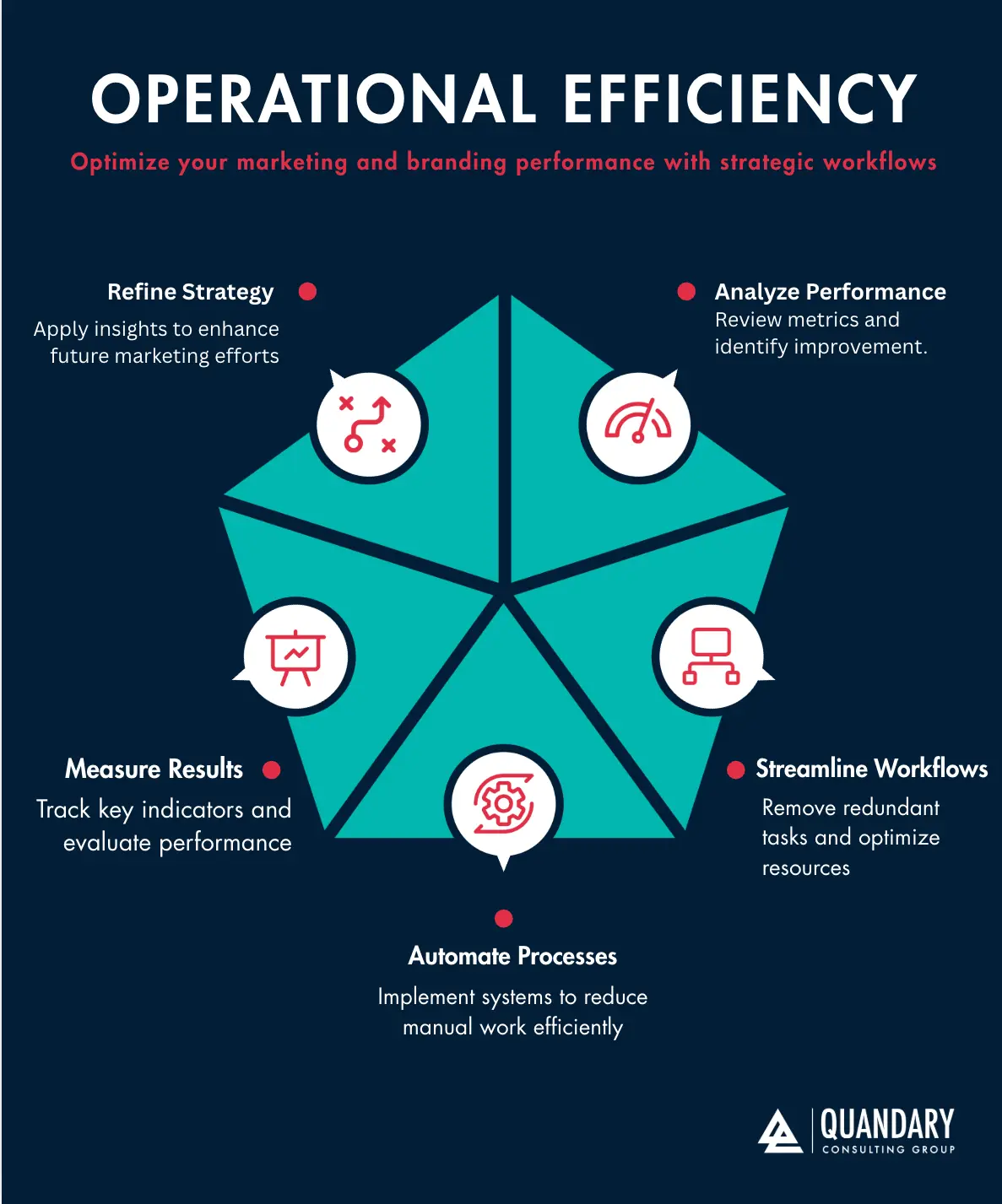
Operational excellence requires prioritization. Organizations must focus on initiatives that directly impact revenue, cost reduction, and customer experience.
This means identifying high-friction processes and deploying targeted automation and system improvements where ROI is most significant.
Case in Point: An aviation services company struggled with manual invoicing and payment processing, resulting in over $800,000 in outstanding invoices and significant customer dissatisfaction.
Transformation Approach: A custom invoicing and payment automation platform was implemented using low-code technology, enabling real-time visibility, automated reconciliation, and proactive collections.
Business Impact: Within the first year, the organization recovered over $400,000 in outstanding invoices—more than 70% of which required no manual intervention—while significantly improving customer experience and cash flow.
To read the full case study, visit: Custom ERP & Billing Automation Platform Recovers $800K for an Aviation Management Company
5. Design for Scalability—and Sustainability
Growth without operational scalability leads to complexity, inefficiency, and employee burnout. Organizations must design systems and processes that scale with demand while reducing dependency on manual effort.
Equally important, sustainable operations enable teams to perform at a high level without sacrificing well-being—an increasingly critical factor in talent retention and organizational performance.
Case in Point: A rapidly growing organization managing quotes, production, shipping, and invoicing across disparate systems faced increasing delays and operational fragmentation.
Transformation Approach: A unified, low-code platform was developed to centralize workflows, integrate cross-functional processes, and provide a single source of truth across the organization.
Business Impact: The organization achieved a 30% reduction in workflow processing time, eliminated duplicate data entry, and improved cross-functional collaboration—while enabling employees to operate more efficiently and sustainably.
To read the full case study, visit: System Consolidation Initiative Unifies 18 Legacy Platforms into Custom Quickbase ERP
Our Final Perspective
Operational efficiency is no longer a back-office initiative—it is a strategic imperative. Organizations that modernize their systems, automate critical processes, and align technology with business outcomes are better positioned to reduce costs, improve margins, and scale effectively.
Take the Next Step with Quandary Consulting Group
At Quandary Consulting Group, we partner with organizations to design, build, and implement scalable, low-code solutions that drive measurable business outcomes—from cost reduction and process automation to enterprise-wide digital transformation.
If your organization is facing inefficiencies, legacy system constraints, or scaling challenges, we can help you unlock new levels of performance. Connect with our team today to explore how we can help you streamline operations, reduce costs, and accelerate your digital transformation journey.
Frequently Asked Questions
What is operational efficiency?
Operational efficiency is an organization’s ability to produce better business outcomes while using fewer resources, less time, and less manual effort. Improving operational efficiency typically involves streamlining business processes, eliminating redundant work, automating repetitive tasks, integrating disconnected systems, and giving employees better access to accurate data. The goal is not simply to reduce costs, but to create an operating model that improves productivity, profitability, customer experience, and scalability.
How can a company improve operational efficiency?
Companies can improve operational efficiency by identifying process bottlenecks, eliminating unnecessary steps, automating repetitive work, integrating disconnected applications, improving data quality, and replacing outdated or manual systems. Organizations should prioritize improvements based on measurable business impact, such as hours saved, processing time reduced, errors eliminated, revenue recovered, or customer response times improved.
What are the best strategies for reducing operational costs?
The most effective cost-reduction strategies focus on eliminating structural inefficiencies rather than simply cutting budgets. This can include business process automation, application modernization, system consolidation, data integration, AI-enabled workflows, improved resource allocation, and replacing manual spreadsheet-based processes with scalable business applications. Sustainable cost reduction occurs when organizations permanently remove unnecessary work from their operating model.
How does automation improve operational efficiency?
Automation improves operational efficiency by reducing the amount of manual work required to complete repetitive, rules-based processes. Automated workflows can handle tasks such as data entry, approvals, notifications, document processing, reporting, invoicing, reconciliation, and system updates. This reduces processing time and human error while allowing employees to focus on higher-value work.
How can AI improve operational efficiency?
AI can improve operational efficiency by helping organizations analyze information, automate decisions, process unstructured data, identify patterns, summarize documents, support employees, and coordinate work across business systems. When AI is combined with workflow automation and system integration, organizations can move beyond isolated AI tools toward intelligent processes that understand information, determine appropriate actions, and initiate downstream workflows with human oversight where necessary.
What is the difference between operational efficiency and cost cutting?
Cost cutting focuses primarily on reducing expenses, while operational efficiency focuses on improving how work gets done. Traditional cost-cutting measures may reduce headcount, budgets, or services without addressing the underlying causes of inefficiency. Operational efficiency targets those root causes by improving processes, technology, data, automation, and resource utilization. As a result, efficiency initiatives can reduce costs while simultaneously improving productivity, service quality, and scalability.
What are examples of operational inefficiency?
Common examples of operational inefficiency include duplicate data entry, spreadsheet-based processes, excessive email approvals, disconnected systems, manual reporting, repetitive administrative work, inconsistent data, unnecessary handoffs, slow invoicing, paper-based workflows, and employees repeatedly searching for information across multiple applications. These inefficiencies increase operating costs and often create delays, errors, poor customer experiences, and difficulty scaling.
How do you identify inefficient business processes?
Organizations can identify inefficient business processes through process mapping, process mining, employee interviews, workflow analysis, system data, and operational performance metrics. Warning signs include excessive manual work, repeated data entry, long cycle times, frequent errors, approval bottlenecks, unnecessary handoffs, inconsistent processes, and employees relying heavily on spreadsheets or email to manage critical workflows.
What business processes should companies automate first?
Companies should typically automate high-volume, repetitive, rules-based processes that consume significant employee time or create operational bottlenecks. Strong candidates include data entry, approvals, invoice processing, reporting, customer onboarding, employee onboarding, service requests, document processing, compliance workflows, notifications, reconciliation, and data synchronization between systems. Processes with measurable labor costs or revenue impact generally provide the clearest automation ROI.
How can low-code development improve operational efficiency?
Low-code development allows organizations to build and modernize business applications faster than many traditional software development approaches. Platforms such as Quickbase can replace spreadsheets, paper processes, and fragmented workflows with centralized applications tailored to specific operational requirements. When combined with integration and automation platforms such as Workato, low-code applications can also connect data and processes across an organization's broader technology ecosystem.
How does system integration reduce operating costs?
System integration reduces operating costs by allowing applications to exchange data and trigger workflows automatically. Instead of employees manually copying information between CRM, ERP, finance, HR, operations, and other systems, integrations can synchronize information in real time or based on defined business events. This reduces duplicate data entry, processing delays, errors, and administrative workload while creating more consistent information across the organization.
How can businesses reduce costs without reducing headcount?
Businesses can reduce operating costs without reducing headcount by eliminating unnecessary work rather than eliminating employees. Automation, application modernization, system integration, AI, process redesign, and better data management can reduce the hours employees spend on repetitive administrative tasks. Those employees can then redirect their capacity toward customer service, revenue-generating activities, analysis, innovation, and other higher-value work.
What technology can improve operational efficiency?
Technologies that can improve operational efficiency include workflow automation platforms, low-code application development, AI agents, integration platforms, process mining software, business intelligence tools, cloud applications, robotic process automation, and modern data platforms. The right technology depends on the underlying business problem; organizations generally achieve better results by designing the process first and selecting technology around the desired business outcome.
How do you measure operational efficiency?
Operational efficiency can be measured using metrics such as cost per transaction, processing time, labor hours per process, error rates, throughput, automation rates, revenue per employee, customer response time, days sales outstanding, system utilization, and cost savings. Organizations should establish baseline performance before implementing improvements so they can quantify the financial and operational impact of transformation initiatives.
What is operational efficiency consulting?
Operational efficiency consulting helps organizations identify inefficient processes, technology gaps, disconnected systems, data problems, and opportunities for automation. Consultants typically assess the current operating environment, prioritize opportunities based on business value, redesign workflows, recommend appropriate technologies, and implement solutions designed to reduce costs, improve productivity, and support growth.
How can Quandary Consulting Group help improve operational efficiency?
Quandary Consulting Group helps organizations modernize operations by combining business process optimization with AI, automation, integration, data engineering, and low-code application development. Quandary designs solutions that connect systems, eliminate manual processes, improve data visibility, and automate critical workflows using technologies such as Quickbase, Workato, Microsoft, and AI platforms. The objective is to turn operational inefficiencies into measurable improvements in cost, speed, productivity, scalability, and customer experience.