Artificial Intelligence (AI)
Digital Entropy in the Age of AI: Managing System Decay While Enabling Intelligent Operations


TL;DR
- Digital entropy is the gradual accumulation of complexity across an organization’s systems, data, integrations, workflows, automations, and AI environments. Without ongoing management, that complexity can reduce reliability, increase operational friction, and erode the value of technology investments.
- AI and AI agents can amplify the effects of digital entropy. Fragmented data, inconsistent processes, unclear business rules, disconnected systems, and outdated integrations can lead to inaccurate AI outputs, unreliable agent actions, higher exception rates, poor customer experiences, and declining trust in AI.
- Business process improvement is becoming an important defense against digital entropy. Simplifying workflows, eliminating unnecessary steps, clarifying ownership, standardizing business rules, and improving data quality create a stronger operational foundation for automation and enterprise AI.
- Organizations need to manage the entire operational ecosystem, not individual technologies in isolation. Strong data governance, standardized integrations, clear systems of record, governed AI agents, context management, observability, human oversight, and defined exception handling help keep increasingly intelligent environments reliable.
- Controlling digital entropy requires continuous improvement. Regular process reviews, system audits, integration monitoring, AI performance measurement, and ongoing optimization help organizations prevent complexity from quietly becoming operational risk while creating a more scalable foundation for intelligent operations.
Enterprise technology is becoming more powerful, connected, and intelligent. Organizations are integrating CRM, ERP, financial, operational, and customer experience platforms while layering in cloud applications, APIs, workflow automation, generative AI, and increasingly autonomous AI agents. Emerging standards such as the Model Context Protocol (MCP) are expanding these possibilities further by giving AI systems standardized ways to access enterprise data, tools, and contextual information.
Every new connection creates opportunity. It also introduces another dependency that must remain accurate, governed, secure, observable, and aligned with the business.
Over time, these dependencies accumulate:
- Data definitions begin to diverge
- Integrations become brittle
- Business rules change without being updated everywhere
- Automations continue running against processes that have evolved
- Applications duplicate functionality
- Permissions drift
- Documentation becomes outdated
- AI systems retrieve conflicting context, and agents inherit the inconsistencies embedded within the environments they are expected to navigate.
This is digital entropy: the gradual accumulation of disorder and complexity across an organization’s systems, data, integrations, workflows, automations, and AI infrastructure.
Digital entropy has always existed, but AI raises the stakes. Traditional technology fragmentation often creates inefficiency for employees. In an AI-enabled enterprise, those same weaknesses can directly influence what an AI system understands, recommends, generates, and ultimately does.
An outdated record can become incorrect context. An inconsistent business rule can become an unreliable recommendation. A broken integration can interrupt an agentic workflow. Poorly defined permissions can become a governance risk. A fragmented customer journey can be amplified across thousands of automated interactions.
As organizations move from AI that primarily generates and summarizes information toward AI agents that reason across context, interact with enterprise applications, and execute multi-step workflows, the quality of the underlying operational environment becomes increasingly important.
The question is no longer simply whether an organization can deploy AI. The more consequential question is whether its processes, data, systems, integrations, governance, and operating model are prepared to support AI reliably at scale.
This white paper examines digital entropy through this lens and explores how complexity accumulates across modern enterprises, how digital entropy affects automation, AI agents, and customer experience environments such as contact centers, and why business process improvement, integration, data governance, observability, and continuous optimization are becoming essential components of AI readiness.
This paper also examines how emerging architectural approaches, including MCP-enabled environments, can help organizations create more structured and governed connections between AI, enterprise systems, tools, and context.
Ultimately, controlling digital entropy is about more than maintaining technology. It is about creating an operational environment where people, processes, data, applications, automation, and AI can continue working together reliably as the enterprise evolves.
From System Complexity to Intelligent Complexity
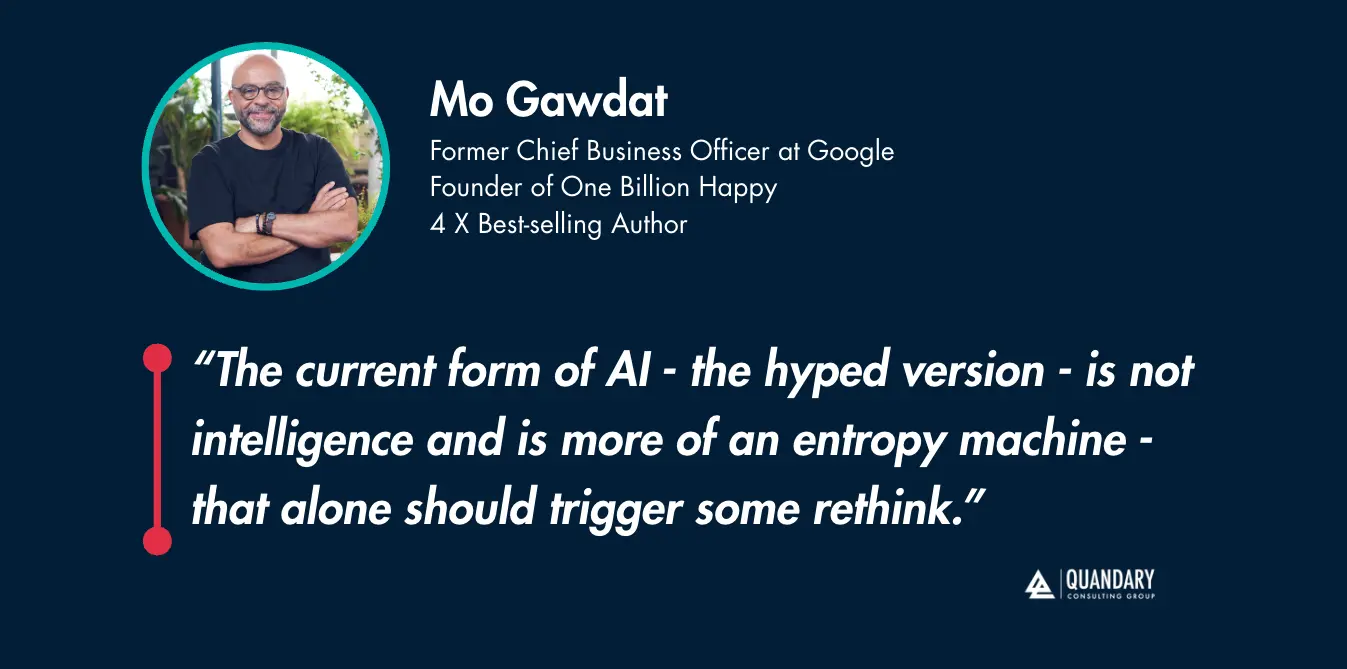
The concept of entropy originates in thermodynamics, where it describes the natural tendency of systems to move toward disorder unless energy is applied to maintain structure (Clausius, 1865). In digital environments, this principle manifests as the gradual degradation of systems over time.
Historically, digital entropy affected core business platforms and integrations. Today, however, organizations are entering a new phase of complexity driven by AI adoption. AI introduces additional layers:
- Dynamic decision-making systems
- Context-dependent data pipelines
- Autonomous or semi-autonomous agents
- Real-time interaction systems, particularly in contact centers
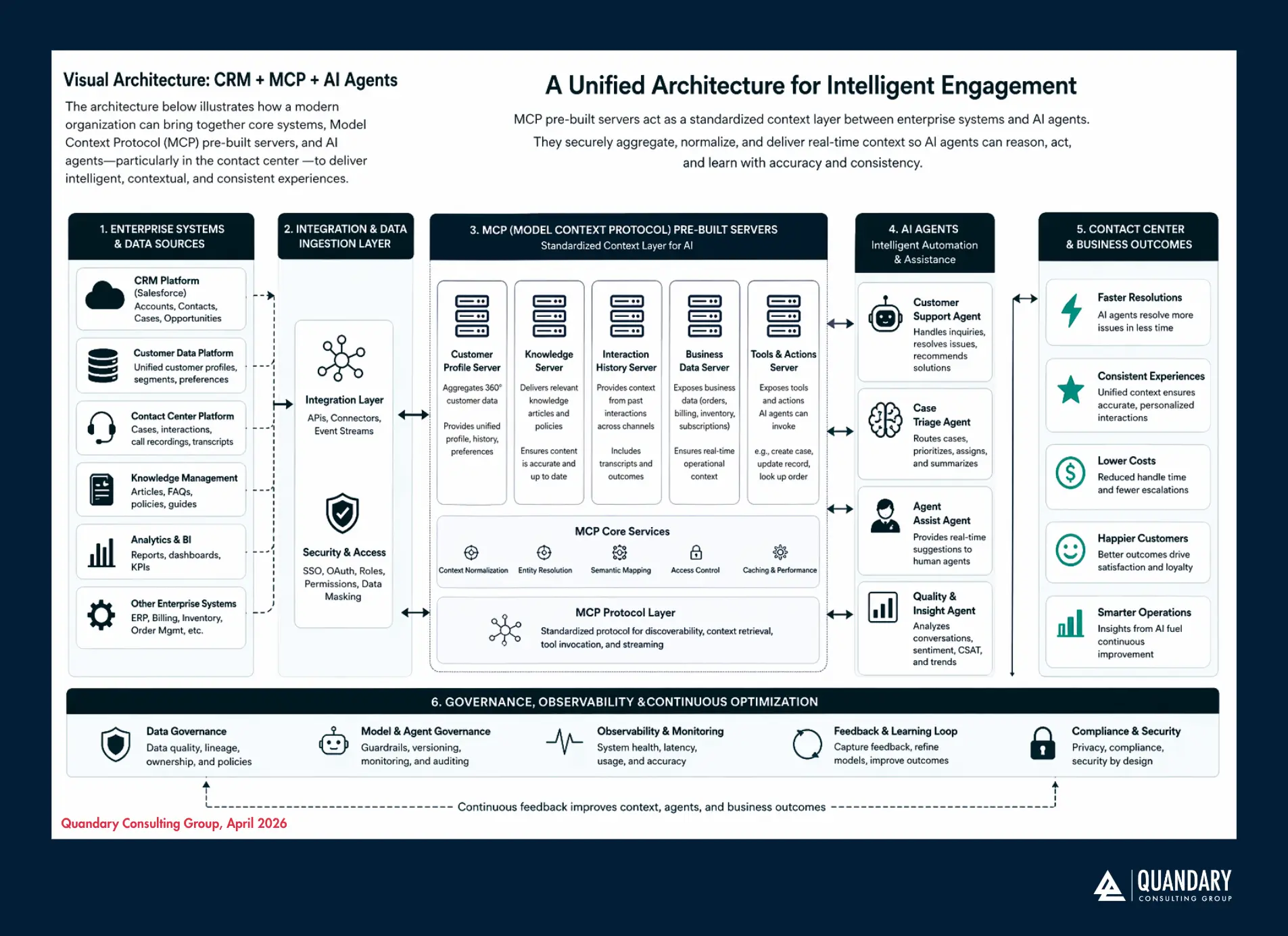
At the same time, emerging standards such as Model Context Protocol (MCP) are enabling organizations to deploy pre-built servers that standardize how AI systems access data, tools, and context. While these advancements unlock significant value, they also introduce new pathways for entropy. Poor data quality, fragmented systems, and inconsistent processes do not just create inefficiency—they directly degrade AI performance.
In this environment, digital entropy is no longer just an operational concern. It becomes a barrier to successful AI adoption.
Defining Digital Entropy in an AI-Enabled Enterprise
In an AI-enabled enterprise, digital entropy is the gradual accumulation of disorder, inconsistency, and unmanaged complexity across the systems, data, processes, integrations, automations, and AI capabilities that support the business.
It rarely appears as a single failure. Instead, it develops incrementally as organizations grow, processes change, applications are added, integrations are modified, data structures evolve, employees create workarounds, and new automation and AI capabilities are layered onto the existing environment.
A workflow changes, but the automation supporting it does not. A field is defined differently across two applications. An integration continues moving information that is no longer required. An AI agent receives conflicting instructions from different sources. A policy changes, but an outdated version remains available to an AI system. An application is replaced, yet dependencies on the old system remain embedded elsewhere.
Individually, these issues may appear minor. Collectively, they create an environment in which technology becomes increasingly difficult to understand, maintain, govern, and trust.
AI makes this problem more consequential because digital entropy can influence not only how efficiently work moves, but also what intelligent systems understand, recommend, and do.
1. Data Entropy: When AI Cannot Trust the Information It Receives
Data entropy occurs when enterprise information becomes increasingly inconsistent, duplicated, incomplete, outdated, poorly structured, or disconnected from its original business context.
Traditional systems can often tolerate some degree of poor data quality because employees recognize inconsistencies and compensate for them manually. AI systems do not necessarily have that same contextual awareness. When inaccurate or conflicting information enters an AI-enabled workflow, the system may use that information to generate an answer, make a recommendation, classify a request, or initiate an action.
This makes data quality and context quality fundamental components of enterprise AI readiness.
In a contact center, for example, data entropy can contribute to:
- AI agents providing inconsistent or outdated answers.
- Customer intent being incorrectly classified or routed.
- Poor personalization because customer information is fragmented across multiple systems.
- Employees and AI assistants receiving different versions of the same customer history.
- Automated workflows triggering actions based on incomplete information.
- Increased escalation rates when AI cannot confidently resolve requests.
- Customers being asked to repeat information that already exists elsewhere in the organization.
As AI becomes more deeply connected to operational systems, organizations need more than large quantities of data. They need accurate, current, permissioned, traceable, and contextually relevant data that AI systems can access when and where it is needed.
2. Process Entropy: When the Workflow and the Business Begin to Diverge
Business processes rarely remain static.
Policies change. Teams reorganize. New regulations emerge. Applications are replaced. Approval requirements evolve. Customers develop new expectations. Employees discover faster ways to complete their work.
Over time, the process documented by the organization can begin to differ significantly from the process employees actually follow.
Automation can deepen this problem when workflows are built around outdated assumptions. AI agents introduce another level of complexity because they may interpret information, make decisions, coordinate activities, and execute actions across multiple systems.
Process entropy can appear when:
- AI agents operate according to outdated business rules.
- Automated workflows continue executing unnecessary steps.
- Different teams follow different versions of the same process.
- Human and AI escalation paths are inconsistent or poorly defined.
- Exceptions are handled through undocumented workarounds.
- Decision authority between employees, automation, and AI agents is unclear.
- The designed workflow no longer reflects actual operational behavior.
- AI agents have access to actions that are no longer appropriate for the process.
This is why business process improvement and AI governance increasingly need to work together.
Before organizations automate or introduce agents into a workflow, they need to understand how the process currently operates, how it should operate, which decisions can be automated, which require human judgment, what exceptions must be anticipated, and what controls should govern AI actions.
Otherwise, automation and AI can scale process entropy along with productivity.
3. System and Integration Entropy: When Connectivity Becomes Complexity
Most enterprises operate across a distributed technology ecosystem rather than a single platform.
That ecosystem may include:
- CRM, ERP, HRIS, EHR, financial, and operational systems.
- Cloud and industry-specific applications.
- APIs and integration platforms.
- Data warehouses, lakes, and analytics environments.
- Workflow automation platforms.
- AI models and enterprise AI platforms.
- AI agents and agent orchestration frameworks.
- Identity, security, and governance systems.
- MCP servers and other mechanisms that provide AI systems with access to enterprise tools and context.
Each component creates dependencies. As those dependencies multiply, organizations can lose visibility into how information and actions move across the environment.
A change in one system can affect integrations, downstream workflows, reporting, automation, AI context, and agent behavior elsewhere.
System and integration entropy can therefore manifest as:
- Redundant point-to-point integrations.
- Multiple systems claiming to be the source of truth.
- Conflicting or duplicated automation.
- Brittle dependencies between applications.
- Inconsistent business logic across systems.
- Poor visibility into integration failures.
- AI agents receiving different information depending on which system they access.
- Multiple agents executing overlapping or conflicting actions.
- Increasing maintenance requirements as the technology ecosystem expands.
At this stage, integration architecture becomes more than a connectivity concern. It becomes part of the organization’s AI operating foundation.
4. Context Entropy: A New Challenge for Enterprise AI
AI also introduces another form of digital entropy: context entropy.
Enterprise AI systems increasingly depend on dynamic context rather than relying exclusively on information contained within a model. That context can come from knowledge bases, databases, enterprise applications, APIs, user permissions, conversation history, business rules, retrieval systems, and tools exposed to AI agents.
The challenge becomes determining whether the AI system is receiving the right information, from the right source, at the right time, under the right permissions.
Context entropy develops when those sources become inconsistent, redundant, outdated, poorly governed, or difficult to trace.
An organization may have accurate information somewhere in its environment while an AI agent still receives outdated or conflicting context. From the user's perspective, the distinction matters very little. The AI appears to be wrong.
As enterprises deploy more AI assistants and agents, context management becomes an extension of data governance and integration architecture.
Where MCP Fits Into the Digital Entropy Equation
The Model Context Protocol (MCP) introduces a standardized way for AI applications to connect with external tools, data sources, and services. This can reduce some of the custom integration work involved in giving AI systems access to enterprise capabilities and can create a more consistent interface between AI applications and the resources they use.
However, standardizing access does not automatically guarantee the quality of what is being accessed. For example, a MCP server can expose a tool, but the organization still needs to determine whether the tool should be available to a particular agent. It can provide access to data, but that data still needs to be accurate and appropriately permissioned. It can standardize how context is delivered, but organizations still need governance around which sources are authoritative and what actions an AI system is allowed to execute.
Without those controls, MCP infrastructure can become another layer where digital entropy accumulates.
Organizations therefore need to manage questions such as:
- Which systems and tools should AI agents be able to access?
- Which sources are authoritative for specific types of information?
- How are permissions and identities enforced?
- How are tools, schemas, and dependencies versioned as systems change?
- How are AI actions logged, monitored, and audited?
- What happens when a tool fails or returns conflicting information?
- When should an AI agent escalate to a human rather than continue autonomously?
MCP can help organizations create more standardized connections between AI and enterprise resources, but architecture, governance, observability, security, and process design determine whether those connections remain reliable over time.
Digital Entropy Is Ultimately Operational Entropy
The different forms of digital entropy do not exist independently.
Poor data affects AI context. Poor context affects AI decisions. Poor process design affects automation. Weak integrations affect data availability. Unclear governance affects agent behavior. Changes to one enterprise application can create downstream consequences across workflows, analytics, customer experiences, and AI systems.
That interconnectedness is what makes digital entropy increasingly important in an AI-enabled enterprise.
Organizations are no longer managing isolated applications. They are managing an interdependent operating environment of people, processes, data, applications, integrations, automation, and AI agents.
As that environment becomes more intelligent, controlling its complexity becomes essential to keeping it reliable.
Why Digital Entropy Is a Growing Enterprise Risk in the AI Era
Digital entropy has always created operational risk, but AI changes both the speed and scale at which that risk can spread.
In traditional enterprise environments, fragmented data, outdated business rules, disconnected applications, and inefficient workflows often create additional manual work. Employees identify inconsistencies, investigate exceptions, and compensate for gaps using their own experience and judgment.
AI-enabled operations introduce a different dynamic.
AI assistants and agents can retrieve information, interpret context, make recommendations, trigger workflows, communicate with customers, and increasingly execute actions across enterprise systems. As a result, an inconsistency that once affected a handful of employees can potentially influence thousands of automated decisions, interactions, or transactions.
The more autonomy organizations give AI, the more important the quality of the operational environment surrounding it becomes.
1. AI Performance and Reliability Degrade
Enterprise AI depends on far more than the capabilities of the underlying model. Reliable performance also requires:
- Accurate and current data.
- Consistent business context.
- Clearly defined processes and business rules.
- Reliable integrations and APIs.
- Appropriate permissions and access controls.
- Well-maintained knowledge sources.
- Defined exception and escalation paths.
- Continuous monitoring and evaluation.
Digital entropy weakens these foundations.
An AI system may retrieve outdated information from one application while another contains the current record. An agent may follow business logic that no longer reflects company policy. Two AI-enabled workflows may interpret the same customer or transaction differently because they rely on different sources of context.
The result can be lower-quality outputs, inconsistent decisions, unnecessary exceptions, unreliable agent behavior, and declining confidence in AI.
Once employees stop trusting AI-generated information or actions, adoption becomes considerably more difficult. Users begin validating outputs manually, creating workarounds, or avoiding the technology altogether, which reduces the productivity gains the organization expected AI to deliver.
2. Contact Center Performance and Customer Experience Suffer
Contact centers provide one of the clearest examples of how digital entropy can become visible to customers.
Modern contact center AI can support or automate activities such as intent recognition, routing, authentication, knowledge retrieval, scheduling, account inquiries, documentation, summarization, and after-call work. AI agents can also handle increasingly complex interactions across voice, chat, messaging, and other digital channels.
However, these capabilities depend on accurate information moving between CRM platforms, contact center technology, knowledge bases, scheduling systems, billing platforms, customer records, and other operational applications.
When those connections become unreliable, organizations may experience:
- Higher escalation and transfer rates.
- Longer resolution times.
- Inconsistent answers across channels.
- Incorrect or incomplete customer information.
- Poor personalization.
- Repeated requests for information the customer has already provided.
- Increased employee intervention.
- Higher volumes of exceptions and rework.
- Lower customer and employee confidence in AI-assisted interactions.
Instead of reducing cost-to-serve and increasing capacity, poorly governed AI can simply move work elsewhere in the organization.
A customer may begin with an AI agent, for example, but an incomplete customer profile or outdated policy can force the interaction to a human employee. That employee must then investigate the issue, correct the information, and potentially reverse an action already initiated by automation.
The organization has technically automated part of the interaction, but the end-to-end process has become more complicated.
3. Operational Complexity Begins to Compound
AI introduces new dependencies across an already interconnected enterprise technology environment.
An AI agent may rely on an integration platform to retrieve information from a CRM, combine it with data from an ERP, reference policies stored in a knowledge system, use an MCP server to access an enterprise tool, initiate an automated workflow, and then write information back to several systems.
Each dependency creates another place where change can affect downstream behavior. When digital entropy exists within this environment, problems can propagate across systems and processes rather than remaining isolated.
A single data-quality issue, integration failure, outdated business rule, or permission change can affect:
- Workflow execution.
- Reporting and analytics.
- AI-generated recommendations.
- Agent decisions and actions.
- Customer communications.
- Compliance processes.
- Financial transactions.
- Employee productivity.
- Executive decision-making.
As organizations deploy more interconnected AI agents, understanding these dependencies becomes increasingly important. Without visibility and governance, teams may struggle to determine why an AI-enabled process failed, which system introduced the problem, or what other workflows may be affected.
4. AI Can Scale Existing Process Problems
One of the greatest risks of enterprise AI is using increasingly powerful technology to execute a poorly designed process.
If a workflow contains unnecessary approvals, duplicate data entry, unclear ownership, inconsistent decision criteria, or undocumented exceptions, introducing AI does not automatically resolve those weaknesses; and, in some cases, it can amplify them.
An inefficient manual process may create dozens of unnecessary actions each day. An automated or agentic version of the same process may execute those actions thousands of times before the organization recognizes the underlying design problem.
This makes business process improvement an important component of AI risk management.
Organizations need to understand how work happens before determining where AI should participate, what decisions it should support, which actions it should execute, and where humans should remain responsible.
5. Governance Becomes More Difficult as AI Autonomy Expands
Digital entropy also creates governance challenges. As organizations move from AI assistants that primarily generate information toward AI agents capable of taking action, questions of authority and accountability become increasingly important.
Organizations need to know:
- Which agents have access to which systems?
- What data can they retrieve?
- Which actions can they execute independently?
- Which decisions require human approval?
- Which business rules determine their behavior?
- How are agent actions logged and monitored?
- Who owns the process when something goes wrong?
When systems, permissions, processes, integrations, and business rules evolve independently, answering these questions becomes more difficult.
Strong AI governance therefore requires more than policies around model usage. It also requires governance of the operational environment in which AI operates.
6. The Cost of Digital Entropy Can Grow With AI Adoption
Digital entropy ultimately becomes a business performance issue.
Organizations invest in AI to increase productivity, reduce manual work, improve customer experiences, accelerate decision-making, and create additional operational capacity. Those benefits become harder to achieve when employees spend their time investigating failed workflows, reconciling inconsistent data, correcting AI outputs, managing unnecessary escalations, or maintaining overlapping integrations and automations.
The organization may continue adding technology while realizing less value from each additional investment.
This creates an important principle for enterprise AI: The more intelligent and autonomous the technology becomes, the more disciplined the underlying operating environment must become.
AI can dramatically increase the speed and scale of enterprise operations. Organizations that actively manage their processes, data, integrations, context, governance, and technology architecture can use that capability to create significant operational leverage; and, organizations that allow digital entropy to accumulate risk scaling complexity just as quickly.
How to Identify Digital Entropy Before It Becomes an Enterprise Risk
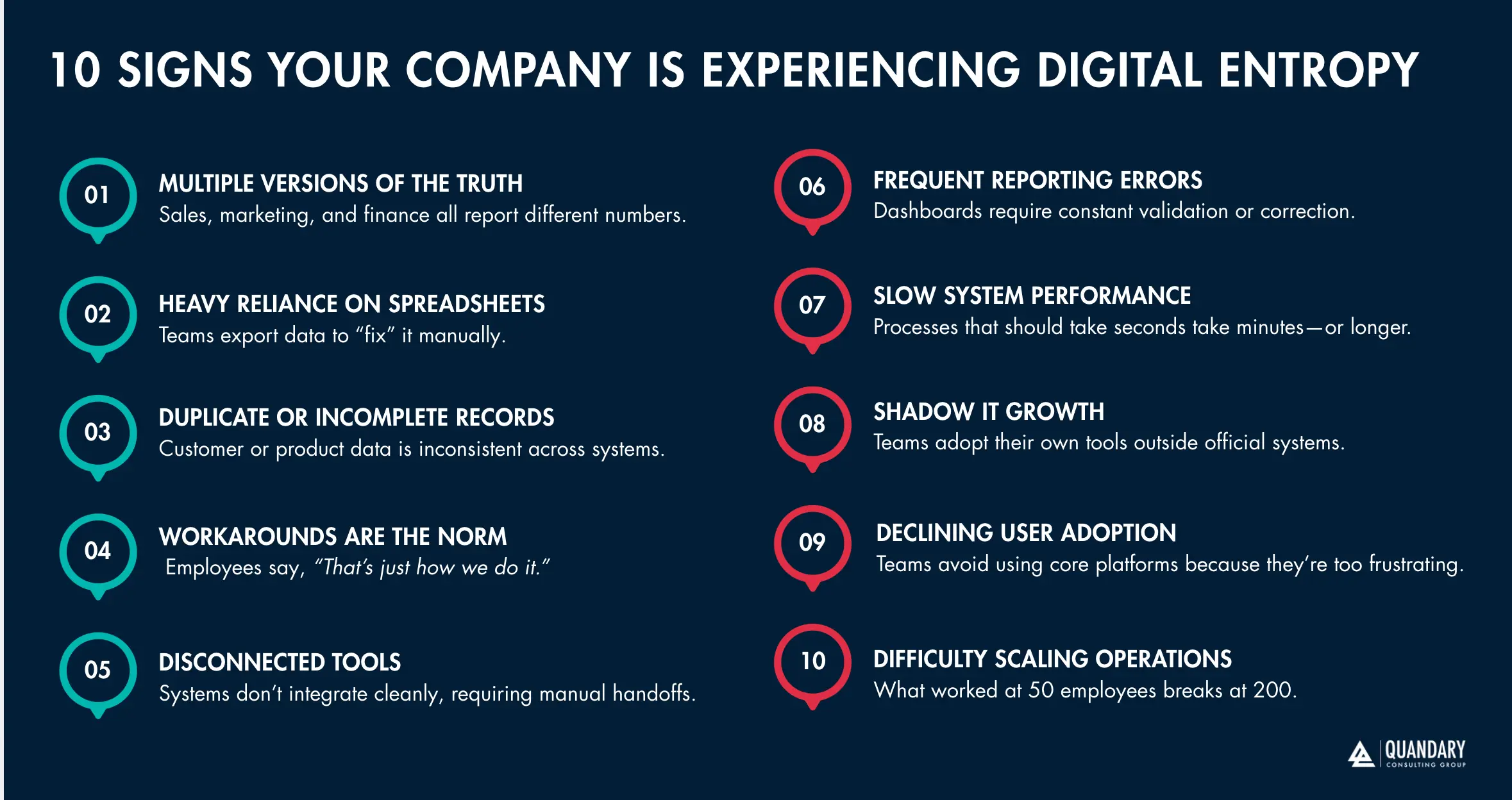
Digital entropy rarely begins with a major system failure. It develops gradually through small inconsistencies, manual workarounds, duplicate technologies, changing business rules, aging integrations, unreliable data, and processes that become more complicated over time.
This makes early detection critical and organizations should look beyond traditional system performance and evaluate the health of the entire operating environment, including processes, data, applications, integrations, automation, AI agents, and the people who depend on them.
The following areas can help organizations identify digital entropy before accumulated complexity becomes a significant operational or financial risk.
1. Evaluate Data and Reporting Consistency
Start by determining whether the organization has a consistent, shared understanding of its data. Reliable operations depend on teams working from the same definitions, systems of record, and performance metrics.
Look across the organization and ask whether departments define critical business information the same way. Do sales and finance agree on revenue and pipeline? Do operations teams use consistent definitions for inventory and utilization? Do reports from different departments produce the same numbers? Most importantly, do employees know which system contains the authoritative record for each type of information?
When different teams can look at the same business activity and arrive at different answers, data entropy may already be taking hold; common warning signs include:
- Duplicate or conflicting records across applications
- Inconsistent definitions for customers, revenue, pipeline, inventory, utilization, or other KPIs
- Dashboards that report different results for the same metric
- Missing, outdated, or incomplete information
- Frequent manual reconciliation between systems
- Teams maintaining their own spreadsheets or databases outside core platforms
- Employees exporting data because they do not trust enterprise reporting
- Uncertainty about which application is the true system of record
For AI-enabled organizations, these inconsistencies create an even greater risk. AI assistants and agents depend on accurate, current, and well-governed information to interpret context, generate reliable outputs, make recommendations, and execute actions across workflows.
As AI becomes more deeply embedded in business operations, inconsistent data can amplify digital entropy. An employee may notice that two dashboards disagree and investigate the discrepancy. An AI agent operating across connected systems can potentially consume conflicting information and carry that inconsistency into downstream decisions, workflows, reports, and automated actions.
The question you need to be asking is, “Can our AI systems reliably determine which data to trust?”
2. Examine Process Consistency
Next, evaluate whether processes operate the way they were originally designed, or whether the reality of getting work done has gradually moved in a different direction.
Business processes naturally evolve as organizations grow, teams change, customer expectations shift, and new technology is introduced. The problem arises when the systems, workflows, integrations, and automation supporting those processes fail to evolve with them. Over time, employees compensate by creating workarounds: skipping outdated steps, managing exceptions through email or chat, maintaining side spreadsheets, duplicating data entry, or building informal processes outside governed systems.
Look closely at how work moves across teams and ask:
- Do employees follow the same process for the same type of work?
- Where do approvals consistently slow down or stall?
- Where is information entered, copied, or validated more than once?
- Which steps require employees to move between multiple applications?
- Where do exceptions regularly force employees outside the standard workflow?
- Which steps exist because of an outdated business rule, system limitation, or legacy requirement?
- Where are employees relying on email, spreadsheets, or manual follow-up to keep work moving?
- Have teams created their own processes because the official workflow no longer meets their needs?
A growing gap between the documented process and the process employees actually follow is one of the clearest indicators of process entropy. What appears to be one standardized workflow on paper may have evolved into dozens of variations across teams, departments, locations, or individual employees.
This becomes especially important as organizations introduce intelligent automation and AI agents. Automation executes the processes it is given, which means inconsistent workflows, unclear business rules, and unmanaged exceptions can quickly become embedded into automated systems. AI agents may also operate across multiple applications and process steps, making clearly defined workflows, escalation paths, permissions, and human decision points increasingly important.
Before organizations automate more work, they need to understand how work actually gets done today, where the process has drifted, and which variations should be standardized, redesigned, or intentionally preserved.
Process entropy begins when the official workflow stops reflecting operational reality. AI and automation can accelerate that gap if organizations do not address it first.
3. Evaluate System and Integration Cohesion
Next, examine how well your applications, integrations, APIs, automation, and data pipelines work together as a connected ecosystem.
Healthy enterprise architecture should allow individual components to evolve without unnecessarily disrupting the broader environment. Applications will change, APIs will be updated, workflows will expand, and new technologies will be introduced. The architecture supporting them should be resilient enough to accommodate that change.
Problems emerge when systems become so tightly coupled or poorly documented that changing one component creates unexpected failures across downstream workflows, reports, integrations, data pipelines, or AI systems. A seemingly minor application update can trigger a chain reaction that teams did not anticipate because dependencies have accumulated faster than the organization can manage them.
Look for warning signs such as:
- Redundant point-to-point integrations connecting the same systems in different ways
- Undocumented APIs, integrations, workflows, or system dependencies
- Multiple applications performing the same or overlapping functions
- Frequent integration failures that require manual intervention
- Duplicate automation built by different teams to solve the same problem
- Legacy applications that cannot be retired because their dependencies are unclear
- Workflows that break whenever an upstream application or data structure changes
- Integrations that depend heavily on individual employees to maintain or troubleshoot them
- Data moving through unnecessary applications before reaching its destination
- New technology being layered onto existing architecture without addressing underlying complexity
These issues are signs of architectural entropy and over time, integrations accumulate, applications overlap, temporary fixes become permanent, and dependencies become increasingly difficult to understand. The technology environment may continue functioning, but every change becomes harder, slower, and riskier to implement. AI can magnify this complexity because AI assistants and agents rarely operate within a single application. They may retrieve information from multiple systems, invoke APIs, trigger automation, update records, communicate with other agents, and initiate downstream workflows. As the number of connections increases, so does the importance of understanding how those systems interact.
Organizations should therefore evaluate more than whether their integrations currently work. They should determine whether the architecture is observable, documented, governed, reusable, and resilient enough to support continuous change.
A healthy architecture absorbs change. An environment experiencing digital entropy becomes increasingly dependent on everything staying exactly as it is.
4. Measure Operational Friction
Digital entropy often becomes most visible through the amount of human effort required to keep everyday operations functioning. Employees are remarkably good at compensating for disconnected systems and inefficient processes. They manually transfer information between applications, reconcile conflicting records, verify that automation completed successfully, search across multiple systems for context, correct errors, follow up on stalled approvals, and maintain spreadsheets outside core platforms simply to keep work moving.
Over time, these activities can become so routine that organizations stop recognizing them as symptoms of a larger problem. What appears to be part of an employee's normal workload may actually represent operational friction created by growing digital entropy.
Look for signs that employees are regularly:
- Copying or re-entering information between applications
- Reconciling data from multiple systems
- Checking whether integrations or automated workflows completed successfully
- Searching across several applications to assemble the context needed to make a decision
- Correcting recurring data or process errors
- Manually following up on approvals, exceptions, or incomplete tasks
- Maintaining spreadsheets, trackers, or databases outside core enterprise platforms
- Acting as the intermediary between systems that should already communicate with one another
Organizations can make this friction measurable by tracking manual processing hours, process cycle times, exception rates, duplicate data entry, approval delays, rework, error rates, and the number of systems employees must access to complete common workflows.
These measurements become even more valuable as organizations introduce automation and AI agents. If an employee needs to search five applications, reconcile conflicting information, and manually determine the next step before completing a task, an AI agent will encounter many of those same operational barriers. Automating the workflow without addressing the underlying friction can simply move existing complexity into a new layer of technology.
Operational friction therefore provides an important signal of both digital entropy and AI readiness. The more human intervention required to connect systems, validate information, resolve exceptions, and keep processes moving, the more fragile the underlying operating environment may have become.
When employees effectively become the integration layer between enterprise systems, digital entropy is already creating a measurable cost in time, productivity, scalability, and organizational capacity.
5. Measure the Speed of Change
System performance is only one measure of speed. Organizations should also evaluate how quickly the business can adapt when something needs to change.
As digital entropy increases, even relatively simple changes can become difficult. Teams may spend more time determining dependencies, coordinating stakeholders, testing downstream impacts, fixing unexpected failures, and navigating governance requirements than implementing the change itself.
Consider how long it takes your organization to:
- Modify an existing workflow
- Add or update an integration
- Introduce a new data source
- Change a business rule
- Deploy or expand an automation
- Replace or retire an application
- Update permissions or security controls
- Connect a new platform to existing enterprise systems
- Give an AI agent secure access to an approved application, data source, tool, or enterprise capability
Then look beyond the implementation timeline. How many teams need to be involved? How much custom development is required? How much regression testing must occur? How often does a seemingly small change create unexpected downstream problems?
When routine modifications require extensive coordination, custom development, manual remediation, or lengthy testing because dependencies are difficult to understand, accumulated complexity may be limiting organizational agility.
This becomes particularly important as organizations expand their use of AI, because despite a company investing in sophisticated models, AI platforms, copilots, agents, etc. yet, still can also still be struggling to move AI initiatives from experimentation into production. The model may be capable of performing the task, but the surrounding operating environment may not be ready to support it.
AI systems still depend on enterprise fundamentals: accessible and trustworthy data, reliable integrations, clearly defined processes, secure permissions, observable workflows, governance controls, and mechanisms for handling exceptions and human escalation. When those foundations are fragmented or overly complex, every new AI capability becomes harder to operationalize.
For this reason, time-to-change can be an important indicator of digital entropy. Organizations should track how long common changes take, how many dependencies they affect, how much manual effort they require, and how frequently those changes create unintended consequences elsewhere in the environment.
A healthy digital environment makes responsible change easier. An environment experiencing digital entropy makes each new change progressively more difficult because teams must navigate the complexity created by everything that came before it.
When technology capabilities are advancing faster than the organization can safely operationalize them, the constraint may not be AI capability. It may be accumulated operational complexity.
6. Evaluate AI Reliability and Agent Performance
As AI becomes embedded in everyday operations, organizations gain another important source of information about the health of their digital environment: how reliably AI systems can perform within it.
AI assistants and agents depend on far more than the underlying model, their performance is influenced by the quality and availability of enterprise data, the systems they can access, the tools and APIs they can invoke, the instructions and business rules they follow, the permissions they receive, and the workflows surrounding their actions.
When those components are inconsistent, fragmented, or poorly governed, AI performance can begin to expose weaknesses that employees have learned to work around.
Look for questions such as:
- How frequently do employees correct AI-generated information?
- Are AI agents escalating tasks they should be able to complete?
- Do agents receive conflicting context depending on which system or data source they access?
- Are automated actions frequently reversed, corrected, or manually completed?
- Are agents failing because required data is missing, outdated, or inaccessible?
- Do tool or API calls regularly fail during multi-step workflows?
- Are agents retrieving the right information but applying outdated business rules?
- How often must employees intervene before an AI-enabled workflow can be completed?
- Does the same AI system produce inconsistent results across departments because teams operate with different data, processes, or configurations?
Organizations can monitor these patterns through metrics such as AI escalation rates, employee override rates, exception rates, failed tool calls, retrieval quality, task completion rates, action success rates, and the percentage of AI-enabled workflows requiring human intervention.
These metrics should also be evaluated in context. A high human-intervention rate, for example, may be entirely appropriate for sensitive or high-risk decisions. The goal is to identify unexpected changes, recurring failure patterns, and situations where AI requires more intervention than the workflow was designed to require.
Most importantly, declining AI performance does not automatically mean the underlying model needs to be replaced, retrained, or upgraded. The model may be functioning correctly while operating within an environment affected by inconsistent data, broken integrations, outdated business rules, unclear permissions, unreliable APIs, fragmented processes, or poor system architecture.
This makes AI performance a valuable diagnostic signal for digital entropy. As AI agents begin operating across more systems and executing increasingly complex workflows, they can reveal operational inconsistencies that were previously hidden by human workarounds.
Before assuming the AI is failing, organizations should determine whether the environment surrounding the AI is giving it the data, context, tools, permissions, and processes it needs to succeed.
7. Examine Technology Redundancy
Organizations should regularly evaluate whether every application, automation, integration, data pipeline, and AI tool still serves a clear and necessary business purpose.
Technology portfolios tend to expand much faster than they contract. Teams adopt applications to solve immediate problems, acquisitions introduce additional platforms, departments purchase overlapping capabilities, temporary solutions become permanent, and legacy systems remain active because no one fully understands what depends on them.
Over time, this creates more than unnecessary software spend, where every additional technology can introduce another set of users, permissions, integrations, APIs, data flows, security requirements, licenses, vendors, maintenance responsibilities, and governance considerations.
Look for signs such as:
- Multiple applications performing the same or similar functions
- Low utilization of licensed platforms or features
- Duplicate automation addressing the same business process
- Multiple AI tools providing overlapping capabilities
- Legacy systems that remain active because dependencies are poorly understood
- Integrations maintained primarily to support applications the organization rarely uses
- Different departments purchasing separate solutions for similar requirements
- Applications with unclear ownership or business justification
- Multiple repositories storing different versions of the same information
- Technology costs increasing faster than measurable business value
AI can accelerate this form of digital entropy; as departments experiment with copilots, AI agents, models, automation platforms, and specialized AI applications, organizations can quickly accumulate overlapping capabilities. Each tool may introduce additional data connections, permissions, integrations, security considerations, and governance requirements.
Redundancy can also make it harder to establish a consistent AI operating environment. If multiple systems perform the same function or maintain competing versions of the same information, AI agents may have difficulty determining which application to use, which data source is authoritative, or which workflow represents the approved process.
Organizations should therefore evaluate technology based on more than whether it still works. They should ask whether each component remains necessary, actively used, appropriately governed, integrated into the broader architecture, and capable of delivering measurable business value.
Tracking metrics such as application utilization, license consumption, overlapping functionality, maintenance hours, integration volume, support costs, and total cost of ownership can help organizations identify where unnecessary complexity has accumulated.
When technology spend continues to increase while utilization declines, maintenance requirements grow, and overlapping capabilities multiply, the organization may be paying to maintain its own digital entropy.
8. Review AI Agent Governance and Context
As organizations move from AI assistants that primarily generate information to AI agents capable of taking action across enterprise systems, governance must evolve with them.
Organizations should maintain a clear understanding of which agents are operating, what they can access, what they are authorized to do, which context informs their decisions, and who is accountable for their performance.
Start with visibility. Can the organization identify every AI agent currently running in production? Is there a defined business and technical owner for each one? Can teams determine which applications, APIs, databases, workflows, and enterprise tools an agent can access?
Then examine the boundaries surrounding agent behavior:
- Which actions is each agent authorized to execute?
- Which systems and data sources can it access?
- What permissions and credentials does it use?
- Where does the context guiding its actions come from?
- Which business rules and policies constrain its behavior?
- Which decisions require human approval?
- What happens when the agent encounters missing information, conflicting context, or an unexpected exception?
- Are agent actions logged, monitored, and auditable?
- Can permissions or capabilities be quickly changed or revoked?
- Who is responsible when an agent behaves unexpectedly or a workflow fails?
Organizations should also understand how tools and context are exposed to AI systems. APIs, integrations, automation platforms, Model Context Protocol (MCP) servers, connectors, retrieval systems, and other architectural components can expand what an agent can see and do. As those connections multiply, organizations need visibility into the dependencies and permissions surrounding them.
Context deserves particular attention. An agent can have access to technically accurate information and still perform poorly if that information is outdated, conflicting, incomplete, or inappropriate for the task. Organizations need clearly defined sources of truth and controls governing which context an agent can retrieve and use.
Without this structure, agent environments can begin developing their own form of AI-driven digital entropy. New agents are deployed, tools accumulate, permissions expand, context sources multiply, and dependencies emerge faster than teams can document or govern them.
Over time, organizations may struggle to answer basic operational questions:
- Which agent performed this action?
- Why did it make this decision?
- What information did it use?
- What systems did it access?
- Who owns it?
- How do we stop or correct it?
AI agent governance should therefore be treated as an ongoing operational discipline. Organizations need an inventory of agents and their capabilities, clearly defined ownership, least-privilege access, approved context sources, decision boundaries, human escalation paths, logging, monitoring, and lifecycle controls for modifying or retiring agents.
If an organization cannot clearly identify what its AI agents know, what they can access, what they can do, and who is accountable for them, AI-driven entropy may already be taking hold.
9. Pay Attention to Trust
Trust is one of the strongest downstream indicators of digital entropy because it reveals how employees actually respond to the technology environment around them. When systems, data, workflows, and AI operate reliably, employees are more likely to use them as intended. When those systems repeatedly produce conflicting information, incomplete context, unexpected errors, or unreliable results, employees adapt. They create their own ways of validating information and completing their work.
Look for behaviors such as:
- Employees maintaining personal spreadsheets because they do not trust enterprise dashboards
- Teams creating separate databases or trackers alongside official systems of record
- Managers requesting manual reports because they question automated reporting
- Employees repeatedly checking information across multiple applications before acting
- Teams maintaining offline copies of data "just in case"
- Users bypassing automation because they expect it to fail
- Employees manually verifying AI-generated outputs regardless of the task or risk level
- Teams avoiding AI recommendations because previous results were inconsistent
- Different departments relying on different sources to answer the same business question
- Employees developing informal processes because they believe the official workflow is unreliable
These behaviors matter because declining trust creates its own operational consequences. Every parallel spreadsheet, duplicate database, manual verification step, offline report, and workaround introduces additional data, processes, dependencies, and opportunities for inconsistency.
This can create a self-reinforcing cycle: Complexity creates inconsistency → inconsistency reduces trust → declining trust creates workarounds → workarounds create additional complexity → additional complexity generates more digital entropy.
AI can intensify this cycle. Employees need confidence that AI systems are using reliable information, operating within appropriate boundaries, and producing results they can depend on. If users feel compelled to independently verify every low-risk AI output or manually supervise every automated action, much of the productivity value of AI can disappear.
At the same time, organizations should distinguish between appropriate human oversight and compensating behavior caused by low trust. Human review is essential when workflows involve sensitive information, material business consequences, regulatory requirements, or decisions that require human judgment. The warning sign is unnecessary verification created because employees do not believe the underlying system will behave reliably.
Organizations should therefore treat declining trust as a diagnostic signal, rather than assuming it is simply an adoption, training, or change-management problem. If employees consistently work around enterprise technology, leaders should investigate why.
The underlying cause may be unreliable data, inconsistent processes, fragile integrations, poor system design, unclear governance, previous automation failures, or AI systems operating without dependable context.
When employees stop trusting the systems designed to support their work, they begin building systems around those systems. That is when digital entropy can become a self-reinforcing operational problem.
10. Determine Whether Complexity Is Growing Faster Than Business Value
Finally, executives should consider a broader question:
Is the organization becoming more capable as its technology environment becomes more complex?
Adding applications, integrations, automation, data platforms, AI assistants, and AI agents should create measurable business value.
If technology investment continues increasing while processes become slower, maintenance costs rise, employees create more workarounds, customer experiences remain fragmented, and AI initiatives struggle to scale, complexity may be growing faster than the value it creates.
That is one of the clearest indications that digital entropy has moved beyond isolated technical debt and become an enterprise performance issue.
Managing Digital Entropy Before It Compounds
Addressing digital entropy does not require eliminating complexity. Complex organizations need sophisticated technology environments, and those environments will continue changing as new business requirements and AI capabilities emerge.
The objective is to manage complexity intentionally.
That means continuously improving business processes, establishing trusted data and systems of record, simplifying unnecessary technology, standardizing integrations, documenting dependencies, governing AI agents, monitoring end-to-end performance, and regularly evaluating whether the technology environment continues to support business objectives.
Organizations should also design for adaptability. A healthy digital ecosystem does not remain unchanged; it can evolve without creating disproportionate operational risk every time a process, application, integration, data source, or AI capability changes.
Digital entropy is a natural consequence of change. Unchecked digital entropy is not.
Organizations that identify it early can reduce unnecessary complexity before it becomes expensive, improve the return on existing technology investments, and create a stronger foundation for automation and enterprise AI.
Ultimately, the goal is to build an organization that can change without losing control, scale without multiplying unnecessary complexity, and become more intelligent without becoming less reliable.
Real-World Use Case: Controlling Digital Entropy in an AI-Enabled Contact Center
Consider a mid-sized SaaS organization that introduces AI across its customer support operation to increase capacity, accelerate resolution times, and reduce the amount of repetitive work handled by customer service employees.
The organization deploys AI-powered self-service, automated intent classification and ticket routing, knowledge retrieval, conversation summarization, and AI-assisted responses for human agents. Early results are promising. Routine inquiries are resolved faster, employees spend less time searching for information, and AI begins absorbing a meaningful portion of repetitive support activity.
But as usage expands, performance begins to deteriorate.
The problem is not necessarily the AI itself. Digital entropy within the surrounding operational environment is beginning to surface through the AI.
The Problem: AI Exposes Existing Operational Weaknesses
Customer information is distributed across the CRM, support platform, billing system, product environment, and other applications. Some records are duplicated, while others contain conflicting or outdated information.
The knowledge base has also evolved over time Older documentation remains searchable alongside current policies, and ownership for maintaining certain content is unclear.
Meanwhile, integrations connecting the CRM, support platform, knowledge environment, and other operational systems have been developed at different points in the company's growth. Some operate in real time, others update periodically, and several rely on different definitions of the same customer or account data.
For human employees, these inconsistencies have always created friction. Experienced agents know which system to check, which information to question, and when an exception requires additional investigation. The AI does not inherently possess that institutional knowledge and as the organization increases its reliance on AI, these weaknesses begin affecting customer interactions more visibly.
AI agents receive incomplete customer context. Knowledge retrieval surfaces outdated information. Automated routing occasionally misclassifies requests. Employees receive AI-generated recommendations based on conflicting records.
The organization begins seeing:
- More AI interactions escalated to human agents.
- Employees spending additional time validating AI-generated responses.
- Customers repeating information after escalation.
- Inconsistent answers across service channels.
- Lower confidence in AI-assisted recommendations.
- Increased exceptions and rework.
- Growing concern about whether AI can reliably handle more complex interactions.
The organization has reached an important realization: scaling AI without addressing the underlying digital entropy risks scaling the problems embedded within the operation.
The Response: Fix the Operating Environment Around the AI
Rather than replacing the AI platform or adding another tool, the organization examines the end-to-end customer service process.
Teams map how customer information moves across applications, identify authoritative systems of record, analyze common escalation paths, review knowledge sources, document business rules, and determine where AI requires access to additional context.
The remediation strategy focuses on several areas.
- Customer data is standardized. Duplicate records are addressed, critical fields are normalized, ownership is established, and systems of record are clearly defined for customer, account, billing, and support information.
- The knowledge environment is governed. Outdated content is archived or updated, ownership is assigned to critical knowledge domains, and processes are established for reviewing information as products, policies, and procedures change.
- Integrations are simplified and standardized. Redundant connections are consolidated, data flows are documented, and integration patterns are redesigned so that AI and human employees receive more consistent information across systems.
- Business processes are improved. Common support journeys are evaluated to eliminate unnecessary handoffs, clarify escalation logic, standardize decision rules, and define which activities can be automated safely.
- AI decision boundaries are clarified. The organization determines which inquiries AI can resolve independently, which actions require validation or approval, and which situations should immediately escalate to a human employee.
- Context delivery is standardized. Where appropriate, the organization introduces an MCP-enabled architecture to provide a more consistent interface for AI applications to access approved enterprise tools and contextual resources. MCP becomes part of the broader architecture rather than a substitute for data governance, integration, security, or process design.
- Observability is expanded. Teams begin monitoring not only AI accuracy but also escalation rates, first-contact resolution, tool failures, knowledge retrieval quality, employee overrides, workflow exceptions, and other end-to-end performance indicators.
The Result: AI Becomes More Reliable Because the Operation Becomes More Reliable
As the underlying environment improves, AI performance improves with it.
The organization experiences:
- Fewer unnecessary escalations to human employees.
- Higher first-contact resolution.
- More consistent answers across customer interactions.
- Better context available to both AI and human agents.
- Less time spent validating or correcting AI-generated information.
- More predictable escalation and exception handling.
- Greater employee confidence in AI-assisted workflows.
- A stronger foundation for expanding AI into additional customer service processes.
Most importantly, the organization gains something more valuable than an improved chatbot or AI agent: a healthier digital operating environment capable of supporting increasingly intelligent automation.
The Bigger Lesson: AI Performance Is an Operational Outcome
This scenario illustrates one of the central principles of digital entropy in the AI era.
AI performance cannot be separated from the environment in which AI operates.
An advanced model connected to fragmented data, outdated knowledge, inconsistent business rules, brittle integrations, and poorly designed processes will eventually inherit those weaknesses. As AI agents gain greater autonomy and begin executing work across multiple enterprise systems, those dependencies become even more consequential.
Organizations should therefore evaluate AI performance as an end-to-end operational outcome, rather than solely as a measure of model performance. Improving the model may improve what the AI is capable of doing. Improving the processes, data, integrations, context, governance, and systems surrounding the AI determines whether those capabilities can produce reliable business value at scale.
A Framework for Managing Digital Entropy in AI-Enabled Environments
Managing digital entropy requires more than periodic technology cleanup. As enterprise environments become increasingly interconnected and AI-driven, organizations need a continuous operating discipline for managing the processes, data, systems, integrations, context, automation, and AI agents that support the business.
The goal is not to eliminate complexity entirely. Modern enterprises will always be complex. The goal is to make that complexity intentional, observable, governed, and manageable.
A practical framework for controlling digital entropy can be organized around seven interconnected disciplines.
1. Improve the Process Before Adding Intelligence
The first step is understanding how work actually happens.
Processes naturally evolve as organizations grow, regulations change, customer expectations shift, and employees develop new ways of completing their work. Over time, documented processes and actual operating behavior can begin to diverge.
Before introducing additional automation or AI, organizations should examine:
- Where bottlenecks and unnecessary handoffs occur.
- Which activities create measurable business value.
- Where information is manually entered or reconciled.
- Which decisions follow predictable business rules.
- Which decisions require human judgment.
- Where exceptions occur and how they are handled.
- Which systems and data sources support each step.
- Where security, compliance, or operational risks exist.
Process improvement creates the blueprint for everything that follows. Once the workflow is understood, organizations can determine which activities should remain human-led, which should be automated, and where AI can safely augment or execute work.
2. Establish a Trusted Data Foundation
AI performance depends heavily on the quality of the information available to it. Organizations should establish clear ownership for critical data domains and define which applications serve as authoritative systems of record. Data standards, validation rules, retention policies, access controls, and quality monitoring should be applied consistently across the enterprise.
This becomes increasingly important when AI systems retrieve information dynamically from multiple sources.
Organizations should continuously evaluate data for:
- Accuracy.
- Completeness.
- Consistency.
- Timeliness.
- Duplication.
- Lineage.
- Accessibility.
- Appropriate permissions.
The objective is not simply cleaner data. It is creating trusted enterprise context that employees, applications, automation, analytics, and AI systems can use consistently.
3. Simplify the Technology Ecosystem
Every application, integration, automation, API, agent, and data pipeline introduces another dependency that must be maintained.
Organizations should regularly evaluate whether technologies still serve a clear business purpose and identify overlapping functionality, redundant applications, abandoned integrations, duplicate automations, and legacy dependencies.
Simplification may involve consolidating platforms, retiring unused applications, eliminating redundant workflows, reducing unnecessary point-to-point integrations, and clearly defining systems of record.
A simpler architecture reduces maintenance requirements while making it easier to understand how data and actions move throughout the organization.
4. Standardize Integration and Context Management
Connected operations require a structured approach to integration.
Instead of creating isolated connections for every new use case, organizations should develop reusable integration patterns, APIs, orchestration capabilities, standardized data models, and consistent approaches to authentication, monitoring, error handling, and exception management.
AI adds another requirement: context orchestration.
AI systems need mechanisms for accessing the appropriate enterprise information and tools at the moment they are required. Technologies and standards such as Model Context Protocol (MCP) can help standardize how AI applications connect with external tools, data sources, and services.
However, standardization alone does not eliminate entropy; organizations still need to determine:
- Which sources are authoritative.
- Which tools should be exposed to AI.
- Which agents can access those tools.
- What permissions should apply.
- How tool definitions and dependencies are maintained.
- How context is validated.
- How failures are detected and handled.
- How AI activity is logged and audited.
MCP can provide a more standardized interface for AI connectivity, while governance and architecture determine whether those connections remain trustworthy over time.
5. Govern AI Agents as Operational Participants
As AI agents become capable of performing work across enterprise systems, organizations need to manage them as active participants in business processes. Every production AI agent needs to have a clearly defined purpose, scope, owner, permissions, and decision boundary.
Organizations should establish:
- What the agent is responsible for.
- Which systems and data it can access.
- Which actions it can execute.
- Which decisions it can make independently.
- When human approval is required.
- How exceptions should be handled.
- When the agent should escalate.
- How actions are logged and audited.
- How performance is measured.
- Who is responsible for modifying or retiring the agent.
This becomes particularly important as multiple agents begin participating in interconnected workflows.
Without clear ownership and orchestration, organizations risk creating a new form of digital sprawl in which agents duplicate work, use inconsistent context, operate under different rules, or take conflicting actions. AI agents should therefore never be treated as “set and forget” technology. They require ongoing governance, evaluation, monitoring, and lifecycle management.
6. Build Observability Across the Entire Workflow
Organizations cannot manage digital entropy they cannot see and traditional monitoring often focuses on whether individual applications or integrations are functioning. AI-enabled environments require broader visibility into the performance of the end-to-end business process.
Organizations should be able to understand:
- Whether integrations are operating correctly.
- Where workflows are slowing or failing.
- How frequently exceptions occur.
- Whether AI outputs meet established quality thresholds.
- How often AI agents escalate to employees.
- Which tools and data sources agents are using.
- Whether agent actions complete successfully.
- Where employees override or correct AI recommendations.
- Whether customer and operational outcomes are improving.
This creates an important shift from system monitoring to operational observability. The organization is no longer asking only, “Is the technology working?” It is also asking, “Is the entire process producing the outcome it was designed to produce?”
7. Continuously Optimize the Operating Environment
Digital entropy cannot be permanently solved because the enterprise itself never stops changing:
- New applications are introduced
- Processes evolve
- Data grows
- Employees change roles
- Regulations shift
- Integrations are modified
- AI capabilities improve
- Agents gain new tools and responsibilities
Managing entropy therefore requires a continuous improvement cycle. Organizations should regularly review process performance, application portfolios, data quality, integration health, automation effectiveness, AI accuracy, agent behavior, user adoption, exception rates, and business outcomes. This means, when problems appear, teams should investigate the underlying process or architectural cause rather than continually adding workarounds.
Over time, this creates a reinforcing cycle: Understand the process → simplify the process → establish trusted data → connect the environment → govern automation and AI → observe performance → optimize continuously.
Each cycle reduces unnecessary complexity while preparing the organization for the next generation of technology.
From Digital Entropy to Intelligent Operations
Digital entropy cannot be eliminated entirely, nor should organizations attempt to create perfectly static technology environments. Modern enterprises are constantly evolving. Business models change, processes mature, applications are replaced, data volumes grow, customer expectations shift, and AI capabilities continue to advance.
The goal is to build an operating environment capable of absorbing that change without sacrificing reliability, security, visibility, or control.
That requires organizations to think beyond individual applications and AI deployments and manage the enterprise as an interconnected operating system. Processes, people, data, applications, integrations, automation, governance, and AI agents increasingly depend on one another. A weakness in one area can quickly influence performance elsewhere.
Organizations that manage digital entropy deliberately create a very different foundation for growth.
- Their processes are continuously evaluated and improved. Their data has clear ownership and trusted sources
- Their systems are intentionally connected rather than accumulated
- Their integrations are observable and maintainable
- Their AI systems receive governed, relevant context
- Their agents operate within defined permissions and decision boundaries
- Their employees understand when AI should act, assist, escalate, or defer to human judgment.
Most importantly, the organization can see whether the entire environment is producing the outcomes it was designed to achieve.
The Future of AI Depends on the Foundation Beneath It
As enterprise AI moves from experimentation toward increasingly agentic operations, the quality of this foundation becomes more consequential.
An AI assistant that produces an inaccurate summary creates inconvenience. An AI agent operating across CRM, ERP, financial, healthcare, customer service, or other operational systems can potentially turn inaccurate information or poorly defined business logic into an action.
That changes the equation for enterprise AI.
Organizations cannot evaluate AI readiness solely by asking whether they have access to the latest models or platforms. They also need to ask whether their processes are understood, data can be trusted, systems are connected, integrations are resilient, context is governed, decision rights are defined, and AI actions can be observed and audited.
Business process improvement therefore becomes part of AI strategy. Integration becomes part of AI strategy. Data governance becomes part of AI strategy. Security, observability, change management, and continuous optimization become part of AI strategy.
Together, these disciplines create the operational foundation required for AI to move from isolated experimentation to reliable enterprise execution.
Managing Entropy Creates Capacity for Change
There is also a larger strategic benefit, organizations that actively control digital entropy become more adaptable.
When a new application needs to be introduced, the integration architecture can accommodate it. When a process changes, dependencies are easier to identify. When new AI capabilities emerge, trusted data and governed context are already available. When an agent gains access to additional tools, permissions and controls can evolve with it. When something fails, teams have the observability required to understand what happened and respond quickly.
The organization spends less energy compensating for accumulated complexity and more energy improving how the business operates; this is the transition from digital entropy to intelligent operations.
Intelligent operations emerge when people, processes, data, systems, automation, and AI work together as a coordinated environment that can continuously learn, adapt, and improve.
The organizations that succeed in the AI era will not necessarily be those that deploy AI the fastest. They will be the organizations capable of integrating AI into the business responsibly, improving the processes around it, governing its actions, measuring its performance, and evolving the surrounding operating environment as technology and business requirements change.
Digital entropy will always exist because change will always exist.
The competitive advantage comes from building an enterprise that can change without losing control, scale without multiplying unnecessary complexity, and become more intelligent without becoming less reliable.
What Is the Financial Impact of Digital Entropy?
Digital entropy rarely appears as a single expense on a financial statement. Its cost is distributed across the organization—in labor, technology, maintenance, customer experience, delayed revenue, failed automation, unreliable AI, and the increasing cost of making future changes.
That makes digital entropy difficult to quantify, but it does not make it inexpensive.
As complexity accumulates across processes, systems, data, integrations, automation, and AI, organizations begin spending more simply to maintain the same level of performance. Employees compensate for system weaknesses. Technology teams maintain unnecessary dependencies. Customer-facing teams manage avoidable exceptions. AI initiatives require additional oversight. New projects take longer because every change must navigate an increasingly complicated operating environment.
Over time, digital entropy can affect both sides of the financial equation: it increases the cost of operating the business while limiting the organization's ability to generate additional value from its technology investments.
1. Lost Productivity and Rising Labor Costs
One of the most immediate costs of digital entropy is employee time. When processes and systems do not work together effectively, employees become the integration layer. They manually move information between applications, reconcile conflicting records, search multiple systems for context, correct data errors, monitor failed automations, and create spreadsheets or other workarounds to keep processes moving.
The individual tasks may appear insignificant. At enterprise scale, they accumulate.
Common sources of productivity loss include:
- Duplicate data entry.
- Manual reconciliation between systems.
- Searching multiple applications for information.
- Correcting incomplete or inconsistent records.
- Following up on unnecessary handoffs and approvals.
- Investigating failed integrations or automations.
- Validating AI-generated information before it can be trusted.
- Managing exceptions that should have been resolved upstream.
The financial impact should be measured against the actual organization rather than assumed through a generic industry estimate.
For example: Annual Productivity Cost = Employees Affected × Average Hours Lost × Fully Loaded Hourly Labor Cost
That gives organizations a practical way to translate operational friction into a financial baseline and measure whether process improvement, integration, automation, or AI actually reduces it.
2. Poor Data Quality Creates Downstream Financial Risk
Poor data quality is particularly expensive because a single issue can influence multiple downstream processes.
Incorrect customer information can affect sales, service, billing, and reporting. Inconsistent product data can disrupt procurement and fulfillment. Duplicate vendor records can create payment problems. Inaccurate operational data can influence forecasts, staffing decisions, and executive reporting.
AI increases the importance of this issue because enterprise data increasingly becomes input for automated decisions and actions.
Poor data can contribute to:
- Incorrect forecasting and planning.
- Ineffective customer segmentation.
- Missed sales opportunities.
- Billing and payment errors.
- Duplicate or unnecessary work.
- Compliance and reporting risk.
- Unreliable analytics.
- Incorrect AI recommendations or actions.
The cost of poor data therefore extends beyond maintaining databases. It influences the quality of decisions made throughout the organization.
3. Technology Spend Increases While Utilization Declines
Digital entropy can also create an expensive pattern of technology accumulation.
When an existing system or process no longer meets business needs, organizations sometimes respond by purchasing another application rather than addressing the underlying process, integration, or data problem.
Over time, the technology portfolio expands and organizations may find themselves paying for:
- Applications with overlapping functionality.
- Duplicate automation capabilities.
- Underutilized software licenses.
- Legacy platforms that remain because of hidden dependencies.
- Multiple integration technologies solving similar problems.
- Custom connections that require ongoing maintenance.
- AI tools that address isolated use cases without fitting into a broader architecture.
The financial problem is not simply the number of applications. It is the total cost of complexity surrounding them.
Licensing is only one component. Every additional platform may also require integration, security review, identity management, data management, administration, training, support, monitoring, and eventual migration or retirement.
Organizations can therefore spend more on technology while receiving progressively less incremental value from each additional investment.
4. Digital Entropy Weakens the Economics of AI and Automation
AI changes the financial consequences of digital entropy and organizations are investing in AI to increase productivity, improve customer experiences, reduce manual work, accelerate decisions, and create operational capacity without proportionally increasing headcount.
Those economics depend on AI being able to operate reliably and if AI systems require employees to continually verify outputs, resolve exceptions, correct actions, search for missing information, or intervene in automated processes, some of the expected productivity gains disappear.
The same applies to automation: A workflow that processes thousands of transactions automatically may appear highly efficient. If a significant percentage of those transactions require manual correction downstream, the organization has shifted the cost rather than eliminated it.
Digital entropy can therefore reduce AI and automation ROI through:
- Higher exception rates.
- Increased human oversight.
- Failed or incomplete workflows.
- Rework caused by incorrect outputs.
- Low employee adoption because systems are not trusted.
- AI initiatives that remain confined to pilots.
- Additional engineering required to compensate for fragmented systems.
- Increased monitoring and support requirements.
This makes AI ROI an operational metric as much as a technology metric and organizations should evaluate the cost of the complete workflow, including human intervention, exceptions, corrections, infrastructure, integration, governance, and ongoing maintenance.
5. Revenue Leakage Can Hide Inside Broken Processes
Digital entropy does not affect only operating expenses. It can also prevent organizations from capturing revenue they have already earned or opportunities they should have been able to pursue. Disconnected processes can create delays between operational activity and financial outcomes.
Examples include:
- Completed work that is not invoiced promptly.
- Sales opportunities that are not routed or followed up correctly.
- Contract changes that do not reach billing systems.
- Customer information that prevents effective cross-selling or upselling.
- Service requests that remain unresolved and contribute to churn.
- Orders delayed because required information is missing.
- Approvals that unnecessarily extend revenue cycles.
These problems are often difficult to identify because the revenue does not necessarily appear as a visible “loss.” Instead, it may appear as slower growth, longer cycle times, lower conversion, delayed cash flow, or missed opportunities.
Process improvement and integration can therefore create value not only by reducing labor costs, but by shortening the distance between work performed and value realized.
6. Customer Experience Problems Become Financial Problems
Digital entropy becomes especially visible in customer-facing operations. When CRM, billing, service, scheduling, knowledge, and communication platforms do not share reliable information, customers experience the fragmentation directly.
They may need to repeat information, receive different answers from different channels, wait while employees search multiple systems, or be transferred because the first employee or AI agent does not have the context required to resolve the issue.
These experiences create measurable costs through:
- Higher contact volumes.
- Increased transfers and escalations.
- Longer resolution times.
- Greater employee workload.
- Lower first-contact resolution.
- Reduced customer satisfaction.
- Increased churn risk.
- Lower customer lifetime value.
AI can magnify both sides of this equation: Connected to trusted data and well-designed processes, AI can increase capacity and improve service economics. Connected to fragmented systems and unreliable context, AI can introduce another layer of interactions that eventually require human intervention.
7. Digital Entropy Makes Growth More Expensive
One of the least visible financial consequences of digital entropy is its impact on scalability. A process may work with 100 transactions per month because employees can manually resolve exceptions. At 10,000 transactions, the same workaround can become an operational bottleneck.
Similar problems emerge as organizations add employees, locations, customers, acquisitions, business units, products, regulatory requirements, and AI capabilities; therefore, without scalable processes and architecture, growth requires disproportionately more:
- Employees.
- Applications.
- Manual oversight.
- Integration maintenance.
- Technical support.
- Exception management.
Eventually, organizations may reach a point where incremental fixes are no longer sufficient and large-scale modernization becomes unavoidable. This can lead to expensive ERP, CRM, data, integration, or other platform transformations that might have been less disruptive if underlying entropy had been addressed continuously.
8. Technical Debt Becomes Operational Debt
Technical debt is often discussed as an IT problem. Digital entropy demonstrates how quickly technical debt becomes operational and financial debt. Every undocumented workaround, duplicate integration, inconsistent business rule, outdated automation, unnecessary application, and temporary patch increases the effort required to make the next change.
Over time, organizations experience:
- Longer development and implementation cycles.
- Higher maintenance costs.
- Greater regression risk.
- More difficult technology migrations.
- Slower integration of acquisitions or new business units.
- Increased dependence on institutional knowledge.
- Longer AI deployment timelines.
- Reduced ability to respond to changing business requirements.
Eventually, the cost is measured not only in technology spending, but in lost organizational agility and when competitors can introduce new capabilities, automate processes, integrate acquisitions, or deploy AI faster, accumulated digital entropy becomes a strategic disadvantage.
The Compounding Economics of Digital Entropy
The most important financial characteristic of digital entropy is that its costs rarely occur independently.
- Poor data creates exceptions
- Exceptions create manual work
- Manual work increases labor costs
- Teams introduce workarounds
- Workarounds create additional systems and integrations
- Those integrations require maintenance
- AI is then introduced into the same environment and inherits many of those dependencies.
One operational weakness begins creating costs elsewhere and that is why the financial impact of digital entropy should be evaluated across several dimensions: Productivity loss + technology redundancy + maintenance costs + exception handling + AI rework + revenue leakage + customer impact + cost of future change
Viewed this way, digital entropy becomes more than technical debt. It represents an accumulating enterprise value gap between what an organization invests in technology and what that technology is ultimately capable of delivering.
Managing Digital Entropy Is a Value-Creation Strategy
Reducing digital entropy does not simply lower technology costs and it can improve the economics of the entire operating environment. Organizations that continuously improve processes, strengthen data quality, simplify technology portfolios, standardize integrations, govern AI agents, and monitor end-to-end performance can create:
- Lower operating costs.
- Greater employee productivity.
- Faster process cycle times.
- Higher returns from existing technology investments.
- More reliable automation.
- Stronger AI performance and adoption.
- Improved customer experiences.
- Reduced revenue leakage.
- Greater capacity to scale without proportional increases in cost.
This reframes digital entropy from a technology maintenance issue into a business performance and value-creation issue.
How Quandary Helps Organizations Reduce Digital Entropy
At Quandary Consulting Group, we help organizations address digital entropy at the operational level by examining how people, processes, systems, data, integrations, automation, and AI work together across the enterprise.
Our approach begins with understanding how work actually happens. We identify unnecessary complexity, manual work, disconnected systems, unreliable data flows, integration gaps, and opportunities where intelligent automation and AI can create measurable value.
From there, Quandary helps organizations improve processes, modernize integration architecture, orchestrate data across enterprise systems, implement intelligent automation, establish appropriate AI governance, and design environments where AI agents can operate within clear business and security boundaries.
The objective is not modernization for its own sake.
It is to create an operating environment that is more reliable today and easier to evolve tomorrow—one where existing technology produces greater value and emerging AI capabilities can be introduced without multiplying the complexity already present.
As AI becomes more deeply embedded in enterprise operations, managing digital entropy will become increasingly important to protecting technology ROI. Organizations that address it proactively can turn complexity into a more connected, governed, and adaptable foundation for intelligent operations.
Contact Quandary today to learn more about how we can help your organization tackle digital entropy.
References and Additional Resources:
- Clausius, R. (1865). The Mechanical Theory of Heat
- Shannon, C. E. (1948). A Mathematical Theory of Communication
- Gartner. (2021). The Cost of Poor Data Quality
- APA (7th edition) | University of Oxford. (n.d.). Basic thermodynamics.
- California Institute of Technology, Michael A. Gottlieb and Rudolf Pfeiffer (2013), "The Laws of Thermodynamics"
- How Value Creation Applies to Your Business (Harvard Business School)
- Organizational agility: new research reveals what’s slowing businesses down (Collective Intelligence)
- What is the difference between operational and financial debt? (RELAY)
- What are End-to-End Processes? (American Productivity & Quality Center)
- What is the Model Context Protocol (MCP)? (modelcontextprotocol.io)
- context-orchestration (Git Hub)
- Don’t Set and Forget Technology–Regular Assessments Deliver Peak Performance (.ORGSource)
- What is Model Context Protocol? A practical guide to MCP (cohere)
- Entropy as a Measure of Consistency in Software Architecture (National Library of Medicine; Multidisciplinary Digital Publishing Institute (MDPI)
Top FAQs About Digital Entropy
What is digital entropy in business systems?
Digital entropy is the gradual accumulation of complexity, inconsistency, and operational friction across an organization’s systems, data, integrations, workflows, automation, and AI environments.
It develops over time as businesses add applications, modify processes, create new integrations, accumulate data, and introduce automation or AI without continuously simplifying and governing the underlying environment.
Digital entropy can appear as duplicate or outdated data, disconnected applications, redundant integrations, broken workflows, inconsistent business rules, manual workarounds, and unreliable automation. In AI-enabled organizations, it can also affect the context provided to AI assistants and agents, reducing the reliability of their outputs and actions.
Left unmanaged, digital entropy can increase operating costs, reduce employee productivity, weaken technology ROI, slow innovation, and make the organization more difficult to scale.
What causes digital entropy in modern organizations?
Digital entropy is caused by continuous business and technology change that occurs faster than organizations simplify, standardize, integrate, and govern their operating environments.
Common causes include rapid application growth, poor data governance, outdated integrations, changing business processes, duplicate systems, inconsistent business rules, undocumented workarounds, unclear ownership, and accumulated technical debt.
AI and automation can accelerate this complexity. As organizations introduce AI agents, APIs, integration platforms, knowledge sources, and new context-management infrastructure, they create additional dependencies that must be maintained.
Digital entropy becomes a problem when those dependencies evolve independently and the organization loses visibility into how its processes, systems, data, automation, and AI capabilities work together.
How does digital entropy impact AI and automation?
Digital entropy can reduce AI and automation performance by introducing unreliable data, inconsistent context, outdated business rules, fragmented processes, and unstable system dependencies.
AI systems depend on the operational environment surrounding them. If an AI agent receives conflicting customer records, retrieves outdated policies, encounters broken integrations, or operates against an inefficient process, its recommendations and actions can become less reliable.
For automation, digital entropy can increase workflow failures, exceptions, rework, and manual intervention. For AI agents, it can contribute to incorrect outputs, inappropriate actions, unnecessary escalations, and lower employee or customer trust.
As AI systems become more agentic and capable of executing work across enterprise applications, controlling digital entropy becomes increasingly important to AI reliability, governance, and ROI.
What are the signs that an organization is experiencing digital entropy?
Common signs of digital entropy include increasing manual work, inconsistent data, redundant technology, unreliable integrations, growing exception rates, and difficulty understanding how work moves across the organization.
Other warning signs include employees maintaining spreadsheets outside core systems, teams reporting different versions of the same metric, information being entered into multiple applications, frequent integration failures, overlapping applications, increasing technology maintenance costs, and processes that depend heavily on institutional knowledge.
In AI-enabled environments, organizations may also see employees regularly correcting AI outputs, AI agents escalating interactions that should be resolved automatically, inconsistent AI responses, and difficulty identifying which system contains the authoritative information AI should use.
How does digital entropy affect contact centers and customer experience?
Digital entropy can increase contact center costs and create inconsistent customer experiences by preventing employees and AI agents from accessing complete, accurate, and timely customer context.
Customer information may be distributed across CRM, billing, scheduling, support, knowledge, communication, and operational systems. When these platforms are poorly integrated or contain inconsistent information, both human and AI agents may struggle to understand the complete customer journey.
The result can include repeated questions, unnecessary transfers, longer resolution times, inconsistent answers across channels, higher escalation rates, increased after-call work, and lower first-contact resolution.
For organizations deploying AI in contact centers, improving data quality, integration, knowledge management, process design, and context orchestration is critical to achieving reliable AI-assisted customer experiences.
What is Model Context Protocol (MCP), and how can it help manage digital entropy?
Model Context Protocol (MCP) is an open standard for connecting AI applications to external tools, systems, data sources, and other contextual resources through a standardized interface.
MCP can help reduce some forms of integration and context fragmentation by providing a more consistent way for AI applications and agents to discover and interact with approved enterprise capabilities.
However, MCP does not eliminate digital entropy by itself. The underlying data must still be accurate, source systems must remain reliable, permissions must be properly configured, tools must be maintained, and organizations must govern what information and actions are available to AI.
When implemented within a strong integration, security, data governance, and AI governance strategy, MCP can become part of a more scalable architecture for connecting enterprise AI with the systems and context required to perform useful work.
How do AI agents depend on system architecture and data quality?
AI agents depend on reliable data, integrations, business rules, permissions, and system architecture because they need enterprise context and tools to reason about and execute business processes.
An AI agent may need to retrieve information from a CRM, reference a knowledge base, analyze a document, check an ERP record, initiate an automated workflow, and update another enterprise application to complete a single task.
Each interaction creates a dependency. If the data is inaccurate, an integration fails, a business rule is outdated, or the agent has inappropriate permissions, the resulting action may be unreliable.
Organizations deploying enterprise AI agents therefore need to treat data quality, integration architecture, process design, security, observability, and governance as fundamental components of AI readiness.
How can organizations reduce or prevent digital entropy?
Organizations can reduce digital entropy through continuous business process improvement, data governance, technology simplification, integration standardization, AI governance, observability, and ongoing optimization.
A practical approach includes improving processes before automating them, establishing authoritative systems of record, eliminating unnecessary applications, reducing redundant integrations, improving data quality, documenting business rules, governing AI permissions, defining human escalation paths, and monitoring end-to-end workflow performance.
Organizations should also regularly evaluate whether systems, integrations, automations, and AI agents continue to support current business requirements.
Digital entropy cannot be permanently eliminated because businesses and technology continually change. The objective is to create an operating environment that can absorb that change without losing reliability, visibility, security, or control.
Why is digital entropy a growing enterprise risk in the age of AI?
Digital entropy is becoming a greater enterprise risk because AI can amplify the consequences of fragmented data, disconnected systems, outdated processes, and inconsistent business rules.
In traditional workflows, employees often recognize problems and compensate for them manually. AI agents can operate at much greater speed and scale, which means an underlying process or data problem can potentially influence large numbers of automated interactions, recommendations, decisions, or actions.
As organizations move from generative AI toward agentic AI capable of executing multi-step workflows, the health of the surrounding digital ecosystem becomes increasingly important.
Managing digital entropy is therefore becoming part of enterprise AI readiness. Organizations need trusted data, connected systems, improved business processes, governed context, defined decision boundaries, and continuous monitoring to operationalize AI reliably at scale.
What is the financial impact of digital entropy?
Digital entropy can increase operating costs, reduce technology ROI, create revenue leakage, weaken employee productivity, and make future digital transformation initiatives more expensive.
The financial impact is often distributed across the organization rather than appearing as a single expense. Employees spend time reconciling information and managing exceptions. IT teams maintain redundant systems and integrations. Customer service teams handle avoidable escalations. Automation requires additional oversight, and AI initiatives may struggle to move from pilots into production.
Digital entropy can also increase the cost of growth because inefficient processes require additional labor, technology, and manual intervention as transaction volumes increase.
Organizations can begin quantifying digital entropy by measuring process cycle times, manual hours, exception rates, technology redundancy, integration maintenance costs, AI escalation rates, rework, revenue leakage, and the cost of future system changes.
What is the relationship between business process improvement and digital entropy?
Business process improvement helps reduce digital entropy by identifying unnecessary complexity before organizations automate or add AI to existing workflows.
Processes naturally change over time, and documented workflows may no longer reflect how employees actually complete their work. Business process improvement helps organizations identify unnecessary steps, duplicate data entry, bottlenecks, unclear ownership, inconsistent decision rules, frequent exceptions, and opportunities for automation.
Once the process is understood and improved, organizations can determine which activities should remain human-led, which should be automated, and where AI agents can safely participate.
This makes business process improvement an increasingly important foundation for intelligent automation and enterprise AI transformation.
Can AI agents make digital entropy worse?
Yes. AI agents can amplify digital entropy when they are deployed across fragmented systems, unreliable data, poorly designed processes, or unclear governance structures.
An agent capable of executing actions can potentially reproduce an inefficient process much faster than a human employee. Multiple agents can also create additional complexity if they use different sources of context, duplicate responsibilities, operate under inconsistent business rules, or take overlapping actions.
Organizations should therefore define ownership, permissions, decision boundaries, escalation logic, approved tools, authoritative data sources, monitoring requirements, and lifecycle management for production AI agents.
AI agents should be treated as governed participants within business processes rather than isolated software features.
How can organizations measure digital entropy?
Organizations can measure digital entropy by tracking operational indicators that reveal unnecessary complexity, system fragmentation, process friction, and declining technology performance.
Useful metrics include manual processing hours, duplicate data rates, workflow exception rates, integration failures, application utilization, process cycle times, employee workarounds, AI escalation rates, AI correction rates, customer transfers, first-contact resolution, system maintenance costs, and the time required to implement changes.
No single metric represents digital entropy. Organizations should establish a baseline across processes, data, systems, integrations, automation, and AI, then monitor whether complexity and operational friction are increasing or decreasing over time.
This allows digital entropy to become a measurable business performance issue rather than an abstract technology concept.
How does Quandary Consulting Group help organizations reduce digital entropy?
Quandary Consulting Group helps organizations reduce digital entropy by improving how people, processes, systems, data, integrations, automation, and AI work together across the enterprise.
Quandary begins by understanding how work actually moves through the organization, including manual steps, system dependencies, data flows, exceptions, bottlenecks, and business rules. From there, we identify opportunities to simplify processes, improve integration architecture, orchestrate enterprise data, eliminate unnecessary manual work, and establish a stronger foundation for intelligent automation and AI.
Our approach can include business process improvement, enterprise integration and data orchestration, intelligent automation, AI and AI agent implementation, system modernization, and governance strategies designed around the organization’s existing technology environment.
The goal is to help organizations move from accumulated complexity toward intelligent operations, where people, processes, data, applications, automation, and AI work together within a more connected, governed, observable, and adaptable operating environment.