Artificial Intelligence (AI)
AI in Healthcare Contact Centers: Improving Patient Access and Operational Efficiency

Healthcare organizations are under increasing pressure to improve patient access, reduce administrative burden, and deliver better patient experiences — all while managing staffing shortages, rising call volumes, and growing operational costs.
Traditional healthcare call centers often struggle to keep pace with patient demand. Long hold times, missed calls, scheduling delays, and overworked staff can negatively impact both patient satisfaction and operational efficiency.
AI-powered voice agents and intelligent contact center platforms are helping healthcare providers solve these challenges.
Modern conversational AI solutions can automate repetitive tasks, support live agents, streamline patient communication, and expand call center capacity without requiring large increases in staffing. Rather than replacing healthcare teams, AI enhances their ability to deliver faster, more responsive, and more patient-centered care.
Platforms like Broadvoice, Dialpad, Synthflow AI, and Observe.AI are helping healthcare organizations modernize patient communication systems while improving efficiency and patient access at scale.
What Are AI Agents in Healthcare Call Centers?
AI agents are intelligent voice or chat systems that use technologies such as:
- Natural language processing (NLP)
- Speech recognition
- Conversational AI
- Workflow automation
- Machine learning
These systems can understand patient intent, respond conversationally, and complete tasks automatically without relying on rigid phone menu systems.
Unlike traditional IVR systems that force patients through endless “Press 1” menus, AI-powered agents can engage in natural conversations and assist patients in real time.
For example, AI agents can:
- Schedule appointments
- Verify insurance information
- Route urgent calls
- Process prescription refill requests
- Send reminders and confirmations
- Handle after-hours support
- Escalate complex cases to live staff
- Provide multilingual support
The result is faster service, lower operational strain, and improved patient satisfaction.
Why Healthcare Organizations Are Investing in AI Call Center Solutions
Healthcare providers are facing several major operational challenges that make AI adoption increasingly attractive.
Rising Patient Expectations
Patients now expect healthcare communication experiences similar to those offered by retail, banking, and hospitality industries:
- Immediate responses
- Minimal hold times
- Self-service convenience
- After-hours and 24/7 availability
Organizations that cannot meet these expectations risk losing patients and lowering satisfaction scores.
Staffing Shortages and Burnout
Healthcare staffing shortages continue to affect both clinical and administrative teams. Front-desk personnel and call center agents are often overwhelmed by repetitive, high-volume requests.
AI automation helps reduce administrative burden and allows staff to focus on higher-priority patient needs.
High Call Volumes
Healthcare organizations manage enormous inbound call traffic related to:
- Appointment scheduling
- Billing questions
- Prescription refills
- Referral coordination
- Insurance verification
- Follow-up care
AI agents can manage thousands of simultaneous interactions without increasing staffing levels.
Operational Efficiency Pressures
Healthcare organizations must improve efficiency while controlling labor costs. AI solutions help reduce:
- Call handling times
- Missed calls
- Manual documentation
- Repetitive administrative tasks
This creates a more scalable and sustainable patient access operation.
10 Ways AI Agents Expand Call Center Capacity and Improve Patient Access
1. Providing 24/7 Patient Support
AI voice agents can operate around the clock, ensuring patients can receive assistance anytime — including nights, weekends, and holidays.
Patients can:
- Schedule appointments
- Request prescription refills
- Receive care instructions
- Leave messages
- Get answers to common questions
All without waiting for office hours. This significantly improves patient accessibility and responsiveness.
2. Reducing Hold Times and Call Abandonment
Long hold times are one of the most common patient frustrations.
AI-powered systems can answer calls immediately and manage large call volumes simultaneously. This helps reduce:
- Patient wait times
- Call abandonment rates
- Scheduling bottlenecks
Patients receive faster support while live staff are freed up to handle more complex interactions.
3. Automating Appointment Scheduling
Appointment scheduling is one of the most repetitive administrative tasks in healthcare.
AI agents can:
- Check provider availability
- Schedule appointments
- Reschedule visits
- Process cancellations
- Send automated confirmations
Platforms like Broadvoice and Syntflow AI help organizations automate these workflows while improving scheduling efficiency.
4. Improving Multilingual Patient Access
Many healthcare organizations serve diverse patient populations with varying language needs.
AI agents can provide multilingual support at scale, helping patients communicate in their preferred language.
This improves:
- Accessibility
- Patient understanding
- Care coordination
- Health equity
All while reducing communication barriers across patient populations.
5. Supporting Live Agents with Real-Time AI Assistance
AI can also improve the performance of human call center agents.
Dialpad provides AI-powered assistance features such as:
- Real-time transcription
- Suggested responses
- Live coaching prompts
- Automated call summaries
- Sentiment analysis
These capabilities help agents resolve patient issues more efficiently while reducing manual note-taking.
6. Enhancing Quality Assurance and Compliance
Healthcare contact centers must maintain strict compliance and quality standards.
Observe.AI helps organizations analyze patient conversations to:
- Monitor compliance risks
- Improve agent performance
- Identify workflow inefficiencies
- Deliver targeted coaching
- Track patient sentiment
AI-powered analytics provide valuable operational insights that improve overall service quality.
7. Automating Routine Administrative Requests
A large percentage of healthcare calls involve repetitive administrative tasks.
AI agents can automate requests such as:
- Insurance verification
- Referral status checks
- Billing inquiries
- Prescription refill requests
- Intake questionnaires
This reduces operational burden and allows healthcare staff to focus on patient care rather than administrative processing.
8. Improving After-Hours Triage and Routing
After-hours patient calls are often difficult and expensive to manage manually.
AI agents can:
- Gather symptom information
- Determine urgency levels
- Escalate emergencies appropriately
- Route calls to on-call providers
- Provide approved care guidance
This improves patient safety while reducing unnecessary emergency department utilization.
9. Scaling Operations During Demand Surges
Healthcare organizations frequently experience sudden spikes in patient communication volume during:
- Flu season(s)
- Public health events
- Nationally Notifiable STIs
- Open enrollment periods
- Weather emergencies
- Vaccination campaigns
AI systems can scale instantly to absorb increased demand without requiring rapid staffing increases. This improves operational resilience during high-demand periods.
10. Delivering Better Overall Patient Experiences
Ultimately, AI-powered communication systems help create smoother and more patient-friendly experiences.
Patients benefit from:
- Faster response times
- Simplified scheduling
- Personalized interactions
- Improved accessibility
- Reduced frustration
When implemented strategically, AI helps healthcare organizations create more responsive and patient-centered communication models.
AI Solutions Transforming Healthcare Contact Centers
Healthcare contact centers are under growing pressure to deliver faster, more personalized, and more efficient patient experiences. As call volumes rise and patient expectations evolve, AI-powered technologies are helping healthcare organizations streamline operations, improve service quality, and reduce administrative burdens.
From automating routine interactions to empowering agents with real-time insights, the following AI solutions are transforming the way healthcare contact centers support patients and providers alike.
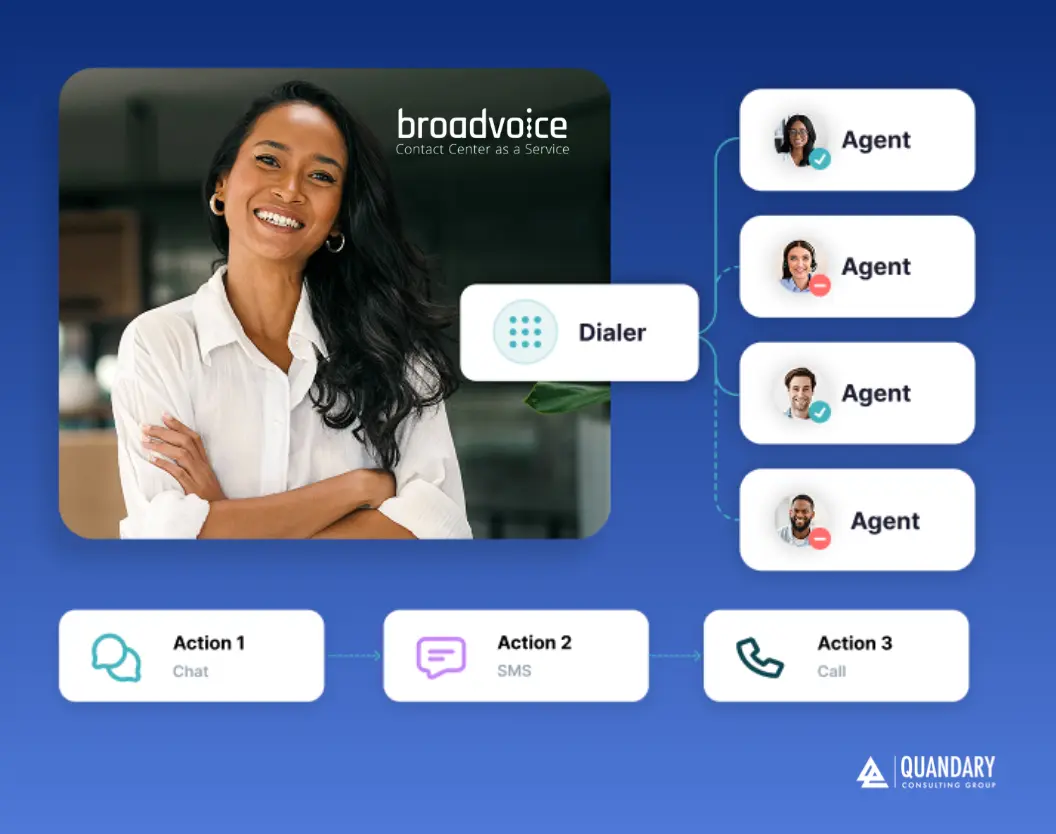
Broadvoice | GO Connect
Broadvoice provides cloud-based communication and contact center solutions designed to help healthcare organizations improve patient communication and operational efficiency.
Key capabilities include:
- AI-powered contact center tools built directly into the platform (no bolt ons) that are designed specifically for healthcare
- Intelligent call routing to ensure the call goes to the right agent every time
- Unified communications
- Omni-channel patient engagement
- Workforce collaboration tools (Call Monitoring & QA)
- Scalable inbound and outbound communication management
- Ability build your own custom AI Agents on their platform based on your contact center workflow.
- Certified across SOC 2, HIPAA, PCI DSS, and GDPR — with full encryption, audit logs, and designated regional hosting.
Broadvoice helps healthcare organizations reduce missed calls, improve responsiveness, and support high-volume patient communication environments without overwhelming staff.
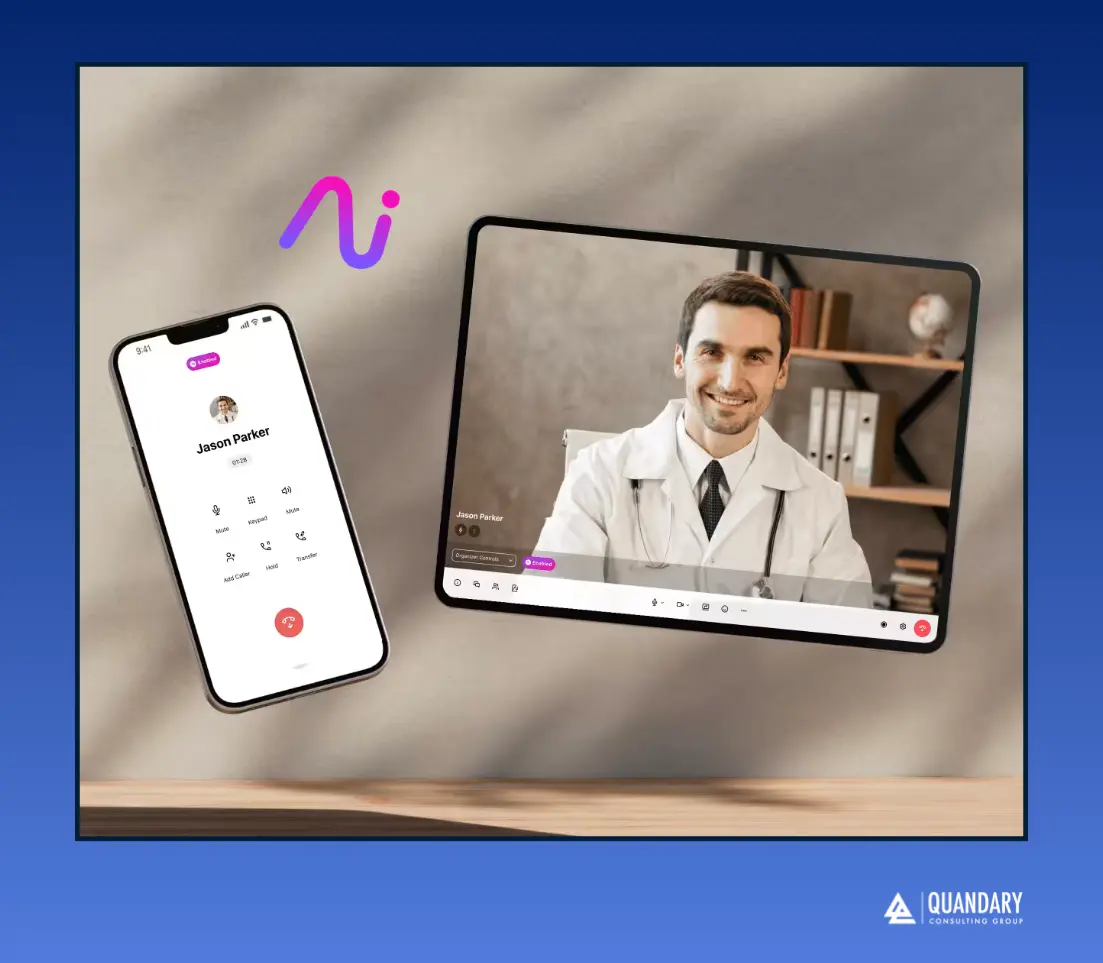
Dialpad
Dialpad combines cloud communications with AI-powered contact center intelligence.
Healthcare organizations use Dialpad for:
- AI call transcription
- Real-time agent coaching
- Intelligent routing
- Automated summaries
- Unified communication workflows
- Ability build your own custom AI Agents on their platform based on your contact center workflow.
- Built-in governance layer that continuously monitor, along with Enterprise-level encryption, and is certified across SOC 2, HIPAA, PCI DSS, and GDPR; full encryption with audit logs.
Dialpad AI Agent's driven features help improve agent productivity and patient interaction quality.
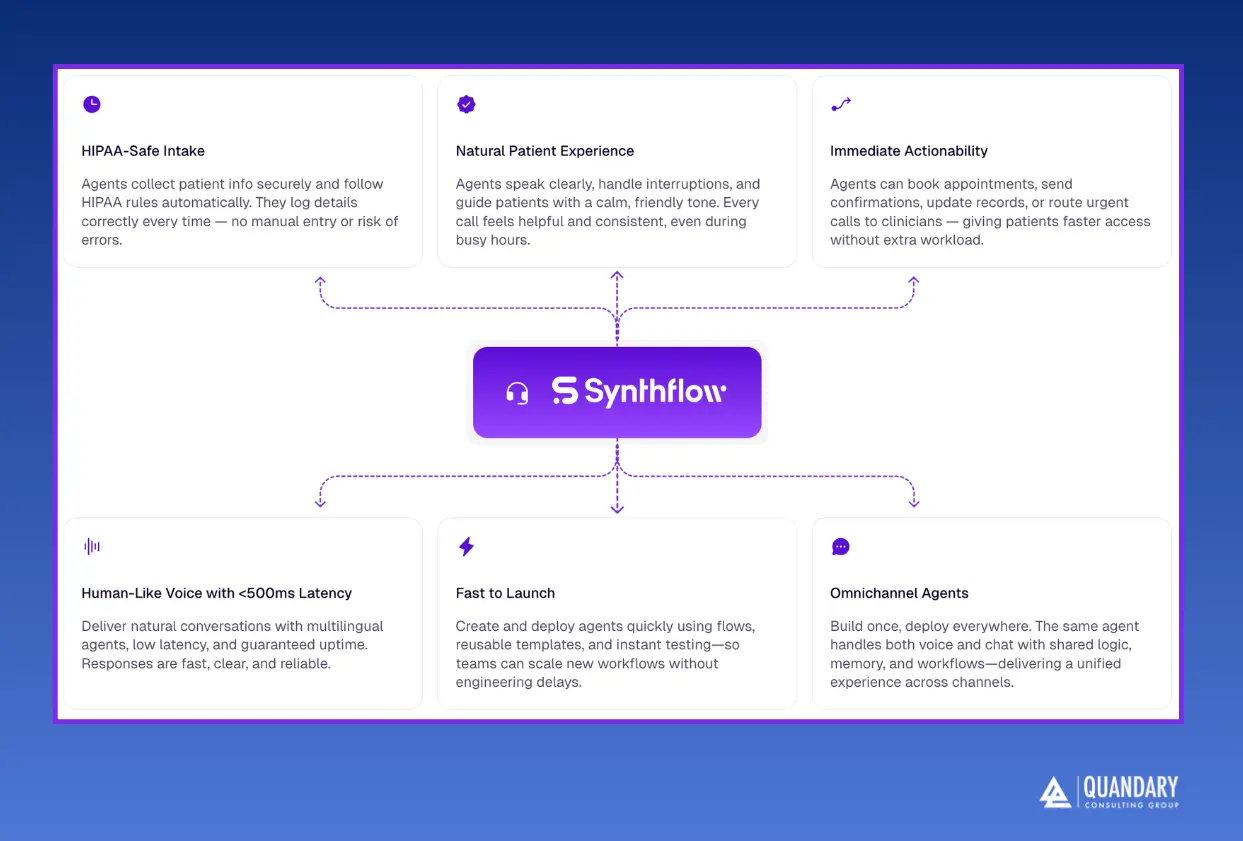
Syntflow AI
Syntflow AI enables organizations to deploy customizable conversational AI voice agents quickly and efficiently.
Healthcare use cases include:
- Patient intake and appointment scheduling
- FAQ automation
- Follow-up communication
- Ability to develop AI Agents on their platform
- After-hours call management 24/7
- Synthflow AI's Infrastructure is also certified across SOC 2, HIPAA, PCI DSS, and GDPR with full encryption, audit logs, and region-based hosting built into every release.
Synthflow AI's flexible, no-code approach allows healthcare teams to implement voice automation without extensive technical resources.
Observe.AI
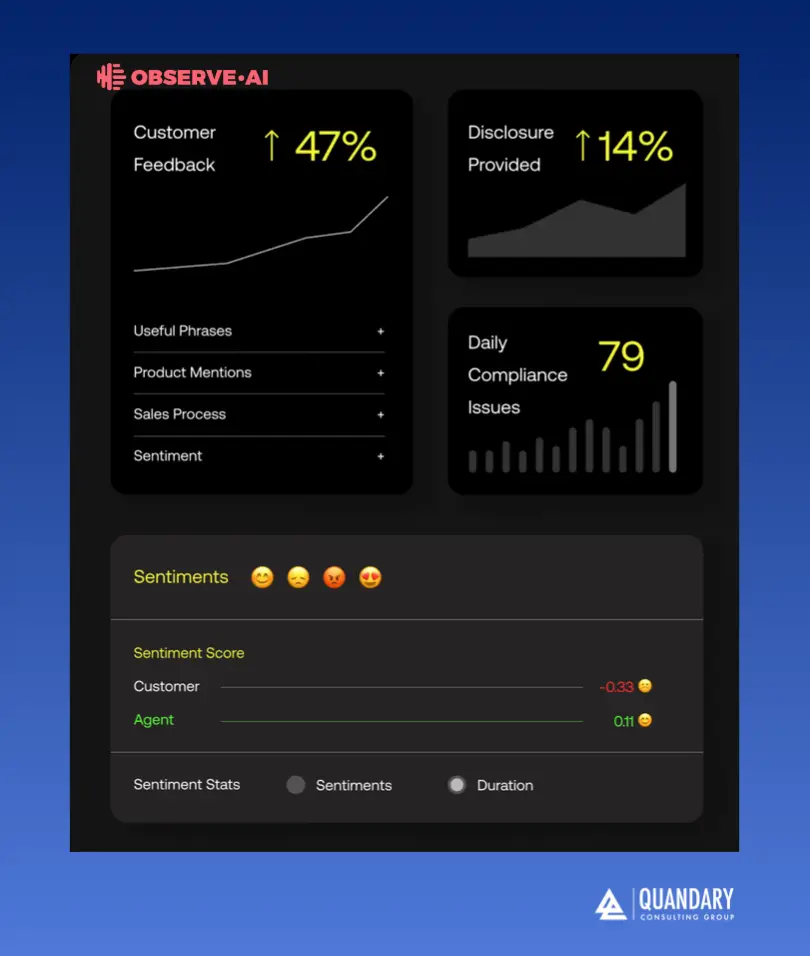
Observe.AI specializes in conversation intelligence and contact center performance optimization.
Healthcare organizations use Observe.AI | HEALTHCARE solutions
- Appoint scheduling and confirmation calls
- Insurance, billing and payment questions
- Discharge and Post-op questions and triage
- Analyze patient interactions for improved quality assurance
- Next-best actions based on patient history
- Real-time compliance monitoring and supervisor alerts
- Update backend systems automatically
- Ability build your own custom AI Agents on their platform based on your contact center workflow.
- Certified across Certified across ISO 42001 SOC 2, HIPAA, PCI DSS, and GDPR — with full encryption, audit logs, and designated regional hosting designated regional hosting
Observe.AI's Healthcare -driven insights help organizations continuously improve both patient experience and staff performance.
Key Considerations for Healthcare AI Implementation
Before implementing AI-powered call center solutions, healthcare organizations should consider several important factors.
Security and Compliance Essentials
In regulated industries like healthcare and finance, security is non negotiable. An enterprise grade ai based call center must provide robust security and compliance features.
Key requirements include:
- HIPAA Compliance: For healthcare, the vendor must be HIPAA compliant and willing to sign a Business Associate Agreement (BAA) from the U.S. Health and Human Services
- ISO/IEC 27001 and SOC 2 Type II: These are global benchmarks for information security management that demonstrates a commitment to enterprise level security controls, audited by a third party.
- Data Encryption: All data must be encrypted both in transit (using protocols like TLS) and at rest (using AES 256).
- Zero Day Data Retention: When using third party large language models, ensure the vendor has agreements for zero day data retention, meaning your sensitive data is not stored or used for training.
- GDPR (EU): The General Data Protection Regulation sets rules for personal data collection, consent, and processing.
- PIPEDA (Canada). The Personal Information Protection and Electronic Documents Act regulates private-sector data practices in healthcare.
- Deployment Flexibility: The ability to choose between a secure cloud or an on premise deployment provides flexibility for organizations with strict data residency or security policies.
Failure to comply with such standards can lead to severe financial penalties and reputational damage. This can result in loss of patient trust, which will be difficult to regain.
If you are considering the development of your own AI agent, it’s vital to find a development team (like Quandary Consulting Group) that will take compliance as a core principle and won’t let you down in this aspect.
EHR and Scheduling Integration
The most effective AI solutions integrate directly with:
- Electronic health records (EHRs)
- Scheduling systems
- CRM platforms
- Patient communication tools
This creates seamless patient workflows and reduces manual work.
Human Escalation Paths
Patients should always have access to live staff when situations require empathy, clinical judgment, or complex support. AI should complement human teams — not completely replace them.
Voice Experience Design
Healthcare conversations require empathy and clarity. AI voice experiences should feel natural, helpful, and patient-friendly.
Poorly designed automation can negatively impact patient trust and satisfaction.
The Future of AI in Healthcare Patient Access
AI-powered communication systems are rapidly becoming essential infrastructure for modern healthcare organizations.
As patient expectations continue to rise and staffing challenges persist, AI agents will play a larger role in:
- Expanding patient access
- Improving operational scalability
- Reducing administrative burnout
- Enhancing patient satisfaction
- Supporting care coordination
Organizations that successfully combine AI automation with compassionate human care will be better positioned to deliver efficient, scalable, and patient-centered healthcare experiences.
AI is not replacing healthcare teams — it is empowering them to operate more effectively and serve patients at a higher level.
Additional Resources
- Redefining Patient Access Through Agentic AI in Healthcare Call Centers (Becker’s Hospital Review) | A strong executive-level overview of how agentic AI is transforming healthcare call centers, reducing staff burnout, and improving patient scheduling workflows.
- Transforming Healthcare Delivery with Conversational AI Platforms (Nature Digital Medicine) | A research-backed analysis of how conversational AI supports healthcare communication, documentation, patient engagement, and operational efficiency.
- The Complete Guide to Conversational AI Agents for Patient Access (HealthNote) | A practical implementation guide for healthcare leaders exploring AI-powered patient access automation across phone, text, and chat channels.
- Improving Consumer Experience with AI in Healthcare Service Operations (McKinsey & Company) | A strategic overview of how AI is reshaping healthcare operations, improving patient experiences, and increasing operational scalability.
- Conversational AI in Healthcare: 2026 Use Cases & Examples (Master of Code Global) | A comprehensive overview of conversational AI healthcare use cases, including scheduling, intake, tele-health, reminders, and patient support automation.
- Improving Patient Experience via Healthcare Call Center AI | An in-depth article exploring how healthcare call center AI reduces wait times, improves patient engagement, and supports operational efficiency.
FAQs: AI Agents in Healthcare Call Centers
1. What are AI agents in healthcare call centers?
AI agents are conversational voice or chat systems that use artificial intelligence, natural language processing (NLP), and automation to manage patient interactions. These systems can answer calls, schedule appointments, verify insurance, route urgent cases, and support patients 24/7 without requiring human intervention for every task.
2. How do AI agents improve patient access in healthcare?
AI agents improve patient access by reducing hold times, automating appointment scheduling, offering after-hours support, and helping patients connect with healthcare services faster. They allow healthcare organizations to manage more patient interactions efficiently while improving responsiveness and accessibility.
3. Can AI agents reduce healthcare call center wait times?
Yes. AI-powered call center solutions can answer multiple patient calls simultaneously, reducing hold times and minimizing abandoned calls. By automating repetitive requests such as scheduling and prescription refills, healthcare staff can focus on more complex patient needs.
4. Are AI healthcare call center solutions HIPAA compliant?
Many healthcare AI platforms are designed to support HIPAA compliance and healthcare data security requirements. However, healthcare organizations should carefully evaluate each vendor’s security standards, encryption methods, compliance certifications, and data handling policies before implementation.
- All vendors listed in this article are all HIPPA compliant:
5. What tasks can AI voice agents automate in healthcare?
AI voice agents can automate:
- Appointment scheduling
- Insurance verification
- Prescription refill requests
- Patient intake
- Referral coordination
- Billing inquiries
- Appointment reminders
- After-hours patient support
- Call routing and triage
This reduces administrative burden while improving operational efficiency.
6. How do AI agents help healthcare call center staff?
AI agents support healthcare staff by automating repetitive tasks, providing real-time coaching, generating call summaries, and assisting with documentation. Solutions like Dialpad and Observe.AI also help improve agent performance through conversation intelligence and workflow optimization.
7. What are the benefits of AI-powered patient scheduling?
AI-powered scheduling helps healthcare organizations:
- Reduce missed calls
- Increase appointment booking efficiency
- Minimize scheduling errors
- Improve patient satisfaction
- Reduce front-desk workload
- Offer 24/7 scheduling access
Patients benefit from faster and more convenient appointment booking experiences.
8. Can AI agents support multilingual healthcare communication?
Yes. Many AI healthcare communication platforms provide multilingual support, allowing patients to interact in their preferred language. This improves accessibility, patient understanding, engagement, and overall healthcare equity.
9. What is the difference between AI agents and traditional IVR systems?
Traditional IVR systems rely on rigid menu options like “Press 1 for scheduling.” AI agents use conversational AI to understand natural language and respond dynamically to patient requests. This creates a more human-like and efficient patient experience.
10. How does conversational AI improve patient experience?
Conversational AI improves patient experience by:
- Reducing wait times
- Providing immediate responses
- Offering 24/7 availability
- Simplifying scheduling
- Personalizing interactions
- Improving communication consistency
Patients receive faster and more convenient support throughout the care journey.
11. What are the best AI platforms for healthcare call centers?
Popular AI-powered healthcare communication platforms include:
- Broadvoice | GO CONNECT
- Dialpad | DialPad Healthcare AI Agent
- Synthflow AI | Healthcare
- Observe.AI | AI FOR HEALTHCARE PROVIDERS
These platforms help healthcare organizations improve patient communication, automate workflows, and optimize contact center operations.
12. Can AI replace human healthcare call center agents?
AI is designed to support and enhance healthcare teams — not fully replace them. While AI can automate repetitive administrative tasks, human staff remain essential for handling sensitive conversations, clinical judgment, empathy, and complex patient interactions.
13. How do AI agents improve healthcare operational efficiency?
AI agents improve efficiency by:
- Automating high-volume requests
- Reducing administrative workload
- Lowering call abandonment rates
- Decreasing average handle times
- Improving workflow consistency
- Scaling patient communication operations
This helps healthcare organizations serve more patients without proportionally increasing staffing costs.
14. Are AI-powered healthcare contact centers scalable?
Yes. AI-powered healthcare contact centers can scale quickly during periods of increased demand, such as flu season, vaccination campaigns, or public health emergencies. Unlike traditional staffing models, AI systems can handle significant call volume increases instantly.
15. What should healthcare organizations consider before implementing AI agents?
Healthcare organizations should evaluate:
- HIPAA compliance
- Security and privacy protections
- EHR integrations
- Workflow customization
- Human escalation processes
- Voice experience quality
- Vendor scalability and support
A successful implementation balances automation with compassionate patient care.
16. How do hospitals integrate AI agents into their systems?
Hospitals integrate AI agents into their EHR systems, diagnostic imaging platforms, clinical decision support tools, and cloud-based AI APIs that connect to existing hospital IT infrastructure.
The process of AI agent implementation usually includes a series of steps, such as assessment, planning, data integration, model deployment, API connection, workflow adaptation, and staff training. Continuous performance monitoring and model improvement are also integral components of this process.
17. What is the future of AI agents in healthcare?
It is expected that in the future, AI agents will evolve into assistants capable of real-time diagnostics, drug discovery, drug refills, continuous patient monitoring, etc. AI systems (and the AI Agents) will likely become deeply integrated into clinical workflows and touch every aspect of the patient lifecycle.
AI Agents will also support personalized medicine and predictive healthcare. Advancements in explainable AI and also multimodal data processing will make such agents more transparent and trusted by clinicians and patients.
18. Why should I hire Quandary Consulting Group for custom software / AI Agent(s) development?
To ensure the highest efficiency, your AI agent should be fully tailored to your specific business needs and workflows. It is possible to achieve this only with custom software development. Apart from it, when you launch your custom AI solution, you can be confident that your proprietary data will be used only in-house, which will minimize security risks.