Artificial Intelligence (AI)
Pave and the Future of Enterprise AI Development | Why Governance-First “Vibe Coding” Is the Next Big Shift

Artificial intelligence has fundamentally changed the speed at which organizations can build software. What once required months of planning, coding, testing, and deployment can now begin with a simple prompt.
This new era of “vibe coding” - AI-assisted application generation through natural language — has captured the attention of startups, developers, enterprise leaders, and business users alike. Platforms such as Lovable, Bolt.new, Cursor, Replit Agent, v0 by Vercel, manus, and Retool AI have accelerated innovation by enabling users to rapidly generate applications, workflows, interfaces, and automations with minimal manual coding.
But as organizations move beyond experimentation and into operational deployment, a larger question is emerging: How do enterprises safely scale AI-generated applications?
At Quandary Consulting Group, we believe this is the defining challenge — and opportunity — in the next phase of enterprise AI transformation.
So, what Is Vibe Coding exactly?
Vibe coding is a modern software development style where programmers build applications quickly using intuition, experimentation, and AI-generated code instead of following a rigid engineering process.
The term became popular alongside AI coding tools like ChatGPT, GitHub Copilot, Cursor, Claude, Replit AI, and Windsurf. In vibe coding, the developer often describes what they want in plain English, lets AI generate large portions of the code, then iterates rapidly through testing and refinement.
At its core, vibe coding prioritizes speed, creativity, and momentum over formal planning.
The Definition of Vibe Coding
Vibe coding refers to:
- Writing software through rapid iteration
- Using AI to generate or modify code conversationally
- Building based on intuition rather than detailed specifications
- Experimenting first and optimizing later
- Prioritizing working prototypes over perfect architecture
Instead of manually engineering every system from scratch, the developer collaborates with AI tools to “feel out” the product direction.
How Vibe Coding Works
A traditional software workflow usually looks like this:
- Plan the application architecture
- Design the database
- Define APIs
- Write backend logic
- Build frontend components
- Add tests
- Optimize performance
- Deploy
A vibe coding workflow is often much more fluid:
- Describe the idea to an AI assistant
- Generate an initial version
- Run the code
- Fix errors
- Add features conversationally
- Iterate rapidly until the product works
The emphasis is on momentum rather than process.
Why Vibe Coding Platforms (like Pave) are Gaining Traction?
Vibe coding isn’t just a clever idea - it’s catching on fast because it aligns with how developers increasingly want to work: faster, more creatively, and with less friction.
In traditional development, there’s often a gap between thinking of a feature and seeing it come to life. You plan, design, write specs, hand them off, code manually, and then finally test. Vibe coding collapses that entire flow. You think it. You describe it. You see it.
Here’s why this shift is happening now:
LLMs Have Reached a Tipping Point
Large language models like GPT-4, Claude, and Codex are now smart enough to take vague, creative prompts and output surprisingly usable code. They can scaffold components, handle boilerplate, and even structure UI elements - all based on natural language. The result? Developers can go from concept to a functioning prototype in minutes.
Faster Prototyping, Quicker Feedback
In an agile world, speed matters. Vibe coding enables rapid iteration by getting something built now—even if it’s not perfect. This encourages experimentation, testing, and validating ideas early, without overcommitting resources.
Coding Feels More Like Thinking
Vibe coding brings back a sense of flow. You don’t need to constantly look things up or dig through docs. You just focus on what you want to build, and the AI assists with syntax, structure, and even refactoring. It feels more like shaping ideas than writing technical instructions.
Designers and Developers Collaborate More Fluidly
Because vibe coding works best when the idea is clear, wireframes become a vital tool in this process. Designers can use wire-framing tools like MockFlow to sketch out layouts and UX flows, and developers can use those wireframes as contextual input to guide their AI-assisted coding.
Instead of asking, “What should I build?” the developer can look at a wireframe and say to the AI, “Build this layout, but make it feel clean and minimal with responsive spacing and smooth transitions.”
Vibe Coding Supports the Modern Dev Cycle
Vibe coding fits naturally into modern, agile workflows: Build fast, Get feedback, Refine & Ship.
Whether you're working solo or in a team, vibe coding enables quicker cycles and more creativity - without sacrificing structure when you get to the polishing phase.
What is the “80% Problem” in Vibe Coding?
Many first-generation vibe coding platforms are incredibly effective at helping users move from idea to prototype. However, organizations are increasingly discovering that the final 20% of application development — governance, scalability, security, testing, compliance, deployment, and operational oversight — often becomes the most difficult and resource-intensive phase.
This challenge has become known across the industry as the “80% problem.”
AI can rapidly generate functional applications, but enterprise readiness requires far more than working code. Organizations still need:
- Governance frameworks
- Security and permissions controls
- Auditability
- Infrastructure management
- Workflow validation
- Scalability planning
- Data integrity protections
- Operational monitoring
- Deployment controls
- Long-term maintainability
In many cases, the speed of AI-generated development has outpaced the operational systems required to support it responsibly.
That is why the market is beginning to shift.
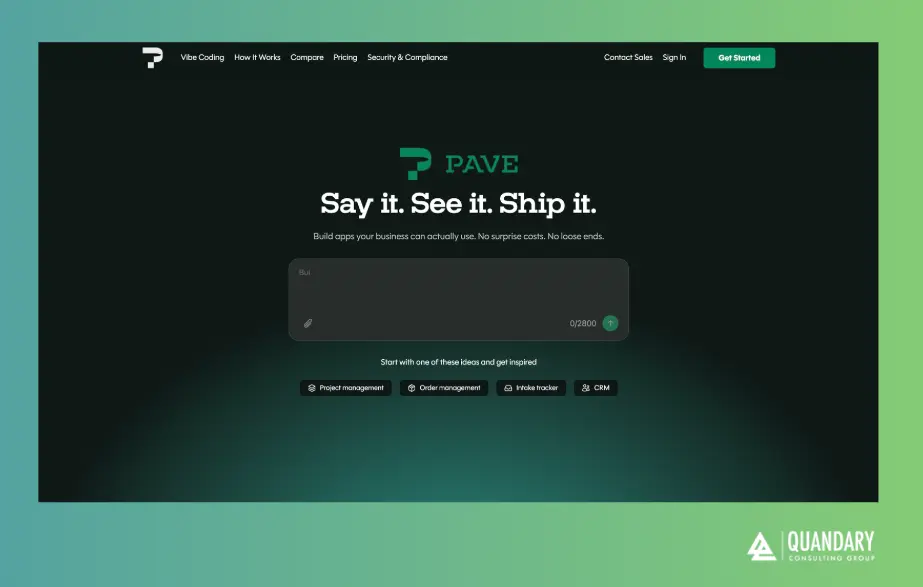
Quickbase's Pave Signals the Next Evolution of Enterprise AI
Quickbase’s launch of Pave represents one of the clearest signals yet that the vibe coding market is maturing beyond rapid prototyping and moving toward enterprise operationalization.
Unlike many AI app builders focused primarily on speed-to-demo, Pave is positioning itself as a full-stack enterprise AI application platform — designed not just to generate applications quickly, but to support secure, scalable, production-ready deployment.
From Quandary Consulting Group’s perspective, this distinction is incredibly important.
Pave appears to recognize a core enterprise reality: innovation without governance creates operational risk.
The platform introduces several capabilities designed specifically to address the challenges organizations encounter when attempting to operationalize AI-generated software, including:
- Built-in governance controls
- Centralized deployment management
- Granular permissions frameworks
- Audit trails and rollback functionality
- Integrated hosting infrastructure
- Data management services
- Authentication and SSO capabilities
- Enterprise operational oversight
Rather than requiring organizations to stitch together multiple third-party tools, databases, hosting providers, and security layers, Pave attempts to consolidate the enterprise AI application lifecycle into a single governed environment.
That model could dramatically simplify how organizations approach AI-driven software development.
Why Enterprise Governance Matters More Than Ever
As organizations accelerate AI adoption, governance is no longer optional.
The rise of agentic AI systems introduces entirely new operational and security considerations. Recent incidents across the industry have highlighted risks tied to:
- Autonomous agent decision-making
- Workflow manipulation
- Privilege escalation
- API misuse
- Inconsistent access controls
- Unintended automation behavior
- Shadow IT proliferation
Traditional software risks have not disappeared — AI has simply increased the speed and scale at which those risks can emerge.
This is where governance-first platforms like Pave may have a significant advantage.
At Quandary Consulting Group, we consistently advise organizations that AI transformation initiatives must be approached with the same rigor as any enterprise-critical system. AI-generated applications still require:
- Architectural validation
- Testing and QA processes
- Security review
- Compliance oversight
- Operational monitoring
- Business continuity planning
The organizations that scale AI successfully will not necessarily be the ones generating applications the fastest — they will be the ones operationalizing AI responsibly.
How Pave Compares to the Leading Vibe Coding Platforms
The current vibe coding landscape is rapidly separating into three distinct categories.
1. AI Prototyping Platforms
Focused on rapid experimentation and MVP creation.
Examples:
These platforms excel at helping users rapidly generate modern applications and interfaces with minimal technical expertise. They are ideal for ideation, prototyping, and startup experimentation, but often require additional operational tooling and governance layers before enterprise deployment.
2. AI-Assisted Developer Platforms
Focused on accelerating professional software engineering workflows.
Examples:
These tools provide developers with AI-enhanced coding environments that improve productivity and flexibility. However, they still rely heavily on engineering expertise and traditional DevOps practices.
3. Enterprise AI Operational Platforms
Focused on governance, deployment, scalability, and operational readiness.
Examples:
This category is where the market becomes especially interesting.
Pave differentiates itself by emphasizing enterprise infrastructure, governance, permissions management, and operational scalability from the start. Rather than treating governance as an afterthought, it appears designed to embed operational oversight directly into the development lifecycle.
From our perspective, this is likely where enterprise AI adoption is headed.
How Quandary Uses Pave Internally to Accelerate Enterprise AI Development
As enterprise organizations continue exploring AI-assisted application development, one challenge consistently emerges: getting from a promising prototype to a secure, scalable, production-ready solution.
At Quandary Consulting Group (QCG), we see this challenge every day — both internally and across client environments.
That’s one reason we’ve been closely evaluating and leveraging Pave by Quickbase internally as part of our evolving AI and automation strategy.
Pave represents a new category of AI-enabled application development focused on helping teams move beyond “vibe coding” prototypes and into governed, enterprise-ready systems. Unlike many lightweight AI app builders, Pave combines AI-driven development with built-in governance, permissions, auditability, and deployment infrastructure.
For a consulting organization (like Quandary), that combination matters.
Why Pave Fits Quandary’s Approach
At Quandary, we focus heavily on enterprise automation, interoperability, governance, and operational scalability. Across our internal systems and client engagements, we prioritize:
- Standardized processes
- Technology-driven QA
- Leadership oversight
- Scalable architectures
- Secure automation practices
These principles are embedded throughout our delivery methodology.
Pave aligns naturally with this philosophy because it enables rapid development while still maintaining the controls enterprises require.
Rather than treating governance as an afterthought, Pave includes:
- Granular permissions
- SSO authentication
- Audit trails
- Version rollback
- Built-in hosting and deployment
- Workflow and logic customization
- All within a unified platform.
For enterprise consulting teams operating across multiple systems and clients, that level of structure is essential.
How Quandary Consulting Group Uses Pave Internally
1. Rapid Internal Workflow Prototyping
Internally, one of the biggest advantages of Pave is speed.
Traditional enterprise application development often involves lengthy coordination between business stakeholders, architects, developers, infrastructure teams, and QA resources before a working solution even exists.
Pave dramatically shortens that cycle.
Our teams use Pave to rapidly prototype internal operational workflows, including:
- Service delivery coordination
- Internal request management
- QA tracking processes
- Automation dashboards
- AI-assisted workflow orchestration
- Operational reporting interfaces
Because Pave supports natural language-driven application creation combined with configurable workflows and governance, teams can move from concept to working prototype significantly faster.
This allows our architects and consultants to validate ideas quickly before investing in larger enterprise implementations.
2. Supporting AI-Driven Operational Workflows
At Quandary, we view AI as a force multiplier for automation.
Our internal philosophy is that AI delivers the most value when embedded directly into operational workflows rather than isolated as standalone tools.
Pave helps support this model by enabling AI-assisted application generation while maintaining enterprise structure around the resulting systems.
Internally, we use AI-enhanced workflows to assist with:
- Knowledge retrieval
- Process acceleration
- Operational visibility
- Intelligent workflow routing
- Data coordination across systems
- Internal reporting and dashboard generation
Pave’s centralized environment helps ensure these workflows remain manageable, governed, and auditable.
3. Governance and Security Alignment
One of the biggest concerns enterprises have around AI-generated applications is governance.
Rapid app generation without controls can introduce:
- Access management risks
- Inconsistent workflows
- Poor auditability
- Security vulnerabilities
- Unmanaged infrastructure sprawl
This is where Pave stands apart.
The platform was specifically designed to support enterprise governance requirements, including permissions, auditing, rollback capabilities, and centralized oversight.
Here at Quandary, governance is not optional. Our internal systems must align with the same standards we recommend to clients:
- Repeatable processes
- Controlled deployment practices
- Transparent workflows
- Secure authentication
- Structured operational oversight
Pave’s architecture supports these requirements while still enabling rapid experimentation and innovation.
4. Faster Solution Validation for Client Engagements
Another major advantage is the ability to validate client concepts quickly. Many organizations know they want automation or AI capabilities but struggle to visualize the end-state solution.
Pave allows our teams to rapidly demonstrate:
- Workflow concepts
- UI structures
- Process automations
- Data relationships
- Operational models
- AI-assisted use cases
This is all before significant engineering investment occurs.
Pave allows us to accelerates discovery workshops and reduces ambiguity during solution planning.
Instead of discussing theoretical workflows, clients can interact with working prototypes early in the process.
5. Integrating AI with Enterprise Operations
At Quandary, we consistently emphasize that AI cannot operate in isolation.
AI systems must coexist with:
- Legacy infrastructure
- SaaS platforms
- Operational workflows
- Compliance frameworks
- Existing governance models
We discuss this frequently with our enterprise AI strategy clients.
Pave’s approach aligns well with this enterprise reality because it combines AI-assisted creation with operational infrastructure already built into the platform.
What once was individual separate systems; we now have the ability to reduces the overhead typically associated with stitching together:
- Hosting
- Databases
- Authentication
- Deployment pipelines
- Governance tooling
- Runtime management
For internal innovation teams, this simplicity creates significant operational advantages.
The Bigger Picture
AI-assisted development is evolving rapidly.
But the real enterprise challenge is no longer generating prototypes — it’s operationalizing them safely, consistently, and at scale.
At Quandary Consulting Group, we believe platforms like Quickbase's Pave represent an important shift toward enterprise-ready AI development environments that balance:
- Speed
- Governance
- Flexibility
- Security
- Operational scalability
Internally, Pave helps our teams accelerate experimentation while maintaining the structure and oversight enterprise environments demand; and ultimately, that balance is what matters most.
Because in enterprise technology, innovation only creates value when it can scale responsibly.
As organizations continue exploring AI-enabled application development, the winners will not simply be the fastest builders — they will be the teams that combine speed with governance, automation with accountability, and innovation with operational maturity.
That’s the lens through which Quandary approaches AI.
And it’s why tools like Pave are becoming an increasingly important part of how we prototype, automate, and operationalize intelligent enterprise workflows internally.
Additional Resources:
To learn more about Quickbase's Pave, we suggest checking out the following:
- How Pave Works (from Quickbase)
- Pave's Embedded Guardrails
- Pave Feature Comparison Guide (by Quickbase)
- Sign up for a free Quickbase Pave account
To get a better understanding about Pave from a developer prospective, read our Knowledge Base article, What is Quickbase's Pave?
Curious to hear about what your others think of Pave? Check out this great blog from Quickbase's Qrew Master, Ben Simon, "From A to Z: Why Pave Feels Like a Big Deal (and What It Means for the Qrew)"
Need help with Pave (or Quickbase)? We can help with that! Visit our Contact Us page and drop us a line, we will get back to you within 15 mins to set up a time that works best for you!
Frequently Asked Questions About Quickbase Pave
1. What Is Quickbase Pave and How Does It Work?
Quickbase Pave is an AI-powered application development platform designed to help organizations build, deploy, and manage business applications using natural language prompts and low-code workflows.
Unlike many AI app builders focused only on prototyping, Pave combines AI-assisted development with enterprise-grade governance, hosting, permissions management, deployment infrastructure, and operational oversight.
2. How Does Quickbase Pave Compare to Other AI App Builders Like Lovable, Bolt.new, and Retool?
Quickbase Pave differentiates itself by focusing heavily on enterprise operational readiness. While platforms like Lovable and Bolt.new excel at rapid prototyping and startup-focused application creation, Pave emphasizes governance, security, scalability, deployment management, and enterprise compliance. Compared to Retool, Pave appears more focused on AI-native application generation and simplified business-user accessibility.
3. Can Quickbase Pave Build Production-Ready Enterprise Applications?
Yes. One of Pave’s primary differentiators is its focus on helping organizations move beyond proof-of-concept development into production-ready deployment.
The platform includes integrated hosting, permissions management, governance controls, audit capabilities, deployment tooling, and operational infrastructure designed to support enterprise use cases.
4. What Are the Biggest Benefits of Using Quickbase Pave for Enterprise AI Development?
Some of the biggest benefits include accelerated application development, reduced infrastructure complexity, built-in governance, centralized deployment management, enhanced security controls, lower operational overhead, and improved collaboration between business and IT teams. Pave also enables organizations to operationalize AI-generated applications more safely and efficiently.
5. How Does Quickbase Pave Solve the “80% Problem” in Vibe Coding?
Many AI app builders can generate working prototypes quickly, but organizations often struggle with the final stages of deployment, governance, testing, and scalability.
This challenge is commonly referred to as the “80% problem.” Pave addresses this by integrating governance, permissions, infrastructure, deployment tools, and operational oversight directly into the development lifecycle.
6. Is Quickbase Pave Secure for Enterprise and Sensitive Data Environments?
Pave includes enterprise-focused security features such as granular user permissions, single sign-on (SSO), audit trails, centralized oversight, rollback functionality, and governance controls.
While organizations should still conduct proper security reviews and operational validation, the platform is designed with enterprise security and operational management in mind.
7. What Governance and Compliance Features Are Included in Quickbase Pave?
Quickbase Pave includes governance capabilities such as permissions management, audit logging, deployment oversight, version rollback, authentication controls, centralized operational visibility, and workflow management tools.
These features help organizations maintain operational consistency, improve accountability, and support compliance initiatives.
8. Can Non-Technical Business Users Build Applications with Quickbase Pave?
Yes. Pave is designed to support both technical and non-technical users through AI-assisted development and low-code functionality. Business teams can use natural language prompts and visual workflows to participate more directly in application development without requiring extensive coding expertise.
9. What Types of Companies and Teams Should Use Quickbase Pave?
Pave is particularly well suited for mid-market and enterprise organizations looking to accelerate digital transformation initiatives while maintaining governance and operational control. Teams involved in operations, process automation, project management, workflow optimization, compliance, and enterprise modernization may benefit most from the platform.
10. Why Is Quickbase Pave Becoming a Major Player in the Future of AI-Powered Software Development?
As organizations move beyond AI experimentation and into operational deployment, demand is growing for platforms that combine rapid AI development with enterprise governance, scalability, and security.
Quickbase Pave addresses this emerging need by helping organizations operationalize AI-generated applications responsibly while reducing infrastructure complexity and improving deployment readiness.