
Knowledge Base
Articles In This Section
How to Resolve Quickbase Login IssuesHow to Optimize High-Volume Quickbase EnvironmentsSections
How to Optimize your Quickbase for Faster Performance
If your Quickbase app is running slower than expected, it can disrupt workflows, reduce productivity, and create frustration for users. Performance issues may show up as long page load times, delayed reports, or sluggish form interactions, often caused by factors like large data volumes, complex relationships, inefficient formulas, or heavily customized dashboards.
This article outlines common causes of slow performance in Quickbase and provides practical steps to diagnose and improve the speed and responsiveness of your applications.
The 10 Most Common Causes for Slow Quickbase Performance
- Large Data Volumes: As record counts grow, Quickbase apps can slow down—especially when tables contain tens or hundreds of thousands of records. Reports, searches, and queries take longer to process without proper filtering or archiving strategies.
- Complex Relationships and Schema Design: Apps with many interconnected tables, multiple relationship layers, or excessive summary fields can create performance bottlenecks. Each relationship adds processing overhead, particularly in large or highly relational apps.
- Inefficient Formulas and Fields: Overly complex formulas, especially those referencing multiple fields or tables, can slow down calculations. Excessive fields on a table (even unused ones) can also impact performance.
- Heavy Reports and Dashboards: Reports that pull large datasets, include many columns, or rely on complex filters and calculations can load slowly. Dashboards with multiple embedded reports amplify this issue.
- Overuse of Summary Fields: Summary fields recalculate frequently and can significantly impact performance, especially in apps with high data volume or frequent updates.
- Excessive Automations and Pipelines: Too many real-time automations, pipelines, or webhooks can slow down app responsiveness. Background processes competing for resources may delay user-facing actions.
- Frequent API Calls and Integrations: Heavy use of APIs or integrations that constantly read/write data can strain performance, particularly if they run on short intervals or process large batches.
- Poorly Optimized Filters and Queries: Reports or searches without proper filtering force Quickbase to scan large datasets. Lack of selective filters or indexed fields increases load times.
- Too Many Fields on Forms: Forms with a large number of fields (especially lookup or formula fields) can become sluggish, leading to slower load and save times for users.
- Lack of Data Maintenance: Failing to archive old data, remove unused fields, or clean up outdated reports can gradually degrade performance over time.
How to Use the Quickbase Performance Bar to Find Optimization Issues
Using the Quickbase performance bar, you can monitor system performance as you work in Quickbase. Use this tool to see data about things that might affect performance.
If you experience slow performance of any kind, the information delivered by the performance bar can help you determine whether the problem originates with:
- Your browser
- The Quickbase service
- Your own network connection
How to Enable the Quickbase Performance Bar
Application administrators can enable the Quickbase performance bar and make it available for all application users. Once the performance bar is enabled, applications users can choose to show or hide it.
- From the app Home page, click Settings.
- Click App properties, then click Advanced Settings to expand the section.
- Under Performance options, click Show performance bar.
- Click Save
How to Show/Hide the Quickbase Performance Bar
If the application administrator enables the performance bar for the application, all application users can choose to hide or show it by clicking More > Show Quickbase Performance Bar on the app Home page.
- You can also hide the performance bar by clicking the X on the left side of the bar.
- When you show the performance bar, it displays at the bottom of your screen while you work in any application.
- If you log out while it is displayed, it remains visible the next time you sign in.
- If you hide the bar, it remains hidden while you work in any application. If you log off while it is hidden, it remains hidden the next time you sign in.
How to Understand your Performance Data in Quickbase
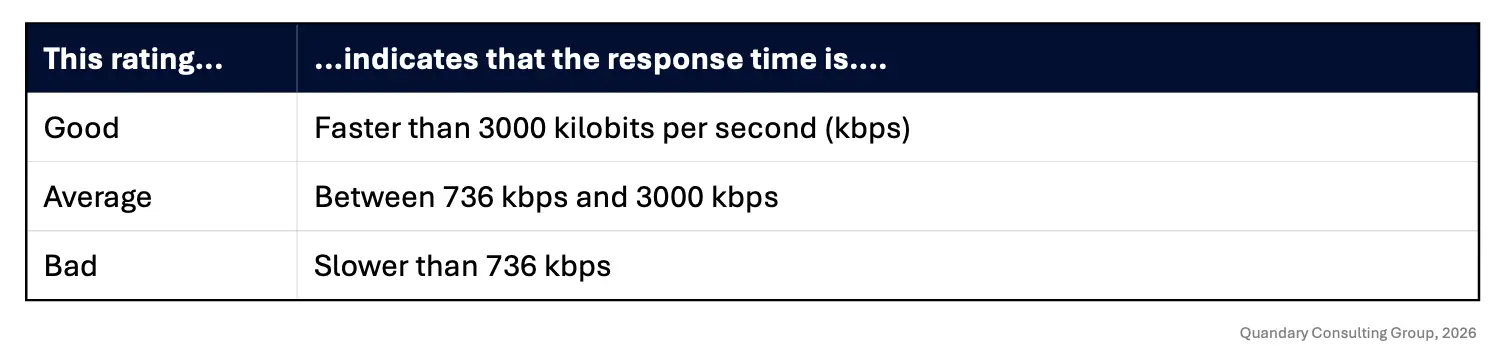
The Quickbase performance bar displays information about your browser, the Quickbase server response time, and your network download speed.
- Quickbase Browser Information: The performance bar detects and displays your browser version. Since newer browsers have better support for CSS and JavaScript, using an older browser could be the source of some performance problems.
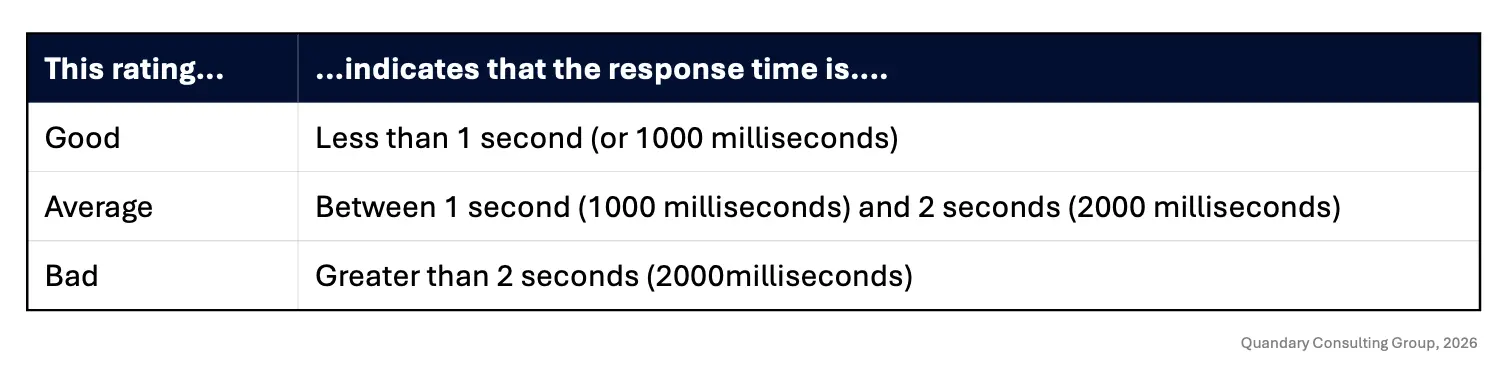
- Quickbase Response Time: The performance bar displays the Quickbase server response time. You'll see the server response time speed displayed in seconds (rounded to the next 1/100 of a second).
- Network Speed: You can ask the performance bar to check out the speed of your own network connection. When you click [Run Network Test], the performance bar displays the speed at which data is downloaded from the Internet to your network (in kilobits per second). You'll see the following ratings (see image below):
How to Email your Performance Data to your Quickbase Application Manager
If you experience slowness of any kind while you're working in a Quickbase application, you may want some help in diagnosing the problem. You can easily send a snapshot of your Quickbase system performance to your application manager.
If you click the email icon in the performance monitor, you can send the following information:
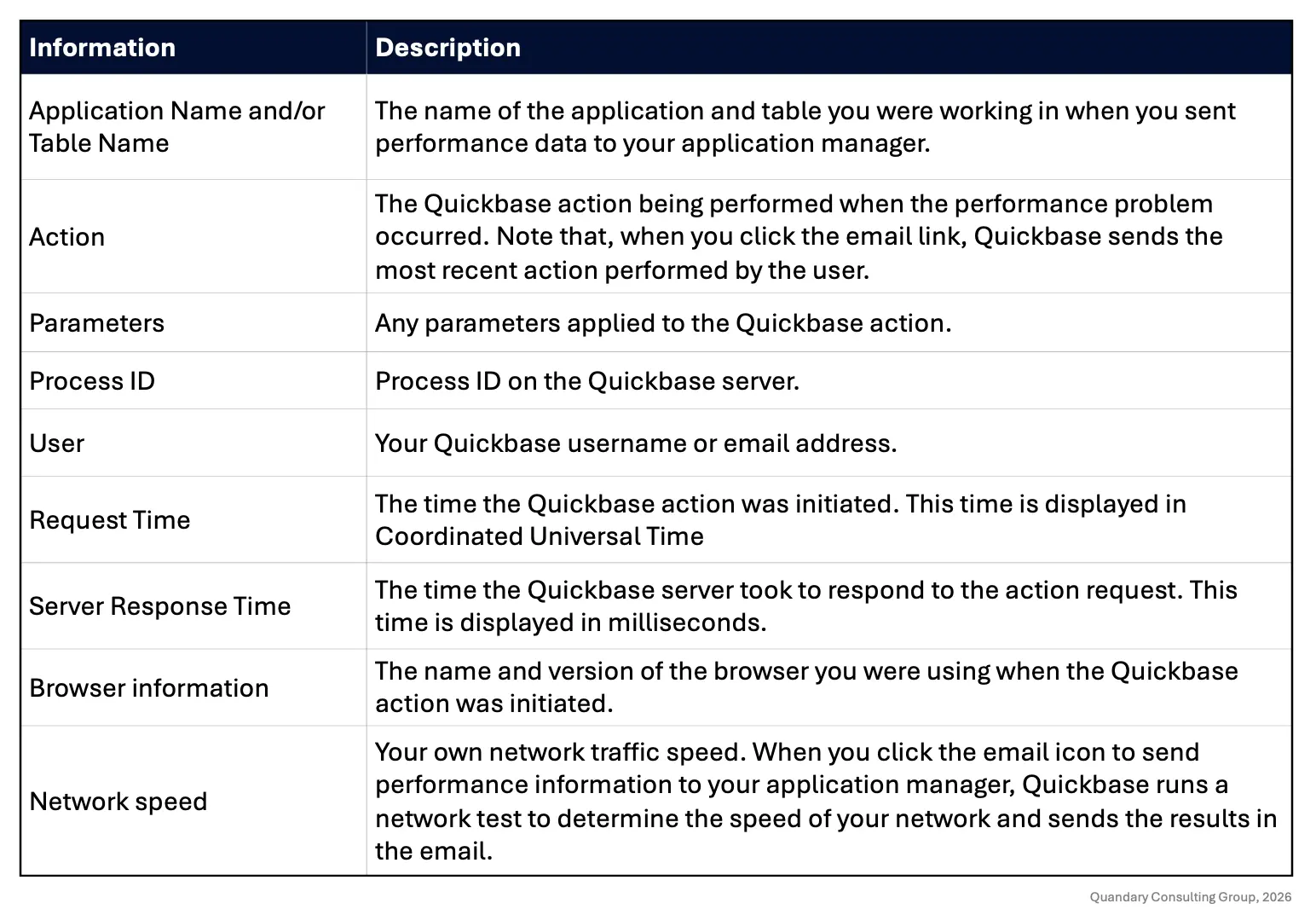
At the time you click the email icon, Quickbase gathers information about the most recent action you performed in your Quickbase application. Therefore, if you are experiencing any kind of performance issue with your application you should send an email immediately after experiencing the problem.
How to Use Quickbase's Performance Analyzer
Once you suspect an app performance issue, the Quickbase Performance Analyzer is your next stop.
Enable Quickbase Performance Analyzer:
- Go to your app experiencing slowness, then:
- Navigate to App Settings > App management > Performance Analyzer.
- Click the, Start Performance Analyzer, button.
Open Quickbase Visualizer:
- The performance will show results on each action took and show the total time for each individual process.
- This breaks down the processes involved and how Quickbase is handling each.
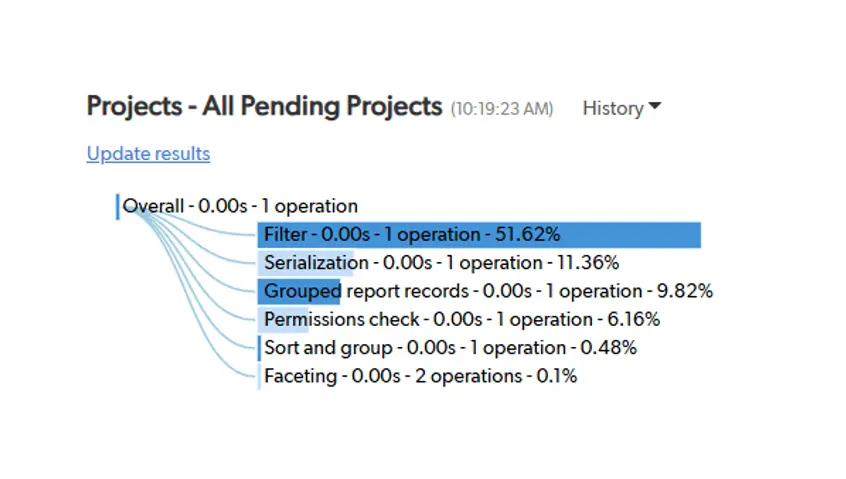
Filters are the single most time-consuming aspect. Quickbase Formula Filters like using contains and not using exact matches cause additional memory consumption, and it is best to avoid as much as possible.
How to Analyze Formula Complexity with the Quickbase Dependency Diagram
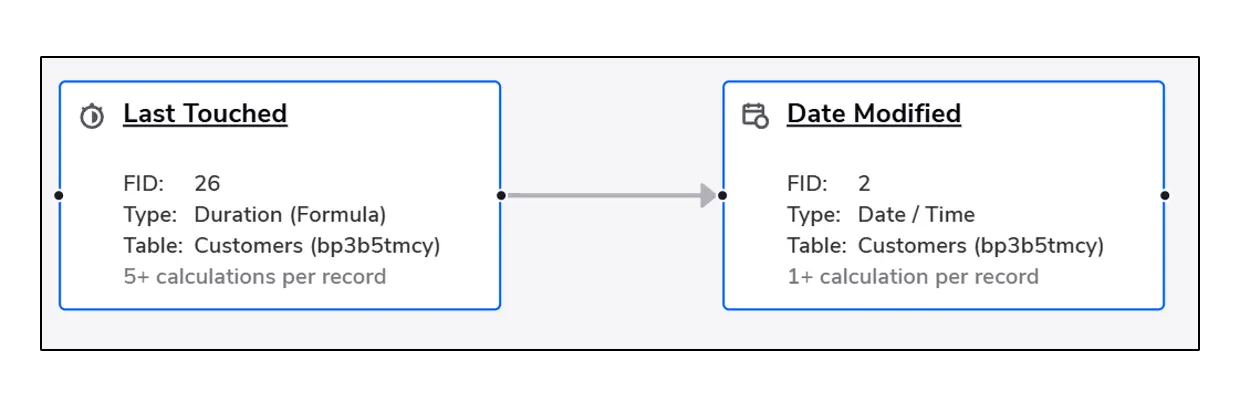
If the Quickbase Performance Analyzer shows that a specific field is taking a long time to calculate, use the Dependency Diagram to see why.
Open the Diagram:
- Go to Settings > Tables > [Select your Table] > Fields.
- Find the slow field and select the Dependency Diagram icon (looks like a flowchart).
Activate the Hot Path:
- Click the Fire Icon in the diagram toolbar.
- This highlights the Hot Path —the specific fields or calculations that contribute to more than 20% of the total calculation load.
Check your Quickbase Calculation Counts:
- Look at the numbers on the nodes.
- If a field has a high Calculation Count (e.g., 50+) this means every time that field is used, Quickbase is doing a massive amount of background work.
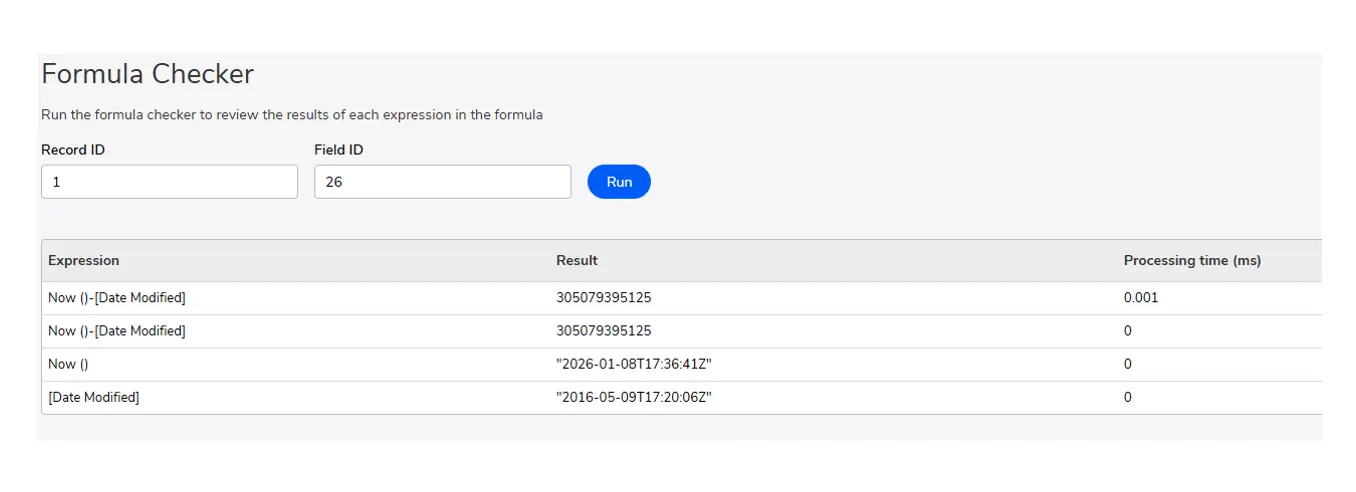
How to Run a Deep-Dive with Quickbase Formula Checker
- For extremely complex formulas, use the Quickbase Formula Checker to see the processing time for every single line of code.
- Test the Formula: Within the field settings of a formula field, look for the Formula Checker section.
- Input a Record ID: Enter a valid Record ID from your table and click Check Formula.
- Identify Bottlenecks: The tool will return a list of every expression evaluated. Also, look for specific lines where the time (in milliseconds) jumps significantly. And, always remember, you want to make sure to look for ways to improve your Quickbase formula.
How to Audit Quickbase's Performance Insights and Optimizer
If you are an Enterprise Quickbase user, you can audit the entire Quickbase app at once rather than checking individual fields.
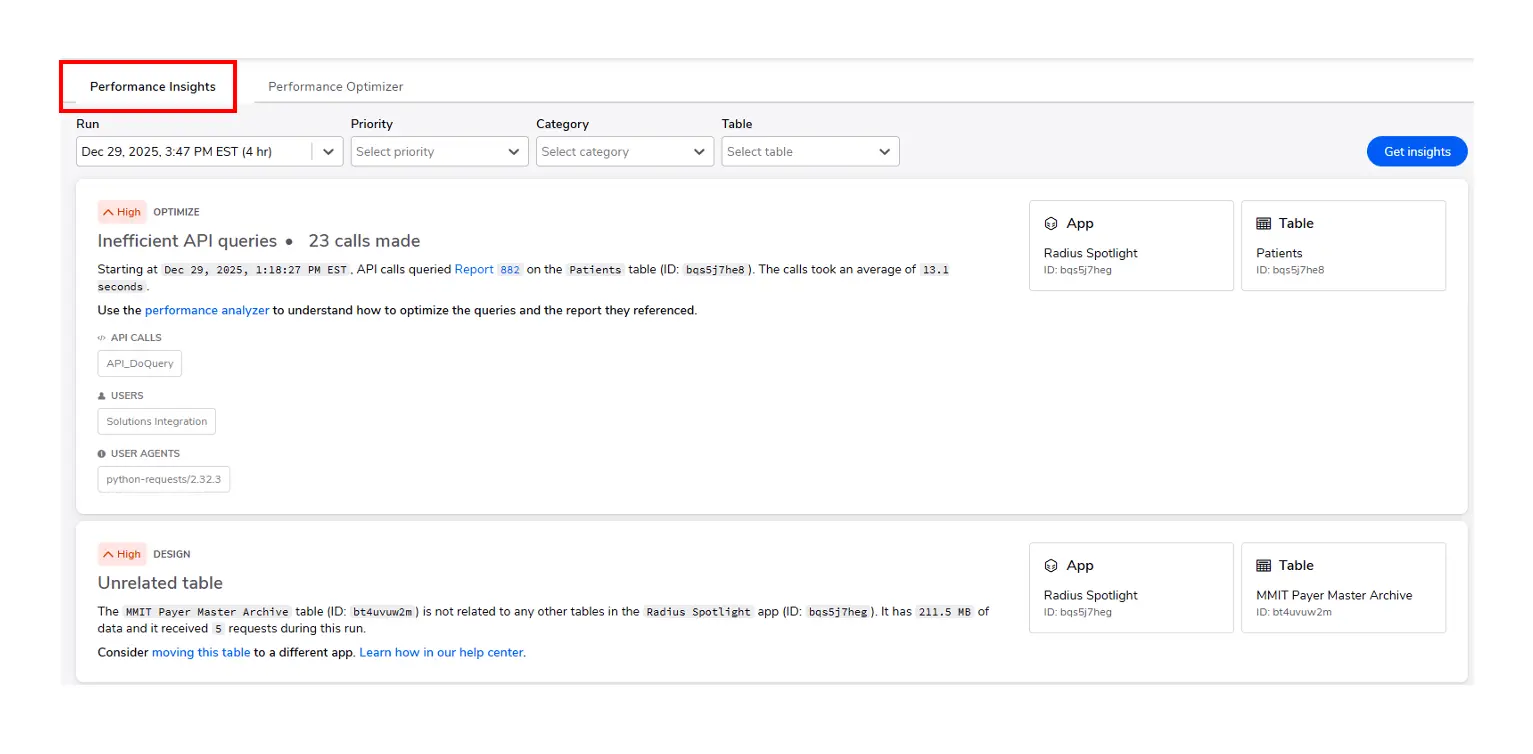
- Run a Scan: Navigate to the Performance Insights tab in your Quickbase App Settings.
- Select a Duration: Choose a window (e.g., 'within the last 1 hour', etc.) to analyze all user traffic.
- Review Recommendations: Quickbase will group issues into High, Medium, and Low priority. It might suggest, 'Adding report caching', or 'Refactoring an API call', that is hitting the server too frequently.
Quickbase Performance Insights
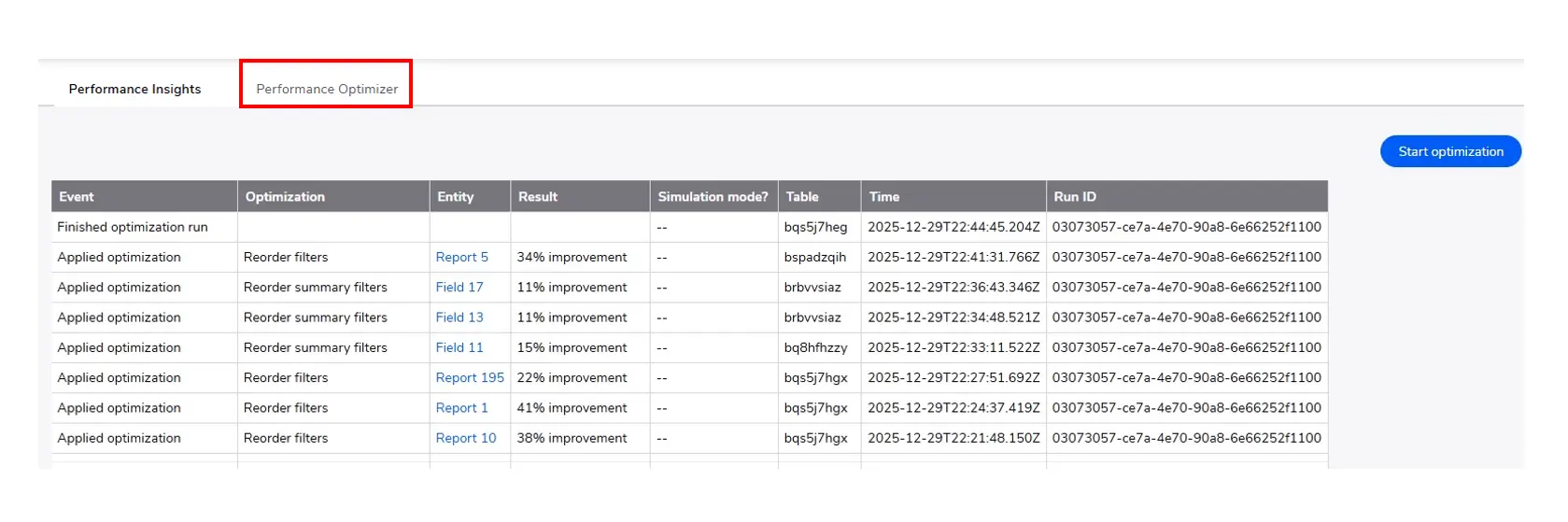
Quickbase Performance Optimizer
The Quickbase Performance Optimizer performs a scan of the application, allowing the user to optimize in Sandbox Mode or allow the Quickbase Performance Optimizer to improve the efficiencies it outlines as suggests.
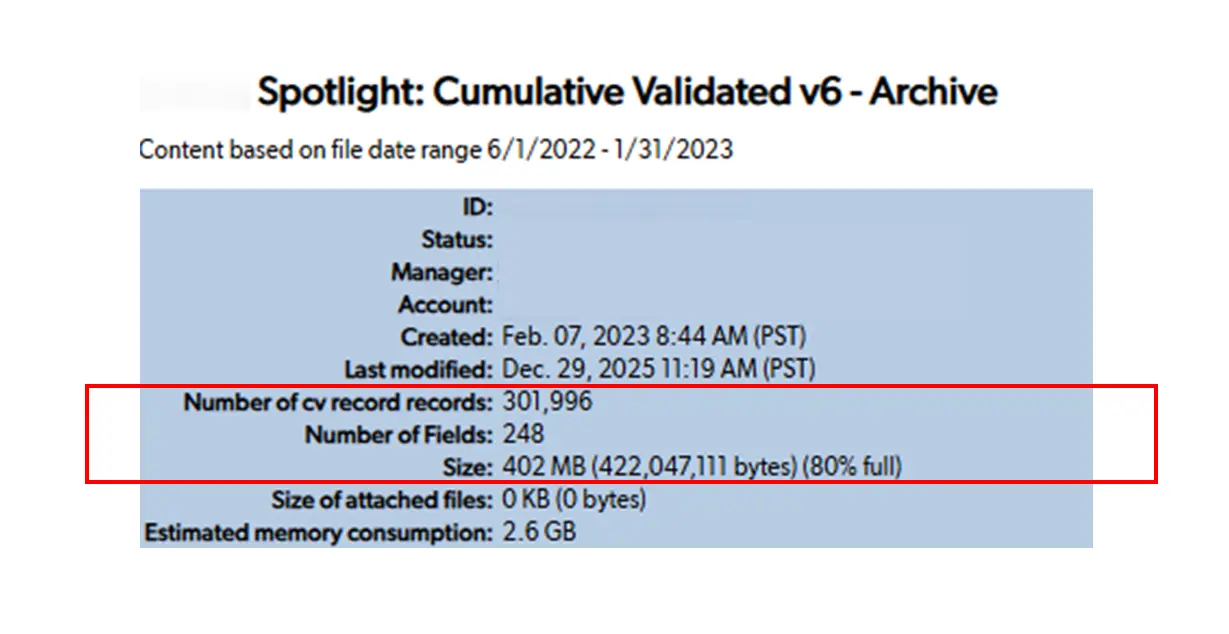
Evaluating the memory of tables and app size limits provides insights to allow for proactive approaches in archiving data into historical apps or historical tables to provide better efficiencies in Quickbase.
- This can be found in the App Management > Show App Statistics.
Typical table size limits are 500 MB and once filled up the table will no longer store data, which then requires the app to be refactored.
Quickbase's Application Checklist
Check the "Evaluate only when data has changed" box, in the settings of your most complex formula fields.
- Limit Sorting: Make sure to not sort or group reports by complex formula fields or formula-URL fields.
- Optimize Filters: Ensure your most restrictive filters (e.g., "Status is Open") are at the top of the report filter list.
- Archive Old Data: If a table has over 500,000 records, consider archiving old data to a separate "History" app for record keeping.
- By: Logan Lott
- Title: Solution Consultant | Quickbase
- Email: llott@quandarycg.com
- Date: April 15, 2026
Top FAQs about Optimizing Quickbase Performance
1. Why is my Quickbase application running slowly?
Several factors can affect Quickbase performance, including large tables, excessive file attachments, complex formulas, inefficient reports, nested relationships, and poorly optimized automations.
As applications grow, performance naturally declines if data is not actively managed. Regular maintenance—including archiving historical records, optimizing formulas, simplifying reports, and reviewing Pipelines—helps keep Quickbase fast and responsive. Organizations should also periodically evaluate their application architecture to ensure it scales with business growth.
2. How can I make Quickbase reports load faster?
Improving report performance begins with reducing the amount of data each report must process.
Use report filters to limit results, archive inactive records, remove unnecessary columns, and avoid overly complex formulas or summary calculations whenever possible. Reports that retrieve only relevant records typically load much faster and provide a better user experience.
3. Does archiving data improve Quickbase performance?
Yes. Archiving historical or inactive records is one of the most effective ways to improve Quickbase performance. Smaller production tables require fewer resources to process searches, reports, dashboards, and automations.
Organizations can retain access to archived data while keeping active applications streamlined, responsive, and easier to maintain.
4. How many records can Quickbase handle before performance is affected?
Quickbase is designed to manage large datasets, but performance depends on more than record count alone. Factors such as the number of relationships, formulas, reports, file attachments, Pipelines, integrations, and user activity all influence application speed.
Rather than focusing solely on record limits, organizations should implement sound data lifecycle management and scalable application design to maintain consistent performance as data volumes grow.
5. Do large file attachments slow down Quickbase?
Large file attachments can increase storage consumption and contribute to longer backup times, higher storage costs, and more complex application management.
While attachments do not always directly slow record retrieval, organizations managing large volumes of documents, images, videos, or engineering files often benefit from storing those files in external platforms such as Amazon S3, Microsoft SharePoint, Azure Blob Storage, or Box while maintaining secure links within Quickbase.
6. What are the best practices for optimizing Quickbase formulas?
Complex formulas can significantly impact application performance, especially when calculated across large datasets. Best practices include simplifying formula logic, minimizing nested IF statements, reducing repeated calculations, eliminating unnecessary formula fields, and using summary fields or lookup fields when appropriate. Periodic formula reviews help ensure applications remain efficient as business requirements evolve.
7. Can Quickbase Pipelines affect application performance?
Yes. Poorly designed Pipelines can create unnecessary processing, duplicate updates, or excessive API calls that impact overall system performance. Organizations should optimize Pipeline triggers, reduce unnecessary workflow executions, batch updates whenever possible, and monitor Pipeline execution history for recurring errors or bottlenecks. Efficient automation improves both reliability and scalability.
8. How can I optimize Quickbase integrations with other systems?
Efficient integrations rely on transferring only the data that is needed rather than synchronizing entire datasets. Organizations should minimize API calls, use incremental updates instead of full synchronizations, implement appropriate error handling, monitor integration performance, and archive outdated records that no longer require synchronization. Integration platforms such as Quickbase Pipelines and Workato can help streamline data movement while improving reliability.
9. What role does data governance play in Quickbase performance?
Strong data governance directly contributes to better application performance. Establishing clear standards for data quality, ownership, retention, security, and lifecycle management prevents unnecessary data growth and reduces application complexity. Regular governance reviews also help eliminate duplicate records, outdated information, and inefficient workflows before they affect system performance.
10. What is the best long-term strategy for maintaining Quickbase performance?
The most successful organizations treat Quickbase optimization as an ongoing process rather than a one-time project. A comprehensive performance strategy should include regular data archiving, application health assessments, formula optimization, report reviews, Pipeline monitoring, storage management, security audits, and governance updates. By proactively maintaining their Quickbase environment, organizations can support continued growth while delivering fast, reliable, and scalable business applications.
11. Should I hire a Quickbase consulting partner to optimize performance?
For organizations with complex applications, multiple integrations, or rapidly growing datasets, partnering with an experienced Quickbase consulting firm can significantly improve performance and reduce long-term administrative costs.
A certified Quickbase Elite Partner, such as Quandary Consulting Group, can perform application health assessments, optimize data architecture, streamline workflows, improve automation, and develop scalable governance strategies that maximize the value of your Quickbase investment while preparing your environment for future growth.


Industries
Resources



© 2026 Quandary Consulting Group. All Rights Reserved.
Privacy Policy