Quickbase
Intelligent Operations: What Business Leaders Need to Know About Quickbase's AI Evolution


The release of the Quickbase Intelligence Pack in April 2026 signals a new chapter for operational excellence.
Organizations have long relied on Quickbase to centralize data and automate workflows. Now, with AI-powered capabilities built directly into the platform, businesses can move beyond process management and begin leveraging predictive insights, intelligent recommendations, and automated decision support. Together with innovations like Quickbase Pave, which is redefining how organizations build and govern AI-powered applications, Quickbase is accelerating the shift from workflow automation to intelligent operations.
This evolution creates tremendous potential—but it also raises important questions. Which AI capabilities deliver the greatest value? How should they be governed? And how can organizations ensure they're driving measurable business outcomes rather than simply adopting technology for technology's sake?
For leaders focused on operational efficiency and growth, developing a thoughtful AI strategy is quickly becoming as important as the technology itself. At Quandary Consulting Group, we've seen that the most successful technology initiatives are built on structure, governance, and intentional change management—and AI is no different. As organizations embrace intelligent operations, success will depend not only on the capabilities they deploy, but also on the frameworks they establish to manage, scale, and sustain them.
What is Quickbase's Intelligence Pack?
The Quickbase Intelligence Pack is Quickbase's enterprise AI offering that brings six integrated artificial intelligence capabilities directly into the Quickbase platform. Introduced in 2026, the package is designed to help organizations automate workflows, analyze data, improve productivity, and make better operational decisions without requiring separate AI tools.
Rather than functioning as a standalone AI product, Quickbase Intelligence is embedded within the applications, workflows, and data that organizations already use to run their operations.
1. Quickbase AI Agent
What It Does
Quickbase AI Agent is a conversational assistant that allows users to interact with Quickbase using natural language. Instead of navigating reports, tables, forms, and dashboards manually, users can simply ask questions or request actions in plain English. The AI Agent can analyze data, create reports, update records, summarize information, and perform actions across multiple applications while respecting user permissions
Think of it as a business-specific ChatGPT that understands your Quickbase environment.
Examples of What Users Can Ask
- "Show me all overdue projects."
- "Summarize current work orders."
- "Create a report of open safety incidents."
- "Update all projects in Region A to high priority."
- "Which customers generated the most revenue this quarter?"
Key Benefits
- Faster Access to Information: Users no longer need deep Quickbase expertise to find answers.
- Greater Adoption by Non-Technical Teams: Business users can perform tasks that previously required administrators or builders.
- Improved Productivity: Routine reporting, analysis, and updates happen much faster.
- Cross-Application Visibility: The AI Agent can work across multiple Quickbase applications to provide a broader operational view.
Real-World Use Case Example | Construction Project Management
A project executive oversees 50 active projects across multiple regions. Instead of opening multiple dashboards, they ask: "Which projects are behind schedule and at risk of missing their completion dates?"
The AI Agent analyzes project data, identifies risk factors, summarizes findings, and provides recommendations in seconds.
2. Quickbase AI Actions
What It Does
Quickbase AI Actions embeds large language models directly into Quickbase workflows and pipelines. It can extract information from documents, summarize content, process emails, categorize records, and trigger downstream automations.
Rather than requiring users to manually review and enter information, AI Actions automates these repetitive tasks.
Key Benefits
- Eliminates Manual Data Entry: Reduces time spent entering information from documents and emails.
- Accelerates Workflow Execution: Moves information into operational systems faster.
- Improves Process Scalability: Teams can handle larger volumes of work without increasing headcount.
- Unlocks Unstructured Data: Allows organizations to operationalize information trapped in PDFs, contracts, emails, images, and forms.
Real-World Use Case Accounts | Payable Automation
A company receives hundreds of invoices each week. AI Actions:
- Reads incoming invoices
- Extracts vendor information
- Identifies invoice amounts
- Creates records in Quickbase
- Routes approvals automatically
What previously required hours of manual entry now happens in minutes.
3. Quickbase AI App Intelligence
What It Does
Quickbase AI App Intelligence automatically analyzes Quickbase applications and generates summaries explaining:
- What an app does
- How it's structured
- Key tables and relationships
- Important business processes
- Application architecture
Essentially, it creates documentation automatically.
Key Benefits
- Faster Onboarding: New administrators and developers can understand applications much faster.
- Reduced Dependency on Tribal Knowledge: Organizations become less reliant on a few power users who understand the system.
- Improved Documentation: Complex applications become easier to maintain and improve.
- Easier Audits and Reviews: Stakeholders can quickly understand how applications function
Real-World Use Case | Manufacturing Operations
A manufacturing company has built dozens of Quickbase applications over several years.
A new operations manager inherits the environment but has little understanding of how the applications connect.
Quickbase AI App Intelligence generates summaries explaining:
- Production tracking workflows
- Quality management systems
- Inventory processes
- Supplier management applications
Instead of spending weeks interviewing staff, the manager gains visibility in hours.
4. Quickbase AI Control Center
What It Does
Quickbase AI Control Center provides governance and administrative oversight for all AI functionality within Quickbase.
Administrators can determine:
- Which AI features are enabled
- Which users can access them
- Which applications can use AI
- How AI activity is monitored
- Audit and compliance visibility
It serves as the governance layer for enterprise AI adoption
Key Benefits
- Centralized Governance: Control AI from a single location.
- Security and Compliance: Ensure AI usage aligns with organizational policies.
- Controlled Rollout: Enable capabilities gradually across departments.
- Visibility and Auditability: Monitor AI activity throughout the organization.
Real-World Use Case | Healthcare Organization
A healthcare provider wants to leverage AI but must maintain HIPAA compliance.
Using Quickbase's AI Control Center, administrators:
- Restrict AI access to approved users
- Limit AI usage to non-sensitive applications
- Track AI interactions through audit logs
- Control expansion of AI capabilities over time
This allows innovation without sacrificing compliance.
5. Quickbase Data Analyzer
What It Does
Quickbase Data Analyzer enables organizations to build predictive models using operational data without requiring data science expertise. The tool analyzes historical data to identify trends, patterns, and predictors of future outcomes.
Instead of only reporting what happened, Data Analyzer helps predict what is likely to happen next.
Key Benefits
- Predictive Decision-Making: Identify issues before they become problems.
- Better Resource Planning: Forecast labor, inventory, and project needs.
- Improved Operational Efficiency: Focus efforts where risk is highest.
- Accessible Advanced Analytics: Provides predictive capabilities without requiring a dedicated data science team.
Real-World Use Case | Field Service Operations
A service company tracks:
- Technician workloads
- Response times
- Customer satisfaction
- Service completion rates
Quickbase's Data Analyzer identifies factors most likely to cause service delays. Managers can then proactively allocate resources before problems occur.
6. Quickbase Knowledge Layer
What It Does
Quickbase Knowledge Layer customizes Quickbase AI using organization-specific knowledge.
Organizations can upload:
- SOPs
- Policies
- Training materials
- Safety procedures
- Compliance documentation
- Internal terminology
The AI then uses this information to provide answers that reflect how the business actually operates. Without Knowledge Layer, AI understands general business concepts. With Knowledge Layer, AI understands your business.
Key Benefits
- Business-Specific AI: Responses align with your processes and terminology.
- Faster Employee Onboarding: New employees can receive contextual guidance based on internal documentation.
- Consistent Decision-Making: Everyone works from the same source of truth.
- Explainable AI Responses: Users can see where information originated.
Real-World Use Case | Safety & Compliance Management
A construction company uploads:
- Safety manuals
- OSHA procedures
- Incident response plans
- Equipment inspection standards
A field supervisor asks:
- "What is our procedure for a confined space entry inspection?"
Instead of searching multiple documents, the AI delivers a response based directly on the company's approved documentation.
Which Quickbase AI Capability Delivers Value First?
For most organizations, the typical maturity path looks like:
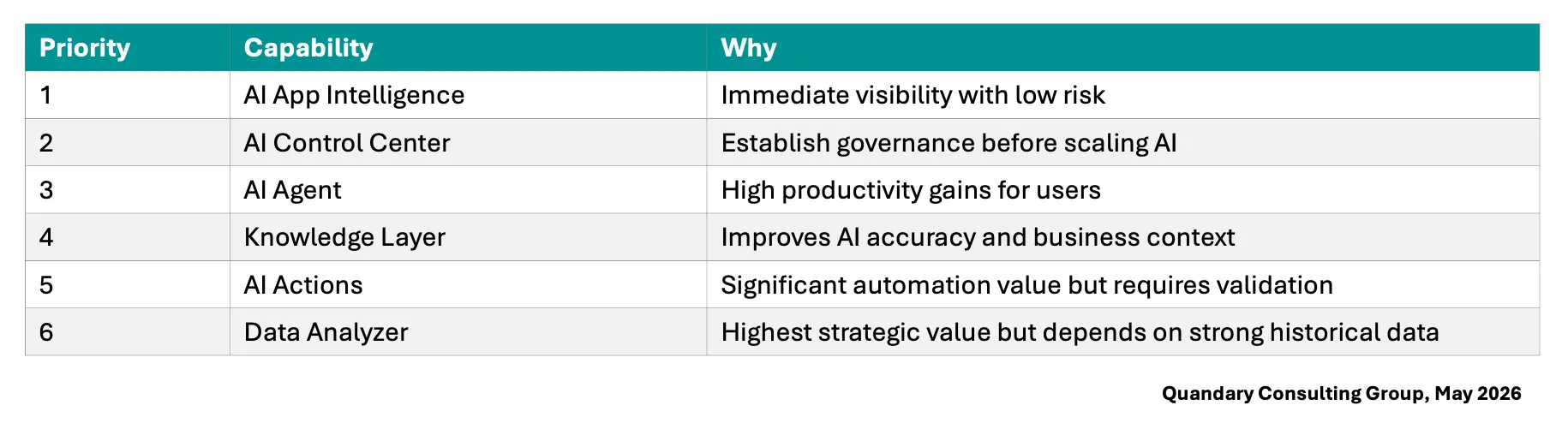
The biggest thing to remember is that these tools are most effective when implemented as part of a structured adoption strategy rather than enabling all six simultaneously. Organizations that establish governance, data quality standards, and user training first will typically realize far greater value from the Intelligence Package over time.
Build the Foundation Before AI Implementation
The Quickbase's Intelligence Pack is not simply another software enhancement. It's a collection of technologies that can fundamentally change how users interact with data, workflows, and business processes.
The organizations that will realize the greatest long-term value won't necessarily be the fastest adopters. They'll be the ones that establish:
- Clear governance models
- Defined ownership and accountability
- User training and adoption plans
- Testing and validation procedures
- Risk management frameworks
Before enabling advanced automation and AI-driven decision support, organizations should understand where AI can provide the greatest benefit and where additional controls may be required.
How Quandary Helps Organizations Adopt Quickbase Intelligence
Quandary Consulting Group helps organizations implement new technology capabilities in a way that balances innovation with operational stability.
Our approach focuses on aligning AI adoption with business objectives while reducing implementation risk.
Foundation Assessments
Before deployment, we evaluate:
- Current 'foundation; (aka architecture)- including, Quickbase
- Data quality and governance maturity
- Security and compliance requirements
- Existing workflows and operational dependencies
- Organizational readiness for AI-enabled processes
This creates a clear picture of which capabilities are appropriate to adopt first and where additional preparation may be needed.
Governance Architecture Design
Successful AI adoption requires more than technical implementation. Quandary works with organizations to establish:
- Implementation of core Center of Excellence
- Access and permission models
- Workflows and hierarchy approvals
- Change management procedures
- Audit and monitoring processes
- AI usage policies and standards
- MCP and/or LLM design, implementation and maintenance
Strong governance provides the flexibility to expand AI capabilities confidently over time.
Controlled Rolling Implementation
Rather than deploying AI capabilities across the organization immediately, we recommend controlled pilots that allow teams to:
- Validate business outcomes
- Measure accuracy and effectiveness
- Identify process improvements
- Refine governance controls
- Build internal confidence
These pilots create a foundation for broader adoption while reducing operational risk.
Training and Organizational Adoption
Technology alone does not drive success. We help organizations prepare users to:
- Understand AI capabilities and limitations
- Validate AI-generated outputs
- Follow governance standards
- Incorporate AI into existing workflows responsibly
The goal is sustainable adoption, not just feature activation.
The Future of Operations is not Automation—It's Intelligence.
The Quickbase Intelligence Pack represents a significant step forward in how organizations manage work, transforming operational data into actionable insights and enabling teams to make faster, more informed decisions. But technology alone is not what drives business value.
As AI becomes increasingly embedded in operational platforms, organizations must balance innovation with governance, scalability, and user adoption. The companies that see the greatest return on their AI investments will be those that approach intelligent operations with a clear strategy, measurable objectives, and a framework for sustainable growth.
For business leaders, the question is no longer whether AI belongs in operations. The question is how to implement it in a way that delivers meaningful outcomes while supporting long-term organizational goals.
At Quandary Consulting Group, we help organizations bridge the gap between technology and business value—ensuring that platforms like Quickbase are not only implemented successfully, but leveraged strategically to drive operational excellence, innovation, and growth.
Schedule a Discovery call with us today to learn more about how we can help your organization with your Quickbase goals.
Additional Resources:
- Quickbase Intelligence Pack One-Pager | Learn more about the package and individual features
- Quandary's Quickbase Knowledge Base | Learn how to develop on Quickbase with our easy to comprehend How-To Guides
- Pave and the Future of Enterprise AI Development | Why Governance-First “Vibe Coding” Is the Next Big Shift | Quandary Consulting Group's take on PAVE, the new vibe coding from Quickbase
- PAVE, by Quickbase
Top FAQs About Quickbase Intelligence Pack
1. What is the Quickbase Intelligence Pack?
The Quickbase Intelligence Pack is a bundled suite of six AI-powered capabilities designed to enhance productivity, automation, analytics, and decision-making within the Quickbase platform. The pack includes AI Agent, AI Actions, AI App Intelligence, AI Control Center, Data Analyzer, and Knowledge Layer.
Together, these tools help organizations automate repetitive work, interact with applications using natural language, improve governance, generate predictive insights, and create AI experiences tailored to their unique business processes.
2. What are the six Quickbase Intelligence capabilities?
The Quickbase Intelligence Pack includes:
- AI Agent – A conversational assistant that allows users to interact with Quickbase using natural language.
- AI Actions – AI-powered workflow automation and document processing.
- AI App Intelligence – Automatically generates application documentation and insights.
- AI Control Center – Centralized governance and administration for AI capabilities.
- Data Analyzer – Predictive analytics and forecasting tools.
- Knowledge Layer – Customizes AI responses using organization-specific information and documentation.
Each capability addresses a different aspect of operational efficiency, automation, and business intelligence.
3. How does Quickbase AI Agent work?
Quickbase AI Agent allows users to ask questions and perform actions in Quickbase using natural language instead of navigating applications manually. Users can generate reports, update records, analyze operational data, summarize information, and retrieve insights by simply typing requests such as:
- "Show me all overdue projects."
- "Which customers generated the most revenue this quarter?"
The AI Agent helps reduce the learning curve for non-technical users while improving access to business data.
4. What is the difference between AI Agent and AI Actions?
AI Agent focuses on user interaction and analysis. It allows people to ask questions, retrieve information, and perform tasks through conversation. AI Actions focuses on workflow automation. It uses AI to process documents, extract data, summarize content, categorize information, and automate repetitive business processes.
In simple terms:
- AI Agent helps people work with data.
- AI Actions helps automate work involving data.
5. What is the Knowledge Layer in Quickbase?
The Knowledge Layer allows organizations to teach Quickbase AI about their unique business processes, terminology, policies, and documentation. Organizations can upload materials such as:
- Standard operating procedures
- Employee handbooks
- Compliance documentation
- Safety manuals
- Internal workflows
This helps AI generate responses that reflect the organization's actual business practices rather than relying solely on generic information.
6. Is Quickbase Intelligence secure?
Quickbase states that customer data remains private and is not used to train public AI models. Organizations can further manage security through AI Control Center, which allows administrators to control access permissions, monitor AI activity, and establish governance policies for AI usage.
As with any enterprise AI implementation, organizations should evaluate security, compliance, auditability, and data governance requirements before deployment.
7. What is AI Control Center in Quickbase?
AI Control Center is the governance layer for Quickbase Intelligence. It allows administrators to:
- Enable or disable AI features
- Control user access
- Monitor AI usage
- Maintain compliance requirements
- Manage deployment across departments
The tool helps organizations adopt AI responsibly while maintaining oversight and control.
8. Can Quickbase AI automate document processing?
Yes, AI Actions can automatically process documents, emails, forms, invoices, contracts, and other unstructured content. The system can extract relevant information, create records, update workflows, and trigger automations based on the data it identifies. Many organizations use AI Actions to reduce manual data entry and accelerate operational processes.
9. What is Data Analyzer in Quickbase?
Data Analyzer is Quickbase's predictive analytics capability. It uses historical operational data to identify patterns and forecast future outcomes. Organizations can use Data Analyzer to:
- Predict project delays
- Forecast resource requirements
- Identify operational risks
- Improve planning and decision-making
- Anticipate future performance trends
The goal is to move beyond reporting what happened and begin predicting what is likely to happen next.
10. Does Quickbase Intelligence require data science expertise?
No., One of the primary goals of Quickbase Intelligence is to make advanced AI and analytics accessible to business users.
While organizations still benefit from governance, training, and validation processes, many capabilities are designed for users without specialized AI or data science backgrounds.
11. What industries benefit most from Quickbase Intelligence?
Quickbase Intelligence can support organizations across many industries, including:
- Construction
- Manufacturing
- Field Services
- Healthcare
- Energy and Utilities
- Government
- Professional Services
- Facilities Management
Organizations that rely on operational workflows, project management, compliance processes, and large volumes of business data often see the greatest value.
12. What are the biggest risks of implementing Quickbase Intelligence?
The most common risks include:
- Poor governance and access controls
- AI-generated inaccuracies or hallucinations
- Overreliance on automation without validation
- Data quality issues affecting predictions
- User adoption challenges
- Lack of implementation planning
Organizations typically reduce these risks by establishing governance frameworks, testing environments, review processes, and phased deployment plans.
14. Should organizations deploy all Quickbase Intelligence features at once?
Most organizations will benefit from a phased implementation approach (we cannot stress this enough). A common adoption sequence is:
- AI App Intelligence
- AI Control Center
- AI Agent
- Knowledge Layer
- AI Actions
- Data Analyzer
This approach allows organizations to build governance and user confidence before introducing more advanced automation and predictive capabilities.
15. How can organizations prepare for Quickbase Intelligence adoption?
Successful adoption typically starts with:
- Evaluating AI readiness
- Assessing data quality
- Establishing governance policies
- Defining business objectives
- Identifying high-value use cases
- Training users
- Creating testing and validation processes
Organizations that focus on preparation before deployment are more likely to achieve long-term success with AI initiatives.
16. Is the Quickbase's Intelligence Pack worth it?
For organizations that rely heavily on Quickbase to manage operations, projects, workflows, and business processes, the Intelligence Pack can provide significant value through automation, productivity improvements, better decision-making, and increased operational visibility.
The return on investment is typically highest when organizations align adoption with clear business goals and implement the capabilities through a structured rollout strategy rather than enabling everything simultaneously.