Artificial Intelligence (AI)
How Quandary Is Helping Healthcare Organizations Transform Revenue Cycle Management with Workato Otto

For years, healthcare organizations have attempted to solve challenges through traditional automation technologies like robotic process automation (RPA). While RPA successfully automated repetitive, rule-based tasks, it was never designed to understand context, reason through exceptions, or adapt to rapidly changing healthcare workflows.
Today, healthcare leaders require something fundamentally different and we believe the future of healthcare automation belongs to Agentic AI—intelligent software agents capable of understanding objectives, making informed decisions, collaborating across systems, and continuously improving business processes.
Powered by Workato Otto, these AI agents move beyond simple automation to orchestrate entire revenue cycle workflows across electronic health records, payer systems, CRM platforms, contact centers, financial applications, and enterprise data platforms.
Rather than replacing healthcare professionals, Agentic AI augments them—eliminating administrative friction while enabling staff to focus on higher-value patient interactions.
First, what is Workato Otto?
Workato Otto is an enterprise AI teammate that can complete work across a company’s applications, data, and workflows. Instead of only answering questions like a traditional chatbot, Otto can take a business goal, determine the required steps, coordinate tasks across connected systems, request human approval when necessary, and complete the work.
For example, a user could ask Otto to:
- Investigate a delayed customer order
- Update information across Salesforce, NetSuite, and ServiceNow
- Prepare an account summary for a sales representative
- Route a healthcare authorization request for review
- Coordinate employee onboarding across Workday, Okta, and Microsoft 365
- Generate a report using information from several business systems
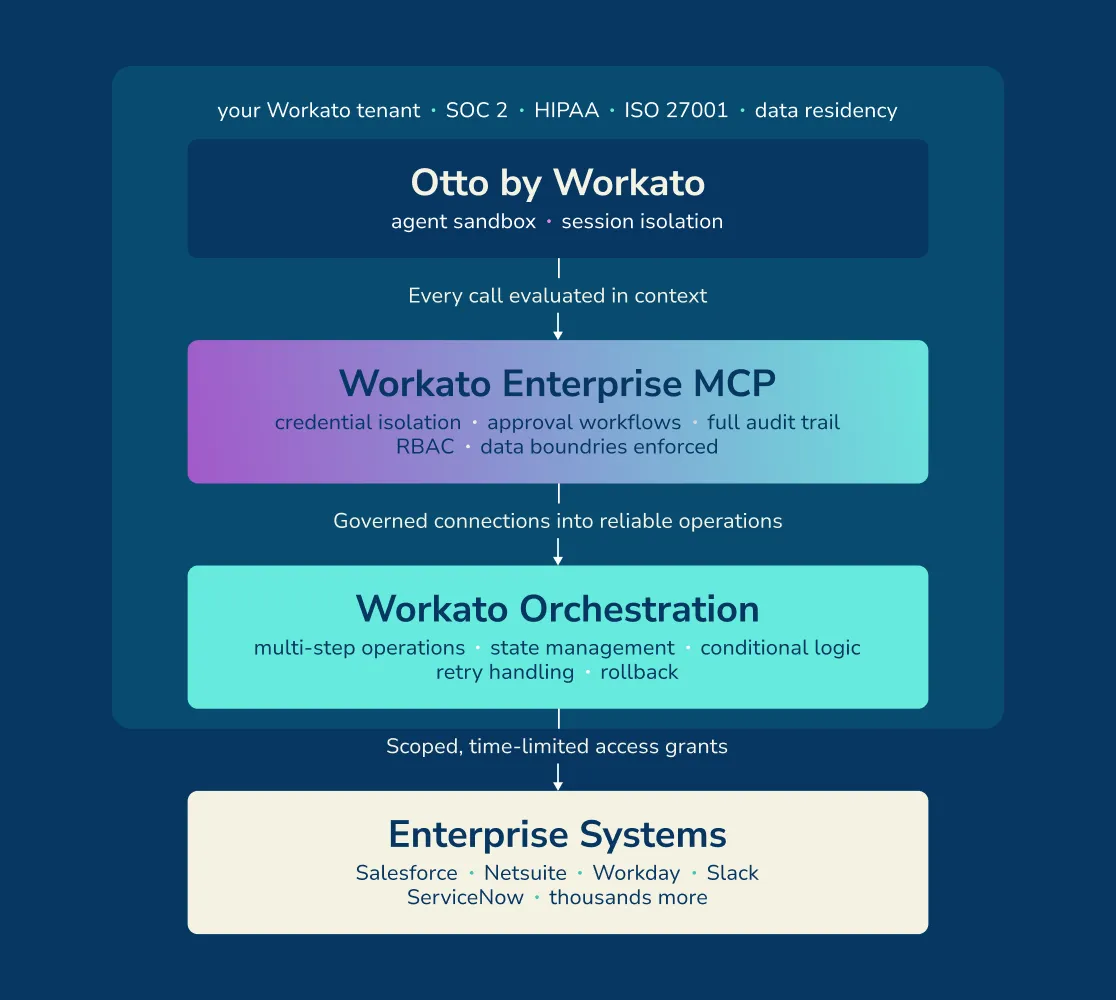
What makes Otto different is that it operates on Workato’s integration and automation platform. That gives it controlled access to enterprise systems and allows it to execute established Workato workflows instead of simply suggesting what a person should do.
Key capabilities
- Goal-based execution: A user describes the desired outcome, and Otto coordinates the work required to achieve it.
- Cross-system action: It can securely retrieve and update information across connected applications, APIs, databases, and workflows.
- Human approvals: Otto can pause before sensitive actions and request authorization from the appropriate person.
- Enterprise governance: Permissions, policies, activity logs, and audit trails help organizations control what Otto can access and do.
- Team coordination: It can assign tasks to people or other AI agents and track the work through completion.
- Contextual intelligence: Otto can use company knowledge, operational data, and real-time information to make more informed decision
Why Traditional Revenue Cycle Automation Has Reached Its Limits
Healthcare organizations have invested millions in workflow automation over the past decade. Yet many revenue cycle teams still struggle with:
- Manual eligibility verification
- Prior authorization delays
- Complex payer rules
- Claim denials
- Payment reconciliation
- Staff shortages
- Administrative burnout
- Fragmented technology ecosystems
The is most automation solutions only execute predefined instructions. Unfortunately, the healthcare industry rarely follows predefined instructions: Every payer has different requirements, every patient presents unique circumstances, documentation changes, forms change policies evolve, exceptions become the norm—not the exception this is precisely where Agentic AI changes the equation.
What Makes Workato Otto Different?
Workato Otto represents the next evolution of enterprise automation. Instead of simply executing workflows, Otto combines AI reasoning, enterprise integrations, large language models, APIs, workflow orchestration, and governance into intelligent digital workers capable of completing complex business processes with minimal human intervention.
When deployed by Quandary, Otto becomes an intelligent orchestration layer across your healthcare technology ecosystem—not another disconnected AI tool. Rather than forcing organizations to replace existing investments, Otto connects systems including:
- Epic
- Oracle Health
- MEDITECH
- Salesforce Health Cloud
- Microsoft Dynamics
- Workday
- SAP
- ServiceNow
- Contact Center platforms (like dialpad or broadvoice)
- Clearinghouses
- Hundreds of additional enterprise applications
This allows healthcare organizations to modernize operations without expensive rip-and-replace initiatives.
How Workato Otto Transforms Revenue Cycle Management
1. Intelligent Claims Orchestration
Claims processing is no longer simply a matter of submitting information to a payer. Modern claims require validation across numerous systems before submission.
With Workato Otto, AI agents can:
- Validate patient demographics
- Review clinical documentation
- Confirm coding completeness
- Verify payer-specific submission requirements
- Detect missing documentation
- Identify claim anomalies before submission
- Automatically initiate correction workflows
- Escalate only complex exceptions to revenue cycle staff
Rather than reacting to denied claims, organizations begin preventing them altogether.
2. Autonomous Prior Authorization Management
Prior authorization remains one of healthcare's largest administrative burdens.
Otto can intelligently coordinate the entire authorization lifecycle by:
- Reviewing payer requirements
- Determining required documentation
- Gathering supporting clinical records
- Monitoring authorization status
- Following up automatically with payers
- Notifying providers when additional documentation is required
- Escalating urgent cases based on clinical priority
This dramatically reduces delays while improving both provider and patient experiences.
3. Continuous Eligibility Verification
Insurance eligibility changes frequently. Traditional verification often occurs only once—creating downstream billing issues.
Workato Otto continuously monitors patient eligibility by:
- Checking payer systems automatically
- Identifying coverage changes
- Detecting coordination of benefits issues
- Alerting registration staff
- Updating downstream systems
- Triggering patient financial communications when necessary
The result is cleaner claims and fewer unexpected billing surprises.
4. Intelligent Denial Prevention and Recovery
Instead of simply reporting denied claims, Otto actively works to prevent them. AI agents can:
- Analyze historical denial patterns
- Identify root causes
- Predict likely denials before submission
- Recommend coding improvements
- Launch automated appeal workflows
- Generate supporting documentation
- Route cases to the appropriate revenue cycle specialists
Healthcare organizations spend less time correcting preventable errors and more time accelerating reimbursement.
5. Automated Payment Reconciliation
Payment posting remains one of the most labor-intensive RCM activities.
Workato Otto can:
- Match payments across multiple systems
- Compare payer remittance files
- Identify underpayments
- Detect duplicate payments
- Flag contractual discrepancies
- Initiate reconciliation workflows
- Generate financial exception reports automatically
Finance teams gain greater visibility while reducing manual effort.
6. Intelligent EHR Workflow Automation
Healthcare organizations frequently struggle with fragmented patient information across multiple systems.
Otto helps unify clinical and financial workflows by:
- Synchronizing patient records
- Updating charts automatically
- Coordinating referrals
- Routing documentation
- Triggering follow-up activities
- Monitoring care transitions
- Maintaining consistent patient information across enterprise applications
Clinicians spend less time navigating systems and more time caring for patients.
7. AI-Powered Patient Financial Engagement
Today's patients expect transparency throughout their financial journey. Workato Otto can coordinate personalized financial communications by:
- Explaining benefits
- Estimating out-of-pocket costs
- Sending payment reminders
- Offering payment plan options
- Answering billing questions through AI assistants
- Escalating complex cases to financial counselors
The result is improved patient satisfaction alongside stronger collections performance.
8. Clinical Decision Support Through Connected Intelligence
Because Otto integrates information from multiple enterprise systems, it can assist providers with contextual recommendations by analyzing:
- Historical patient data
- Clinical documentation
- Care pathways
- Scheduling constraints
- Population health trends
- Operational capacity
Rather than replacing clinicians, Otto provides actionable insights that support faster, more informed decisions.
Why Quandary's Approach Is Different
Technology alone does not transform healthcare. Successful AI adoption requires governance, integration, security, change management, and operational redesign.
That's where Quandary delivers value. Our consultants help healthcare organizations design and implement AI strategies that align technology investments with measurable business outcomes.
Our healthcare transformation methodology includes:
- AI readiness assessments
- Revenue cycle process redesign
- Enterprise integration architecture
- Workato Otto implementation
- Data governance
- HIPAA-compliant automation
- Human-in-the-loop approval workflows
- Change management and user adoption
- KPI development and executive reporting
- Continuous optimization
We don't simply deploy software—we help organizations reimagine how work gets done.
Key Considerations Before Implementing Agentic AI
Healthcare organizations should approach Agentic AI strategically. Several factors are essential for long-term success.
- Data Privacy and Security: AI agents must operate within HIPAA-compliant environments with role-based access controls, audit logging, encryption, and governance policies that protect patient information.
- Enterprise Integration: Agentic AI delivers the greatest value when connected across EHRs, ERP systems, payer platforms, CRM applications, contact centers, and financial systems. A phased integration strategy often provides the fastest return while minimizing operational disruption.
- Human Oversight: High-impact financial and clinical decisions should continue to include appropriate human review. Workato Otto supports configurable approval workflows that balance automation with accountability.
- Change Management: Successful adoption depends on preparing users, redesigning workflows, and building confidence in AI-assisted operations. Organizations that invest in education and governance typically realize stronger adoption and greater long-term value.
- Operational Governance: Defining clear ownership, standardized AI agent roles, performance metrics, and ongoing monitoring ensures AI operates consistently, transparently, and in alignment with organizational objectives.
The Future of Healthcare Revenue Cycle Management Is Intelligent Orchestration
The future of healthcare automation isn't about replacing people with AI. It's about empowering healthcare professionals with intelligent systems that eliminate administrative complexity, improve financial performance, and create better experiences for both patients and staff.
As Agentic AI continues to mature, healthcare organizations will increasingly rely on intelligent orchestration to manage complex workflows across clinical, financial, and operational systems.
With Workato Otto as the AI orchestration engine and Quandary Consulting Group as your strategic implementation partner, healthcare organizations can move beyond isolated automations to build an intelligent, connected revenue cycle that continuously learns, adapts, and improves.
Organizations that begin this transformation today will be better positioned to reduce costs, accelerate reimbursement, strengthen operational resilience, and deliver exceptional patient experiences in the years ahead.
Ready to explore how Agentic AI can modernize your revenue cycle?
Quandary Consulting Group helps healthcare organizations design, implement, and optimize intelligent automation strategies powered by Workato Otto.
Whether you're looking to reduce denials, improve prior authorizations, automate patient access, or orchestrate AI across your entire revenue cycle, our consultants can help you build a secure, scalable roadmap that delivers measurable results.
Contact Quandary Consulting Group to schedule an AI Readiness Assessment and discover how Agentic AI can transform your revenue cycle from reactive administration into proactive, intelligent operations.
FAQs about Workato Otto and Agentic AI in Healthcare Revenue Cycle Management
1. What is Agentic AI in healthcare revenue cycle management?
Agentic AI uses intelligent software agents to pursue defined goals, make context-aware decisions, coordinate work across systems, and escalate exceptions to human employees. In healthcare revenue cycle management, these agents can help manage eligibility verification, prior authorizations, claims processing, denial prevention, payment reconciliation, and patient financial communications.
Unlike traditional automation, Agentic AI can respond to changing information and complex payer requirements instead of relying exclusively on rigid, predefined rules.
2. What is Workato Otto?
Workato Otto is an enterprise AI teammate designed to complete work across an organization’s applications, data, and automated workflows. Users can provide Otto with a business objective, and it can determine the necessary steps, retrieve information from authorized systems, execute approved workflows, coordinate tasks, and request human approval when needed.
Because Otto operates on Workato’s integration and automation platform, it can take governed action across connected enterprise systems rather than simply generating recommendations.
3. How can Workato Otto improve healthcare revenue cycle management?
Workato Otto can improve healthcare revenue cycle management by orchestrating administrative and financial workflows across EHRs, payer platforms, clearinghouses, CRM systems, contact centers, and financial applications. Potential use cases include verifying eligibility, gathering prior authorization documentation, validating claims, identifying likely denials, reconciling payments, and communicating billing information to patients.
This connected approach can reduce manual work, accelerate reimbursement, improve data accuracy, and give revenue cycle employees more time to address high-value exceptions.
4. How is Agentic AI different from robotic process automation?
Robotic process automation, or RPA, generally follows predefined rules to complete repetitive tasks. Agentic AI can interpret context, evaluate available information, determine the next appropriate step, and adjust when conditions change.
RPA may be effective when every transaction follows the same process. Agentic AI is better suited to healthcare workflows involving payer-specific rules, incomplete documentation, changing patient circumstances, system dependencies, and frequent exceptions.
5. Can Workato Otto automate healthcare prior authorizations?
Workato Otto can help orchestrate many steps in the prior authorization process, including identifying payer requirements, collecting supporting clinical records, checking documentation completeness, monitoring authorization status, initiating follow-ups, and routing exceptions to the appropriate employee.
Healthcare organizations should maintain human review for clinical decisions, ambiguous cases, and other high-impact actions. This human-in-the-loop approach combines faster processing with appropriate oversight and accountability.
6. How can Agentic AI help prevent claim denials?
Agentic AI can help prevent claim denials by reviewing patient, clinical, coding, and payer information before a claim is submitted. AI agents can detect missing documentation, identify inconsistent data, apply payer-specific validation requirements, recognize historical denial patterns, and initiate corrective workflows.
Rather than waiting for a payer to reject a claim, healthcare organizations can identify preventable issues earlier in the revenue cycle and improve clean-claim performance.
7. Can Workato Otto improve insurance eligibility verification?
Workato Otto can coordinate continuous insurance eligibility verification instead of relying on a single check during registration. It can connect with authorized payer and healthcare systems to detect coverage changes, identify coordination-of-benefits issues, update downstream records, and alert registration or billing employees when further action is required.
More consistent eligibility verification can support cleaner claims, fewer billing surprises, and a more transparent patient financial experience.
8. How does Agentic AI support denial management and appeals?
Agentic AI can analyze denial trends, classify denials, identify likely root causes, assemble relevant supporting documentation, initiate appeal workflows, and route cases to the appropriate revenue cycle specialist. It can also track deadlines and monitor each appeal through completion.
These capabilities help healthcare organizations prioritize higher-value cases, reduce repetitive administrative work, and respond to denials more consistently.
9. Can Workato Otto integrate with existing healthcare systems?
Workato Otto can operate across applications, APIs, databases, and workflows connected through the Workato platform. Depending on the organization’s technology environment and available integrations, this may include EHR platforms, payer systems, clearinghouses, CRM applications, contact center technology, ERP systems, and financial platforms.
Quandary Consulting Group can design a phased integration strategy that connects existing technology investments without requiring an immediate replacement of every legacy system.
10. Is Workato Otto HIPAA compliant?
HIPAA compliance depends on how the technology is contracted, configured, integrated, governed, and used—not on the product name alone. A healthcare implementation should include appropriate agreements, access controls, encryption, audit logging, data-minimization policies, secure integrations, and human approval requirements.
Quandary helps healthcare organizations design HIPAA-aligned automation environments in which AI agents receive only the access and information required to perform their authorized functions.
11. Will Agentic AI replace healthcare revenue cycle employees?
Agentic AI is best used to augment healthcare employees rather than replace them. It can handle repetitive research, data validation, workflow coordination, status monitoring, and documentation tasks while employees manage exceptions, patient conversations, payer negotiations, compliance decisions, and other work requiring human judgment.
The goal is to reduce administrative burden and burnout while increasing employee capacity and improving the patient experience.
12. How can Workato Otto improve patient financial engagement?
Workato Otto can coordinate personalized patient financial communications across billing, insurance, CRM, and contact center systems. It can help explain benefits, deliver cost estimates, send payment reminders, present payment-plan options, answer common billing questions, and escalate sensitive or complicated cases to financial counselors.
Connected and timely communication can improve financial transparency, patient satisfaction, and collection performance.
13. What healthcare revenue cycle processes should organizations automate first?
Most healthcare organizations should begin with workflows that are high-volume, repetitive, measurable, and administratively burdensome. Strong starting points may include eligibility verification, prior authorization status checks, claim-documentation validation, denial classification, payment reconciliation, referral intake, and patient payment reminders.
An AI readiness assessment can identify which opportunities offer the strongest combination of financial value, operational feasibility, data availability, and manageable risk.
14. What should healthcare organizations consider before implementing Agentic AI?
Healthcare organizations should evaluate data security, HIPAA requirements, integration readiness, workflow ownership, human oversight, change management, and performance measurement before deploying Agentic AI. They should also define what each AI agent may access, which actions it may complete independently, and when it must request approval.
Starting with a governed, phased implementation allows an organization to demonstrate measurable value before expanding AI across the revenue cycle.
15. How should healthcare organizations measure the ROI of Agentic AI?
Healthcare organizations can measure Agentic AI ROI using metrics such as prior authorization turnaround time, clean-claim rate, denial rate, days in accounts receivable, cost to collect, employee hours saved, appeal recovery rate, payment-posting accuracy, exception volume, and patient satisfaction.
Organizations should establish baseline performance before implementation and continue monitoring both financial outcomes and the accuracy, security, and reliability of each AI-assisted workflow.
16. How does Quandary Consulting Group implement Workato Otto for healthcare organizations?
Quandary Consulting Group helps healthcare organizations assess AI readiness, redesign revenue cycle workflows, establish governance, connect enterprise systems, configure human approvals, and implement Workato Otto around measurable business objectives.
The engagement can include integration architecture, HIPAA-aligned automation, KPI development, change management, user adoption, and continuous optimization. This approach helps transform isolated automation projects into a secure and scalable intelligent orchestration strategy.