Artificial Intelligence (AI)
Digital Entropy in the Age of AI: Managing System Decay While Enabling Intelligent Operations


Executive Summary
Modern organizations rely on increasingly complex digital ecosystems to drive growth, enable decision-making, and support operations. These ecosystems now extend beyond traditional systems such as CRM, ERP, and marketing automation platforms to include artificial intelligence (AI), AI agents, and emerging infrastructure layers such as Model Context Protocol (MCP) servers.
While these technologies introduce powerful new capabilities, they also amplify a largely invisible but inevitable force: digital entropy.
Digital entropy refers to the progressive decline in the quality, consistency, and reliability of digital systems and data over time. As organizations adopt AI and automation at scale, unmanaged complexity can accelerate this degradation, leading to unreliable outputs, inefficient operations, and diminished return on technology investments.
This white paper explores digital entropy in the context of modern AI-enabled organizations. It examines how entropy manifests, why it poses a strategic risk, how it impacts AI and contact center performance, and how organizations can leverage structured frameworks—including MCP-enabled architectures—to mitigate and reverse it.
DIGITAL ENTROPY | From System Complexity to Intelligent Complexity
The concept of entropy originates in thermodynamics, where it describes the natural tendency of systems to move toward disorder unless energy is applied to maintain structure (Clausius, 1865). In digital environments, this principle manifests as the gradual degradation of systems over time.
Historically, digital entropy affected core business platforms and integrations. Today, however, organizations are entering a new phase of complexity driven by AI adoption.
AI introduces additional layers:
- Dynamic decision-making systems
- Context-dependent data pipelines
- Autonomous or semi-autonomous agents
- Real-time interaction systems, particularly in contact centers
At the same time, emerging standards such as Model Context Protocol (MCP) are enabling organizations to deploy pre-built servers that standardize how AI systems access data, tools, and context.
While these advancements unlock significant value, they also introduce new pathways for entropy. Poor data quality, fragmented systems, and inconsistent processes do not just create inefficiency—they directly degrade AI performance.
In this environment, digital entropy is no longer just an operational concern. It becomes a barrier to successful AI adoption.
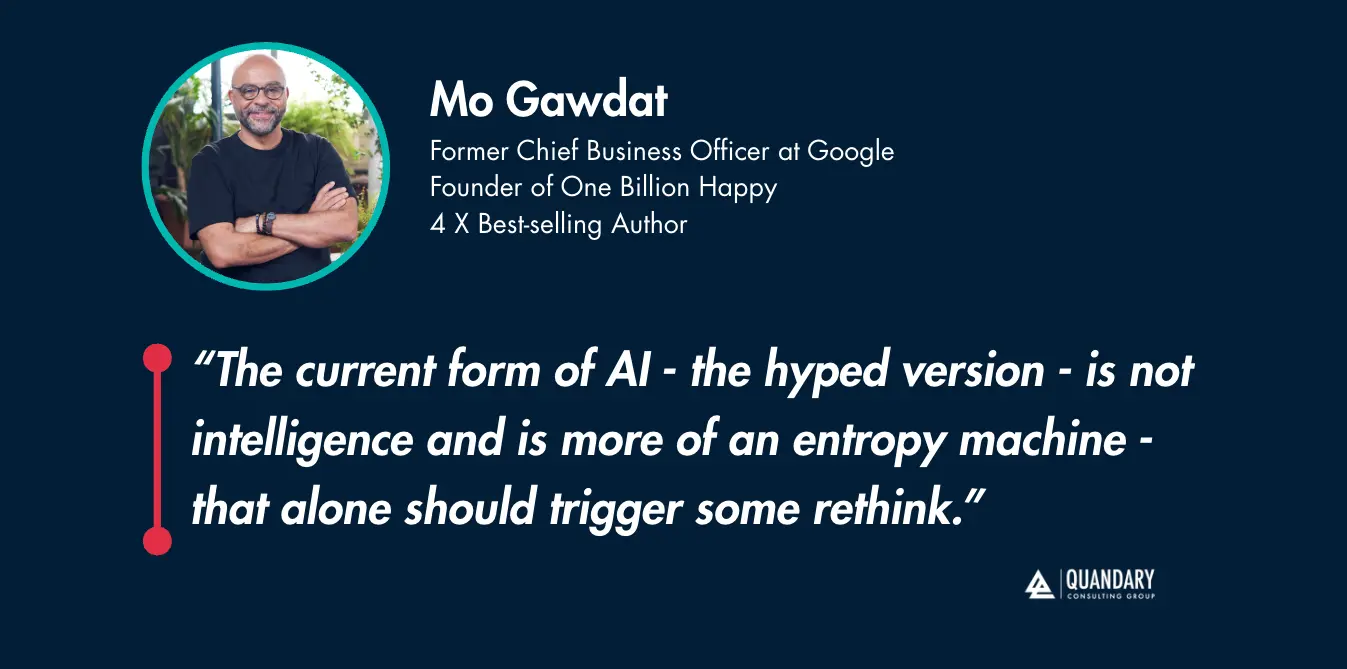
Defining Digital Entropy in an AI-Enabled Enterprise
In a modern enterprise, digital entropy can be defined as:
- The progressive decline in the integrity, consistency, and usability of systems, data, and AI-driven processes due to unmanaged complexity and change.
This definition extends beyond traditional systems to include AI models, agents, and orchestration layers.
Data Entropy and Its Impact on AI
Data entropy remains the foundation of the problem. Inconsistent, duplicate, or incomplete data leads to unreliable AI outputs. AI systems, particularly those used in customer-facing environments, are only as effective as the data they are trained on and connected to.
In a contact center context, this may result in:
- AI agents providing inconsistent answers
- Misclassification of customer intent
- Poor personalization due to fragmented customer profiles
Process Entropy in Automated and AI-Driven Workflows
As organizations automate processes and introduce AI agents, process entropy becomes more complex. Instead of simple workflow breakdowns, organizations may encounter:
- AI agents operating on outdated logic
- Inconsistent escalation paths between automated and human interactions
- Divergence between designed processes and actual system behavior
Without governance, automation can amplify inefficiencies rather than eliminate them.
System Entropy in Distributed Architectures
Modern architectures often include:
- Core business systems
- Integration layers
- AI platforms
- MCP servers that mediate context and tool access
If these components are not aligned, entropy manifests as:
- Redundant or conflicting integrations
- Inconsistent context delivery to AI systems
- Fragmented orchestration of AI agents
MCP servers are designed to reduce this complexity by standardizing how AI systems access data and tools. However, without proper implementation and governance, they can become another layer affected by entropy.
Digital Entropy plays a Huge Risk in the AI Era
Digital entropy has always been a business risk, but its impact is significantly magnified in AI-enabled environments.
AI Performance Degradation
AI systems depend on:
- Clean, structured data
- Consistent context
- Reliable system integrations
When entropy is present, AI outputs become:
- Less accurate
- Less consistent
- Less trustworthy
This undermines confidence in AI initiatives and limits adoption.
Contact Center Inefficiency
AI agents are increasingly deployed in contact centers to handle customer interactions at scale. However, digital entropy can severely impact their effectiveness.
Organizations may experience:
- Increased escalation rates to human agents
- Longer resolution times
- Inconsistent customer experiences across channels
Instead of reducing operational costs, poorly governed AI deployments can increase them.
Compounding Operational Complexity
AI introduces additional dependencies between systems. Entropy in one area propagates quickly across the ecosystem, affecting:
- Reporting accuracy
- Workflow execution
- Customer interactions
How does Digital Entropy Impact Machine Learning Models
Entropy in machine learning models refers to uncertainty—how unpredictable or “spread out” a model’s predictions are. It’s a concept borrowed from information theory, and it plays a central role in how models measure confidence, make decisions, and learn from data.
At a high level, entropy tells you how sure a model is about its prediction. When a model outputs probabilities across multiple classes, entropy quantifies how concentrated or dispersed those probabilities are. If one class has a probability close to 1 and the others are near 0, entropy is low—meaning the model is confident. If probabilities are more evenly distributed, entropy is high—meaning the model is uncertain.
Mathematically, entropy is often expressed using the Shannon entropy formula:
H(X)=−∑i=1np(xi)logp(xi)H(X) = -\sum_{i=1}^{n} p(x_i) \log p(x_i)H(X) =−∑i=1np(xi) logp(xi)
Here, each p(xi)p(x_i)p(xi) represents the probability assigned to a possible outcome. The formula essentially measures how much “information” or unpredictability is present in the distribution.
In practice, entropy shows up in several important ways in machine learning.
One of the most common uses is in classification models. When a model predicts class probabilities, entropy can be used to gauge confidence.
- For example, a model predicting [0.9, 0.1] has low entropy (high confidence), while [0.5, 0.5] has high entropy (low confidence). This becomes especially useful in applications like medical diagnosis or fraud detection, where knowing when a model is uncertain is just as important as the prediction itself.
Entropy is also fundamental in decision trees. Algorithms like ID3 and C4.5 use entropy to decide how to split data. The idea is to choose splits that reduce uncertainty the most—this reduction is called information gain. By repeatedly selecting splits that lower entropy, the model organizes data into more predictable groups.
In active learning, entropy helps prioritize which data points should be labeled next. Models can flag high-entropy examples—cases where they’re most uncertain—and request human input. This makes training more efficient by focusing effort where it matters most.
There’s also a close relationship between entropy and loss functions. Cross-entropy loss, widely used in classification tasks, measures the difference between the predicted probability distribution and the true distribution. Minimizing this loss effectively pushes the model toward lower entropy in the right places—becoming more confident when it’s correct.
However, entropy isn’t always something you want to minimize globally. In some contexts, higher entropy can be beneficial.
- For example, in exploration-heavy systems like reinforcement learning, maintaining some level of uncertainty encourages the model to explore new possibilities rather than prematurely locking into suboptimal decisions.
In modern AI systems, especially large language models, entropy can also reflect how “creative” or diverse outputs are. Higher entropy can lead to more varied responses, while lower entropy produces more deterministic, predictable outputs. This is often controlled indirectly through parameters like temperature.
The key idea is that entropy is not just a mathematical abstraction—it’s a practical signal. It tells you when your model knows something, when it’s guessing, and where it needs help. Understanding and managing entropy allows you to build systems that are not only accurate, but also reliable and transparent about their limitations.
In a broader sense, entropy connects back to system health. When entropy is well-managed, models are confident where they should be and cautious where they shouldn’t. When it’s not, you either get overconfident errors or paralyzing uncertainty—both of which can undermine trust in AI systems.
How to Identify Digital Entropy in AI-Driven Organizations
In fast-moving, AI-driven organizations, there’s a quiet force that can erode progress from the inside out. It doesn’t show up in dashboards right away, and it rarely gets a line item in strategy decks; over time, it slows teams down, fragments systems, and weakens decision-making. That force is digital entropy.
Digital entropy is the gradual breakdown of structure, clarity, and efficiency across your technology, data, and processes. In organizations powered by AI—where speed, scale, and precision are everything—this kind of disorder compounds quickly. The very systems designed to create intelligence can start producing confusion instead.
The challenge is that digital entropy doesn’t arrive all at once. It builds quietly through small, seemingly harmless decisions: adding one more tool, launching one more model, patching one more workaround. Individually, these choices make sense. Collectively, they create a tangled ecosystem that becomes harder to manage, trust, and scale.
One of the clearest signs of digital entropy is fragmentation. AI-driven organizations often rely on a growing stack of models, data pipelines, and platforms. Without strong governance, these systems drift apart. Teams end up working with different versions of the truth, duplicating efforts, or building solutions that don’t integrate cleanly. Instead of accelerating innovation, the organization starts fighting its own complexity.
Another indicator is declining data integrity. AI systems depend on high-quality, consistent data—but entropy shows up when data sources become inconsistent, poorly documented, or loosely governed. You may see models producing unpredictable outputs, insights that don’t align across teams, or increasing time spent validating results rather than acting on them. When trust in data erodes, the value of AI diminishes with it.
Operational friction is also a major signal. In a healthy system, deploying a new model or updating an existing one should feel streamlined. In a high-entropy environment, those same tasks become slow and error-prone. Dependencies are unclear, pipelines break unexpectedly, and institutional knowledge lives in silos. What should take hours starts taking days—or longer.
There’s also a human dimension that’s easy to overlook. As entropy grows, teams feel it. Decision-making becomes harder because information is scattered. Collaboration suffers because systems don’t align. Talent gets frustrated spending more time navigating complexity than creating value. Over time, this can lead to burnout or stagnation, even in otherwise high-performing organizations.
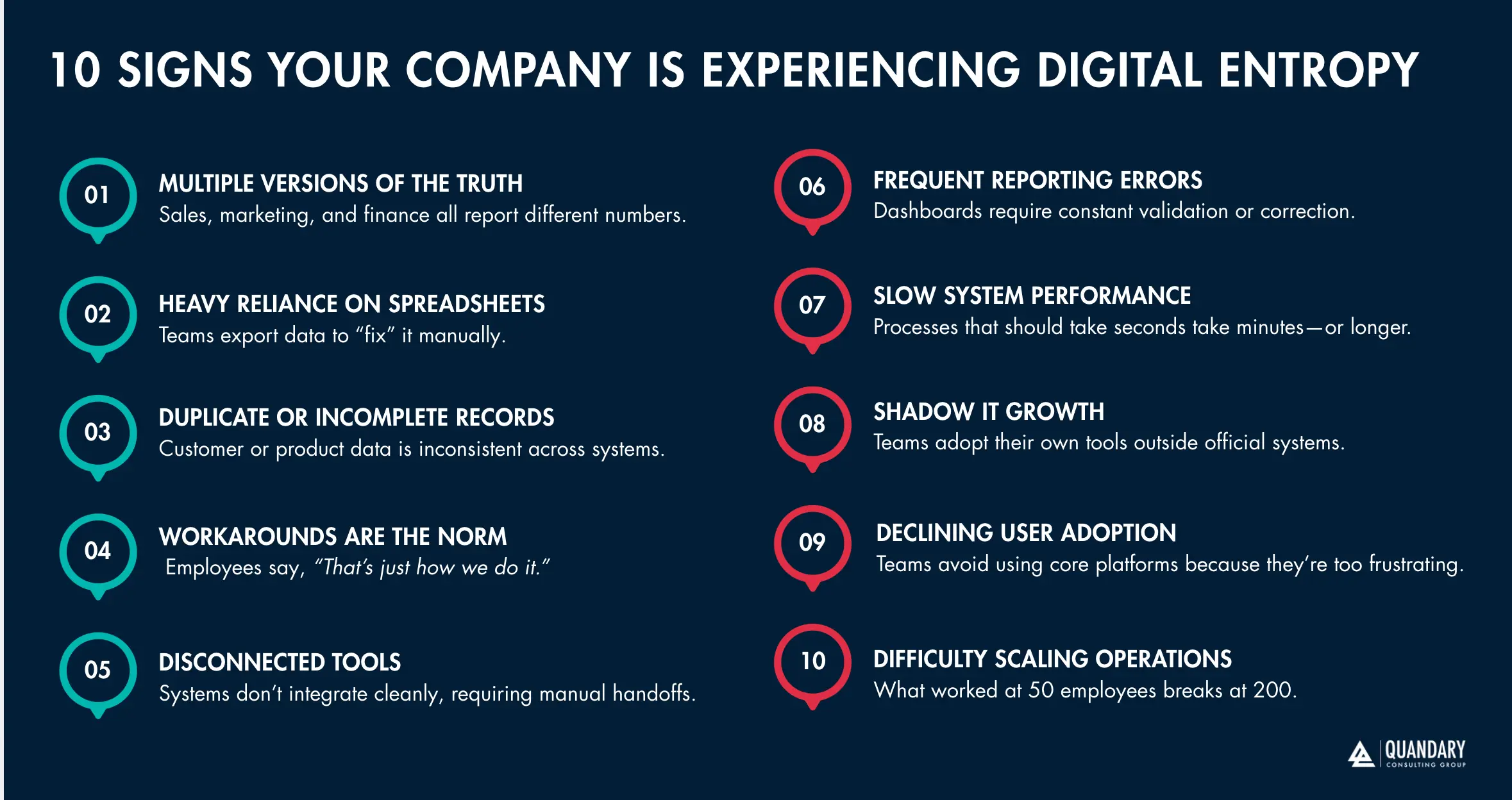
So, how do you identify digital entropy before it becomes a serious problem?
- Start by looking at consistency. Are your data definitions, model outputs, and reporting metrics aligned across teams? If different departments are telling different stories with the same data, entropy is already at work.
- Next, examine system cohesion. How well do your tools, platforms, and pipelines integrate? If adding or modifying one component creates ripple effects across the organization, it’s a sign your architecture is becoming fragile.
- You should also assess speed. Not just how fast your systems run, but how quickly your teams can move. If innovation cycles are slowing down despite increased investment in AI, the issue may not be capability—it may be complexity.
- Finally, pay attention to trust. Do stakeholders trust the outputs of your AI systems? Do teams rely on shared data sources, or do they build their own parallel solutions? A lack of trust is often the downstream effect of unmanaged entropy.
Addressing digital entropy doesn’t mean eliminating complexity altogether—that’s unrealistic in any advanced organization. Instead, it’s about managing it intentionally. That includes establishing clear governance for data and models, standardizing core systems, and regularly auditing your technology stack for redundancy and drift.
It also means designing for adaptability. The goal isn’t to create a perfectly ordered system that never changes, but one that can evolve without breaking down. Strong foundations, clear documentation, and aligned processes make that possible.
In AI-driven organizations, entropy is inevitable—but unchecked entropy is optional. The teams that recognize and manage it early are the ones that stay fast, focused, and truly intelligent at scale.
Real-World Use Case: AI-Enabled Contact Center Transformation
A mid-sized SaaS organization implemented AI agents within its contact center to improve efficiency and reduce support costs. The deployment included chatbot capabilities, automated ticket routing, and AI-assisted responses for human agents.
Initially, the solution showed promise. However, over time, underlying digital entropy began to impact performance.
Customer data was inconsistent across systems, leading to incomplete context for AI agents. Integrations between the CRM, support platform, and knowledge base were not fully aligned. As a result, AI agents frequently provided incorrect or incomplete responses, leading to increased escalation rates.
To address these challenges, the organization implemented a structured remediation strategy. This included cleaning and standardizing customer data, consolidating integrations, and introducing an MCP-based architecture to ensure consistent context delivery to AI systems.
Following these changes, the organization achieved:
- A significant reduction in escalation rates
- Improved first-contact resolution
- Greater consistency in customer interactions
- Increased trust in AI-driven processes
This example highlights a critical insight: AI effectiveness is directly dependent on the health of the underlying digital ecosystem.
What is the Framework to Managing Digital Entropy in AI-Enriched Environments
Addressing digital entropy in modern organizations requires an evolution of traditional approaches.
- Organizations must begin by establishing strong data governance practices, ensuring that AI systems are built on reliable and consistent data foundations. This includes defining ownership, enforcing standards, and continuously monitoring data quality.
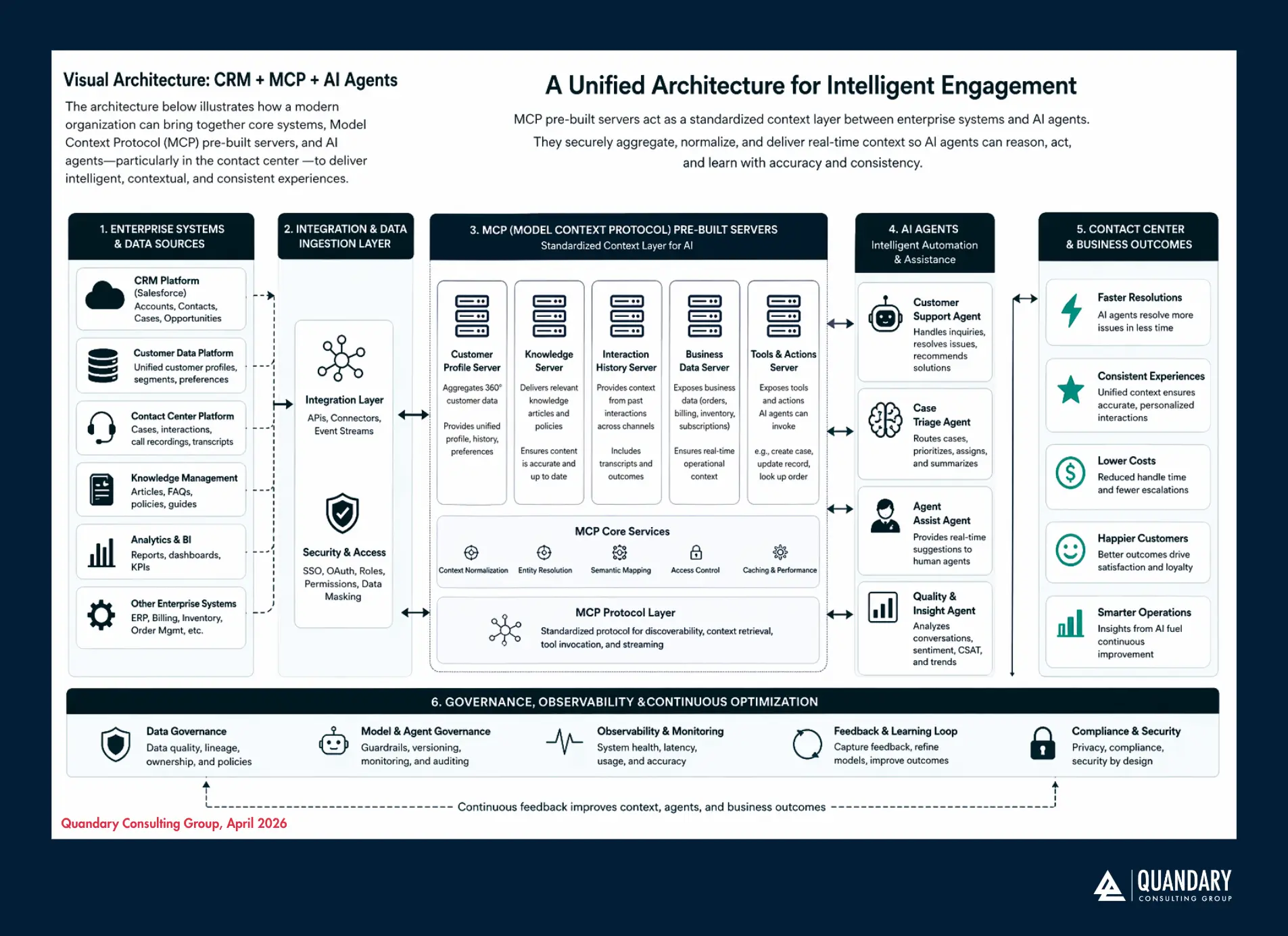
- In parallel, organizations should adopt structured integration and context management strategies, leveraging technologies such as MCP servers to standardize how AI systems access data and tools. When properly implemented, MCP provides a scalable and maintainable approach to managing AI context, reducing fragmentation and improving consistency.
- System simplification remains critical. Reducing redundancy across tools and aligning platforms with business objectives helps minimize complexity and improve maintainability.
- Equally important is the governance of AI agents themselves. Organizations must define clear rules for how AI agents operate, including escalation logic, decision boundaries, and performance monitoring. AI agents should not be treated as “set and forget” solutions but as continuously managed components of the system.
- Finally, organizations must adopt a mindset of continuous optimization. Monitoring AI performance, user adoption, and system health enables early identification of entropy and prevents its accumulation over time.
What Is the Financial Impact of Digital Entropy?
The financial impact of digital entropy is both significant and often underestimated, because it does not appear as a single line item on a balance sheet. Instead, it manifests as a series of compounding costs that affect productivity, technology spend, revenue performance, and long-term scalability.
At its core, digital entropy creates inefficiency across the entire organization, and inefficiency is expensive.
1. Lost Productivity and Labor Costs
One of the most immediate financial impacts comes from wasted employee time. When systems are unreliable or data is inconsistent, employees are forced to:
- Reconcile conflicting reports
- Manually correct data errors
- Build workarounds outside core systems
- Validate outputs before taking action
Even a modest estimate—such as 5–10 hours per week per employee spent on these tasks—quickly translates into thousands of lost hours annually across teams. For mid-sized and enterprise organizations, this can equate to millions of dollars in lost productivity.
2. Poor Data Quality Costs
Digital entropy is a primary driver of poor data quality, which has a well-documented financial impact. According to Gartner, organizations lose an average of $12.9 million per year due to poor data quality.
These costs show up in multiple ways:
- Incorrect forecasting and budgeting
- Ineffective marketing campaigns
- Missed sales opportunities
- Compliance and reporting risks
When data cannot be trusted, every decision carries financial risk.
3. Increased Technology Spend
As systems degrade, organizations often respond by adding more tools rather than fixing root issues. This leads to:
- Redundant platforms with overlapping functionality
- Higher licensing and subscription costs
- Increased integration and maintenance expenses
Over time, this creates an over-inflated tech stack where organizations are paying more but getting less value. In many cases, companies are using only a fraction of the capabilities they are paying for.
4. Wasted AI and Automation Investment
In AI-enabled organizations, digital entropy directly impacts return on investment. AI systems rely on clean data and consistent architecture. When those conditions are not met:
- AI outputs become unreliable
- Automation breaks or requires manual oversight
- Projects fail to scale beyond pilot stages
This results in delayed or unrealized ROI on AI investments, which can represent hundreds of thousands—or millions—of dollars depending on the scope of the initiative.
5. Revenue Leakage and Missed Opportunities
Digital entropy also affects top-line performance. Disconnected systems and inconsistent data can lead to:
- Poor customer targeting and segmentation
- Missed cross-sell and upsell opportunities
- Delayed or inaccurate sales insights
- Inefficient lead management
In customer-facing functions like sales and support, this translates into lost revenue that is often difficult to track but highly material.
6. Customer Experience and Retention Costs
In environments such as contact centers, digital entropy leads to fragmented customer experiences. Customers may receive inconsistent answers, repeat information across channels, or experience delays in resolution.
The financial impact includes:
- Increased support costs due to escalations
- Lower customer satisfaction scores
- Higher churn rates and reduced lifetime value
Over time, these factors directly affect revenue and brand reputation.
7. Reduced Scalability and Costly Replatforming
As entropy grows, systems become harder to scale. Processes that once worked efficiently begin to break under increased volume and complexity.
Eventually, organizations reach a point where incremental fixes are no longer viable. At this stage, they are forced into:
- Large-scale system overhauls
- Data migrations
- Platform reimplementations
These initiatives are expensive, time-consuming, and disruptive, often costing far more than proactive optimization would have.
8. Accumulation of Technical and Operational Debt
Digital entropy contributes to long-term technical debt. Each workaround, patch, or quick fix adds complexity to the system, increasing the cost of future changes.
This results in:
- Longer development cycles
- Higher maintenance costs
- Slower innovation
Over time, the organization becomes less agile and more expensive to operate.
The Bottom Line
The financial impact of digital entropy is not isolated—it is systemic and compounding. It affects both cost structure and revenue generation, often simultaneously.
Organizations that ignore digital entropy typically experience:
- Rising operational costs
- Lower return on technology investments
- Slower growth and reduced competitiveness
By contrast, organizations that actively manage and reduce digital entropy can unlock:
- Greater efficiency
- Higher ROI from AI and technology investments
- Improved customer outcomes
- Stronger, more scalable growth
In financial terms, addressing digital entropy is not just a cost-saving initiative—it is a value creation strategy.
Partnering with Quandary Consulting Group
At Quandary Consulting Group, we help organizations navigate the complexity of modern digital ecosystems, including the integration of AI, AI agents, and emerging technologies such as MCP.
Our approach focuses on aligning systems, data, and processes to create a strong foundation for scalable, high-performing operations. We work with organizations to ensure that their AI investments deliver meaningful and measurable outcomes, rather than being hindered by underlying system challenges.
Whether you are beginning your AI journey or looking to optimize an existing implementation, we can help you with your digital entropy and build a more resilient, intelligent organization.
If your AI initiatives are not delivering the expected results, the issue may not be the technology—it may be the system supporting it
References
- Clausius, R. (1865). The Mechanical Theory of Heat
- Shannon, C. E. (1948). A Mathematical Theory of Communication
- Gartner. (2021). The Cost of Poor Data Quality
- APA (7th edition) | University of Oxford. (n.d.). Basic thermodynamics.
- California Institute of Technology, Michael A. Gottlieb and Rudolf Pfeiffer (2013), "The Laws of Thermodynamics"
Digital Entropy FAQs
1. What is digital entropy in business systems?
Digital entropy is the gradual decline in the quality, consistency, and reliability of an organization’s digital systems, data, and processes over time. It occurs as systems evolve without proper governance, leading to issues like duplicate data, broken workflows, and disconnected tools. Left unmanaged, digital entropy reduces efficiency, increases costs, and undermines decision-making.
2. What causes digital entropy in modern organizations?
Digital entropy is caused by a combination of unmanaged system growth, poor data governance, evolving business processes, and increasing integration complexity. As companies adopt more tools—including AI platforms and automation—without standardization, inconsistencies accumulate and systems become harder to maintain and scale.
3. How does digital entropy impact AI and automation?
Digital entropy directly reduces the effectiveness of AI and automation by feeding systems inconsistent or incomplete data. This leads to inaccurate outputs, unreliable predictions, and poor user experiences. AI systems, including AI agents, depend on clean data and consistent context—both of which degrade in high-entropy environments.
4. What are the signs your company is experiencing digital entropy?
Common signs include inconsistent reporting across teams, heavy reliance on spreadsheets, duplicate or incomplete data, low system adoption, and frequent manual workarounds. In AI-enabled environments, additional signs include inconsistent AI responses, high escalation rates in contact centers, and poor model performance despite retraining.
5. How does digital entropy affect contact centers and customer experience?
In contact centers, digital entropy leads to fragmented customer data and inconsistent interactions. AI agents may provide incorrect or incomplete answers, increasing escalation rates to human agents. This results in longer resolution times, higher operational costs, and lower customer satisfaction.
6. What is MCP (Model Context Protocol) and how does it help reduce digital entropy?
Model Context Protocol (MCP) is an emerging standard that enables AI systems to access data, tools, and context in a consistent and structured way. MCP pre-built servers act as a centralized context layer, reducing fragmentation and ensuring AI agents receive accurate, real-time information. This helps mitigate digital entropy by standardizing integrations and improving data consistency.
7. How do AI agents depend on system architecture and data quality?
AI agents rely on well-structured system architecture and high-quality data to function effectively. Without clean data and consistent integrations, AI agents cannot accurately interpret context, make decisions, or execute tasks. Poor system design and data entropy directly lead to unreliable AI performance.
8. How can companies reduce or prevent digital entropy?
Organizations can reduce digital entropy by implementing strong data governance, simplifying their technology stack, standardizing integrations, and conducting regular system audits. Leveraging modern architectures like MCP and continuously monitoring system performance also helps maintain long-term system health and scalability.
9. Why is digital entropy a growing problem in the age of AI?
Digital entropy is increasing as organizations adopt AI, automation, and complex integrations at a faster pace than they can govern them. AI amplifies existing system issues, meaning poor data quality and fragmented systems now directly impact business-critical outcomes like customer experience and operational efficiency.
10. How can consulting firms like Quandary help solve digital entropy?
Consulting firms like Quandary Consulting Group help organizations identify and reduce digital entropy by aligning systems, data, and processes. This includes system audits, data governance frameworks, integration optimization, and AI architecture design. The result is improved efficiency, more reliable data, and better performance from AI and digital systems.