Building a HIPAA-Compliant Healthcare Operations Platform with Quickbase | How Healthcare Organizations Are Using Secure, Low-Code Applications to Modernize Operations, Improve Compliance, and Deliver Better Patient Care
Healthcare organizations have never faced greater operational complexity. Between rising patient volumes, staffing shortages, increasingly sophisticated cybersecurity threats, evolving regulatory requirements, and growing expectations from both patients and providers, many organizations are discovering that their greatest obstacle is no longer clinical care—it is operational efficiency.
Across hospitals, home healthcare providers, outpatient clinics, rehabilitation networks, behavioral health organizations, hospice providers, and telehealth companies, critical business processes still rely on spreadsheets, email chains, disconnected software applications, and manual approvals. While electronic health records (EHRs) have become essential for managing clinical information, they were never designed to automate every operational workflow that supports patient care.
Referral management, credential tracking, prior authorizations, equipment inventory, provider onboarding, quality reporting, compliance documentation, staffing coordination, contract management, and executive reporting often exist outside the EHR. As organizations grow, these disconnected processes create unnecessary delays, duplicate work, inconsistent data, compliance risks, and frustrated employees.
This is where Quickbase has become a powerful platform for healthcare operations.
At Quandary Consulting Group, we help healthcare organizations design and build secure, HIPAA-aware operational applications using Quickbase. Rather than replacing existing investments like Epic, athenahealth, Oracle Health, PointClickCare, MatrixCare, Microsoft 365, Salesforce, or Workday, Quickbase extends them—creating a centralized operational layer where people, systems, and data work together.
The result is a connected healthcare ecosystem that improves visibility, strengthens governance, reduces administrative burden, and enables organizations to deliver better patient outcomes.
Why Healthcare Organizations Need More Than an EHR
Most healthcare executives quickly discover that an EHR cannot solve every operational challenge.
Clinical systems are designed to document patient encounters, manage medical records, schedule appointments, and support care delivery. They are excellent at managing clinical information but often lack the flexibility needed for operational process management.
Healthcare organizations frequently ask questions like:
- Where are referrals getting delayed?
- Which providers have expired credentials?
- What prior authorizations are still pending?
- Which patients are waiting for discharge documentation?
- Which clinicians have not completed mandatory compliance training?
- Where are equipment shortages occurring?
- Which locations have staffing gaps?
- Which quality initiatives are behind schedule?
Finding those answers typically requires searching through multiple systems, emailing department managers, or exporting spreadsheets from several applications.
Quickbase solves this challenge by serving as the operational command center that connects information across systems and presents it through a single, secure interface.
What Makes Quickbase Valuable in Healthcare?
Quickbase is a configurable low-code platform that enables organizations to build custom applications tailored to their unique operational workflows.
Unlike traditional software development projects that can take months or years, Quickbase applications can be developed rapidly while remaining flexible enough to evolve alongside changing business requirements.
Healthcare organizations use Quickbase to:
- Automate complex workflows
- Centralize operational data
- Improve collaboration
- Standardize approvals
- Track compliance
- Build executive dashboards
- Connect legacy applications
- Reduce manual data entry
- Eliminate spreadsheets
- Improve reporting accuracy
Because every healthcare organization operates differently, Quickbase allows applications to reflect real-world business processes instead of forcing teams to adapt to rigid software.
Building a HIPAA-Conscious Operations Platform
Protecting patient information requires more than technology. It requires governance, clearly defined workflows, access controls, monitoring, and accountability.
Quickbase can play an important role in a HIPAA-conscious architecture when it is designed and implemented appropriately. At Quandary, security is incorporated into every stage of application design.
Key considerations include:
Role-Based Security
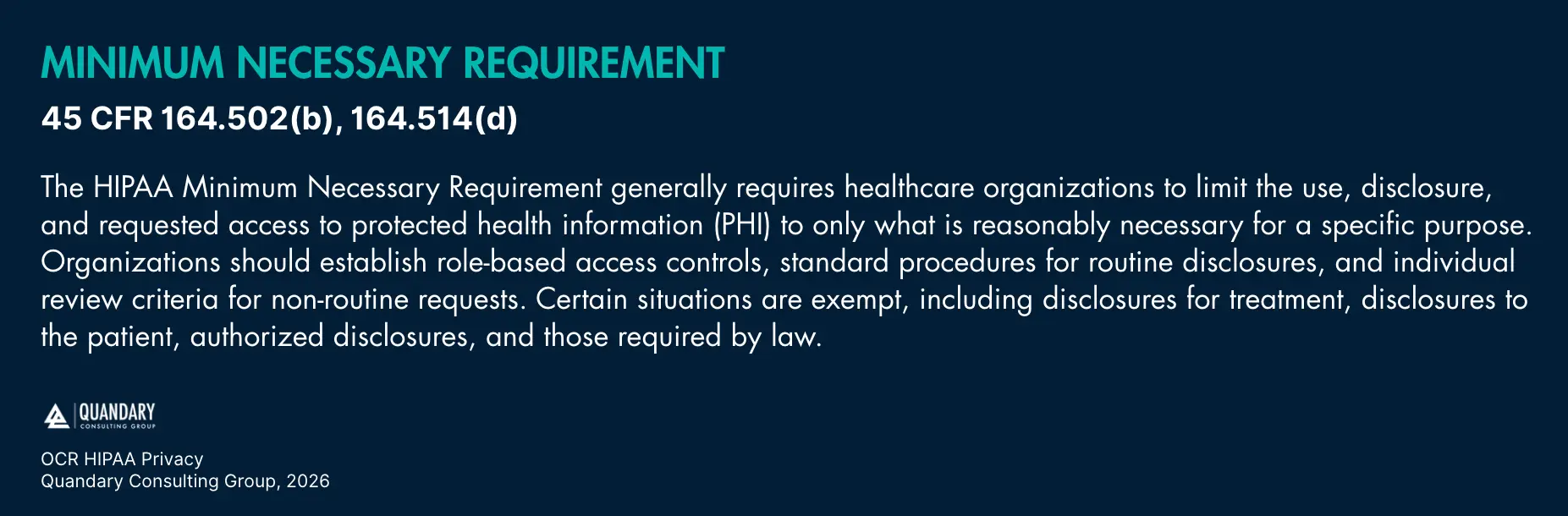
Not every employee should access every record. Applications can be designed so clinicians, managers, billing specialists, executives, and contractors each see only the information necessary for their responsibilities. Limiting access reduces organizational risk while supporting the HIPAA "minimum necessary" principle.
User Permissions
Every workflow includes defined permissions governing who can:
- View information
- Create records
- Edit records
- Approve requests
- Export reports
- Delete records
- Manage workflows
These permissions create consistency across departments while supporting organizational governance.
Audit Trails
Healthcare organizations need visibility into operational activity.
Applications can capture:
- User activity
- Status changes
- Workflow approvals
- Time stamps
- Process history
- Documentation updates
These audit capabilities improve accountability while simplifying internal reviews and external audits.
Secure Workflow Automation
Manual handoffs often introduce unnecessary risk. Automated workflows can securely route requests between departments while reducing delays.
Examples include:
- Referral approvals
- Prior authorizations
- Credential renewals
- Equipment requests
- Compliance reviews
- Policy acknowledgments
Automation reduces manual intervention while improving consistency.
Managing Protected Health Information
Organizations should carefully evaluate what information belongs in operational workflows and ensure appropriate safeguards are in place whenever protected health information (PHI) is involved.
A common design pattern is to store detailed clinical records within the EHR while using Quickbase to orchestrate operational workflows, task management, approvals, and status tracking. Where PHI must be referenced, organizations should apply appropriate security controls, access restrictions, and governance consistent with their compliance program and vendor agreements.
Connecting the Healthcare Technology Stack
Healthcare organizations often operate dozens of software systems. Instead of replacing them, Quickbase connects them. Quandary frequently integrates Quickbase with:
- Epic
- athenahealth
- Oracle Health
- PointClickCare
- MatrixCare
- Microsoft 365
- Microsoft Teams
- SharePoint
- Salesforce
- Workday
- DocuSign
- QuickBooks
- Snowflake
- Azure
- Workato
- HL7 interfaces
- FHIR APIs
This creates a unified operational platform where information flows automatically between systems.
Microsoft Integration
Many healthcare organizations already rely on Microsoft 365. Quickbase can integrate with:
- Outlook
- Teams
- SharePoint
- Power BI
- Excel
- Entra ID (formerly Azure Active Directory)
These integrations allow employees to work within familiar tools while maintaining operational consistency.
Intelligent Automation with Workato
Healthcare workflows rarely begin and end inside a single application. Workato enables Quickbase to orchestrate complex workflows across multiple enterprise systems.
Examples include:
- Creating patients after referrals
- Launching onboarding workflows
- Updating HR systems
- Synchronizing provider data
- Sending notifications
- Creating compliance tasks
- Triggering AI workflows
- Routing approvals
Rather than requiring staff to move between multiple systems, automation coordinates the entire process.
Governance Matters as Much as Technology
Technology alone does not create compliance. Strong governance ensures applications remain secure, accurate, and scalable.
Successful organizations establish:
- Data ownership
- Approval standards
- Change management
- Security reviews
- Documentation requirements
- Workflow governance
- User training
- Periodic access reviews
This operational discipline helps organizations maintain consistency as applications grow.
Case Study #1: National Home Healthcare Provider Modernizes Referral Operations
Industry: Home Healthcare
Organization Size: 2,400 employees
A rapidly growing home healthcare organization relied on referrals from more than 150 hospital systems.
Each referral required coordination between intake coordinators, clinical reviewers, insurance specialists, schedulers, and field clinicians.
The process relied heavily on spreadsheets, email, and manual status updates. Referral packets were often incomplete, duplicate work was common, and leadership lacked visibility into where patients were delayed. Staff spent valuable time calling hospitals for missing documentation and manually checking payer requirements, extending admission timelines and creating unnecessary administrative work.
Quandary designed a custom Quickbase application that became the organization's centralized referral management platform. Every referral entered a standardized workflow that tracked required documentation, insurance verification, clinical review, scheduling, and admission readiness. Automated notifications alerted the appropriate team members when action was required, while dashboards gave leadership real-time visibility into referral volumes, bottlenecks, turnaround times, and pending tasks.
The platform integrated with the organization's EHR and Microsoft 365 environment through secure automation, reducing duplicate data entry and improving communication across departments.
Results
- Reduced referral processing time by 58%
- Improved referral visibility across all locations
- Eliminated spreadsheet-based tracking
- Increased patient admissions without adding administrative staff
- Improved executive reporting and operational planning
Case Study #2: Regional Outpatient Network Streamlines Prior Authorization
Industry: Outpatient Rehabilitation
Organization Size: 1,100 employees
A multi-location outpatient rehabilitation provider faced growing challenges managing prior authorizations across thousands of patient visits each month. Authorization requirements varied by payer, documentation was frequently incomplete, and staff had no centralized way to monitor the status of requests.
Quandary implemented a Quickbase-based operational platform integrated with Workato to coordinate the entire authorization process. Requests were automatically routed to the appropriate specialists, documentation checklists adapted to payer requirements, and exceptions were escalated before appointments were affected. Leadership dashboards displayed authorization volumes, aging requests, denial trends, and staff workloads, allowing managers to intervene proactively instead of reacting after delays occurred.
The organization also implemented role-based security, detailed audit histories, and standardized approval workflows to strengthen governance while supporting operational consistency.
Results
- Reduced authorization turnaround time by 46%
- Significantly decreased delayed patient appointments
- Improved payer documentation accuracy
- Increased staff productivity through workflow automation
- Strengthened compliance and audit readiness
Case Study #3: Multi-State Hospice Organization Strengthens Compliance and Workforce Operations
Industry: Hospice Care
Organization Size: 3,100 employees
A hospice provider operating across multiple states struggled to manage clinician credentials, compliance documentation, annual training, vehicle inspections, equipment tracking, and quality audits using several disconnected systems. Managers often discovered expired certifications only after compliance reviews, while executives lacked a unified view of workforce readiness.
Quandary developed a custom Quickbase operations platform that centralized credential management, compliance tracking, policy acknowledgments, equipment oversight, and workforce dashboards into a single secure application. Automated reminders notified clinicians and managers well before credential expirations, while approval workflows ensured documentation was reviewed and verified before records were finalized. Integration with Microsoft 365 and Workato synchronized user information, training status, and operational updates across the organization's technology ecosystem.
Executive dashboards provided real-time insight into compliance rates, upcoming expirations, audit findings, and organizational readiness across every location.
Results
- Reduced manual compliance administration by more than 60%
- Improved credential renewal completion rates
- Increased visibility into workforce readiness
- Simplified internal audit preparation
- Created a scalable operational platform capable of supporting continued organizational growth
Looking Ahead
Healthcare organizations will continue investing heavily in AI, automation, and digital transformation. However, success will depend on more than deploying new technologies. It will require building operational foundations that connect people, processes, and systems securely and intelligently.
Quickbase provides the flexibility to modernize operational workflows without replacing existing clinical systems, while integrations with platforms like Microsoft 365 and Workato help unify fragmented technology environments into a cohesive operational ecosystem.
At Quandary Consulting Group, we believe the future of healthcare belongs to organizations that can adapt quickly, automate intelligently, and govern data responsibly. By designing secure, scalable Quickbase applications that align with each organization's unique processes, we help healthcare providers reduce administrative burden, improve compliance, and create more efficient operations—allowing clinicians and staff to focus on what matters most: delivering exceptional patient care.
Top FAQs about Building a Quickbase HIPAA-Compliant Healthcare Operations Platform
What is Quickbase, and how is it used in healthcare?
Quickbase is a low-code application development platform that allows healthcare organizations to build custom operational applications without replacing existing electronic health record (EHR) systems.
Healthcare providers use Quickbase to automate referral management, prior authorizations, provider credentialing, patient intake, compliance tracking, equipment management, staffing coordination, quality reporting, and executive dashboards. By connecting people, processes, and enterprise systems, Quickbase improves operational efficiency while reducing manual work.
Is Quickbase HIPAA compliant?
Quickbase offers capabilities that can support HIPAA requirements when it is configured, implemented, and governed appropriately. Healthcare organizations should establish proper administrative, technical, and physical safeguards, apply role-based access controls, execute applicable agreements with vendors, and follow organizational security policies.
When configured correctly, Quickbase can serve as a secure foundation within a HIPAA-compliant healthcare technology ecosystem. Working with a Quickbase service provider experienced in healthcare regulations is essential. The right partner can design and implement a custom application that supports your organization’s current workflows, protects sensitive patient information, and adapts to evolving operational and compliance requirements.
Why do healthcare organizations use Quickbase instead of spreadsheets?
Healthcare organizations replace spreadsheets with Quickbase because spreadsheets are difficult to scale, prone to errors, and lack real-time collaboration, workflow automation, audit history, and centralized reporting. Quickbase provides a secure operational platform that improves visibility, standardizes business processes, automates approvals, and enables leadership to make faster, data-driven decisions.
Can Quickbase integrate with Epic, athenahealth, PointClickCare, and other EHR systems?
Yes, Quickbase integrates with leading healthcare systems through
- APIs
- HL7 interfaces
- FHIR standards
- Middleware platforms (like, Workato)
- Or custom integrations.
Organizations commonly connect Quickbase with
- Epic
- Oracle Health
- athenahealth
- MatrixCare
- PointClickCare
- Salesforce Health Cloud
- Microsoft 365
- Workday
and many other enterprise applications to eliminate manual data entry and improve workflow automation.
What healthcare workflows can Quickbase automate?
Quickbase can automate a wide range of operational healthcare workflows, including:
- Patient referrals
- Prior authorizations
- Provider onboarding
- Credential management
- Employee compliance
- Equipment tracking
- Quality improvement initiatives
- Incident reporting
- Contract approvals
- Scheduling requests
- Revenue cycle workflows
- Patient intake
- Policy acknowledgments
- Executive reporting
Organizations can also build custom workflows tailored to their specific operational needs.
Can Quickbase improve patient referral management?
Yes, it can! Quickbase helps healthcare organizations streamline referral management by centralizing referral information, automating notifications, tracking documentation requirements, assigning tasks, monitoring referral status, and integrating with hospital discharge systems. This reduces referral delays, improves communication, and enables patients to begin care sooner.
How does Quickbase help healthcare organizations improve compliance?
Quickbase strengthens compliance by standardizing workflows, documenting approvals, maintaining audit trails, automating reminders, tracking required documentation, and limiting access through role-based permissions. These capabilities improve operational governance while helping organizations prepare for internal audits and regulatory reviews.
What types of healthcare organizations use Quickbase?
Quickbase is used across nearly every healthcare sector, including:
- Hospitals
- Health systems
- Home healthcare providers
- Hospice organizations
- Behavioral health providers
- Outpatient clinics
- Rehabilitation networks
- Telehealth companies
- Skilled nursing facilities
- Specialty medical practices
- Healthcare staffing organizations
- Medical device companies
- Life sciences organizations
Because Quickbase is highly configurable, it can be tailored to organizations of virtually any size.
Can Quickbase support AI and healthcare automation?
Yes. Quickbase serves as an excellent operational platform for AI-powered healthcare automation. When integrated with solutions like Workato, Microsoft Copilot, or custom AI agents, Quickbase can automate document processing, patient communications, referral routing, prior authorization workflows, predictive reporting, intelligent task assignment, and operational decision support. AI extends Quickbase by making workflows faster, more intelligent, and more scalable.
What are the biggest benefits of using Quickbase in healthcare?
Healthcare organizations choose Quickbase because it helps them:
- Improve operational efficiency
- Automate repetitive workflows
- Reduce manual data entry
- Increase visibility across departments
- Strengthen compliance
- Connect disconnected systems
- Improve executive reporting
- Accelerate patient onboarding
- Scale operations without adding administrative staff
- Support continuous process improvement
Ultimately, Quickbase enables healthcare organizations to spend less time managing operations and more time delivering exceptional patient care.
What is the best low-code platform for healthcare?
There is no single "best" low-code platform for every healthcare organization, but Quickbase is one of the strongest options for operational workflow automation because it combines flexibility, rapid application development, enterprise-grade security, and extensive integration capabilities.
Unlike platforms that focus primarily on software development, Quickbase allows healthcare organizations to quickly build custom applications for referral management, provider credentialing, patient intake, compliance tracking, quality reporting, and operational dashboards without replacing existing EHR systems.
When implemented by an experienced consulting partner like Quandary Consulting Group, Quickbase becomes a centralized healthcare operations platform that connects people, processes, and enterprise systems while supporting digital transformation initiatives.
Can Quickbase replace Microsoft Excel?
Yes, it can! Quickbase can replace Microsoft Excel for many healthcare operational processes while providing significantly greater visibility, security, collaboration, and automation.
Although spreadsheets are commonly used for tracking referrals, credentialing, compliance, staffing, and equipment, they often create duplicate data, version control issues, and manual reporting challenges. Quickbase centralizes information into a secure cloud application where multiple users can collaborate in real time, automate workflows, generate dashboards, and maintain complete audit histories.
For healthcare organizations managing complex operational workflows, Quickbase offers a far more scalable and reliable alternative to spreadsheets.
How does Quickbase improve healthcare operations?
Quickbase improves healthcare operations by centralizing disconnected workflows into one secure, configurable platform. Instead of relying on spreadsheets, email chains, and multiple software applications, organizations can automate approvals, standardize processes, connect enterprise systems, and provide leadership with real-time operational visibility.
Healthcare providers frequently use Quickbase to manage patient referrals, prior authorizations, provider onboarding, compliance documentation, scheduling coordination, equipment tracking, and executive reporting. These improvements reduce administrative work, improve collaboration, and allow clinicians and support staff to spend more time focusing on patient care.
Is Quickbase secure enough for healthcare organizations?
Quickbase includes enterprise security capabilities that make it well suited for many healthcare operational applications when it is implemented with appropriate governance and security controls. Organizations can configure role-based permissions, audit histories, user authentication, workflow approvals, and data access policies to help protect sensitive information.
Healthcare organizations should also establish comprehensive security practices, execute applicable agreements with technology vendors, and follow HIPAA requirements for administrative, technical, and physical safeguards. Working with an experienced implementation partner helps ensure the platform is configured according to organizational security and compliance objectives.
Can Quickbase integrate with Epic?
Yes. Quickbase can integrate with Epic and many other electronic health record systems using APIs, HL7 interfaces, FHIR standards, or integration platforms like Workato.
Rather than replacing Epic, Quickbase extends its capabilities by managing operational workflows that often fall outside the EHR, including referral management, provider credentialing, equipment tracking, compliance initiatives, project management, staffing coordination, and executive reporting.
This approach allows healthcare organizations to maintain Epic as the clinical system of record while using Quickbase to improve operational efficiency across the organization.
What healthcare processes should be automated first?
Most healthcare organizations achieve the fastest return on investment by automating repetitive, high-volume administrative workflows that consume significant staff time.
Common starting points include:
- Patient referral management
- Prior authorization workflows
- Provider credentialing
- Employee onboarding
- Compliance documentation
- Incident reporting
- Equipment requests
- Patient intake
- Scheduling coordination
- Executive approvals
Automating these operational processes reduces delays, improves consistency, and creates immediate productivity gains across clinical and administrative teams.
How do hospitals use low-code applications?
Hospitals use low-code platforms like Quickbase to rapidly build custom operational applications without lengthy software development projects.
These applications support functions such as project management, capital planning, compliance tracking, patient referral management, quality improvement initiatives, construction oversight, staffing coordination, inventory management, and executive reporting.
Because every hospital operates differently, low-code platforms allow organizations to build workflows that reflect their specific operational requirements while integrating with existing enterprise systems.
Can Quickbase manage provider credentialing?
Yes. Quickbase is frequently used to manage provider credentialing and workforce compliance.
Healthcare organizations can create centralized applications that track licenses, certifications, training requirements, continuing education, insurance documents, expiration dates, and approval workflows. Automated reminders help providers renew credentials before expiration, while dashboards allow leadership to monitor compliance across multiple facilities and departments.
This significantly reduces manual tracking while improving organizational readiness for accreditation and regulatory reviews.
How does workflow automation improve patient outcomes?
Workflow automation improves patient outcomes by reducing delays, improving communication, eliminating administrative bottlenecks, and ensuring critical operational tasks are completed consistently.
For example, automating referral management can shorten the time between hospital discharge and the first home health visit. Automated prior authorization workflows reduce treatment delays, while provider credential tracking ensures qualified clinicians remain available to deliver care.
When healthcare staff spend less time managing paperwork and repetitive administrative tasks, they can devote more attention to patient care and clinical decision-making.
What is healthcare operations management software?
Healthcare operations management software helps organizations coordinate the administrative and operational activities that support patient care.
Unlike electronic health record systems, which primarily manage clinical information, healthcare operations platforms oversee workflows such as referral management, staffing, compliance, project management, credentialing, quality initiatives, scheduling, equipment tracking, financial approvals, and executive reporting.
Platforms like Quickbase allow healthcare organizations to build customized operational applications that connect departments, automate processes, and improve organizational visibility.
What is the difference between an EHR and an operational workflow platform?
An electronic health record (EHR) is designed to manage patient medical information, clinical documentation, treatment plans, medication records, and encounters.
An operational workflow platform like Quickbase focuses on the business processes that support healthcare delivery. It automates referrals, approvals, staffing coordination, credentialing, compliance tracking, equipment management, quality initiatives, and executive reporting.
Many healthcare organizations use both systems together, allowing the EHR to manage clinical data while Quickbase streamlines operational workflows across the enterprise.
Can Quickbase be used for HIPAA-regulated workflows?
Yes. Quickbase can be used as part of HIPAA-regulated operational workflows when organizations implement appropriate security controls, governance practices, and compliance procedures.
Many healthcare organizations use Quickbase to automate referral management, provider onboarding, credential tracking, compliance documentation, and quality reporting while integrating with clinical systems that maintain the official patient record.
Organizations should carefully evaluate their specific compliance requirements and configure Quickbase accordingly to protect sensitive healthcare information.
How can healthcare organizations reduce administrative costs?
Healthcare organizations reduce administrative costs by eliminating manual processes, automating repetitive work, integrating disconnected systems, and providing employees with centralized operational tools.
Solutions like Quickbase allow organizations to replace spreadsheets, reduce duplicate data entry, automate approvals, improve reporting accuracy, and streamline communication across departments.
These efficiencies reduce administrative burden while enabling healthcare professionals to spend more time supporting patients and delivering high-quality care.
What are the benefits of healthcare systems integration?
Healthcare systems integration connects previously disconnected software applications so information flows automatically between departments without requiring manual data entry.
Integrated healthcare environments improve operational efficiency, reduce errors, increase data accuracy, accelerate decision-making, strengthen reporting, and improve collaboration across clinical and administrative teams.
Platforms like Quickbase, combined with integration technologies such as Workato, help organizations connect EHRs, HR systems, CRM platforms, financial software, Microsoft 365, and other enterprise applications into a unified operational ecosystem.
Why are healthcare organizations investing in low-code platforms?
Healthcare organizations are investing in low-code platforms because they enable faster digital transformation while reducing software development costs and increasing organizational agility.
Rather than waiting months or years for custom software, healthcare providers can quickly build applications that automate workflows, improve compliance, integrate enterprise systems, and solve operational challenges as they arise.
Low-code platforms like Quickbase empower organizations to continuously improve processes, respond to changing regulatory requirements, and support long-term innovation without replacing existing technology investments.